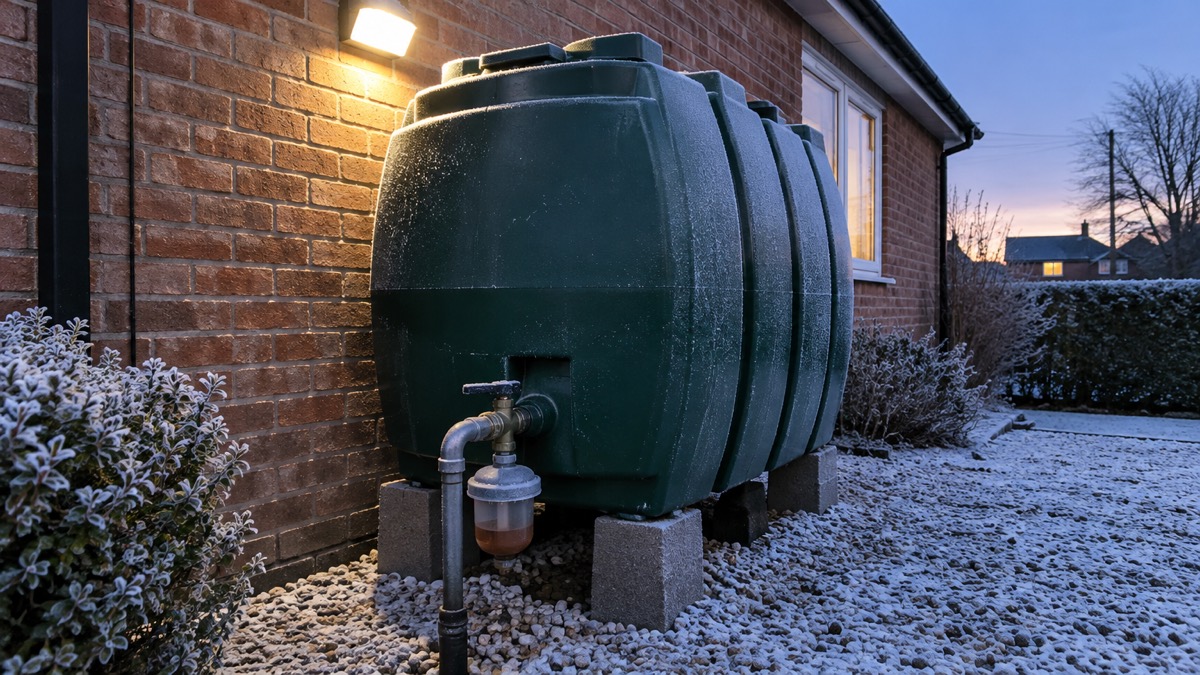
If your home is off the gas grid and runs on heating oil, your heating is only as reliable as the tank in the garden and the delivery lorries that reach it. Winter is when both are tested: demand for oil rises, snow and ice can hold up deliveries, and faults that have been quietly developing all year show up on the coldest night. The good news is that a small amount of preparation covers most of it.
The core advice from local authorities and health bodies is consistent: order your winter fuel early and make sure you have a sufficient supply to see you through the winter period1, get the boiler serviced before the cold weather arrives2, and check the tank itself for leaks, cracks and damage before you fill it3. If a leak does happen, it is your responsibility as the property owner, and oil spills can harm health, property and watercourses, so knowing what to do in the first hour matters3.
This page walks through it in the order you need it: ordering ahead, keeping the tank sound, what the rules say about bunded tanks, what to do if oil escapes, what to do when the boiler stops in a cold snap, and where to find help with the cost.
Order your oil before winter, not during it
The single most useful thing an oil-heated household can do is order early. Suffolk Fire and Rescue Service's winter advice is to check that you have ordered your winter heating fuel5, and Derbyshire's keeping warm guidance is to stock up on supplies such as heating oil if you use it2. Public Health Wales puts it plainly: if you have home heating fuel delivered, make sure you are stocked up7.
The reason is timing. Once cold weather sets in, two things happen at once: every other oil household in your area places an order at the same time, and the roads the tankers use become harder to drive. Lancaster City Council's advice for households preparing for heavy snow is to ensure you have adequate storage of heating fuel, and to have contact details for fuel suppliers close at hand, but not to rely on them being able to reach you8. That is the honest position: a delivery you have ordered may still be delayed by snow, so the order needs to be placed with enough oil already in the tank to absorb a delay.
A useful habit is to treat the boiler and the fuel order as one job. The Met Office's winter preparation advice is to get a heating boiler serviced before the cold weather arrives9, and its WeatherReady checklist leads with the same point: boiler serviced10. Nottinghamshire County Council adds the reason: getting heating, radiators and boilers serviced reduces the risk of breakdown in cold weather11. A service visit in autumn is also a natural moment for the engineer to look over the tank and pipework while they are on site.
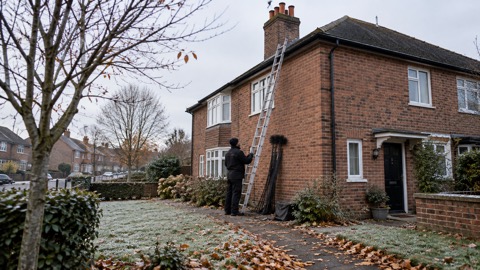
If you or someone in your household is older or vulnerable, it is worth knowing about the Cold Weather Priority Scheme for heating oil, which exists so distributors can identify households who should get priority treatment when deliveries are stretched. Our broader before-winter checklist for your heating and stove pulls these jobs together in one list.
How much oil to keep in the tank
There is no single figure that fits every household, because tank sizes, house sizes and insulation levels vary. The official advice is framed around sufficiency rather than a number: the Humber Local Resilience Forum's winter guidance tells heating oil, LPG and solid fuel users to make sure you have a sufficient supply to see you through the winter period1, and Derbyshire's guidance is to stock up on heating oil if you use it2.
What "sufficient" means for you is something you learn from your own usage. Watch how quickly the level drops across a normal winter week and use that to judge when to reorder, leaving a margin for a delayed delivery. The principle is the same one official advice applies to car fuel in winter: Nottinghamshire's safe driving advice is to keep at least a quarter of a tank of fuel in case you get stuck in traffic12, and Anglesey's winter driving tips say to keep your fuel tank near to full so you do not run out13. For a heating oil tank, the equivalent logic means not letting the level run low going into a cold spell.
Running the tank very low has a second drawback beyond the risk of running out. Debris and water tend to sit at the bottom of a tank, and drawing from the dregs of the tank is when any of that is most likely to be pulled through towards the boiler. Keeping a reasonable level, and ordering before you are near empty, avoids that as a side benefit.
While you are thinking about levels, remember what the oil is for. The NHS-backed winter advice for the West Midlands is to heat your home to at least 18°C14, and the Met Office advises setting the heating to come on just before you get up and switching it off after you have gone to bed, and in very cold weather setting it to come on earlier rather than turning the thermostat up15. A well-stocked tank is what makes that possible through a sustained cold spell.
Check the tank and pipework before you fill it
The best time to find a fault in your tank is before you put several hundred litres of oil into it. Somerset Council's guidance on domestic oil storage tank leaks sets out the checks you can do yourself3:
- Are there any visible leaks or stains?
- Are there any cracks or damage to the tank, pipes, sight gauges or the support system?
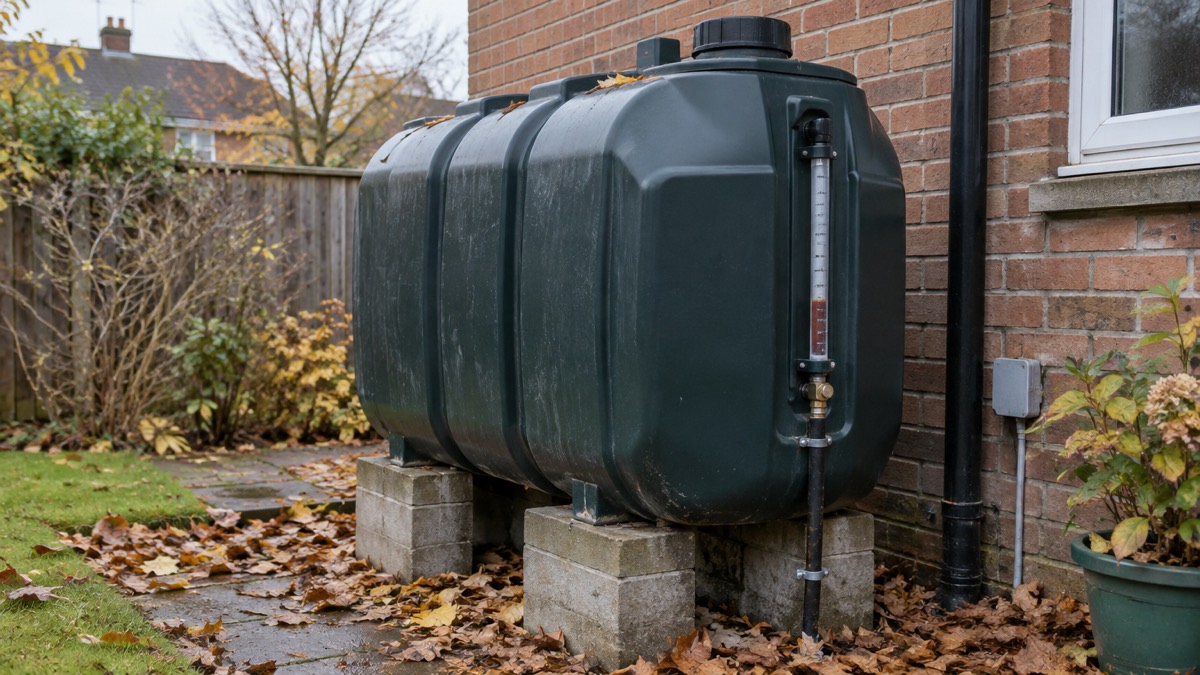
Do this walk-around in autumn, and again after any severe weather. We have a separate narrow guide on checking a heating oil tank for leaks and storm damage for the aftermath of a storm.
Northumberland Council's advice on domestic oil adds the routine habits that prevent leaks in the first place: check the condition of your tank and boiler regularly, watch out for black stains, know how much oil you use, get your heating system serviced regularly, do not overfill your oil tank, keep the fill points clear, and review your home insurance policy to make sure you are covered for oil leaks or spills4. Black stains and dead plants or grass around your tank are listed warning signs of a leak3.
Underground pipework needs a different check because you cannot see it. Ceredigion County Council's snow and ice advice is to keep a check on oil consumption: if you appear to be using more than usual but there is no evidence of oil spillage, that could indicate defective underground pipe work, and installers can pressure test the lines6. Ceredigion also advises checking your household insurance for cover6, which matches Northumberland's advice to review your policy4.
Lagging and insulation matter here too. Derbyshire's keeping warm guidance says to check that pipes are adequately lagged16, and the Met Office notes that good quality lagging protects from freezing, helps insulate your hot water system and saves you money17. The Drinking Water Inspectorate, writing about storage tanks generally, requires that all storage tanks be insulated to guard against freezing during the winter and excessive warming during the summer months18. That is written for water storage, but the same physics applies to any tank and its pipework sitting outdoors through a British winter.
Water in the tank: why it matters at delivery time
Water gets into heating oil tanks through condensation, damaged lids and fill points left exposed, and it causes two separate problems. The first is corrosion from inside: water sitting at the bottom of a steel tank rusts it from within, which is one route to the leaks and stains you are checking for outside. The second is what happens when the tank is disturbed, and a delivery is exactly that: fresh oil arriving at speed stirs up whatever is lying at the bottom, and water and sediment can then be drawn towards the boiler.
The Drinking Water Inspectorate's guidance on water storage tanks and cisterns lists the conditions under which water in a tank deteriorates: there is no lid on the storage tank; the water becomes warm; too much water is stored and turnover is low; the tank is made from or lined with an unsuitable material; or work on the tank is carried out by an unqualified person19. The lessons for an oil household are the practical ones: keep the lid and fill points sound and closed, do not leave the tank to sit part-empty for long stretches (low turnover), and only let a qualified person work on the tank.
Delivery time is when you want the tank in good order, which is one more reason the pre-winter check comes before the pre-winter order. If the tank lid is cracked or the fill point is damaged, get it fixed before the tanker comes, not after. Keeping a reasonable level of oil in the tank through the year, rather than letting it run nearly empty each summer, also reduces the air space in which condensation forms.
Bunded tanks and the rules on oil storage
A bunded tank is a tank within a tank: an outer container that catches the contents if the inner one leaks or fails. For a household, it is the difference between a fault being a repair job and a fault being a pollution incident.
The rules come from oil storage legislation. Northumberland Council states that all tanks for outside storage of oils and fuel must be bunded to comply with current oil storage legislation, except for domestic heating oil below 3,501 litres and all oils on farms in England4. In practice, that means many domestic heating oil tanks fall below the threshold, but larger domestic tanks, and tanks in situations where a spill would be serious, are covered. If you are replacing a tank or installing a new one, ask your OFTEC-registered installer what the legislation requires for your site, and consider a bunded tank even where the smaller exemption applies, because the protection is the same whatever the law requires.
Where you site a tank matters as much as what it is made of. A tank placed where a leak could run into a drain, a stream, a pond or a soakaway turns a small spill into a watercourse incident. When you have the tank checked, ask the engineer to look at where any escaping oil would actually go.
You are responsible for the tank on your property
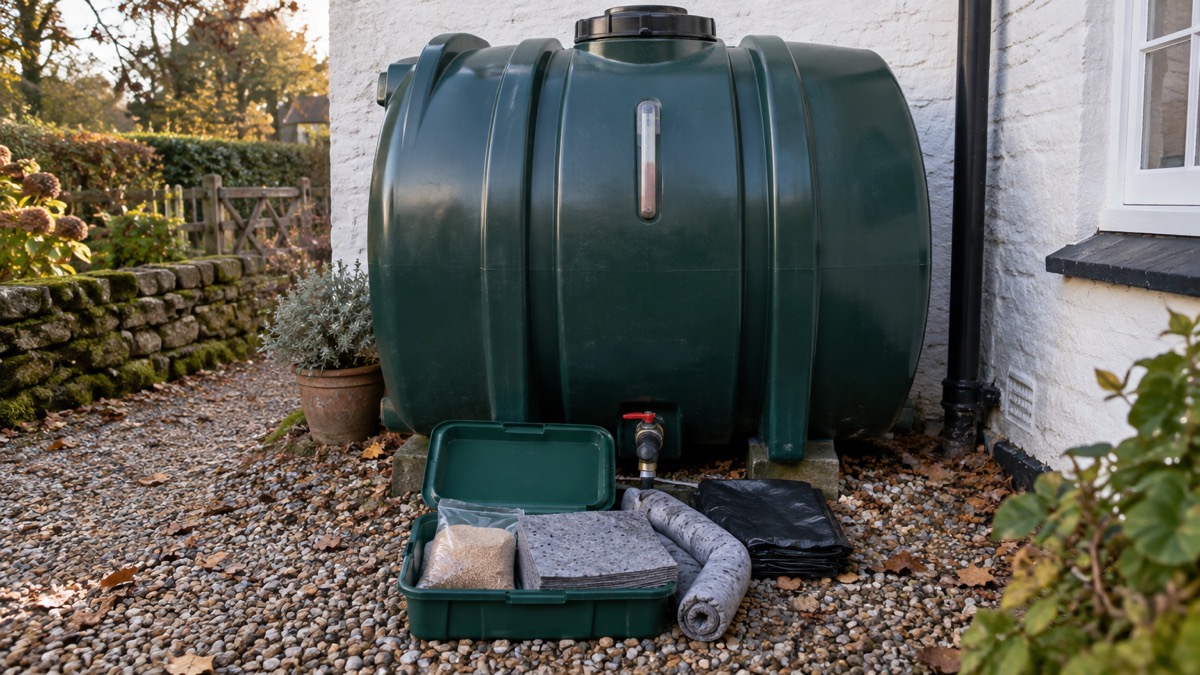
Somerset Council's guidance is unambiguous: it is your responsibility to keep your domestic oil storage tank safe3. If you rent, your landlord has a duty of care towards you as a tenant to repair and keep in working order any room heater and water heating equipment4, so tenants should not assume the problem is theirs to solve alone, but the householder on the spot is the one who has to act in the first hour.
That responsibility is worth taking seriously because of what oil can do when it escapes. Northumberland Council notes that faulty or badly maintained domestic central heating oil tanks cause numerous pollution incidents4. Somerset Council's guidance lists the harms: oil is one of the most common causes of contamination and can affect human health, property, water courses, plants, wildlife, soil and habitats3. Leaks can pollute drinking water supplies and cause structural damage, and they can cause harm to human health by the release of vapours3. Environmentally, they can pollute rivers and groundwaters, threatening fish and other aquatic life3.
What to do if oil leaks or spills
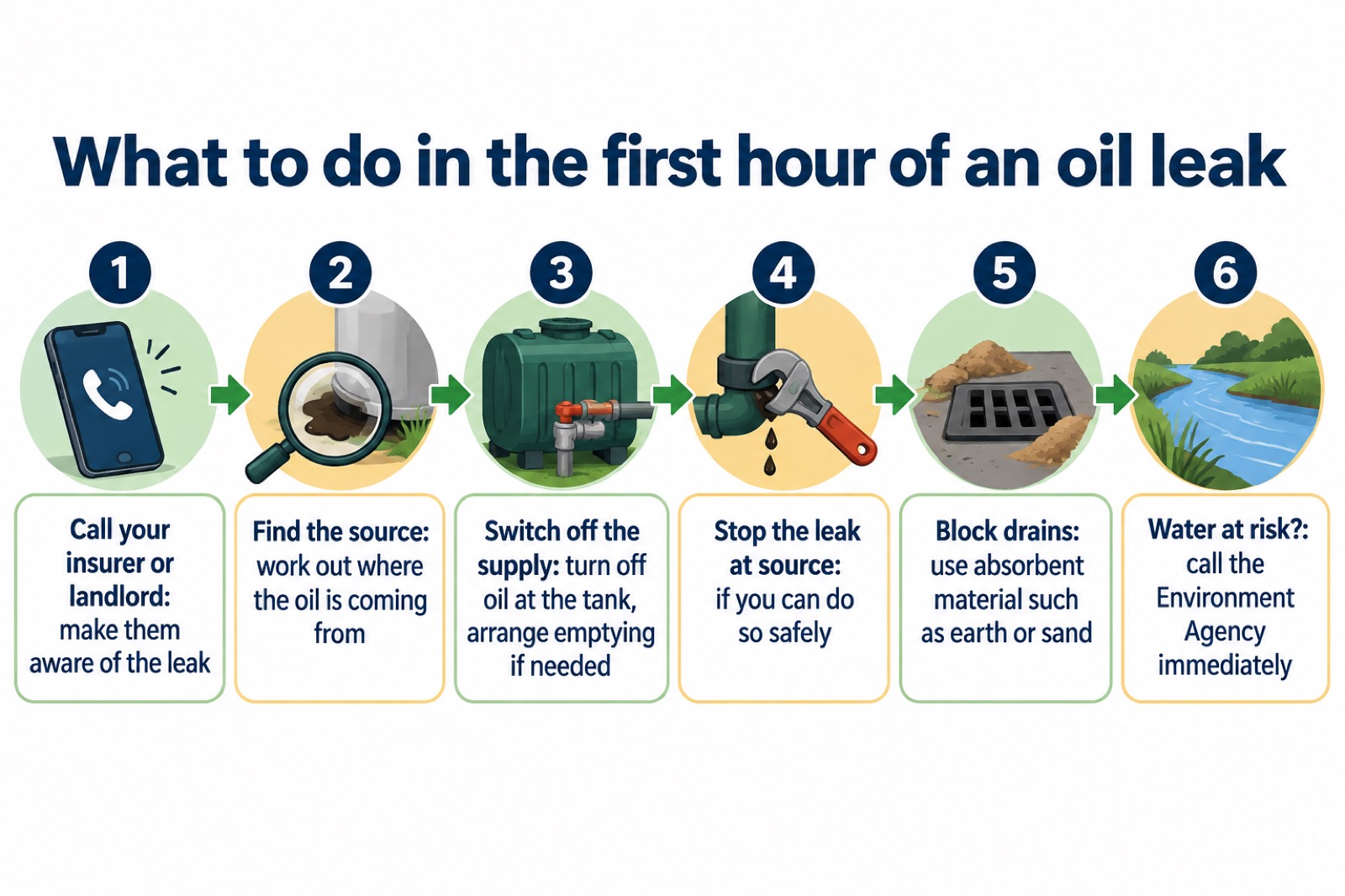
Northumberland Council sets out the response steps for a domestic oil leak4:
- Call your home insurance company or landlord and make them aware of the leak.
- Find where the leak is coming from.
- Switch off your oil supply at the tank and arrange to have it emptied if needed.
- Try to stop the leak at the source.
- Block the spill from entering drains using absorbent materials such as earth or sand.
Somerset Council adds the escalation rule: if the leak could affect a stream, pond or other water supply, call the Environment Agency immediately3.
When the oil boiler stops in cold weather
Boilers that have been idle since spring have a habit of failing on the first genuinely cold night, which is exactly why the official advice is to test boilers or heating systems before winter1 and get them serviced before the cold weather arrives9. If yours does stop during a cold snap, the first question is whether it is the boiler or the fuel.
On the fuel side, check the tank gauge and the sight gauge for damage as part of your checks3, and think back to your recent consumption: unusually high use with no visible spill points towards pipework rather than the boiler6. On the boiler side, cold weather itself is the culprit as often as anything. Ready Scotland's guidance on cold, snow and ice notes that severe cold can cause frozen or burst pipes20, and a frozen condensate pipe is a well-known cause of boilers cutting out in a cold snap. The preventive measure is lagging: good quality lagging protects pipes from freezing17, so make sure external pipework, including the condensate run, is properly covered before winter.
Who works on it matters. Devon and Somerset Fire and Rescue Service states that anyone carrying out work on installations and appliances in your home must be registered with the Oil Firing Technical Association (OFTEC) for oil appliances21. London Fire Brigade similarly directs households to the Oil Firing Technical Association (OFTEC) for oil appliances22. So the call is to an OFTEC-registered engineer, not a general handyman.
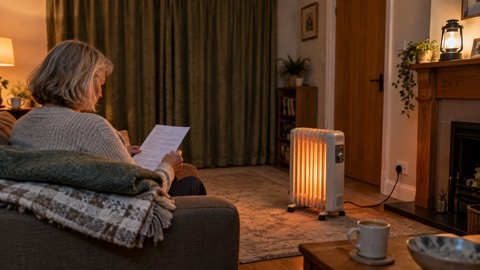
While the heating is off, the household still needs to stay warm. Our guide on keeping one room warm when the heating fails covers how to do that safely, and the section page on gas and heating failures covers the wider picture. If you use any portable heater as a stopgap, follow the fire and rescue service's safety advice for portable heaters22, and be aware of the carbon monoxide risk that comes with any fuel-burning appliance: Devon and Somerset Fire and Rescue Service and Public Health Wales both publish carbon monoxide safety advice for homes21.
Who to call: OFTEC engineers and fuel distributors
Two organisations sit at the centre of oil heating, and it is worth having the right details written down before you need them.
For anything to do with the boiler, the tank or the pipework, the person must be OFTEC-registered. Public Health Wales gives the contact for oil appliances as OFTEC, telephone 0845 658 508024. You can use that number to find or verify a registered engineer. The related point from the NHS's stay well this winter advice, that you should contact a registered engineer to make sure heating and cooking appliances are working properly25, applies to gas appliances through Gas Safe; for oil, OFTEC is the equivalent register.
For the fuel itself, your relationship is with a distributor. UKIFDA is the trade association for fuel distributors, and heating oil reaches homes through its member companies. The practical advice from Lancaster City Council stands: have contact details for fuel suppliers close at hand, but do not rely on them being able to reach you in severe weather8. Write down your distributor's phone number and your account details somewhere that does not depend on the internet or mains power, alongside your insurer's number and OFTEC's.
| Who | When to call them | Contact |
|---|---|---|
| OFTEC-registered engineer | Boiler service, tank checks, repairs, pressure testing pipework | OFTEC, tel. 0845 658 508023 |
| Your fuel distributor | Ordering oil, delivery queries | Keep their details close at hand8 |
| Your home insurer | Any leak or spill, before cleanup begins | Call them and make them aware of the leak4 |
| The Environment Agency | A leak that could affect a stream, pond or water supply | Call immediately3 |
Help with heating oil costs
Heating oil is bought in bulk and paid for on delivery, which makes a winter fill a large single bill. There is help available, and it is worth knowing what exists before the bill arrives.
The national payments are the ones that apply across Great Britain. The Humber Local Resilience Forum lists three: the Winter Fuel Payment, the Cold Weather Payment and the Warm Home Discount scheme1. The Met Office's guidance on keeping your home warm gives the detail on the Winter Fuel Payment: if you were born before 22 September 1959, you could get between £100 and £300 to help pay your heating bills for winter 2025 to 202615. Our page on the Winter Fuel Payment, Cold Weather Payment and Warm Home Discount explains how each works and who qualifies.
Local schemes go further in some areas. Suffolk's Warm Homes service, cited in Suffolk Fire and Rescue Service's winter advice, can help with your fuel payments, lend you electric heaters, assess you for financial assistance towards the cost of repairs or replacements if your boiler or heater stops working, discuss energy efficiency improvements, and help you access grants for insulation and basic draught proofing5. If your boiler fails in winter, that kind of scheme can be the difference between a repair and a cold house, so search for the equivalent service run by your own county or council.
If heating costs leave you choosing between warmth and other essentials, warm spaces and warm hubs are free heated rooms open to anyone in many areas during winter, and our extra help page sets out the support available to older, disabled and medically dependent households.
Sources (25)
- Winter guidance for staying warm, Humber Local Resilience Forum, 2024-08
- Keep warm in winter, Derbyshire County Council, 2026-10-29
- Domestic oil storage tank leaks, Somerset Council, 2025-07-29
- Domestic oil storage and pollution, Northumberland County Council, 2026-10-28
- Seasonal winter safety advice, Suffolk Fire and Rescue Service, 2026-10-29
- Snow and ice advice, Ceredigion County Council, 2026-10-29
- Bad weather preparation, Public Health Wales, 2026-07-16
- Be prepared for severe weather, Lancaster City Council, 2026-10-26
- 10 things you should do now to prepare for winter, Met Office, 2026-10-25
- WeatherReady winter checklist, Met Office, 2026
- Top tips for keeping warm, Nottinghamshire County Council, 2023
- Safe driving in winter, Nottinghamshire County Council, 2026-10-29
- Winter driving tips, Isle of Anglesey County Council, 2026-10-29
- Cold weather: staying warm and well, NHS and West Midlands Local Resilience Forum, 2023-12
- Keeping your home warm in winter, Met Office, 2026-10-26
- Keep warm in winter, Derbyshire County Council, 2026-10-29
- Protecting your property from winter weather, Met Office, 2026-10-25
- Water storage in private supply networks, Drinking Water Inspectorate, 2025-11-05
- Water storage tanks and cisterns, Drinking Water Inspectorate, 2026-06-09
- Cold, snow and ice, Ready Scotland, 2026-03-25
- Carbon monoxide safety at home, Devon and Somerset Fire and Rescue Service, 2026
- Portable heaters, gas fires and open fires, London Fire Brigade, 2026-10-25
- Carbon monoxide (CO), Public Health Wales, 2025-12-08
- CMO(2011)14 - Carbon monoxide (CO) poisoning: needless deaths, unnecessary injury, Scottish Government Health Directorate (Chief Medical Officer)
- Fire_safety_in_the_home__0.pdf, Westminster City Council / London Fire Brigade
 Before-Winter Heating Checks
 Backup Stove Kit Checklist
 Wood Burner Lighting Kit
 Keeping One Room Warm
 Clothing and Bedding for Cold
 Stopping Draughts
 Hot Water Bottle Safety
 Wheat Bags and Fire Risk
 Electric Blanket Safety
 Portable Heater Types
 Portable Heater Safety
 Wood Burners in a Power Cut
 Using a Wood Burner Safely
 Open Fires and Fire Guards
 Firewood and Seasoning Logs