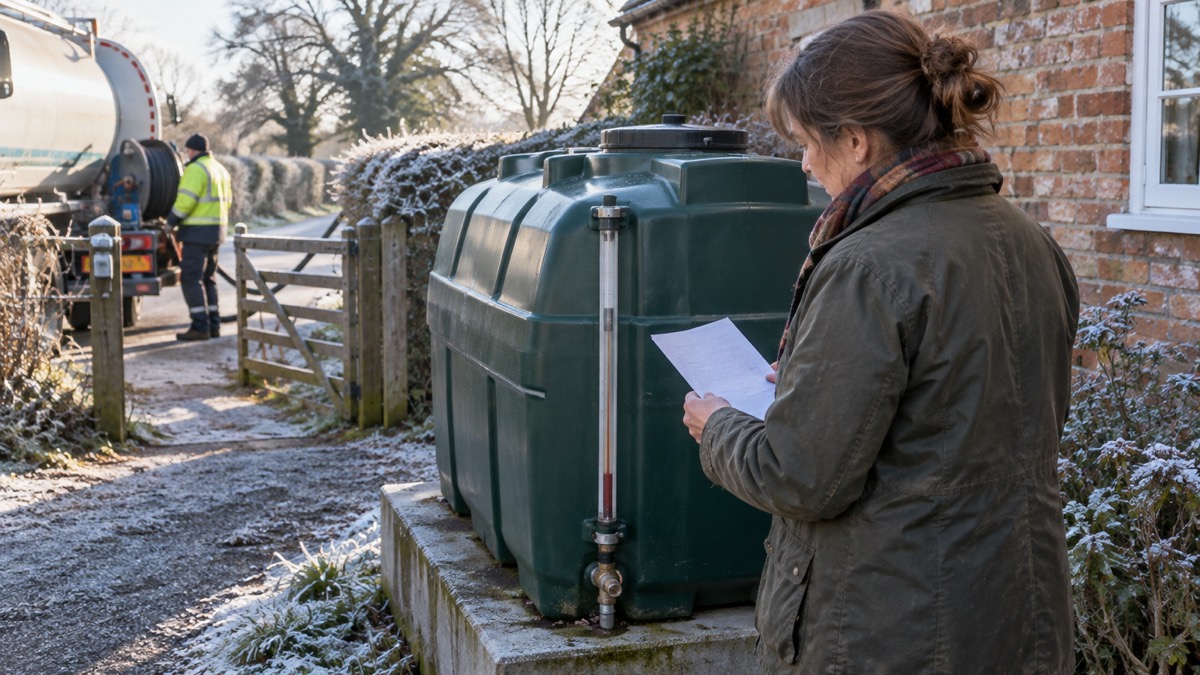
If your home is heated by oil, you are outside the mains gas network, and in a hard winter your delivery depends on a small number of local distributors and treatable roads. The practical step that matters most is simple: contact the company that delivers your oil, tell them someone in the household is vulnerable to cold, and ask to be recorded as a priority customer before winter starts. Registration is done by contacting your supplier directly, and if you use more than one supplier you need to contact them each separately1.
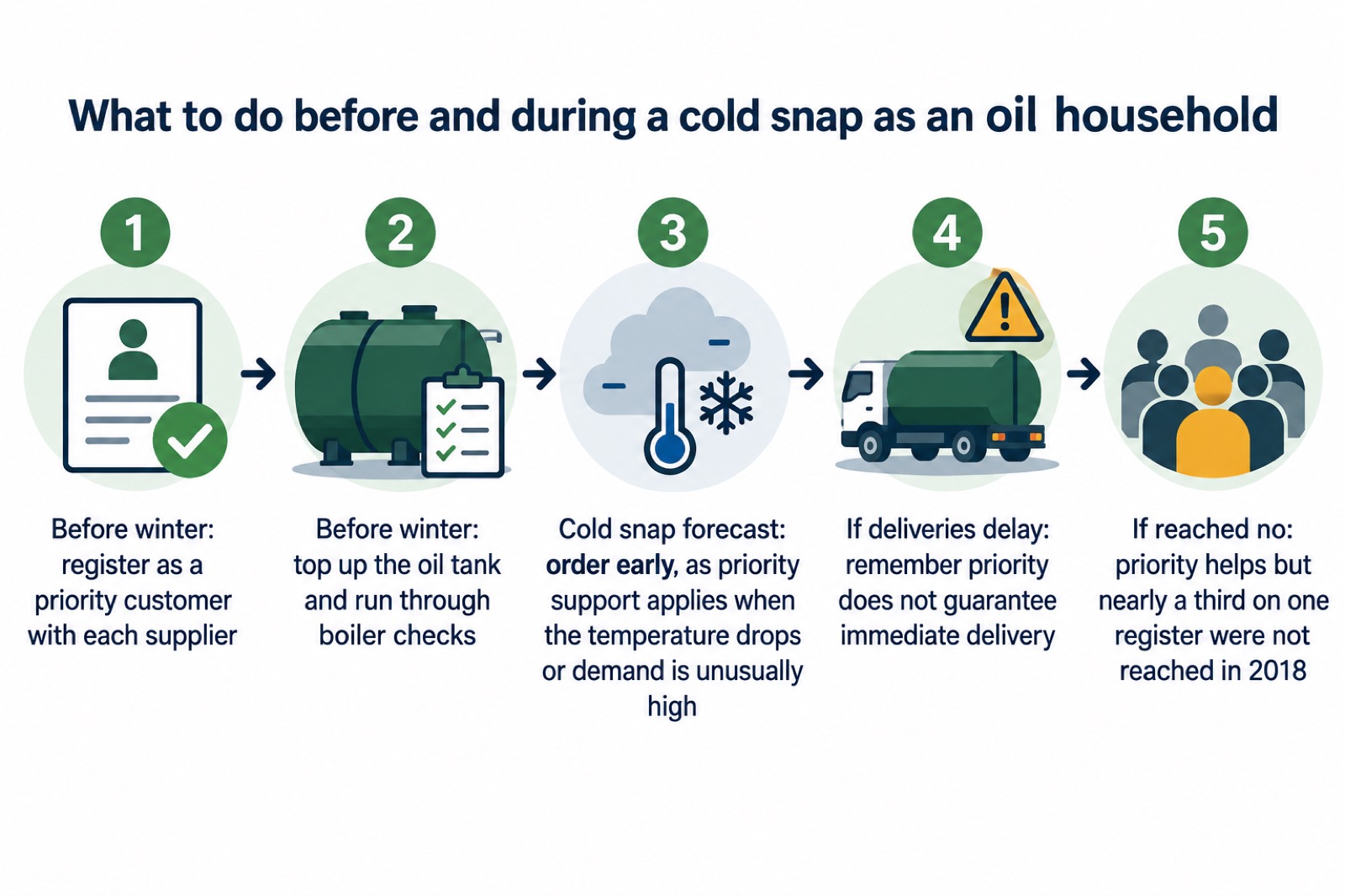
What priority gives you is being known. Suppliers and network operators use their registers to give priority help in an emergency, advance notice of power cuts, and in some cases practical support such as temporary heating and cooking appliances during a supply interruption1. What it does not give you is a guaranteed delivery: when a freeze stretched one utility's response in 2018, nearly a third of the customers on its priority register were not directly reached5. So register, but also order early, keep the tank topped up, and have a plan for keeping one room warm if a delivery is delayed.
What priority registration does for a heating oil household
Around four million UK households are off the mains gas network, and most of those rely on heating oil delivered by road. In a normal winter that works well. In a cold snap, when demand jumps and roads are treated in a strict order of priority, deliveries slow down at exactly the moment an older or unwell person most needs heating. Councils are explicit that non-priority roads and pathways are highly unlikely to be treated unless there is an emergency situation, with routes to hospitals treated first10. That is the gap priority registration is meant to close: it tells the company delivering to you that your household should not wait at the back of the queue.
The support attached to a register varies by company, but the pattern across official guidance is consistent. Surrey County Council describes the register as giving priority help in an emergency4. Derbyshire's guidance describes advance notice of power cuts as one of the things registration can bring1. Dorset's preparedness guidance records one gas network's promise to its registered customers: "If there is a supply interruption and you're a listed Priority Service Register (PSR) customer we'll provide you with temporary heating and cooking appliances within four hours to make sure you stay warm and can have a hot meal"3. Warwickshire describes the wider Priority Service as "a UK program aimed at assisting vulnerable individuals and households during energy-related emergencies", with registered users getting priority support during power cuts, alternative ways of staying informed, and access to extra services such as emergency heating in cold weather11.
For an oil household, the equivalent questions to ask your distributor are: do you keep a priority list, what does being on it change in a cold snap, and how do you contact registered customers when deliveries are delayed. The principle is the one the registers are built on: the company cannot help you first if it does not know you exist.
Who counts as vulnerable in cold weather
Official cold weather guidance across the UK is consistent about who is most at risk, and it is broader than many people expect. The groups listed are: people aged 65 and over; babies and children under 5; people on a low income who cannot afford heating; people with a long-term health condition, particularly heart, lung or kidney disease; people with a disability; pregnant women; and people with a mental health condition7. NHS guidance in Northern Ireland and England frames it the same way: you are at greater risk if you are over 65, on a low income and finding heating difficult to afford, have a long-term condition, or are disabled7. The Met Office adds that cold weather is a health risk particularly if you are over 65 or have health conditions13. Government guidance for care professionals also names people living in households experiencing fuel poverty as a vulnerable group14.
| Group named in official guidance | Why cold weather raises the risk |
|---|---|
| People aged 65 and over | Named in every UK cold weather guidance source as at greater risk7 |
| Babies and children under 5 | Listed among the groups most vulnerable to cold8 |
| Long-term health conditions | Heart, lung and kidney disease, and cardiovascular and respiratory conditions, including COPD and asthma7 |
| Disabled people, including learning and physical disabilities | Named across NHS and government guidance8 |
| Pregnant women | Listed in NHS and government cold weather guidance9 |
| Mental health conditions | Named in NHS and government guidance9 |
| People on a low income | Cannot afford to keep the home warm8 |
One point worth knowing if you have looked at this before: age thresholds in official guidance have moved. Current heat-health guidance uses 65 and over and notes this is a change from the previous threshold of 75 years and above15. Cold weather guidance likewise uses 65 and over. So if you were told in the past that these schemes started at 75, do not assume you are too young now: check the current threshold with your supplier, and register anyone in the household who falls into any of the groups above, not only the oldest.
If you are not sure whether your household qualifies, the advice from Nottinghamshire's Keep Warm Keep Well campaign is simply to check if you're eligible to register on your energy company's Priority Service Register16. Suppliers can also tell you what evidence, if any, they need.
How to register, step by step
Registration is deliberately low-effort. Every official source gives the same route: contact the company directly.
- Find your supplier's contact details. For electricity and gas, the Priority Services Register "is offered by your energy supplier", so start with the company that bills you1.
- Contact them and ask to register. Derbyshire's guidance is direct: "Register now by contacting your energy supplier or network operator directly"1. Warwickshire's advice is the same: "To register, simply contact your energy supplier or visit Cadent Gas to check your eligibility"11.
- Say who in the household is vulnerable and why. Age, health conditions, disability, pregnancy or low income all count8.
- Ask what being registered changes. Each company attaches its own support, from priority help in an emergency to advance notice of planned interruptions1.
- For heating oil, contact your oil distributor the same way. The distributor delivering to your tank is the company whose queue you are in during a cold snap, so ask them directly whether they keep a priority list and how to get on it.
- For water, sign up separately. If you are eligible, sign up to your water supplier's Priority Service Register to let them know you need additional support during interruptions to your supply; one official route is via thepsr.co.uk17.
Using more than one supplier means registering with each
This is the step households most often miss. There is no automatic carry-over between companies. Derbyshire's guidance states it plainly: "If you have a different supplier for your gas and energy you need to contact them both"6. Ofgem's own consumer guidance says the same: "If you have a different supplier for your gas and electricity, you'll need to contact them separately"2.
For an oil household this matters in a specific way. You may have an electricity supplier, a gas supplier if you use bottled or mains gas for cooking, and an oil distributor, and each keeps its own list. Being registered with your electricity supplier does not register you with the oil distributor, and the regulator has decided not to extend data sharing more widely to other utilities and other fuel providers18. So the working rule is: one registration per company you depend on.
How suppliers find and record priority customers
Behind the registers sits a system of shared information, and knowing roughly how it works helps you use it. Ofgem's position, set out in a 2015 policy statement, is that "all energy companies should proactively identify and record information about their vulnerable customers and share this" with other energy companies, with informed consent from the customer before anything is shared19. In practice that means your details can follow you between energy firms, so you do not start from scratch if you switch electricity supplier, but only if you gave permission.
The minimum details energy companies share are set out in Ofgem's consultation: customer contact name; phone number where available; email address where available; address; details of a nominated person if you have one; details of any password agreed; and details of your needs20. Two of those are worth acting on. First, you can nominate a person: a relative, neighbour or carer the company will contact about you. Second, you can agree a password, a scheme offered by suppliers and network operators to disabled, chronically sick and pensionable age customers so you can verify that a caller genuinely represents the company before opening the door or giving information21. For an older person living alone, both are cheap protections.
| Detail recorded on the register | What it is for |
|---|---|
| Contact name, phone, email, address | So the company can reach you in an emergency20 |
| Nominated person | Someone else the company contacts about you, if you agree one20 |
| Agreed password | Lets you verify a caller really is from the company21 |
| Details of your needs | Tells the company what support to provide20 |
Consent is the foundation of all of it. Ofgem's view is that energy companies can share sensitive information about customers' circumstances only where they have obtained the customer's permission in the first instance20. When you register, expect to be asked what you are happy to have shared, and with whom.
Not every supplier takes part, and awareness is low
Participation is not universal across every scheme a household might rely on. The Warm Home Discount, for example, depends on the company: "Your energy supplier needs to participate in the scheme for you to get the discount"22. The same caution applies to priority arrangements: ask your oil distributor directly whether they operate a priority scheme, and what it commits to, rather than assuming.
The other problem is that most people have never heard of this help. Ofgem's consultation found that only 24 per cent of consumers are aware of any non-financial support provided by energy companies to customers in vulnerable situations21, a figure repeated in the regulator's final proposals18. If you are reading this page, you are already ahead of most households. It is worth mentioning the registers to older neighbours and relatives: a two-minute phone call each is often all it takes.
Priority is not a guarantee of delivery
This is the honest limit of the scheme, and planning around it is what keeps a household safe. The clearest evidence comes from the water sector's experience of the 2018 freeze and thaw, when pipes burst across the country: "Nearly a third of customers on Thames Water's priority services register were not directly reached during the freeze and thaw period"5. Being on a register improved those customers' chances, but it did not remove the risk.
The same logic applies to oil deliveries. Roads are treated in a strict order of priority, with routes to hospitals first, and non-priority roads are highly unlikely to be treated unless there is an emergency situation10. A tanker cannot deliver oil it cannot drive to you. Ofgem has also declined to make some forms of support compulsory: it does not propose to require distribution network operators to offer alternative forms of heating and cooking facilities during supply interruptions, taking the view that they already assist vulnerable customers during such times19. The regulator has, though, said it does not expect changes in policy to result in support being withdrawn from any customer who currently receives it21.
So treat registration as one layer, and build the others:
- Order oil early, well before cold weather, and keep the tank as full as you can afford; see Heating Oil Tanks: Keeping a Supply Through Winter.
- Work through the before-winter checks for your boiler and stove in autumn.
- Plan for one warm room with suitable clothing and bedding if heating fails.
- Know your local warm spaces and warm hubs in case the house cannot be kept warm.
- Check the extra help arrangements for older, disabled and medically dependent households.
Help that differs across the four nations
The priority registers themselves operate UK-wide, but the financial schemes around them are national, and an oil household may qualify for more than one. In Wales, a Winter Fuel Support Scheme announced on 16 November 2021 provided households where one member received certain welfare benefits with a one-off payment of £10024. Wales also piloted emergency assistance for off-grid households: a 2020-21 pilot scheme provided emergency assistance payments of up to £175 to purchase oil and liquid fuel24. That pilot is the clearest example in the official record of emergency help aimed squarely at heating oil households, and it is worth asking your local authority in Wales whether anything similar runs this winter.
In Northern Ireland, the Housing Executive delivers the Affordable Warmth scheme25. Across the UK, the Cold Weather Payment scheme runs between 1 November and 31 March26, with the 2024 to 2025 scheme running from 1 November 2024 to 31 March 202526, and payments going to households in receipt of certain benefits or the Support for Mortgage Interest scheme24. Local resilience forums signpost the winter fuel payment, cold weather payment and warm home discount scheme as the main financial help with heating27. Staffordshire's council guidance also points to help with heating for eligible homes28. Our page on Winter Fuel Payment, Cold Weather Payment and Warm Home Discount sets these out in full.
| Nation | Scheme to ask about |
|---|---|
| England | Cold Weather Payments27 |
| Wales | Winter Fuel Support Scheme (£100 one-off, 2021-22) and the off-grid emergency payment pilot of up to £17524 |
| Scotland | Cold Weather Payments between 1 November and 31 March26 |
| Northern Ireland | Affordable Warmth scheme, delivered by the Housing Executive25 |
Where to get help if the cold bites before the oil arrives
If a delivery is delayed and the house is getting cold, do not wait for the situation to become dangerous. Ofgem's review of the networks' response to Storm Arwen found the industry running winter preparedness campaigns aimed at ensuring that all customers, including those in vulnerable situations, are effectively supported during power outages29, so your electricity supplier's priority team is one call worth making. Your local authority and its severe weather planning are another: Derbyshire's plan, for example, covers protecting people from the effects of cold weather, reducing excess winter illness and death, and dealing with fuel poverty30. Charities and local warm hubs can bridge a gap for a few days, and the Heating and Cooking Without Mains Power or Gas guide covers the practical options, from portable heaters to wood burners, with their safety rules.
The short version of this whole page: register with every company that supplies you, ask each what priority actually means when they give it, agree a password and nominate someone, and then do not rely on the register alone. Order early, keep the tank full, and know how you would keep one room warm for a few days. That combination is what gets an oil-heated household through a cold snap.
Sources (30)
- Priority Services Register, Derbyshire County Council, Derbyshire County Council
- Get help from your supplier: Priority Services Register, Ofgem
- Utility companies and priority services, Dorset Prepared
- Priority Services Register, Surrey County Council
- Thaw report, Ofwat, 2018-06
- Priority Services Register: how to sign up, Derbyshire County Council
- Staying warm in winter, nidirect, Northern Ireland government
- How to stay well in winter, Villa Medical Centre, NHS
- Supporting vulnerable people before and during cold weather, for healthcare professionals, UK Government
- Winter weather, roads and travelling FAQs, Argyll and Bute Council
- Electrical fire safety and the Priority Service, Warwickshire County Council
- Stay well this winter, NHS Cheshire and Merseyside
- Ten things you should do now to prepare for winter, Met Office
- Supporting vulnerable people: guidance for care professionals, UK Government, 2025-09-24
- Beat the heat: staying safe in hot weather - GOV.UK, UK Health Security Agency (GOV.UK)
- Keep Warm Keep Well, Nottinghamshire County Council, 2020-11
- Water supply interruptions or outages, Prepare Campaign, UK Government, 2026-10-12
- PSR final proposals, Ofgem, 2015-12-17
- PSR update, open letter to publish, March 2015, Ofgem, 2015-03-26
- Consultation on the PSR review, Ofgem, 2014-06-30
- PSR review consultation document, Ofgem, 2014-06-30
- Keeping your home warm, Frimley Healthier Together, NHS
- UKIFDA Winter Campaign 2026-27 - UKIFDA, UKIFDA
- Cold weather resilience plan, Welsh Government, 2022-02
- Stay warm this winter, Belfast City Council
- England and Wales energy domestic consumer advice, Ofgem, 2024-11
- Winter readiness guidance, Humber Local Resilience Forum, 2024-08
- Falls prevention and warmer homes, Staffordshire County Council
- Review into the networks' response to Storm Arwen, Ofgem, 2022-06-09
- Severe weather planning, Derbyshire County Council
 Warm Spaces and Warm Hubs
 Winter Heating Payments