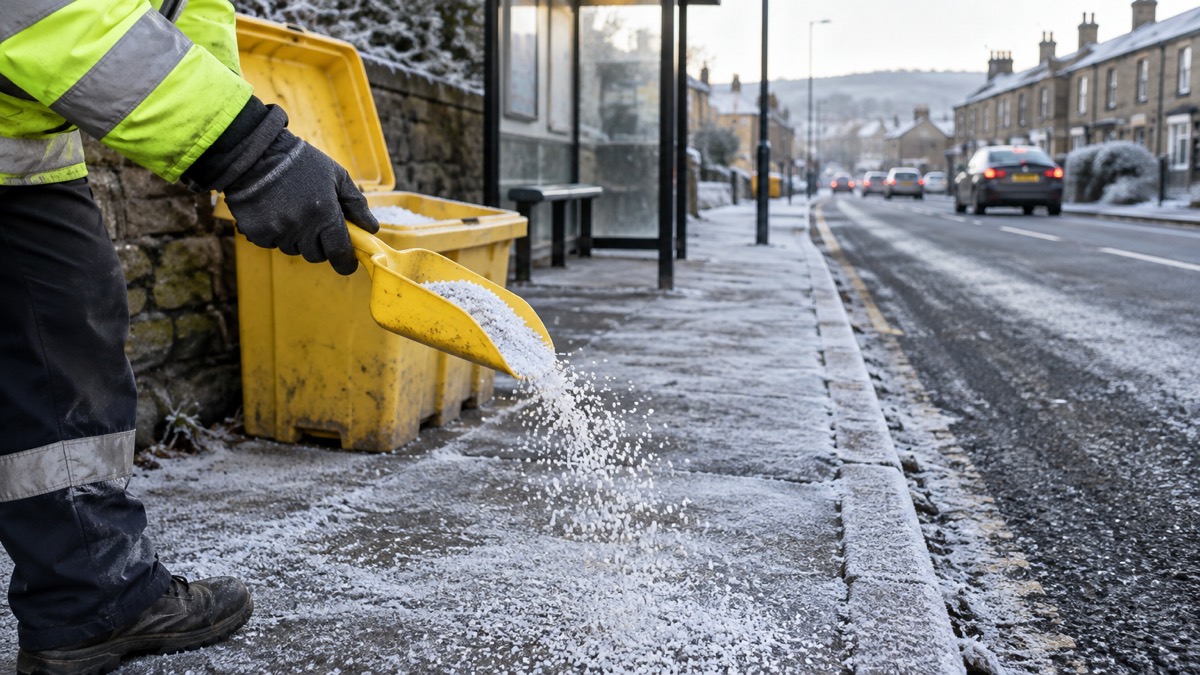
If you are wondering whether the road outside your house will be gritted tonight, the honest answer for most people is no. Councils salt only a small, chosen part of their network: Somerset Council treats around 900 miles of road and states plainly that "only the busiest roads are salted, most are not"1. Devon's primary salting network of 37 routes covers 20 per cent of its road network2. The figure varies between councils, but the pattern is the same everywhere: a defined priority network gets precautionary salting whenever ice or snow is forecast, and everything else waits.
Motorways and trunk roads are treated separately, by National Highways in England, which runs a winter service from 1 October to early April each year with over 530 gritters based at 128 depots3. Councils look after the rest, from A roads down to residential streets, and each publishes a map or list of its gritting routes so you can check whether yours is on one.
This page explains who decides what gets gritted, how those decisions are made, when gritters actually go out, why a gritted road can still be icy, and how to check tonight's treatment in your area. It sits alongside our wider guide to storms, snow and ice, and our pages on driving in snow and ice and clearing snow from pavements.
Who grits which roads
Responsibility is split between two bodies, and knowing which one looks after your road tells you who to check, and who to contact if there is a problem.
National Highways treats motorways and trunk roads across England. In Nottinghamshire that means the M1, A1, A46, A52 and A4535; in Cumberland, National Highways looks after and grits 4 major roads6; in Devon it maintains the M5, A30, A303, A35 and A382. National Highways operates its winter service from 1 October to early April each year, with winter maintenance teams working 24 hours a day, more than 250 weather stations monitoring conditions around the clock, and a weather forecast team based at its National Traffic Operations Centre3.
Your local council treats everything else it maintains, from A roads and B roads down to local streets. Highland Council, for example, plans daily treatments across the council-maintained road network, excluding private roads7. Councils do not salt private roads or non-highway areas except in exceptional circumstances, such as a location with a high number of vehicle movements like a hospital or bus station8. If your road is private, it is the person responsible for it who must arrange any treatment, and grit bins and salt for private use can be bought from builders' merchants9.
| Road type | Who treats it | Where to check |
|---|---|---|
| Motorways and trunk roads (e.g. M1, A1, M5) | National Highways3 | National Highways and Traffic England |
| A and B roads and other priority routes | Your county or unitary council10 | Your council's gritting map |
| Residential roads off the priority network | Usually not gritted11 | Your council's gritting map |
| Private roads and unadopted streets | The person responsible for the road9 | Not the council |
| Pavements and footpaths | Rarely salted routinely12 | Your council |
In Scotland, Wales and Northern Ireland the same split applies in principle: national bodies treat the trunk road network and councils treat the rest. Northern Ireland's winter service is run by the Department for Infrastructure, with duty controllers on call 24 hours a day in each of its 4 divisions4.
How councils decide which roads get salted
Councils cannot salt everything, so they rank their network and publish the result. Surrey, for instance, divides its treated roads into Priority 1 and Priority 2. Priority 1 roads are the most important in terms of the volume of traffic carried, and are the first to be treated in advance of any forecast frost, ice or snow; they include roads that link gritting routes with those of adjoining counties. Priority 2 roads are only treated during prolonged and persistent frost, ice or snow, and only once Priority 1 roads have been cleared11.
The criteria councils use are broadly similar across the country, even where the wording differs:
- Traffic volume. Argyll and Bute bases its routes on priority, focusing on the roads with the most traffic, with main routes treated first13. Bedford grits all A and B roads along with other important local roads, classing the busiest roads with the highest accident risk as priority10.
- Buses. Devon salts bus routes with a service interval of at least 15 minutes within any one hour of the day, in one direction of travel2. Northern Ireland's winter service counts a 40-seater bus as 40 vehicles when weighting a route4.
- Hospitals and emergency services. Warwickshire includes accesses to hospitals and main industrial estates in urban areas14; Derbyshire includes emergency service locations and transport interchanges on its main routes15.
- Schools and villages. Derbyshire's main gritting routes include links to villages and areas around schools15. Warwickshire grits a school only if it is already on an agreed gritting route14. Nottinghamshire, when severe weather is forecast and resources permit, also grits one road to every major settlement, some steep residential roads, and access routes to special educational needs schools, because some of the children get medical care there5.
- Traffic thresholds. Northern Ireland's winter service may include other roads carrying more than 1,000 vehicles per day if they are in hilly areas or there are other difficult circumstances4.
What is deliberately left out is just as important. Surrey does not grit residential roads unless they are on the priority list, nor alleyways, car parks or private property11. Carmarthenshire does not routinely salt footpaths or pavements, because it has to prioritise major roads over pavements to prevent the most serious accidents12. Argyll and Bute warns that if a road is not part of a winter gritting route, it is highly unlikely to be gritted unless in an emergency13.
The scale of the network that gets precautionary salting varies a lot between councils, which is why your experience in one county may not match the next:
| Council | Scale of treatment | Detail |
|---|---|---|
| Devon | 20% of its road network | 37 primary routes2 |
| Somerset | Around 900 miles of road | Only the busiest roads salted1 |
| Carmarthenshire | Approximately 25% | County and trunk roads treated as priority12 |
| Northern Ireland (Winter Service) | 28% | Almost 7,000 km (4,300 miles)4 |
| Suffolk | 36 gritting vehicles | Publishes which roads are gritted8 |
Derbyshire notes that it grits more of its roads than most councils, and that tough decisions have to be made about which roads are treated and which are not15. Suffolk, by contrast, publishes the full list of roads treated by its 36 gritting vehicles so residents can check their own street8.
The gritting season: October to April, on standby around the clock
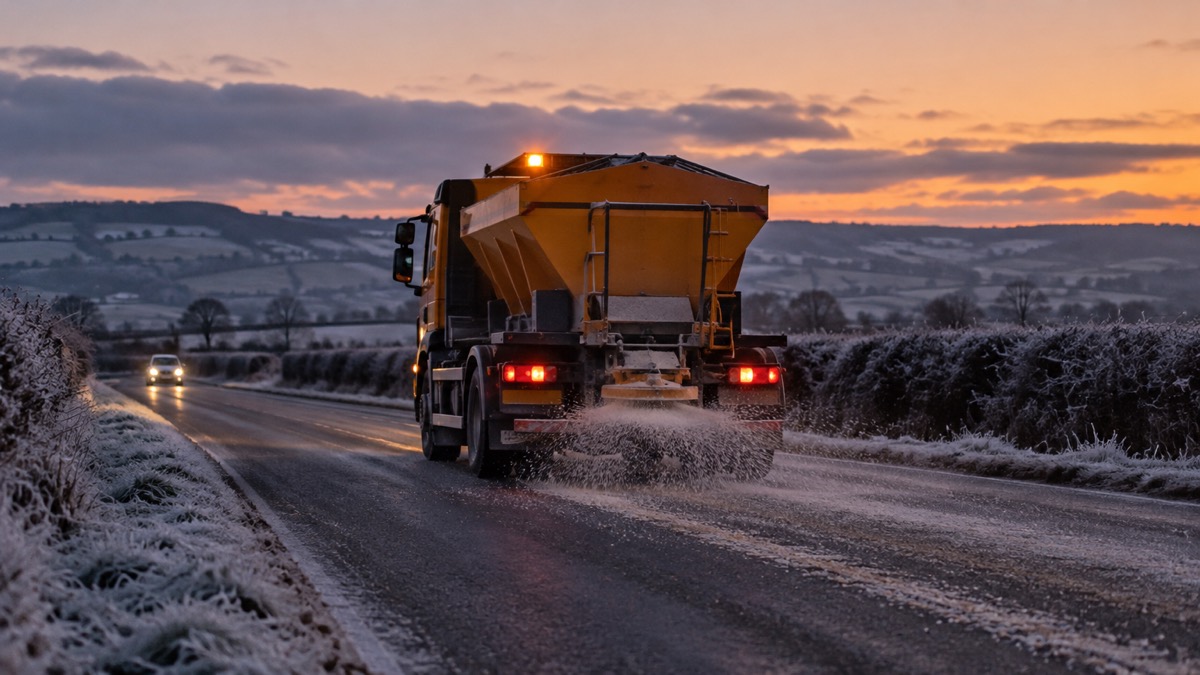
Gritting is not a fair-weather service that switches on after the first frost. Councils prepare for it months ahead and then keep crews on standby throughout the winter. Northumberland's routine gritting covers a network of 28 main routes, with busy footpaths, car parks and shopping areas also gritted during persistent icy conditions16. Lincolnshire works with the Met Office to monitor weather conditions around the clock from October to April, with 43 gritting crews on call 24/717. Highland Council runs its season from mid-October to mid-April, monitoring forecasts and real-time data from an ice-detection system7.
The standby commitment is total. Carmarthenshire's staff are on standby 24 hours a day, seven days a week, 365 days a year to respond to changing weather and road conditions12. Anglesey has 12 gritter drivers working shifts, on call 24 hours a day, seven days a week18. Nottinghamshire fields a team of 23 permanent night shift drivers from November to March, with additional drivers providing cover for daytime and weekend gritting5. Surrey's winter service runs from October through to April, and can run longer if forecasts indicate cold weather will continue after April; it operates on a standby basis, 24 hours a day, seven days a week19.
The scale of the operation behind those standby crews is considerable. Surrey stockpiles around 10,000 tonnes of grit across four grit barns, aims to keep the barns at 75 per cent capacity, and runs 38 gritters and 2 mini gritters from four winter service depots, travelling around 1,775 miles of road when gritting Priority 1 routes19. National Highways holds around 280,000 tonnes of salt at the start of each winter, runs over 360 salting and ploughing routes, and employs 1,600 gritter drivers and over 120 trained winter decision-makers providing a 24/7 service3.
The season's exact dates differ slightly by body, so treat "October to April" as the frame rather than a promise:
| Body | Season | Notes |
|---|---|---|
| National Highways | 1 October to early April3 | England's motorways and trunk roads |
| Highland Council | Mid-October to mid-April7 | Ice-detection system monitored |
| Surrey | October to April, extendable20 | Extended if cold weather continues |
| Northern Ireland | Early November to late March4 | Provided outside the period if necessary |
| Lincolnshire | October to April17 | 43 crews on call 24/7 |
When gritters go out, and when salt is not spread
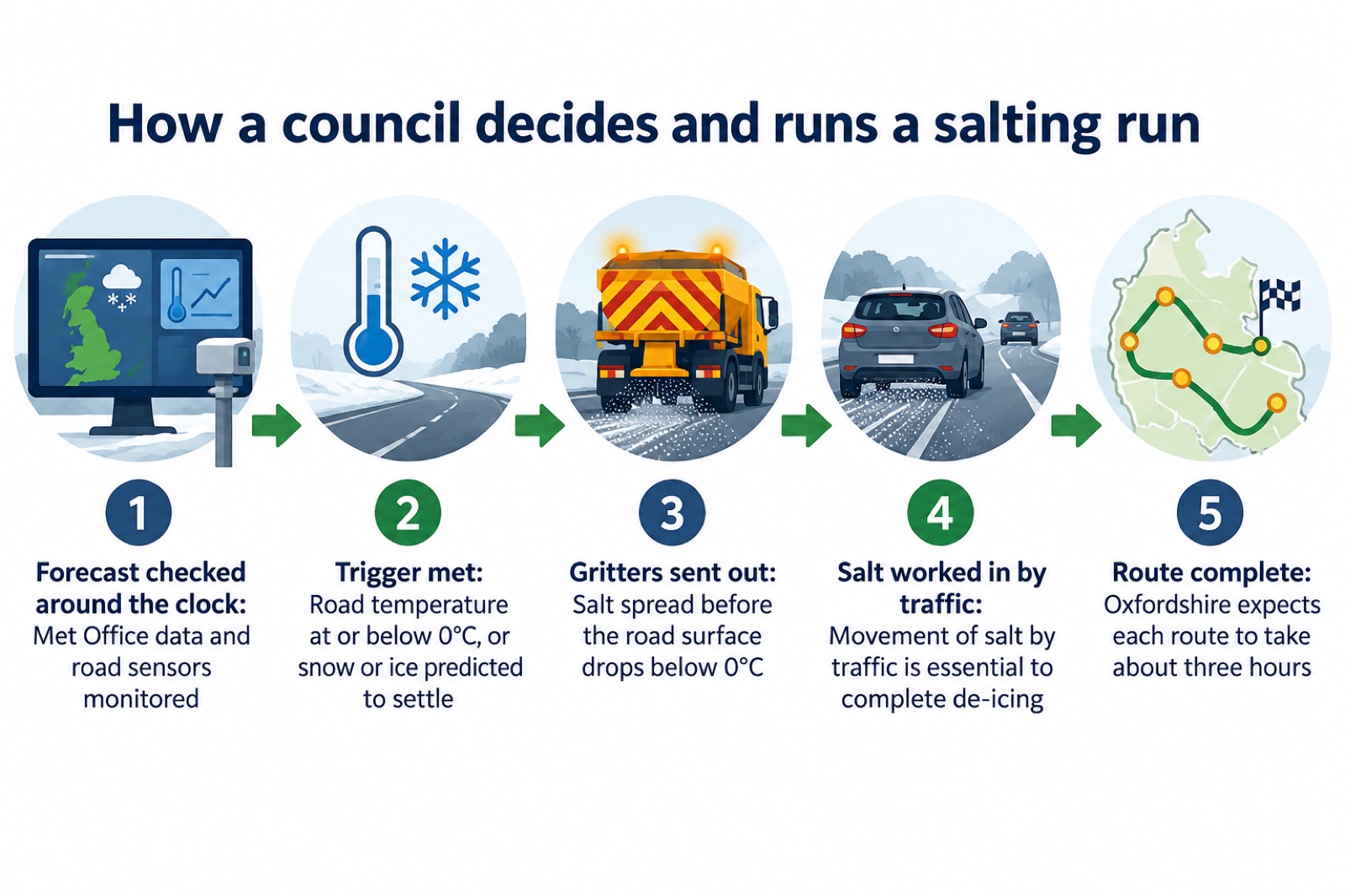
Gritters are sent out when the forecast demands it, not on a fixed schedule. Via East Midlands, which manages Nottinghamshire's highways, grits when road temperatures are predicted to be at or below zero degrees and when snow or ice is predicted to settle on the road surface5. Cumberland sends its gritters out to spread salt on its network of priority gritting routes whenever the forecast shows cold, icy and snowy weather is due6. National Highways works to ensure salt has been spread onto the road surface before the road surface drops below 0°C, to minimise the risk of frost or ice forming, and also treats its roads prior to any expected snowfall3.
Just as important is when salt is not spread, because a dry, unsalted road on a freezing night is usually a deliberate decision rather than an oversight:
- During heavy rain. Salting is done when it is not raining, to avoid the grit being washed away21. If rain continues close to freezing, or turns to snow, gritters must wait until the rain stops19.
- On dry roads. Oxfordshire may not salt if no rain has fallen and roads are dry, because ice will not form22.
- In the middle of the night. Northern Ireland's winter service does not normally spread salt in the middle of the night because there is not enough traffic to turn the salt and ice into solution and make it effective4.
- When salt remains from a previous run. Oxfordshire may skip salting if there is enough salt left on the road from the previous treatment22.
If you see a gritter with nothing coming out of the spreader, it does not mean the run has been abandoned. The vehicle may not have reached the starting point of its treatment route, or may be returning to the depot at the end of its route or to refill23. Suffolk's gritting vehicles use computer-controlled mechanics to dispense the required amount of salt directly onto the road, with GPS tracking each vehicle's route, speed and spreading, and gritters cease treating when they are off their prescribed route8.
On motorways, National Highways gritters usually salt from the middle lanes at speeds up to 50mph, but you may also find them salting in any lane when necessary, and where possible message signs will inform you that salt spreading or snowploughing is taking place24. Our page on whether to overtake a gritter or snowplough covers how to pass one safely.
How salt actually works, and what "grit" really is
Despite the name, what comes out of a gritter is almost always salt. National Highways states that on the vast majority of its routes it uses rock salt, not grit, "as many people often think"3. Staffordshire uses brown, unrefined rock salt with a gritty texture25, and Bedford spreads 6mm crushed rock salt using purpose-built gritters which can have a snowplough fitted when needed10. National Highways uses salt no larger than 6mm in size, most of it from UK mines in Winsford in Cheshire or Boulby in Cleveland, and most of its vehicles can spread either dry salt or pre-wetted salt, a brine solution sprayed onto the rock salt as it leaves the gritter; pre-wetted salt is used on most occasions because it reduces the environmental impact3.
The chemistry is simple. Salt lowers the freezing point of water. Surrey explains that grit works by turning the ice or snow surrounding each grit granule into a saline solution which has a lower freezing point than water19; Cheshire West and Chester describes how salt lowers the freezing temperature of water, preventing ice or frost forming once the road surface falls to 0°C, with pre-salting forming a separating layer so snow does not freeze onto the road surface23. Staffordshire adds that salt lowers the freezing point when driven or walked over, forming a solution that helps melt ice25.
Two practical points follow from this. First, salt does not directly melt snow: it has to be spread before the snow falls, and over time traffic works it into the road surface, where it mixes with snow or moisture to form a saline solution which does not freeze as quickly as water10. Second, salt is most effective on busy roads with high traffic volumes25, which is one reason the busiest roads are the ones chosen for precautionary salting in the first place.
Salt and settling snow
Salt will not stop snow from settling on the road surface. National Highways is explicit about this, but notes that salt acts as a debonding layer, making it easier to plough snow off the roads3. Surrey says road grit melts snow less than 40mm deep, and only when traffic moves the salt around20. Once snow settles on roads more than one inch deep, heavier applications of salt are needed, and roads are treated in order of importance starting with priority routes22. In extremely low temperatures or heavy snowfall, a mix of salt and grit may be used to help vehicles get about20. When the weather gets severe, all of National Highways' gritters can have snow ploughs fitted3, and it also operates 12 snow blowers which can remove up to 1,200 tonnes of snow per hour3.
Why a gritted road can still be icy
This is the point that catches people out. A road can be on the gritting route, treated on schedule, and still be icy under your wheels. Northern Ireland's winter service puts it bluntly: "Ice-free roads cannot be guaranteed"4.
The reasons are practical, not careless:
- Timing. It takes up to three and a half hours to salt a route, so your journey may start or end on an untreated section4. Oxfordshire anticipates each salting route taking approximately three hours, with all routes undertaken simultaneously22. Anglesey's teams take around 2.5 hours to salt the main route each time they go out18. National Highways treats all of its routes within 2 to 3 hours3.
- Unpredictable frost. Some conditions are particularly hard to predict, such as early morning frost, and ice can form on the road before gritting is completed21. The Met Office can only guarantee 80 per cent accuracy in its forecasts, and Northern Ireland has a high proportion of marginal nights when temperatures sit very close to zero4.
- Rain washing salt away. Rain can wash grit off roads, leaving them prone to re-icing, and a wet surface may freeze if the temperature falls below zero4.
- Extreme cold. Grit is less effective on road surface temperatures of less than -5°C, and so takes longer to melt snow in those conditions19.
- Not enough traffic. Spreading salt is only the start of the de-icing process; movement of salt around the road by traffic is essential to complete it, and roads can remain icy overnight when traffic is low23.
- Cold spots. Beware of "wet looking" patches, or cold spots under trees, near rivers and on bridge decks, where temperatures can be lower than the surrounding area; be aware of dawn frost and fresh snow on gritted surfaces26.
Oxfordshire's advice to drivers is the summary worth remembering: never assume that a road will be free from ice. Priority routes only may be treated, salt has limited effect in severe cold, high winds or rain can remove salt, and many minor roads do not get salted at all22. For what to do when you meet ice, see our page on what to do if you hit black ice.
Grit bins: clearing your own street and paths
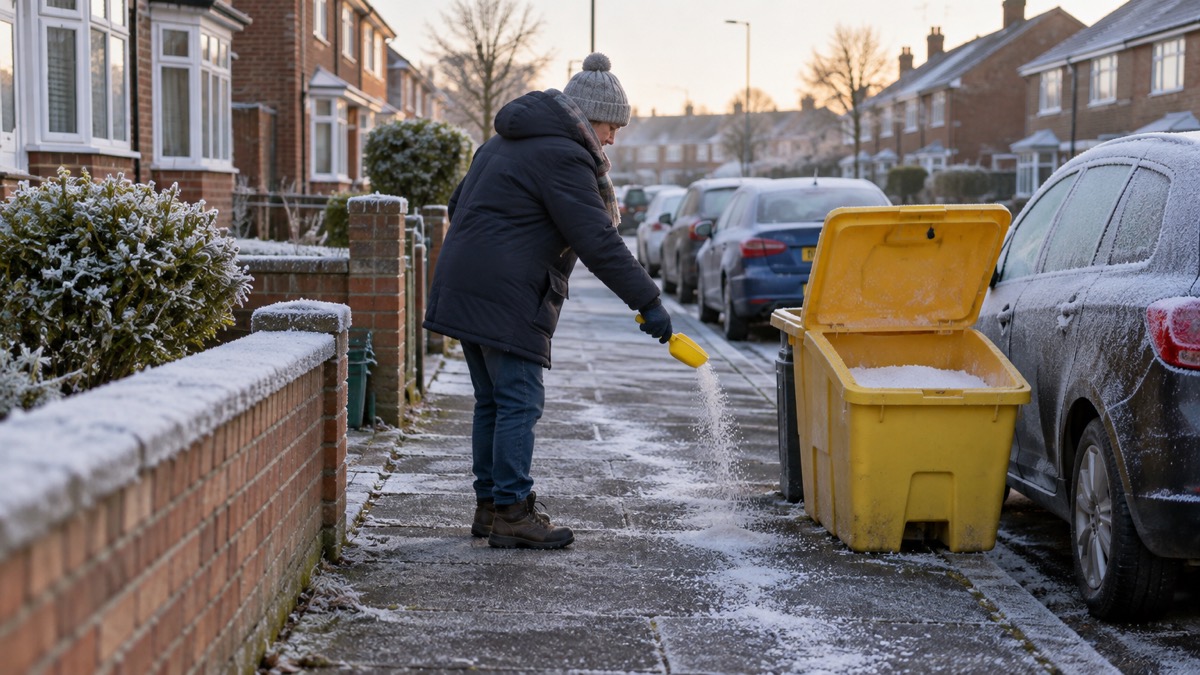
Because most residential roads and pavements are not on gritting routes, many councils provide grit bins so residents can treat local hazards themselves. Grit bins are provided to help make public highways and footpaths safer during icy weather27, and Argyll and Bute provides more than 300 of them in more urban areas, allowing people to spread salt themselves on local pavements and roads9. On more lightly trafficked roads, salt boxes or grit piles may be placed at hills, bends or junctions for use by the public4.
The rules on what the salt may be used for are consistent, and worth knowing before you fill a bucket:
- Derbyshire: you are welcome to use grit from the county's grit bins to grit public roads and footpaths, but not on private property28.
- Lancashire: use the grit only on public roads, pavements and rights of way27.
- Northumberland: grit from bins and heaps can be used to clear snow and ice from roads and pavements around your home, but not on private property16.
- Carmarthenshire: bin salt is provided for use only on public roads and pavements and should not be used or transported anywhere else12.
- Staffordshire: salt is for public highway use only, not for private paths or driveways25.
When you use a bin, Lancashire advises you to focus on slopes, steps and busy walking routes27. If your street has no bin, or one that needs refilling, our guide on how to request or refill a grit bin explains what to do, and our pages on how much salt you need to clear ice and clearing snow from a path safely cover the technique. Some councils also support volunteer snow wardens who clear local paths in winter; if that appeals, our community resilience guide is the place to start.
Driving when roads are icy
The advice from Northern Ireland's winter service is direct: drive at a slow speed in as high a gear as possible, and accelerate and brake very gently4. Keep well back from the road user in front, as stopping distances can be ten times greater than on dry roads4. If the steering feels unresponsive, this may indicate ice and your vehicle losing its grip on the road; when travelling on ice, tyres make virtually no noise4.
Before you set out, National Highways advises you to plan your route, check the availability of service areas along it, make sure you know how to operate your headlights and fog lights, pack a winter kit, check the weather forecast, consider delaying your journey if snow or ice is expected, and check traffic conditions24. Lancashire's advice is the same in spirit: check the latest forecast and gritting updates before you travel, and take extra care in winter conditions even on treated roads29. Our pages on how much longer stopping distances are on ice, whether to delay your journey in bad weather and car checks before winter take these further.
Checking tonight's gritting status, and reporting an icy road
The most reliable way to know whether gritters are going out is your own council's gritting page, which most update daily through the winter. Northern Ireland's winter service information is updated 24 hours a day, as necessary, with winter service details, and shows the current decision, for example: "Positive temperatures with no winter hazards forecast - no salting of the scheduled road network has been programmed"4. Suffolk publishes which roads are gritted so you can check whether your street is on a route8, and Nottinghamshire publishes a gritting map5.
Some councils go further and show the gritters moving. Cumberland's tracker displays the locations of gritter lorries in the county and where they have gritted along planned routes, though it is a new service currently being tested, and the council advises checking the gritting map page for details of which roads will be treated today30. In Scotland, the Trunk Road Gritter Tracker shows live gritter tracking from 1 November to 31 March; between April and October it does not provide live tracking, but does show the names of the gritters for the previous winter period31.
To report an icy or untreated road on the council network, contact your council's highways team through its website. For motorways and trunk roads, National Highways can be called on 0300 123 50005. If the road is private, speak to the person responsible for it9. In an emergency, call 999 and ask for the police.
A final habit worth forming: check the Met Office weather warnings alongside your council's gritting page. A yellow warning for ice or snow tells you treatment is likely and journey planning matters; the gritting page tells you whether your roads are in line for it.
Sources (31)
- Gritting: precautionary routes and winter advice, Somerset Council, 2026
- Gritting frequently asked questions, Devon County Council, 2026
- Winter driving: how we help you on our roads, National Highways, 2026
- Winter news and Winter Service details, TrafficWatchNI, 2026
- Gritting map and winter service, Nottinghamshire County Council, 2026
- Winter road maintenance and gritting, Cumberland Council, 2026
- Our road gritting priorities, The Highland Council, 2026
- Check which roads are gritted, Suffolk County Council, 2026
- Grit bins and heaps, Argyll and Bute Council, 2026
- Keeping winter roads safe, Bedford Borough Council, 2026
- Salting and gritting priorities, Surrey County Council, 2026
- Gritting, Carmarthenshire County Council, 2026
- Gritting priority routes, Argyll and Bute Council, 2026
- Gritting policy, Warwickshire County Council, 2026
- Which roads we grit, Derbyshire County Council, 2026
- Gritting and ploughing, Northumberland County Council, 2026
- Winter road management, Lincolnshire County Council, 2026
- Winter gritting, Isle of Anglesey County Council, 2026
- Salting: how road grit works, Surrey County Council, 2026
- Salting and gritting: Winter Service, Surrey County Council, 2026
- Does gritting always work?, Derbyshire County Council, 2026
- Salting and snow clearance, Oxfordshire County Council, 2026
- Common myths about gritting, Cheshire West and Chester Council, 2026
- Travelling in snow and ice, National Highways, 2026
- Frequently asked questions about grit, Staffordshire County Council, 2026
- Winter and wet weather driving tips, North Yorkshire Council, 2026
- Using grit bins, Lancashire County Council, 2026
- Gritting and snow information, Derbyshire County Council, 2026
- Gritting service, Lancashire County Council, 2026
- Track our gritter lorries, Cumberland Council, 2026
- Winter treatments and the Trunk Road Gritter Tracker, Traffic Scotland, 2026
 Car Checks Before Winter
 Flood Warning Checklist
 First Steps After a Flood
 Beast from the East 2018
 Driving in Snow and Ice
 Winter Home Preparation
 Staying Well in Cold Weather
 Walking on Ice Safely