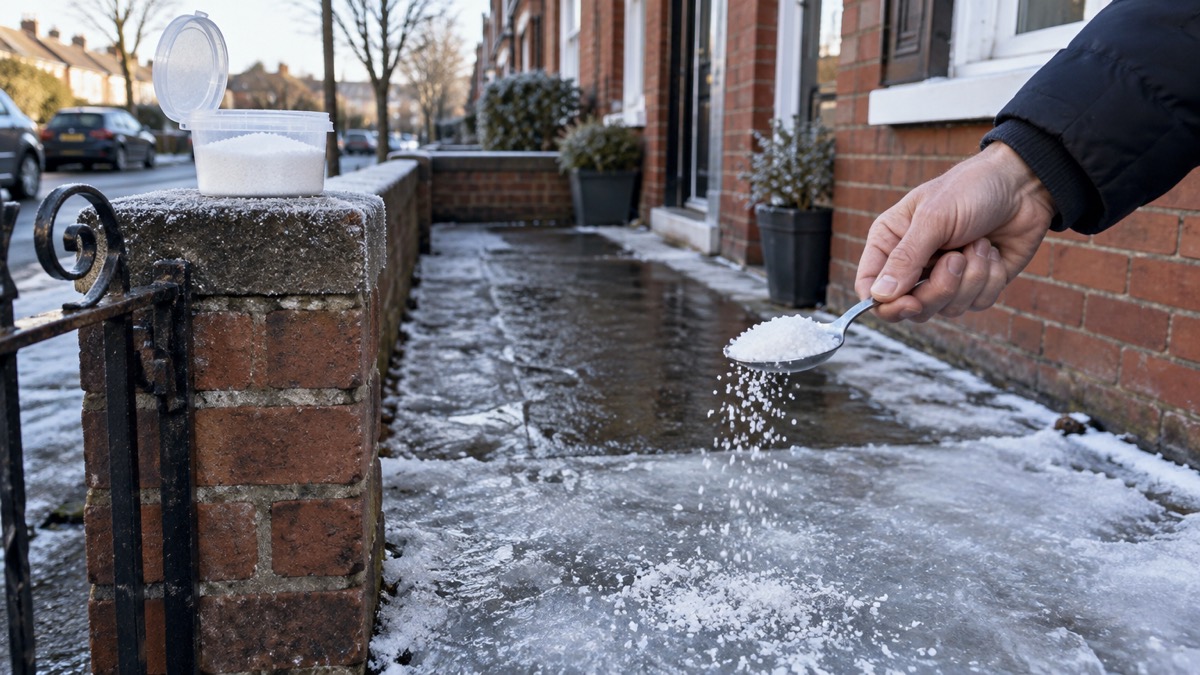
A tablespoon of ordinary table salt or dishwasher salt is enough for each square metre of path you clear. That is the figure the Met Office and the government's Snow Code both give, and it is far less salt than most people expect1. You do not need a sack of grit or a specialist product: a tub of table salt from the kitchen will melt snow and stop black ice forming on a garden path, a drive or a run of steps.
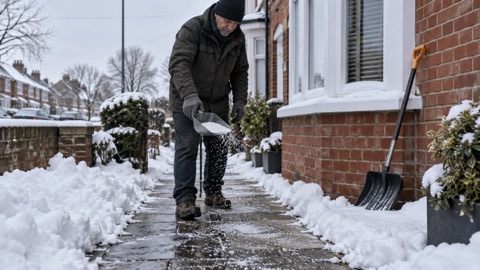
The method matters as much as the amount. Clear the snow and ice first, spread the salt thinly and evenly, and do it early enough that the salt is down before the temperature drops and the melted surface refreezes overnight3. Salt works by lowering the freezing point of water, so it is a preventive treatment as much as a cure5. Water is the one thing to keep off a frozen path: it refreezes into clear black ice that you cannot see6.
For a normal UK household, a few kilograms of salt kept dry in a lidded container will see you through a winter of path clearing. The sections below set out how much to use, how to measure it, when to put it down, and how to work out how much to store for your own paths and drive.
One tablespoon per square metre, and what that looks like
The headline rate is simple: a tablespoon of salt for each square metre you clear1. The Met Office's winter advice puts it the same way, and adds that ordinary table or dishwasher salt can be used1. The Snow Code, published on gov.uk, says the same tablespoon per square metre should work2.
Different councils express the same idea by weight, which helps if you are scattering by hand rather than measuring with a spoon. Suffolk County Council says a small handful of salt, approximately 20g, can treat approximately one square metre of cleared surface8. Oxfordshire County Council describes 20g per square metre as about a heaped tablespoon, sufficient to clear and protect a square metre of footway or carriageway9. A tablespoon and a small handful are close enough for practical purposes.
Councils spread at different rates depending on whether they are preventing ice or melting it. Argyll and Bute Council spreads salt at 10 to 15 grammes per square metre to prevent ice forming, and 20 to 40 grammes per square metre to melt ice that has already formed10. That is the same principle you can apply at home: a lighter dusting before a frost, a heavier application on ice that is already there.
| Situation | Rate | What it means at home |
|---|---|---|
| Preventing ice before a frost | 10 to 15g per square metre10 | A light scattering, less than a tablespoon |
| Melting ice already formed | 20 to 40g per square metre10 | A tablespoon to a heaped tablespoon |
| Household rule of thumb | One tablespoon per square metre1 | About 20g, a small handful8 |
Do not be tempted to heap it on. Carmarthenshire County Council advises that salt should be used very sparingly, because it does not aid grip but is there to prevent ice forming and to melt snow11. More salt does not clear a path faster; it just wastes what you have stored and puts more salt onto plants and grass at the edges.
Table salt, dishwasher salt or grit: what actually works
You do not need to buy specialist grit for a domestic path. The Snow Code says to use ordinary table or dishwasher salt, a tablespoon for each square metre4. The Met Office says the same1, and Nottinghamshire County Council's winter driving advice repeats it6. West Yorkshire Prepared, the region's resilience partnership, also advises ordinary table or dishwasher salt at a tablespoon per square metre7.
Dishwasher salt has a practical advantage: it is coarse and free-flowing, so it scatters evenly from a scoop or a gloved hand and does not clump in damp conditions. Table salt is finer and works just as well on the ice, but it can cake in the container if it gets damp, so keep it in a lidded tub.
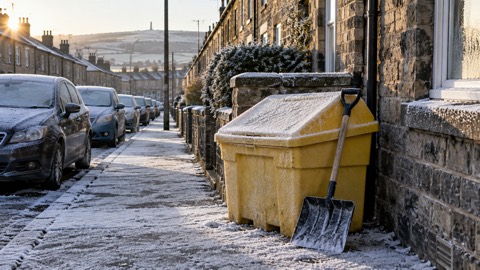
What you should not do is take salt from a council grit bin. The Snow Code is explicit: do not use the salt from salting bins, as this is used to keep roads clear2. Grit bins are there so residents can treat the public road and pavement in their street when a gritter has not been, not to supply private paths and drives. If your local bin is empty, the right step is to ask the council to refill it, not to stock up from it.
Sand or ash is the fallback if you run short. Nottinghamshire County Council advises that if you do not have enough salt, you can use sand or ash, which will not stop the path icing over as effectively as salt but provides good grip underfoot6. That is a useful distinction: sand is for grip, salt is for melting and preventing ice. Keep a bag of sand or grit alongside your salt for the coldest days when salt alone is struggling.
Melting snow and stopping black ice forming
Salt does not work instantly on a thick layer of snow. Derbyshire County Council explains that salt only effectively melts snow when it is less than 40mm deep and traffic can move the salt around12. On a domestic path there is no traffic, so you are the mechanism that works the salt in: clear the bulk of the snow with a shovel first, then salt the cleared surface.
The timing is what prevents black ice. The Snow Code says to start early, clear the snow or ice early in the day, and cover the path with salt before nightfall to stop it refreezing overnight3. Nottinghamshire County Council gives the same advice: if you remove the top layer of snow in the morning, any sunshine during the day will help melt any ice beneath, and you can then cover the path with salt before night to stop it refreezing6. Cornwall Council notes that salting is usually done before freezing occurs14.
Black ice is the reason timing matters more than quantity. A path salted before a frost has a layer of salty water on it that freezes at a lower temperature than plain water, so the surface stays wet rather than turning to a sheet of ice5. A path left unsalted, or salted only after ice has formed, needs the heavier 20 to 40 grammes per square metre rate to make any impression10.
How much salt to keep in for your paths and drive
Work out your area first, then buy to that figure. Measure the length and width of each path or drive section in metres and multiply them: a path 10 metres long and 1 metre wide is 10 square metres, which needs about 10 tablespoons of salt per treatment. Add up the sections and write the total on the lid of your salt container so you are not doing arithmetic in the cold.
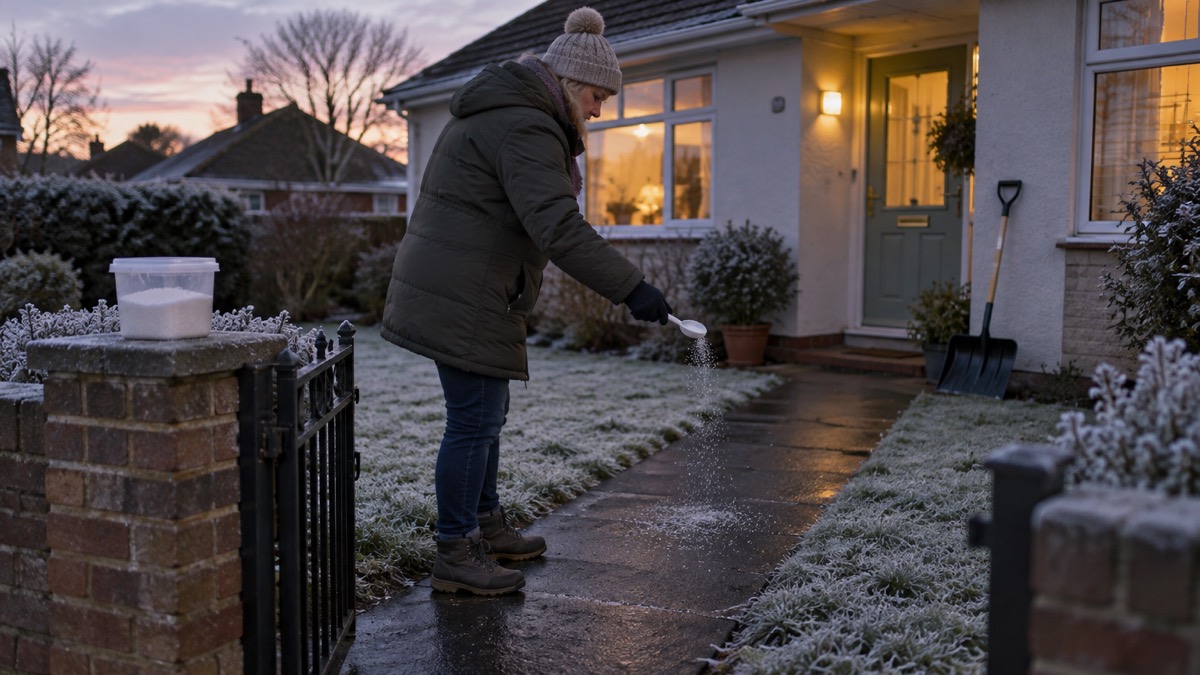
Staffordshire County Council's gritting advice gives a rough conversion from shop quantities to path area: a bag of sugar-sized amount of salt covers approximately 25 square metres5. Treated at about 20g per square metre, that is enough for a full treatment of a path or drive of that size, with lighter preventive dustings stretching it further.
For a typical UK winter, a few kilograms kept dry is a sensible household store. Keep it in a lidded container in a shed or garage, with a scoop inside, and a smaller lidded tub by the door for steps and the doorstep. Salt that gets damp sets solid and is hard to scatter when you need it.
If you have a larger area, or you look after a shared path or a community space, there are council schemes worth knowing about. Devon's Snow Warden scheme offers up to five tonnes of salt free of charge, usually delivered in one-tonne dumpy bags to one agreed location before winter, along with a small number of bagged salt supplies17. These are for local councils and community organisations rather than individual households, but if you help run a residents' group or a village hall, they are worth asking about.
For the wider picture on which roads get treated and how councils decide, see Which Roads Are Gritted and How Councils Decide. For clearing a path safely, including lifting and shovel technique, see How to Clear Snow and Ice from a Path Safely.
Measuring without a tablespoon, and other practical questions
If you have no tablespoon to hand, use a small handful. Suffolk County Council's figure of approximately 20g is about a small handful, and that treats approximately one square metre8. Oxfordshire's heaped tablespoon is the same quantity9. A plastic scoop from a dishwasher salt bag, a dessertspoon heaped twice, or a small cup will all do the job; precision is not critical, but a thin even layer is better than a heap in one spot.
For steps and doorsteps, treat them exactly as you would a path: clear the snow and ice, then spread salt at about a tablespoon per square metre before nightfall3. Steps are where falls happen most often, so keep the small tub by the door and do them last thing at night as well as first thing in the morning.
Salting a neighbour's path is actively encouraged. The Met Office's stay safe in ice advice says to offer to clear their paths when you clear yours and spread salt, using ordinary table or dishwasher salt at a tablespoon per square metre18. This matters most for older neighbours or anyone unsteady on their feet. For more on avoiding slips and falls, see Walking on Ice: Avoiding Slips and Falls on Pavements.
A few practical points to keep in mind:
- Salt before the frost, not after. Councils salt before freezing occurs14, and the Snow Code says to cover the path with salt before nightfall3.
- Clear snow first, then salt. Salt only effectively melts snow when it is less than 40mm deep12, so shovel the bulk away before treating.
- Keep salt off plants and grass. Warwickshire County Council advises avoiding spreading salt on plants or grass as they may be damaged19.
- Do not use bin salt on private paths. The Snow Code says bin salt is for keeping roads clear2.
- Sand or ash for grip. If salt is short, sand or ash provides grip even though it will not stop icing as effectively6.
Sources (19)
- Met Office Weather Ready tips for snow and ice, Met Office, 2025-11-19
- Clear snow from a road, path or cycleway, GOV.UK, 2026-10-29
- Snow Code, Derbyshire County Council, 2026-10-29
- Snow Code, Derbyshire County Council, 2026-10-29
- Frequently asked questions about grit, Staffordshire County Council, 2026
- Safe driving in winter, Nottinghamshire County Council, 2026-10-29
- Severe weather, West Yorkshire Prepared, 2026-10-29
- Check which roads are gritted, Suffolk County Council, 2026-10-29
- Salt and grit bins, Oxfordshire County Council, 2026
- Gritting priority routes, Argyll and Bute Council, 2026
- Gritting, Carmarthenshire County Council, 2026-08-04
- Does gritting work?, Derbyshire County Council, 2026-10-29
- Does gritting always work?, Derbyshire County Council, 2026-10-29
- Gritting, Cornwall Council, 2024-10-22
- Adverse weather events, Llangattock Community Council, 2026-10-25
- Extreme weather winter guide, London Fire Brigade, 2025-01
- Snow warden scheme, Devon County Council, 2026-03-13
- Stay safe in ice, Met Office, 2026-10-28
- Snow wardens, Warwickshire County Council, 2026-10-29
 Car Checks Before Winter
 Flood Warning Checklist
 First Steps After a Flood
 Bedroom Temperature at Night
 Hitting Black Ice
 Car Battery in Winter
 Car Stuck in Snow
 Clearing Snow and Ice Safely
 Clearing Snow from Pavements
 Using Fog Lights
 Signs of Frostbite
 Falling Through Ice
 De-Icing a Frozen Windscreen
 Request or Refill a Grit Bin
 Overtaking a Gritter