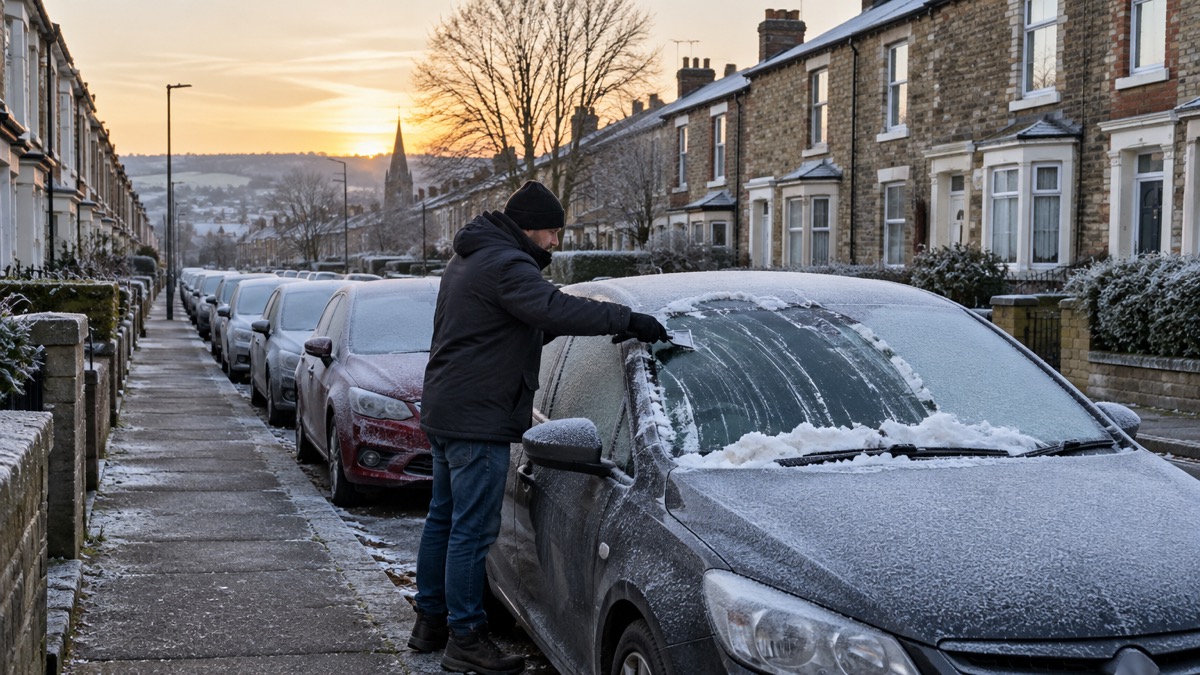
A frozen windscreen is a ten minute job if you do it in the right order, and a cracked windscreen or a damaged wiper motor if you do not. The rule is simple: clear every window completely, inside and out, before you move. All windows should be demisted and fully cleared of any frost, snow or ice before setting off1. The Highway Code requires you to be able to see out of every glass panel in your vehicle2.
Use a scraper and de-icer, not boiling water. Run the engine with the heater on the windscreen if you need to, but stay with the car while it runs. And clear the roof, lights and number plate as well as the glass: clear ice off all windows, lights, number plate, and vehicle roof before you set off3.
Clear every window before you drive
The windscreen is only part of the job. Official guidance is consistent across the UK: clear ice, snow and condensation completely from your windscreen and all windows before setting off8. North Wales Fire and Rescue Service puts it plainly: "Don't simply clear a 'porthole' to look through."9 A small clear patch gives you a view straight ahead and almost nothing else, and the side windows and mirrors are what you need at junctions.
Set aside enough time to do it properly before work rather than rushing it5. The full list of what to clear is longer than most people think:
- Every window, inside and out, including the rear screen9
- The roof, because snow sliding forward onto the windscreen under braking blocks your view3
- Lights and the number plate, so you can be seen and identified4
- Mirrors, cleared completely of snow and ice10
- The inside of the glass, de-misted before you set off11
The legal position is worth knowing. The Highway Code stipulates you must be able to see out of every glass panel in your vehicle8, and you must keep your front and rear windscreen clear of snow and ice before driving12. Driving with snow or ice may potentially be a criminal offence if driving under reduced visibility13. That is the reason the guidance is so firm about the roof and the side windows, not just the bit you look through.
The arrangements are the same in all four nations, since the Highway Code applies across the UK. What differs is who is telling you: Traffic Scotland advises making sure you have full visibility through your windscreen and de-icing the car inside and out9, and Cornwall Council advises clearing your windows and mirrors before you set out and carrying a screen scraper and de-icer4. For the wider picture on winter roads, see Driving in Snow and Ice: Staying Safe on the Road.
Use a scraper and de-icer, never boiling water
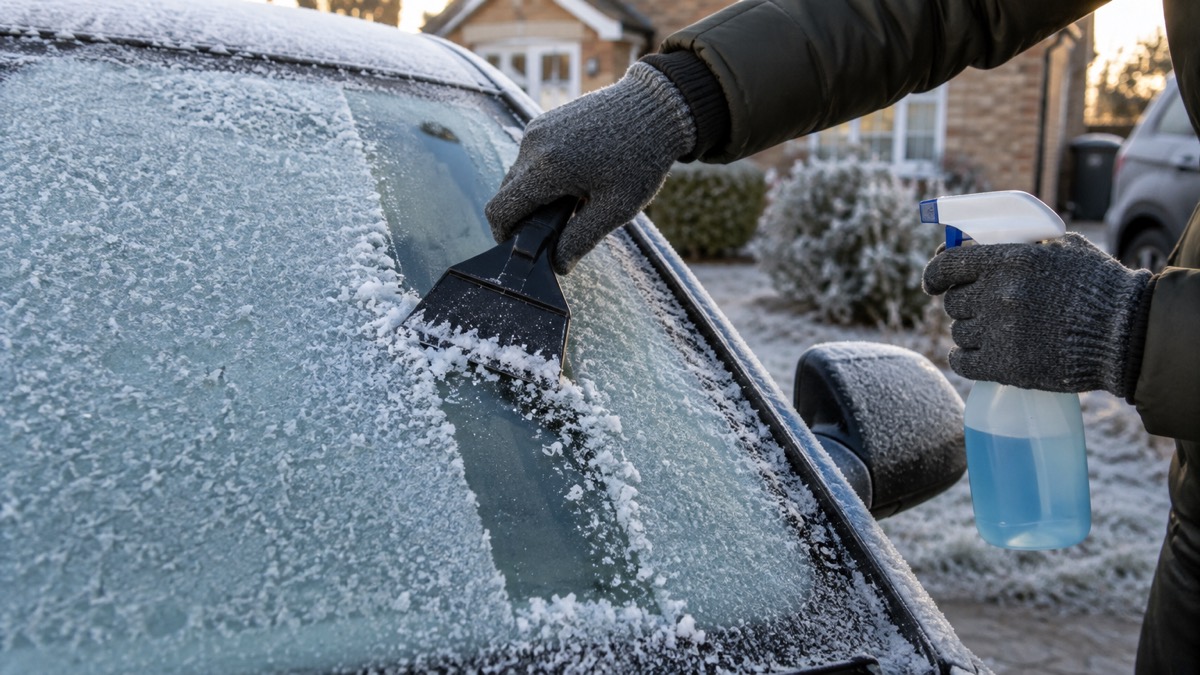
The method is straightforward. Clear all windows using a scraper and de-icer, and do not drive off with a tiny hole cleared in the windscreen5. Keep de-icer spray handy to clear your windows quickly, because it is dangerous to drive without full visibility through your vehicle's windows14. An ice scraper and de-icer are basic winter items, listed in the Met Office winter car kit alongside jump leads, a reflective warning triangle, sunglasses, an in-car phone charger and a blanket15.
Boiling water is the mistake to avoid. A sudden change of temperature on cold glass risks cracking it, and any water left behind refreezes, often as a thicker sheet than you started with. No official source recommends it. Use de-icer and a scraper instead.
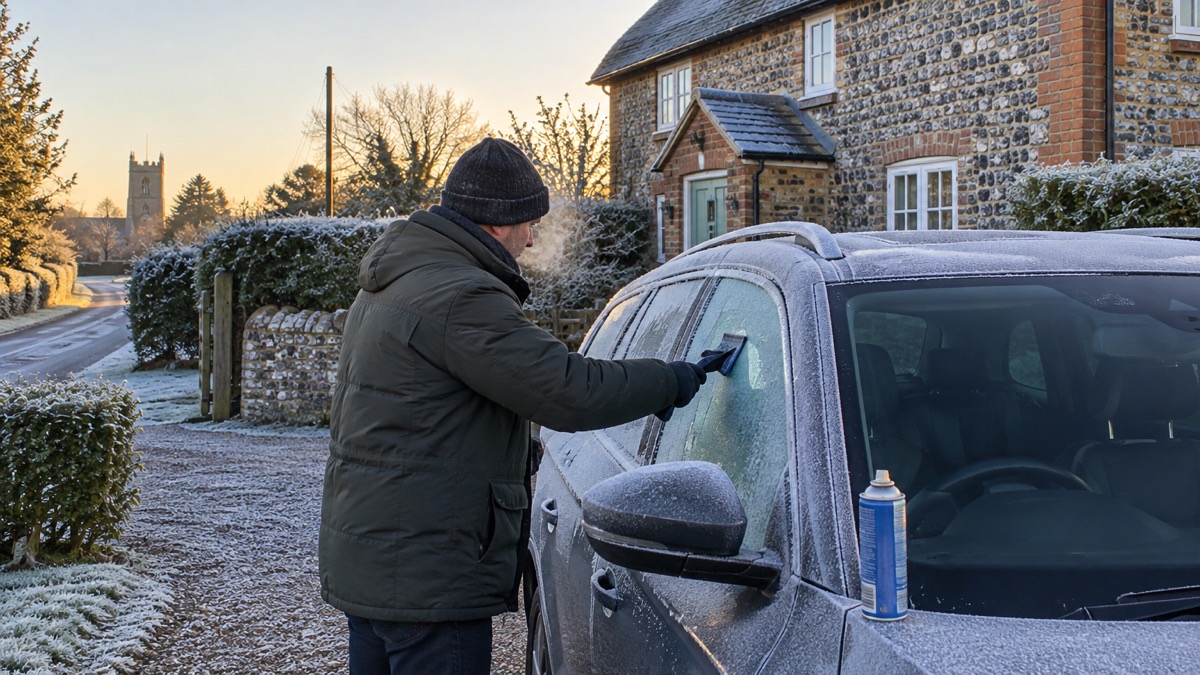
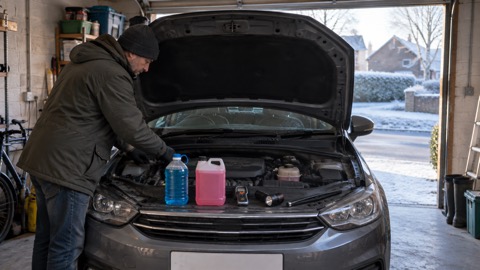
Two other things catch people out. First, do not add anti-freeze to your windscreen washer bottle: it is corrosive and will damage paintwork16. Use winter screen wash instead, which stops the water in the bottle freezing1. Second, more often than not you will actually clear your windscreen faster using cold air than hot air6. That is worth knowing when you are in a hurry and the heater is still blowing cold.
For the washer bottle, top up with a good quality screenwash which protects down to at least -10C, and have some de-icer on hand in the house7. The two documents disagree, so check the label on the bottle and pick one that states its protection temperature clearly.
Run the engine with the heater on the windscreen, staying with the car
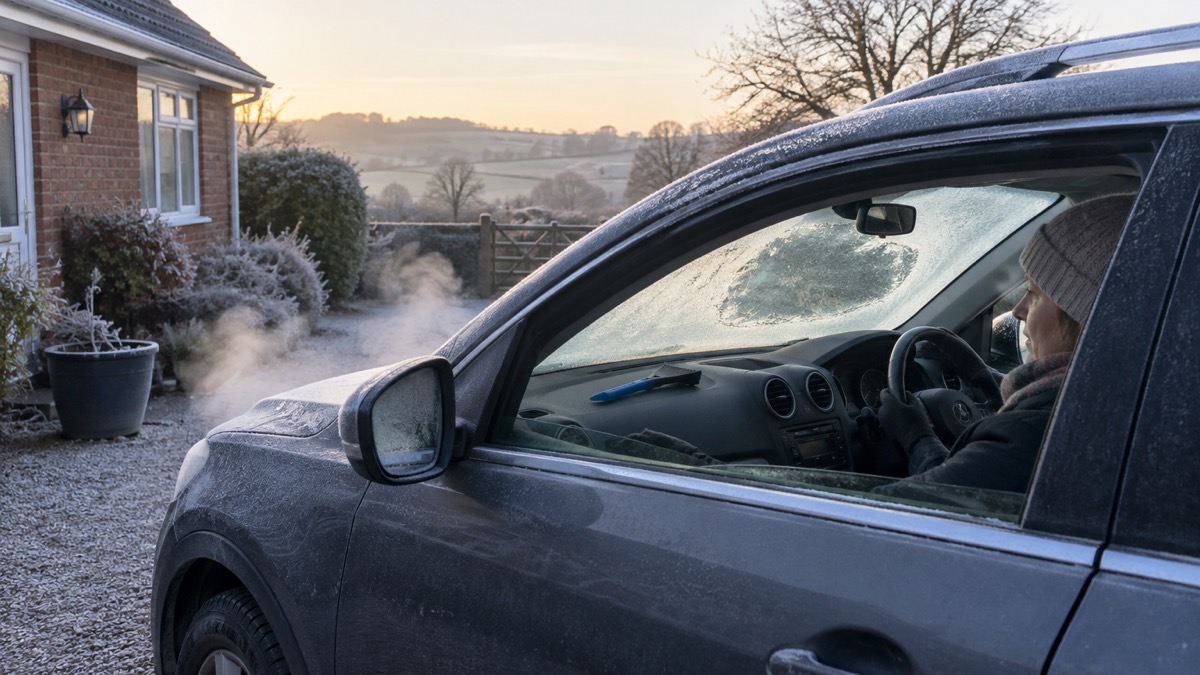
Running the engine for a few minutes before your trip helps clear the windscreen17. Set the heater to windscreen de-misting and open all the vents to keep your windscreen clear18. If your car is fitted with air conditioning, use it, as it will stop the windows from misting up2.
The safety rule is the one people break. If you leave the car running to warm up while you go back inside, you are leaving an unattended vehicle with the keys in it, and you are not watching for anything going wrong. Stay with the car while the engine runs.
That advice comes from guidance on being stuck in a winter storm in a remote area, but the principle applies whenever an engine is running in still, cold conditions. If you are caught out and have to wait in the car, Ceredigion County Council advises running the engine and heater for about 10 minutes every hour to keep warm, opening a window slightly while it runs and clearing snow from the exhaust pipe20. Move around to keep warm but avoid over-exertion, and make sure someone stays awake to watch for rescue teams19.
If you are likely to be out in bad weather, the Met Office winter car kit is worth keeping in the boot: ice scraper and de-icer, jump leads, a reflective warning triangle (ideally two), sunglasses, an in-car phone charger and a portable battery charger, and a blanket15. Transport Scotland also lists de-icer spray as part of a vehicle emergency kit, for the same reason: full visibility14.
Stopping the windscreen freezing overnight
A little preparation the night before saves the scraper work in the morning. The simplest measure is to stop the wipers sticking to the glass. In very cold weather, you can prevent your windscreen wipers getting stuck to the glass by putting something under them, like a thin piece of plastic, cardboard, newspaper or even some old socks7. Lift the blades gently, slide the material underneath, and remove it before you drive.
For misting on the inside, West Yorkshire Prepared suggests a household trick: clean the windscreen with shaving foam to prevent it misting up, though the barrier will need to be reapplied21. It is not a substitute for proper demisting on a cold morning, but it reduces how much condensation forms.
Other overnight measures from official guidance:
- Check the wipers before winter sets in. Top up anti-freeze and screen wash and check for wear and tear on wiper blades22.
- Keep the washer bottle full. Keep the windscreen and windows clean and the washer bottle filled with screenwash23.
- Use a screen wash additive to keep your windscreen free of winter road grime caused by road salting and gritting24.
- Check wipers, tyres and screen wash before setting off in icy weather25.
There is no official recommendation in this guidance for covers, windscreen blankets or sprays applied the night before, so treat them as a matter of personal choice rather than a rule. What the councils and the Met Office do recommend is the simple, cheap routine: clear the glass properly, keep the washer bottle topped up with the right screenwash, and look after the wipers.
If the cold snap is part of a wider spell of severe weather, it is worth reading Getting Your Home Ready for Cold Weather and Ice as well, since the same conditions that freeze your windscreen can freeze pipes and leave you without water.
What can go wrong: cracked glass, smears and damaged wipers
Most frozen windscreen problems come from rushing. Here is what tends to go wrong, and how to avoid it.
| What goes wrong | Why it happens | What to do instead |
|---|---|---|
| Cracked glass | Hot water on cold glass, or a scraper used with too much force on a chip | Clear all windows using a scraper and de-icer, and do not drive off with a tiny hole cleared in the windscreen5 |
| Smears in low sun | A dirty windscreen, worn blades or the wrong screenwash | Keep your windscreen clean and free from smears, which low sun will enhance26 |
| Damaged wipers | Switching them on while frozen to the glass, or blades worn and splitting | Check wiper blades and replace if worn11; replace them as soon as they start to smear rather than clean windows4 |
| Misting up again | Damp inside the car and no ventilation | Use air conditioning if fitted, heater on de-misting, vents open2 |
| Snow sliding onto the glass | Snow left on the roof | Remove all snowfall from the roof of your car before setting off3 |
Wiper blades are the part most often neglected. Regularly check your windscreen wipers and renew them if they are worn or damaged3. To test them, spray some washer fluid and check the wipers clean the windscreen, then run your fingers along the blades to check for splits15. A blade that smears is not doing its job, and in low winter sun a smeared windscreen can hide a cyclist or a pedestrian at a junction.
If the roads themselves are the problem rather than the glass, What to Do If You Hit Black Ice and How Much Longer Are Stopping Distances on Ice? cover what changes once you are moving. And if you want a full pre-winter routine for the car, the Car Checks Before Winter checklist sets it out step by step.
Sources (26)
- Driving in bad weather, Transport Scotland
- Driving in severe weather - Met Office, Met Office
- Driving in snow and icy conditions, Devon and Somerset Fire and Rescue Service, 2026
- Ice weather warning: information and advice, nidirect, 2026-02-16
- Safe driving in winter, Nottinghamshire County Council
- Cold weather and driving, Met Office, 2026-10-28
- Weather hacks, Met Office, 2026-10-26
- Driving in snow and icy conditions, Devon and Somerset Fire and Rescue Service, 2026
- Driving in snow, North Wales Fire and Rescue Service
- Winter driving tips, Isle of Anglesey County Council
- Winter driving, Derbyshire County Council
- Winter car kit, Met Office, 2026-10-25
- Adverse Driving Conditions - South Wales Fire and Rescue Service, South Wales Fire and Rescue Service
- Vehicle emergency kit, Traffic Scotland
- 6 things to do to prepare your vehicle for winter weather, Met Office, 2026-10-25
- Winter driving advice, Nottinghamshire County Council
- Extreme weather, Flintshire County Council
- Travelling in fog, Traffic England
- Severe weather, Pembrokeshire County Council
- Snow and ice, Ceredigion County Council
- Severe weather, West Yorkshire Prepared
- Seasonal winter, Suffolk Fire and Rescue Service
- Travelling safely in winter, Traffic Wales
- Top tips to be weather ready, Met Office, 2026-10-25
- Stay safe in ice, Met Office, 2026-10-28
- Driving in adverse weather, Cheshire Fire and Rescue Service, 2026-03-11
 Car Checks Before Winter
 Flood Warning Checklist
 First Steps After a Flood
 Bedroom Temperature at Night
 Hitting Black Ice
 Car Battery in Winter
 Car Stuck in Snow
 Clearing Snow and Ice Safely
 Clearing Snow from Pavements
 Using Fog Lights
 Signs of Frostbite
 Falling Through Ice
 Request or Refill a Grit Bin
 Overtaking a Gritter
 Insulating a Loft Water Tank