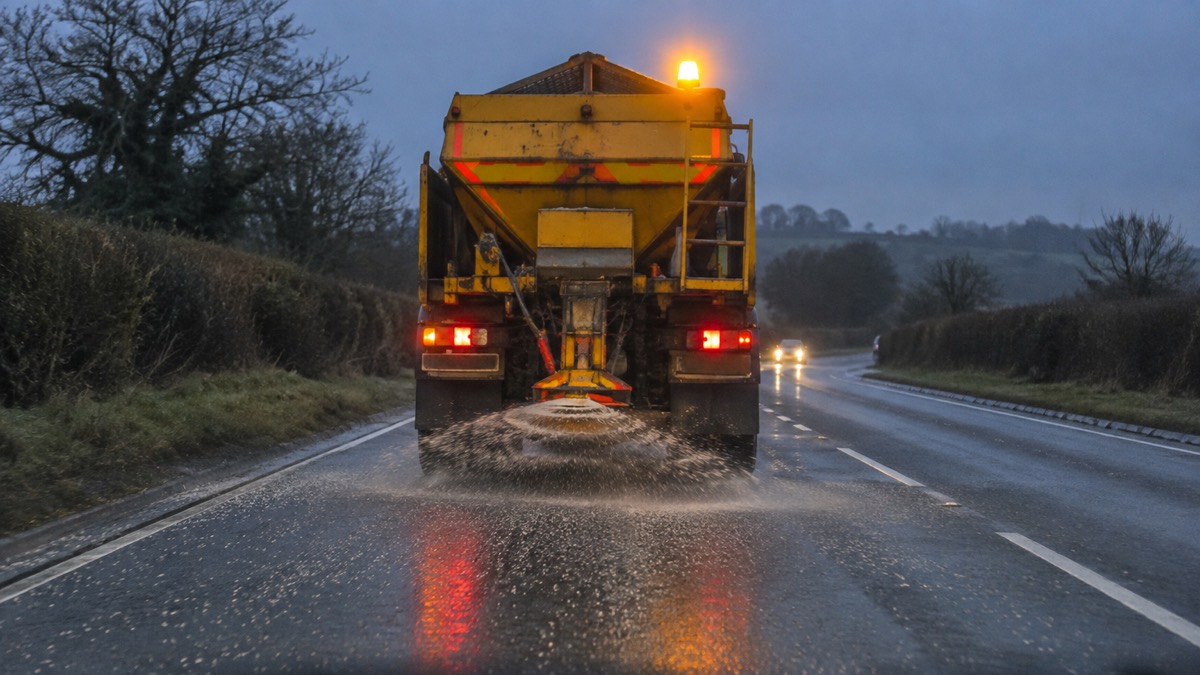
The short answer is no, not as a rule. Official guidance from councils and from National Highways is consistent: stay well back from a gritter or snowplough, never tailgate, and pass only when it is genuinely safe to do so1. Ceredigion County Council puts it plainly: "Take care around gritters. Don't be tempted to overtake"3. The Met Office advises taking care around gritters and not being tempted to overtake4.
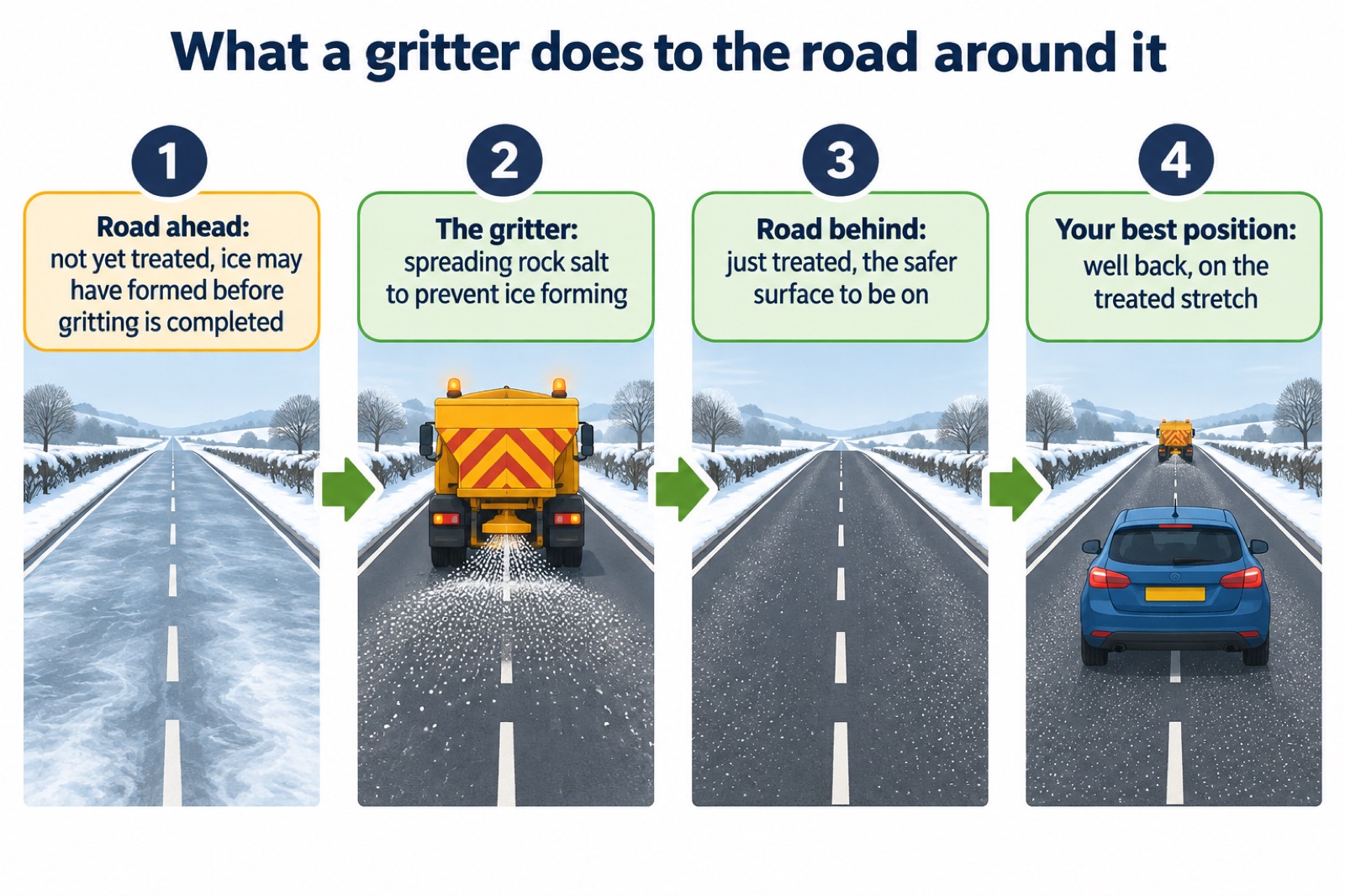
There is a practical reason as well as a safety one. A gritter is laying salt to stop ice forming, and the road behind it is the road it has just treated5. The road in front of it may not be treated yet, and in hard-to-predict conditions such as early morning frost, ice can form on the road before gritting is completed6. Passing the gritter can mean driving from the safer surface onto the riskier one.
If you are stuck behind one, hold back, keep your distance and let it do its job. Stopping distances in snowy or icy conditions can be 10 times longer than on a dry road, so the gap you leave matters far more than usual4. This page sets out how close to follow, when passing is acceptable, and how to check which routes have been treated before you leave.
Stay well back from a gritter or snowplough
The core instruction is simple and it comes from several official bodies. National Highways says: "Never tailgate, always leave a sensible distance between you and the gritter"2. The Met Office advises taking care around gritters and not being tempted to overtake4. Ceredigion County Council puts it plainly: "Take care around gritters. Don't be tempted to overtake"3.
Why the emphasis on distance? A gritter is a large vehicle spreading salt, and in heavy snow it may have a plough fitted that throws snow out to either side7. Following too closely leaves you no room to react if it slows, changes lane or throws material. National Highways also warns against undertaking, because gritters need to change lanes at junctions2.
There are things you can do to make the drive behind a gritter easier:
- Use a screen wash additive to keep your windscreen free of the winter road grime caused by salting and gritting9.
- Check your tyres before a cold snap, as the Met Office advises9.
- Slow down and use the highest gear possible to avoid wheel spin, manoeuvring gently and avoiding harsh braking and acceleration4.
- If you start to skid, gently ease off the accelerator and avoid braking; if braking is necessary, pump the brakes rather than slamming them on4.
"Take care around gritters. Don't be tempted to overtake."
Why the road ahead of a gritter can be more dangerous
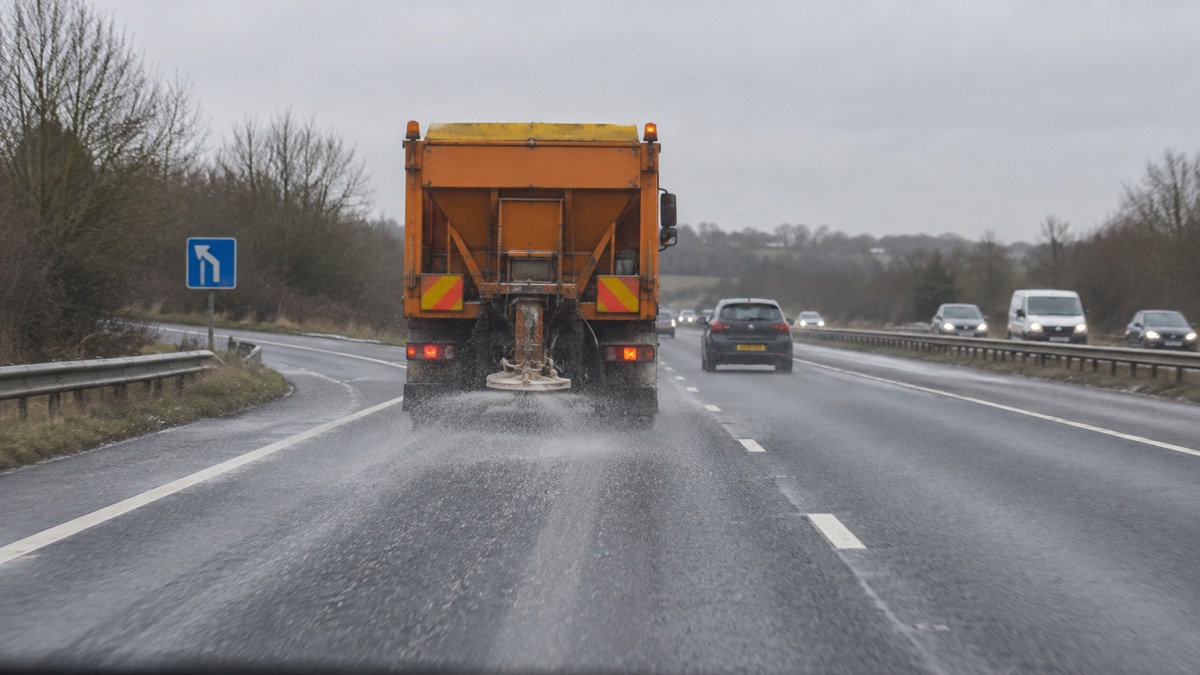
It is tempting to think that the vehicle in front is clearing your path, so getting past it gets you to your destination sooner. In practice the opposite is often true. The gritter treats the road as it goes, so the surface behind it is the surface it has just salted5. The road ahead is the road it has not reached yet.
Derbyshire County Council explains one reason this matters: some conditions are particularly hard to predict, such as early morning frost, and ice can form on the road before gritting is completed6. Gritting is not instant and it is not guaranteed. Derbyshire also notes that when snow or ice formation coincides with the rush hour and early salting has not been possible due to rain, traffic congestion can significantly delay the gritters12. In other words, the very traffic that wants to overtake is part of what slows the treatment down.
There is a limit to what salt can do in heavy snow, too. During heavy snowfall, snow can fall faster than the grit can work, so it may build up and has to be cleared using a plough14. And spreading grit after snow has already settled has limited effect14. A gritter is therefore most useful to you when you stay behind it, on the stretch it has just treated.
When overtaking a gritter or snowplough might be safe
There are circumstances in which passing is acceptable, but they are narrow and they depend on the road, not on your impatience. The NHS advises: "Look out for gritters spreading salt or using snow ploughs, and only overtake if it's safe to do so"15. National Highways says to "pass carefully, only when it's safe to"2.
For a snowplough the bar is higher. Northern Ireland guidance is explicit: watch out for snowploughs, which may throw out snow on either side, and "do not overtake them unless the lane you intend to take has been cleared"7. That is the test to apply. If the lane you would move into has not been cleared, do not use it.
A few practical points help you judge whether passing is safe:
- Check the lane you intend to use is clear of snow and ice, not just free of traffic7.
- Do not use the hard shoulder unless it is open as indicated by overhead signs2.
- Do not undertake, because gritters need to change lanes at junctions2.
- Reduce your speed when conditions are severe2.
Snowploughs are fitted to gritters when snow is forecast, often before the vehicles leave the depot, so a vehicle that looks like a plain gritter may in fact be ploughing16. Northumberland County Council says that when snow falls in excess of 50mm, with possible drifting, snowploughs attached to gritters will be used, and snowblowers and other specialist machines are sometimes used too17. Give all of them the same room.
Driving behind winter maintenance vehicles on motorways and dual carriageways
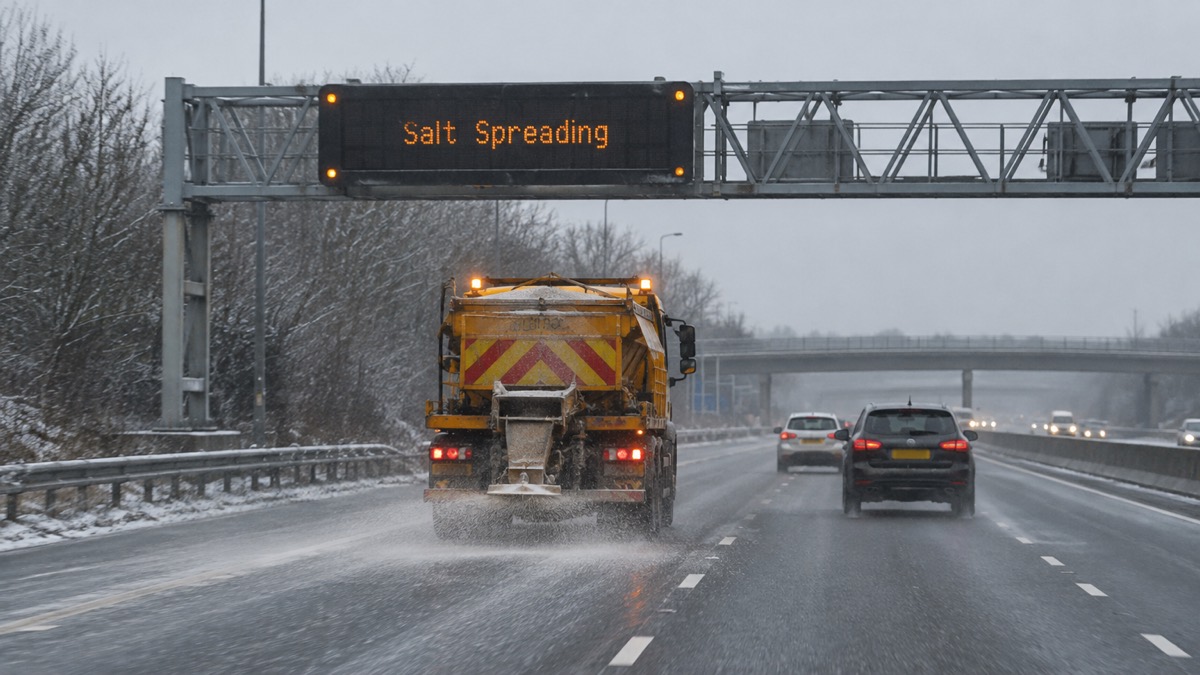
On a motorway or dual carriageway the rules are the same but the speeds are higher, so the consequences of getting it wrong are greater. National Highways says its gritters will usually be salting from the middle lanes, at speeds up to 50mph, but you may also find them in other lanes2. That matters because a gritter in the middle lane is treating the lane you might otherwise use to pass.
National Highways also says that where possible, message signs will inform you that salt spreading or snowploughing is taking place1. Look out for those signs and treat them as a prompt to slow down and hold back. Do not use the hard shoulder unless it is open as indicated by overhead signs, and do not undertake2.
| Motorway situation | What to do | Why |
|---|---|---|
| Gritter salting from the middle lane | Hold back, do not pass on the inside | Gritters need to change lanes at junctions2 |
| Message sign warns of salt spreading | Slow down and increase your gap | Signs flag active treatment1 |
| Hard shoulder looks clear | Do not use it unless overhead signs say it is open | It is not a running lane by default2 |
| Conditions severe | Reduce your speed | Stopping takes far longer2 |
The stopping distance figure is the one to keep in mind. It can take 10 times longer to stop in icy conditions2. At motorway speeds that turns a normal gap into something far larger, which is why the advice is to leave a sensible distance rather than a token one.
Where to check gritting routes and road conditions before you set out
The best way to avoid an awkward encounter with a gritter is to know before you leave whether your route is treated, and to travel at a time when treatment is likely to have happened. Councils publish gritting maps and updates, and several offer live tracking of their gritters.
Before you travel:
- Check the latest forecast and gritting updates, and take extra care even on treated roads5.
- Check which roads are on the gritting route map and try to keep to treated routes wherever possible18.
- Check the council's gritting map page for details of which roads will be treated today8.
- Think about whether your journey is necessary, plan to use main roads, check live weather cameras, allow extra time and tell someone your plans19.
- Prepare your vehicle for winter and carry a shovel and blanket20.
Routes are treated in priority order. Argyll and Bute Council says winter maintenance routes are determined in order of priority, with resources focused on the roads carrying the greatest amount of traffic21. Surrey County Council extends gritting to Priority 2 roads during prolonged frost, ice or snow, but only once Priority 1 roads have been cleared22. Priority 1 roads include those that link gritting routes with those of adjoining counties22. In the Scottish Borders, the priority network is shown in red on the council map and is treated before ice forms or before morning traffic, covering roads that carry significant traffic or are in some cases school bus routes23.
Most gritting takes place overnight, according to Staffordshire County Council24, which is why a road can be treated before the morning rush. Anglesey has 12 gritter drivers working shifts on call 24 hours a day, seven days a week25. If a road near you has not been treated, report it through your council's reporting pages; Northumberland County Council, for example, lets residents request road gritting and report an empty grit bin or an untreated road or path17.
For the wider picture on which roads are treated and how councils decide, see Which Roads Are Gritted and How Councils Decide. For the driving basics in winter weather, see Driving in Snow and Ice, and for the stopping distance figures in full, How Much Longer Are Stopping Distances on Ice?.
Sources (25)
- Travelling in snow and ice, Traffic England, 2026-10-29
- Travelling in snow and ice, National Highways, 2026-10-29
- Snow and ice, Ceredigion County Council, 2026-10-29
- Travelling in heavy snow and ice, Met Office, 2026-10-25
- Gritting, Lancashire County Council, 2026-10-29
- Does gritting work?, Derbyshire County Council, 2026-10-29
- Driving in adverse weather conditions, nidirect, 2026-09-22
- Track our gritter lorries, Cumberland Council, 2026
- Top tips to be WeatherReady, Met Office, 2026-10-25
- Top tips to be WeatherReady, Met Office, 2026-10-25
- Does gritting always work?, Derbyshire County Council, 2026-10-29
- Weather forecasting, Derbyshire County Council, 2026-10-29
- Weather forecasts, Derbyshire County Council, 2026-10-29
- Salting, Surrey County Council, 2026-10-28
- Cold weather advice, West Midlands Ambulance Service NHS, 2026-05-20
- Clearing snow, Cumberland Council, 2026
- Gritting and ploughing, Northumberland County Council, 2026-10-28
- Winter driving, Staffordshire County Council, 2026
- Winter, summer and wet weather driving tips, North Yorkshire Council, 2026
- Gritting, Somerset Council, 2026-10-28
- Winter road maintenance, Argyll and Bute Council, 2026
- Priorities, Surrey County Council, 2026-10-28
- Gritting and grit bins, Scottish Borders Council, 2026-10-29
- Frequently asked questions about gritting, Staffordshire County Council, 2026
- Winter gritting, Isle of Anglesey County Council, 2026-10-29
 Car Checks Before Winter
 Flood Warning Checklist
 First Steps After a Flood
 Bedroom Temperature at Night
 Hitting Black Ice
 Car Battery in Winter
 Car Stuck in Snow
 Clearing Snow and Ice Safely
 Clearing Snow from Pavements
 Using Fog Lights
 Signs of Frostbite
 Falling Through Ice
 De-Icing a Frozen Windscreen
 Request or Refill a Grit Bin
 Insulating a Loft Water Tank