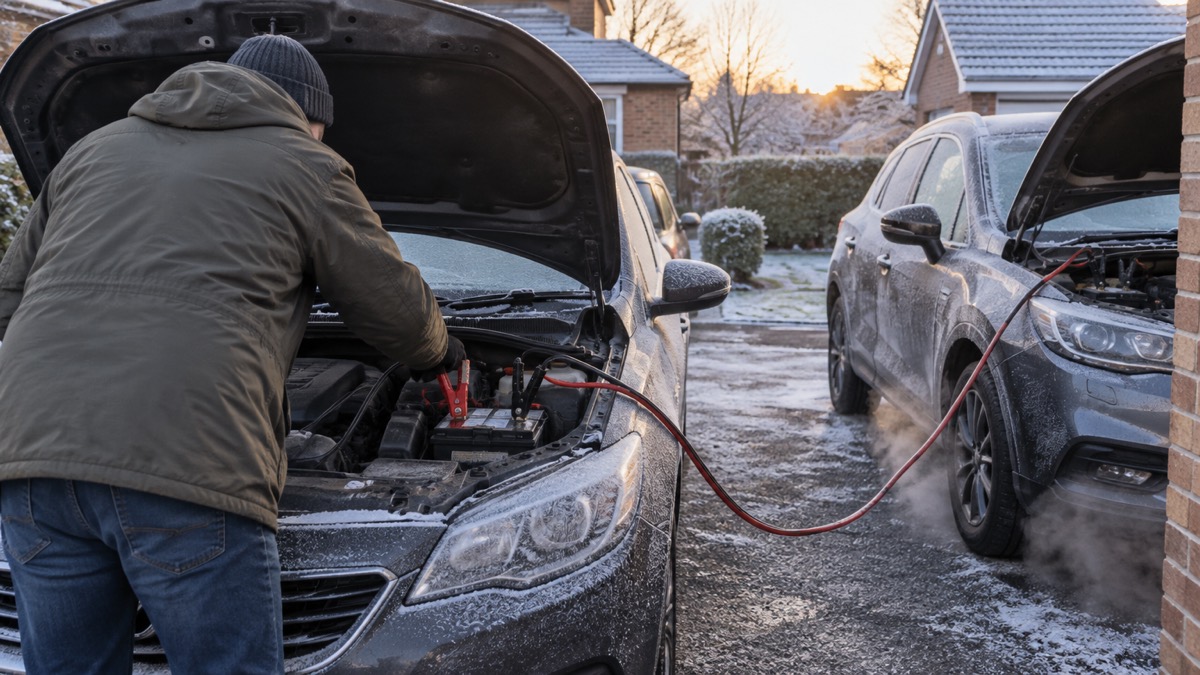
A flat battery is the most common reason for a winter breakdown call-out, and cold weather is when it happens. Battery problems are the reason for more RAC call-outs in winter than anything else1. Flat or dead batteries can happen to any car regardless of age and at any time, but in cold weather such problems are far more likely to occur2.
The good news is that most of this is preventable. Have the battery tested before the cold sets in, keep it charged through a cold spell, and know how to jump-start it safely if it does go flat. Council winter driving guidance puts the average life of a car battery at five years3, so if yours is around that age, or starting has become sluggish, get it checked now rather than waiting for the first hard frost.
This page covers why cold drains a battery, the signs it is weakening, how to keep it charged, how to jump-start safely, and what to keep in the car if you do get stuck. For the wider picture, see Driving in Snow and Ice: Staying Safe on the Road and Car Checks Before Winter.
Why cold weather drains a car battery
Cold affects a battery in two ways. First, the battery itself works less well in low temperatures, so it holds and delivers less charge just when the engine needs more of it to turn over. Second, winter driving loads the battery harder: during winter months the battery will drain more quickly with the additional use of electrical items such as heaters, lights and heated rear windscreen3. Every one of those draws on the same battery that has to start the car.
That combination is why flat or dead batteries can happen to any car regardless of age and at any time, but in cold weather such problems are far more likely to occur2. A battery that coped all summer can fail on the first really cold morning.
Age matters too. Council guidance puts the average life of a car battery at five years3, and the Met Office says car batteries need replacing every few years, according to usage, so make sure you get yours checked at your car service1. A battery near the end of its life has less margin when the temperature drops.
It is worth knowing that winter is not the only season that stresses a car. In summer there are often breakdowns due to cooling-related faults, whether faulty cooling fans or a lack of coolant6. The difference is that a cooling fault usually gives warning, while a battery can simply fail to start the car one morning.
Signs your battery is weakening before winter
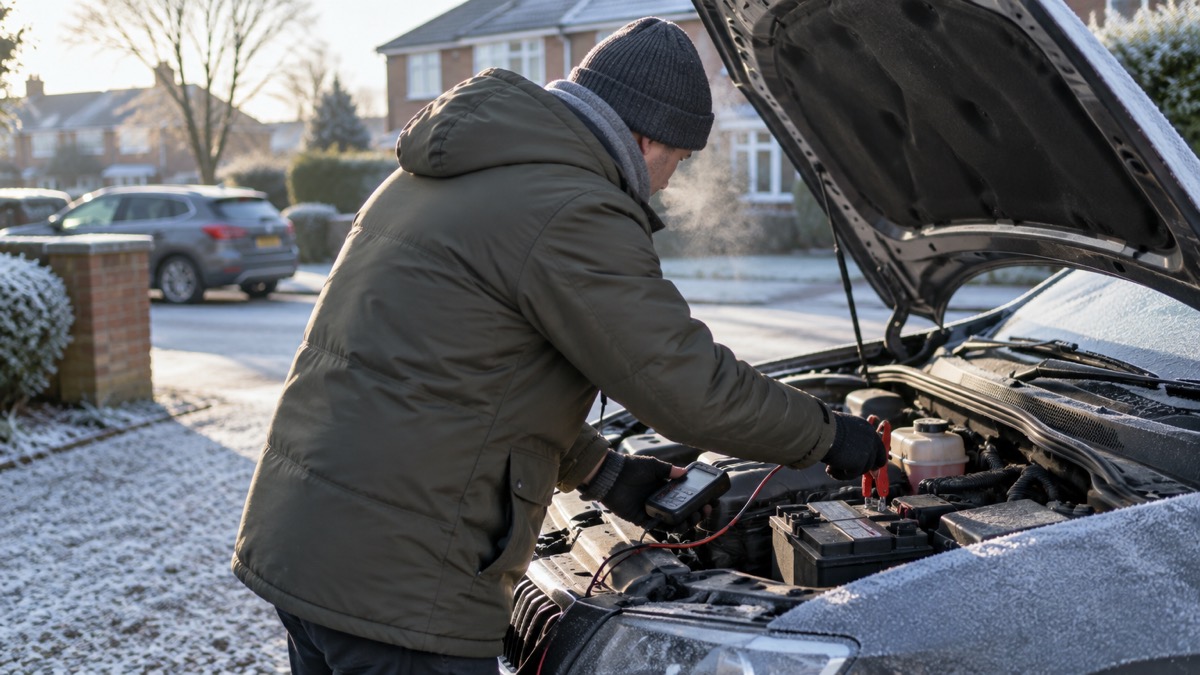
The simplest check is to have the battery tested. Cold temperatures can decrease your car battery's performance, so have it tested to ensure it holds a sufficient charge7. Many garages will do this at a service, and the Met Office advises getting the battery checked at the car service1.
Watch for the everyday signs as well. A slow, laboured turn of the engine on a cold morning, lights that dim when you start up, or needing to jump-start more than once all point to a battery on its way out. If in doubt, replace it: official guidance is to make sure your battery is fully charged and replace it if it is no longer reliable4. North Wales Fire and Rescue Service puts it plainly: is the battery fully charged? Replace it if it's not completely reliable8.
Use this checklist before the cold arrives:
- Test the battery and replace it if it is not holding charge7.
- Check it is fully charged and top it up if needed9.
- Look at the age: around five years is the average life3.
- Check the terminals are clean and tight, and the battery is secure.
- Test the lights, heaters and heated screen so you know what is drawing on the battery3.
Keeping the battery charged through cold spells
The core advice from councils across the UK is consistent: keep the battery fully charged and topped up10, and check that your vehicle battery is in a good condition and fully charged9. Cornwall Council's winter driving guidance is simply to keep your battery fully charged11. Traffic Wales advises making sure your battery is in good condition12.
How you do that depends on how you use the car:
- Regular longer runs give the alternator time to replace the charge used to start the engine.
- Short journeys in cold weather, with heaters and lights on, can gradually run the battery down.
- A battery maintainer or trickle charger keeps a healthy battery topped up through a cold spell, but it cannot rescue a failing battery. Have the battery tested first7.
- Park under cover where you can: official advice for heavy snow is to park vehicles in a garage if available13.
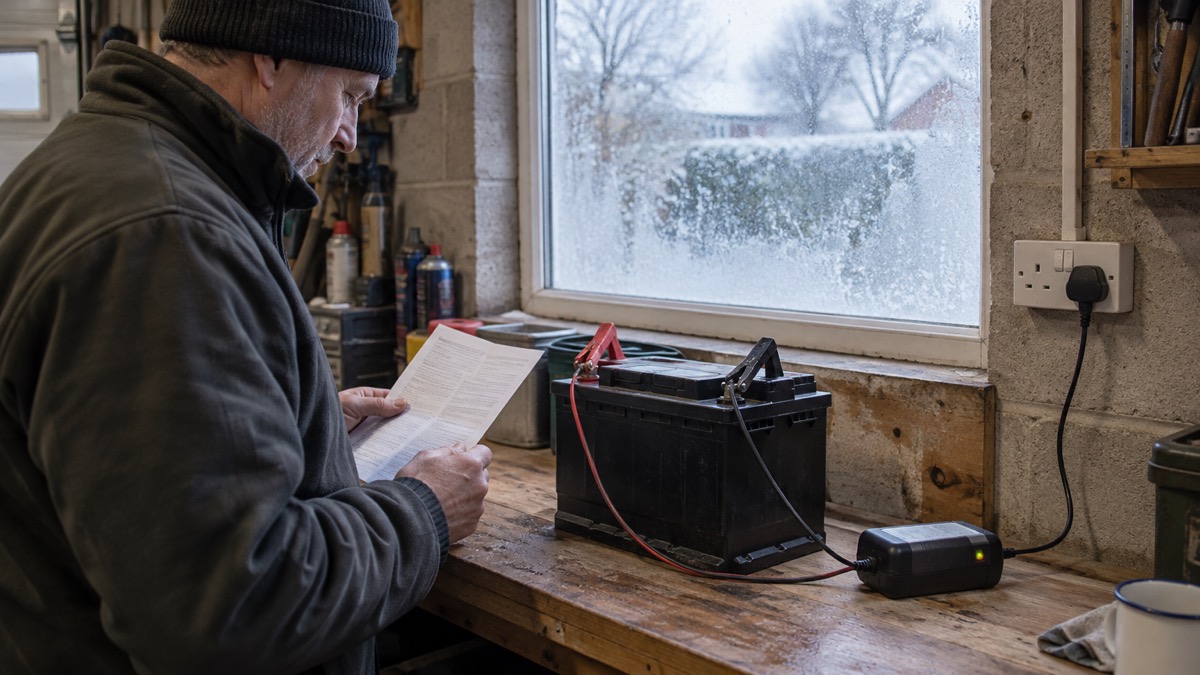
If you use a charger or maintainer at home, follow the fire and rescue service's advice: charge on a hard, flat, heat-resistant surface, away from extreme heat, cold, direct sunlight, and flammable materials14. If a battery has been left in freezing conditions, allow it to warm up slowly indoors before using or charging it15. Never charge a battery in a confined space where flammable vapour could build up.
Jump-starting safely when the battery goes flat
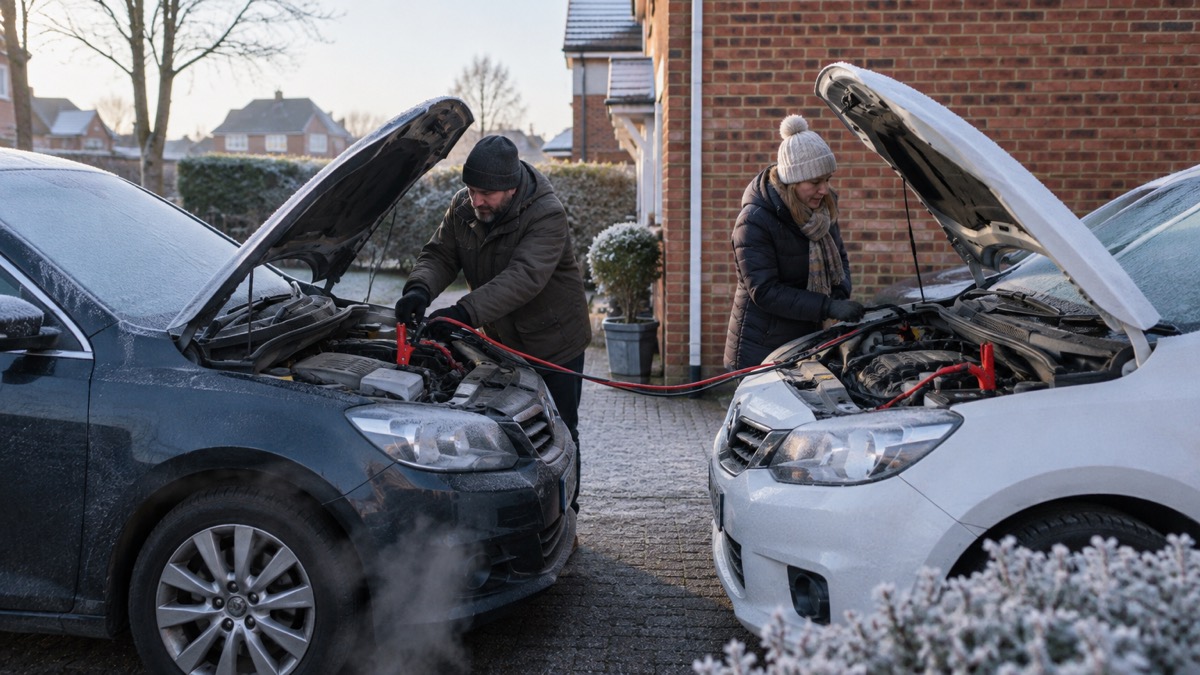
If the battery does go flat, jump leads are the standard remedy. Before you connect anything, read your vehicle handbook: the maker's instructions for your own car take priority, and some modern cars should not be jump-started in the usual way.
The safe order, following the fire and rescue service's battery advice, is:
- Make sure both vehicles are off and the handbrakes are on.
- Connect the red lead to the positive terminal of the flat battery, then to the positive terminal of the good battery.
- Connect the black lead to the negative terminal of the good battery, then to a metal earth point on the car with the flat battery, away from the battery itself.
- Start the good car, let it run, then start the flat car.
- Remove the leads in reverse order, and let the engine run to recharge.
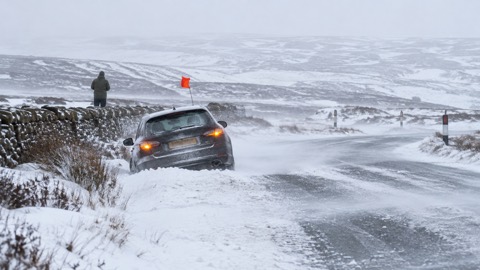
If you are stuck at the roadside, make the vehicle and yourself as visible as possible to other road users and rescuers, keep warm, and if you use a mobile phone, give accurate details of your location5. On a motorway, switch on your sidelights in low-light conditions, but turn them off if your battery starts to run down17.
What to keep in the car for a winter breakdown
Getting stuck in your car in winter could be dangerous, so get a winter car kit ready18. The Met Office's list is a good starting point: an ice scraper and de-icer, a torch, a paper road atlas, an in-car phone charger, warm clothes and blankets, high-visibility clothing, jump leads, an empty fuel can, food and drink, a shovel, warning triangles and sunglasses2.
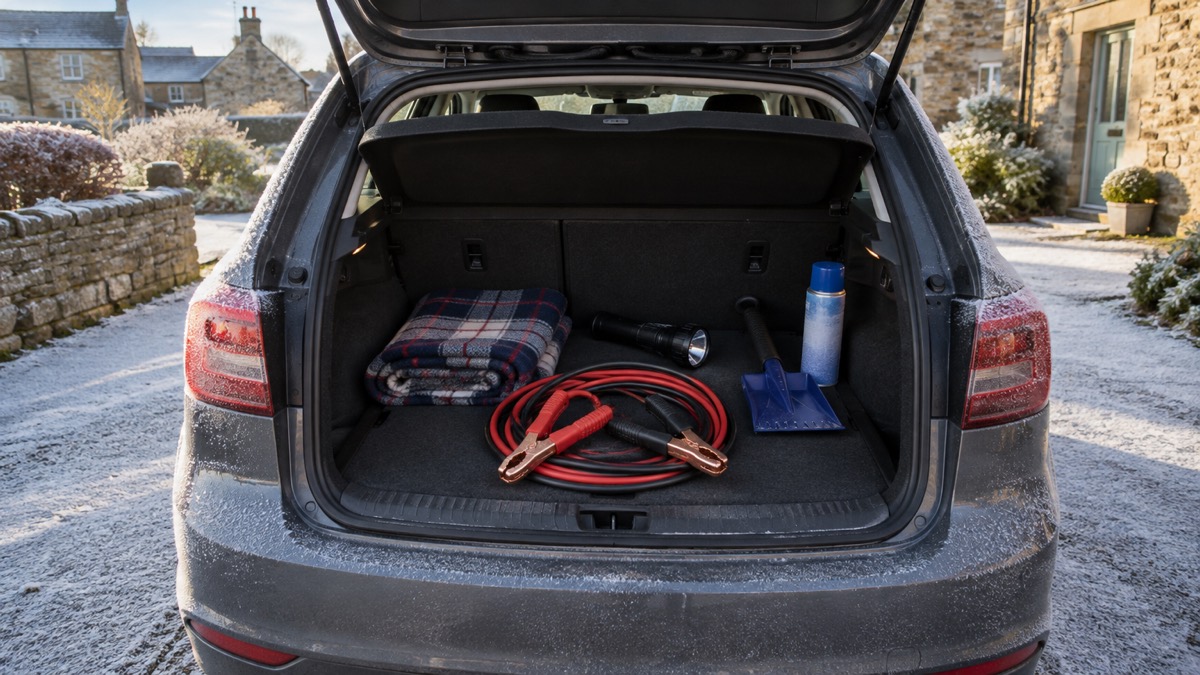
Different official sources add useful items. Transport Scotland's list includes a torch and spare batteries, a pair of boots, a first-aid kit, a tow rope, a hot drink in a flask, a fully charged mobile phone and a map for unplanned diversions19. The NHS adds warm clothing, a phone charger and drinking water20. National Highways suggests warm clothes, a hi-vis jacket, a torch and your breakdown cover details21.
| Item | Why it helps | Source |
|---|---|---|
| Jump leads | To restart a flat battery | 2 |
| Torch and spare batteries | Light if you break down in the dark | 19 |
| Warm clothes and blanket | Stay warm while waiting for help | 20 |
| Hi-vis jacket | Make yourself visible to traffic | 21 |
| Ice scraper and de-icer | Clear the windscreen safely | 2 |
| Phone charger | Keep the phone charged for calls | 20 |
| Food, drink and flask | Keep energy and warmth up | 19 |
| Shovel | Clear snow from around the wheels | 2 |
| First-aid kit | Deal with minor injuries | 19 |
| Breakdown cover details | Call the right number quickly | 21 |
Pack a few essential items in your car's boot to make sure you are ready in case of getting stuck in cold and wintry weather22. Keep the kit in the car all winter, not just for long journeys, because a breakdown can happen on a short trip too.
Sources (22)
- 6 things to do to prepare your vehicle for winter weather, Met Office, 2026
- Winter car kit, Met Office, 2026
- Winter driving advice, Nottinghamshire County Council, 2026
- Ice weather warning information and advice, nidirect, 2026
- Winter driving, Staffordshire County Council, 2026
- 10 things you should do now to prepare for summer - Met Office, Met Office
- Winter safety checks, Warwickshire County Council, 2026
- Driving in snow, North Wales Fire and Rescue Service, 2026
- Winter driving, Derbyshire County Council, 2026
- What advice can you give me on driving, Argyll and Bute Council, 2026
- Winter driving, Cornwall Council, 2026
- Travelling safely in winter, Traffic Wales, 2026
- Be prepared, Lancaster City Council, 2026
- Battery safety, Greater Manchester Fire and Rescue Service, 2026
- Heat, cold and rain: how weather conditions affect e-bikes and e-scooters, London Fire Brigade, 2026
- Vaping and e-cigarettes, London Fire Brigade, 2026
- Vehicle breakdown advice, Milton Keynes Council, 2026
- Top tips to be weatherready, Met Office, 2026
- Driving in bad weather, Transport Scotland, 2026
- Be prepared for winter emergencies, NHS Norfolk and Suffolk ICB, 2026
- Driving on motorways, National Highways, 2026
- Cold weather, snow and ice, UK Government, 2026
 Car Checks Before Winter
 Flood Warning Checklist
 First Steps After a Flood
 Bedroom Temperature at Night
 Hitting Black Ice
 Car Stuck in Snow
 Clearing Snow and Ice Safely
 Clearing Snow from Pavements
 Using Fog Lights
 Signs of Frostbite
 Falling Through Ice
 De-Icing a Frozen Windscreen
 Request or Refill a Grit Bin
 Overtaking a Gritter
 Insulating a Loft Water Tank