

CTEK is a Swedish maker of battery chargers and maintainers, and its products reach UK households in two ways: bought directly as a charger for a car, boat or other vehicle, or fitted as original equipment and badged by a vehicle manufacturer. The unit most clearly documented for UK buyers is the CTEK M100 UK, an 8-step 12V battery charger and maintainer that the maker describes as suitable for boats, yachts and demanding outdoor vehicles1. It charges 12 V lead-acid batteries of the WET, MF, AGM and GEL types, and it is an AC charging product, so it works from a mains socket1.
For an ordinary household, the practical value is in maintenance rather than emergencies. A charger like this keeps a car battery in condition through months of little use, can recondition a deeply discharged battery, and tells you when a battery is nearing the end of its life1. What it cannot do is run anything during a power cut: with the mains off, a mains charger is simply a piece of idle equipment.
What CTEK makes for UK households
CTEK's range is built around charging and maintaining lead-acid batteries, and the M100 UK shows how the maker sets out a product: a charging category, a battery voltage, a list of battery chemistries and types, a set of programs, and a set of safety features1. The M100 UK is rated for 12 V systems and lead-acid chemistry, and the maker lists WET, MF, AGM and GEL as the battery types it will charge1. That covers the great majority of conventional car, van and boat batteries sold in the UK.
The safety features the maker lists are worth knowing because they decide how forgiving the unit is in ordinary use: safe spark-free operation, short circuit proofing, reverse polarity protection and no harmful galvanic currents1. In plain terms, clipping the leads on the wrong way round or shorting them should not damage the charger, though it is still worth connecting them carefully and reading the instructions first.
The M100 UK is supplied with a range of accessories for use with different types of battery, and the maker lists eyelet connectors among them1. Eyelet leads let you bolt a permanent connection to the battery terminals so the charger can be plugged in without opening the bonnet each time. The maker's own listings disagree on one point: one describes the eyelet connectors as compatible with CTEK chargers up to 10A, another as compatible with chargers up to 8A, and the documents do not resolve which applies. Check the rating on the connector you are sold against your charger's output before relying on it.
For a household building up general resilience, a charger sits alongside the other equipment covered in our emergency kit guide and our guide to backup power at home. It is maintenance kit, not emergency kit: it keeps a battery healthy so that the vehicle starts when you need it, rather than providing power when the grid fails.
Car manufacturer partnerships and custom versions
Vehicle manufacturers commonly sell chargers under their own brand, and a CTEK unit may reach you badged with a car maker's name rather than CTEK's. Which models are rebadged, and which makers use them, is not listed here, so treat any branded charger as a unit to identify from its own label. Official guidance on buying electrical goods is consistent on one point: look for a manufacturer's brand name or logo, the model and the batch number4. That applies to a charger as much as to anything else.
Registering a product with its manufacturer is the other habit worth adopting. Fire and rescue services across the UK advise registering e-bikes and e-scooters with the manufacturer so that warranties can be validated and the maker can contact you with safety information or a recall notice, and they note that batteries are usually included in warranties5. The same reasoning applies to a charger: registration is how a recall reaches you. The registration process normally means visiting the manufacturer's website, finding the product registration page and entering details such as the model number, serial number and purchase date6.
If your charger carries a car maker's badge and you cannot find the model, ask that manufacturer's dealer for the original reference, and keep the receipt. For the wider question of how vehicle systems and emergency calls work, see our guide to staying informed and in touch.
Battery chargers for cars at home
A car battery that sits unused loses charge, and a flat battery is one of the most common reasons a vehicle will not start on a cold morning. A maintainer addresses that by holding the battery at full charge over weeks or months. The M100 UK runs three programs: Normal, AGM and Recond1. Normal suits an ordinary battery in regular condition. The AGM setting is described by the maker as an optional cold weather and AGM mode, which matters because AGM batteries are common in cars with stop-start systems and need a different charge profile1. Recond is for reconditioning deeply discharged batteries1.
| Setting | What it is for | When a household would use it |
|---|---|---|
| Normal | Standard charging of a 12 V lead-acid battery | Routine top-ups and maintenance1 |
| AGM | Optional cold weather and AGM mode | AGM batteries, and charging in cold conditions1 |
| Recond | Reconditioning deeply discharged batteries | A battery that has been flat for some time1 |
The charger also detects automatically whether a battery is near the end of its life1. That is useful information: a battery on the way out will let you down eventually, and knowing before winter is better than finding out on a frosty morning. Warwickshire Fire and Rescue Service's winter checks include keeping battery terminals clean and secure to prevent poor electrical connections and potential breakdowns7.
Before charging, read the maker's instructions for your model and follow them. Official guidance on rechargeable batteries is to always follow the manufacturer's instructions for using, charging, storing and disposing of them2. If you have bought the charger second-hand and there is no manual, download one: official advice on second-hand electrical goods says that if the seller cannot provide the instruction manual, look online and download a copy8.
Keeping a battery ready during long storage
A vehicle left standing for months, a caravan over winter or a boat ashore all put the battery at risk. The maker's answer is a maintainer that can be left connected to hold the charge, and the M100 UK is described as a charger and maintainer for exactly this kind of use1. The general principle from fire and rescue guidance is to follow the manufacturer's instructions for proper storage and maintenance when a battery will not be used for an extended period9.
A few practical checks belong with that:
- Keep battery terminals clean and secure to prevent poor electrical connections and potential breakdowns7.
- Follow the battery usage, storage and charging guidelines in the user guide10.
- Refer to the device manual for proper storage and maintenance instructions11.
- If a battery is being set aside rather than charged, tape over its terminals with electrical tape to prevent short circuits and fire risk, and store it in a cool, dry place12.
That last point is written for batteries being prepared for disposal, but the short-circuit risk it addresses applies to any loose battery in a shed or garage. Single-use batteries should always be stored in their original packaging and away from metal objects, because contact with metal can cause overheating and a fire2.
Using a CTEK charger in an emergency
A mains battery charger has no role during a power cut. With the supply off, it cannot charge anything, and the priority shifts to the power you already hold in devices. Northern Ireland's official advice for severe weather is to keep mobile phones, laptops or tablets fully charged so you will have use of battery power for a short time at least3. The Met Office gives the same instruction ahead of thunderstorms: charge mobile phone devices13.
Household emergency kit lists reflect that. Lancashire's emergency pack guidance includes a waterproof torch and spare batteries, checked regularly, and suggests considering a wind-up model14. Scotland's prepare campaign lists a torch and spare batteries for a car emergency kit15. Nottinghamshire's list includes a mobile phone and a wind-up or battery powered charger16, and Dumfries and Galloway's includes spare batteries17. A portable power bank and charging cables appear on North Devon's emergency planning list18.
What this means in practice is that the charger's job happens before the emergency, not during it. Keep the vehicle battery maintained so the car starts if you need to leave or help a neighbour. Keep phones and power banks charged while the supply is on. Then, when the power goes, you are working from stored energy rather than hoping to create it. Our guides to power cuts and emergency lighting cover what to do next.
Safe charging: where and how
The fire and rescue service advice on charging is written mainly for lithium-ion batteries in e-bikes, scooters and phones, but the principles apply to any charger left running in a home. South Wales Fire and Rescue Service advises charging batteries in a safe place from a socket that is RCD protected, and in an area with working smoke alarms19. Greater Manchester Fire and Rescue Service advises charging in a safe, visible location, away from flammable materials or escape routes2.
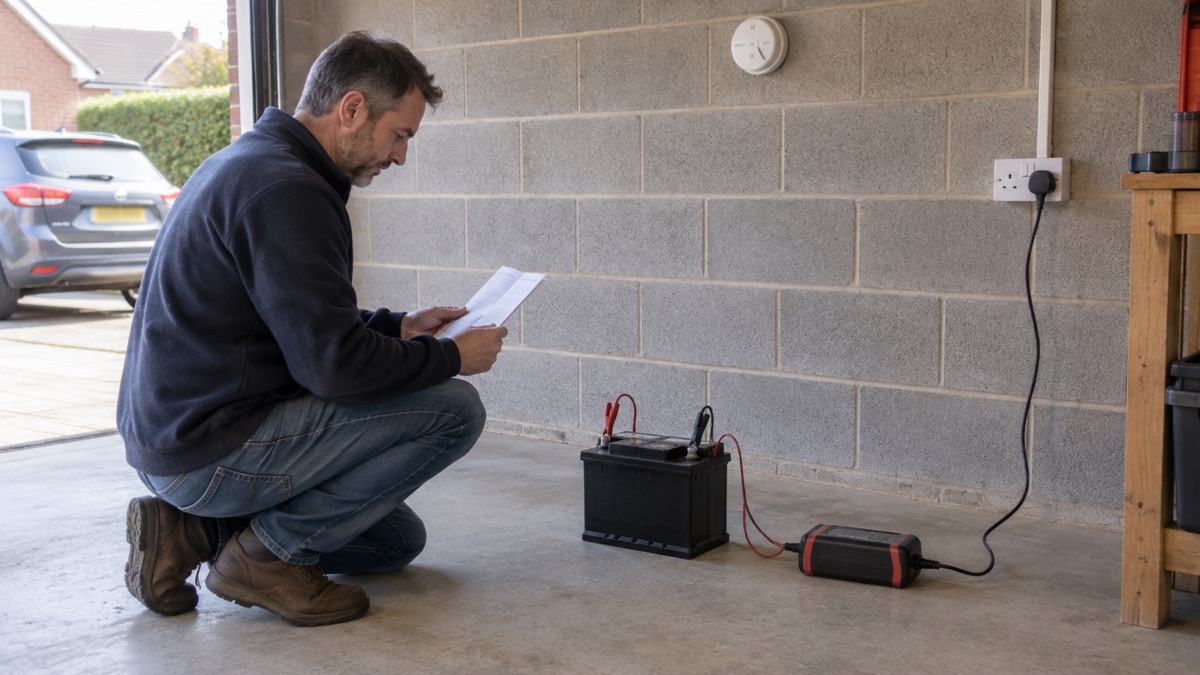
Where to put the charger matters as much as how you connect it. Greater Manchester Fire and Rescue Service says never to charge or store an e-bike, e-scooter or mobility scooter in hallways, near exits, on escape routes or where people sleep, and to keep away from communal areas20. Where possible, it advises charging or storing in a secure outbuilding, shed or garden area20. The Office for Product Safety and Standards sets out the same idea as a step: always charge in a safe place without blocking exits, and always unplug your charger when you have finished charging21.
The rules that decide whether a charging session is safe are short:
- Use the charger supplied with the device, or a replacement recommended by the manufacturer11.
- Check for the CE or UKCA safety marking to make sure your battery and charger meet safety standards22.
- Charge in a safe location that does not block fire escape routes or exits22.
- Do not cover the charger or battery22.
- Charge when you are awake and present, and unplug once fully charged22.
- Unplug the charger when charging has finished23.
What can go wrong with a battery charger
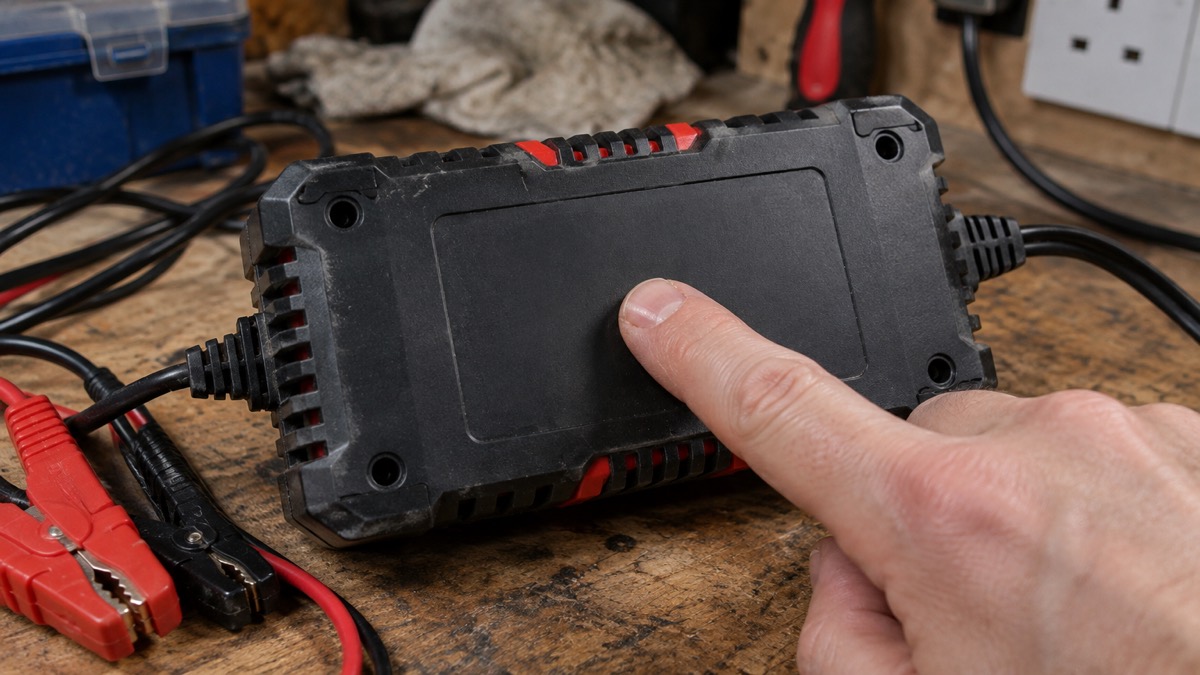
Most charger failures trace back to the wrong charger, a damaged battery or a counterfeit product. The London Fire Brigade explains the mechanism: charging places stress on the battery, and if the charger is incompatible or the battery is damaged, it can overheat and fail24. Using the wrong charger can overload the battery and increase the risk of overheating and fire24. Greater Manchester Fire and Rescue Service puts it just as plainly: always use the manufacturer approved charger, because using the wrong charger can lead to the battery overheating and a fire starting20.
The same warning appears across the UK's fire services. South Wales Fire and Rescue Service says that if the wrong charger is used for an electrical device, the internal battery cannot handle a different voltage and it can catch fire25. West Yorkshire Fire and Rescue Service advises always using the charger supplied with the device, or a replacement recommended by the manufacturer, because the wrong charger can cause overheating and increase the risk of fire11. The Office for Product Safety and Standards warns that connecting the wrong charger to a battery can pose serious fire risks, as not all batteries and chargers are safe when used together22.
Damage is the other route to failure. Batteries can be damaged by dropping them or if a vehicle has been involved in a crash, and a damaged battery can overheat and catch fire without warning; it should be replaced, not used or charged5. Cheap chargers and batteries may not meet UK safety standards and can be dangerous12.
Support and warranty for UK owners
The M100 UK carries a 5 year warranty1. The maker's terms are specific: CTEK issues a limited warranty to the original purchaser of the product, it is not transferable, it applies to manufacturing faults and material defects, it is void if the product has been handled carelessly or repaired by anyone other than CTEK or its authorised representatives, and it carries no consequential damages1. In practice that means keeping your proof of purchase, not opening the unit yourself, and going back through the retailer or the maker's authorised channels if something goes wrong.
The item number for the M100 UK is 56-5541. Have it ready whenever you contact support, along with the model name and, if you registered the product, your registration details. No UK telephone number or email address for CTEK support is given here, so use the contact route published on the maker's own website. If your charger came badged by a vehicle manufacturer, that maker's dealer is the first point of contact.
For a warranty claim, the same registration advice that fire services give for e-bikes applies: register the product with the manufacturer to validate any warranties, and so the maker can contact you with safety or recall information5. Registration normally means entering the model number, serial number and purchase date on the manufacturer's product registration page6.
Safety notices and recalls
Product recalls are issued through the Office for Product Safety and Standards, and checking recall notices is the standard way to find out whether an electrical product in your home has been withdrawn6. East Sussex Trading Standards summarises the consumer route: if a product turns out to be unsafe, the retailer and manufacturer have responsibilities, and product safety information is published so households can check21.
No recall notice for any CTEK product is listed here. The recall notices that do appear are for other electrical goods, and they show how the system works: a Deltronic Security AB environmental alarm was recalled from end users, with owners told to contact the Careium Support Team for a replacement unit or to ask questions26, and a Bull and Cygnus fire alarm detection system was also recalled27. Neither concerns a battery charger, and neither should be read as a statement about CTEK.
The practical steps for any household with a charger in the garage are these:
- Check the product recall notices issued by the Office for Product Safety and Standards from time to time6.
- Register the charger with the maker so a recall notice reaches you directly5.
- If a product is recalled, stop using it and contact the retailer where you purchased it6.
- Keep the instruction manual with the charger, and follow its charging and storage guidance10.
For the wider picture of electrical safety at home, see our guide to home emergencies.
Sources (27)
- CTEK M100 UK product page, CTEK, 2026-10-29
- Battery safety, Greater Manchester Fire and Rescue Service, 2026-10-29
- Strong winds and heavy rain warning: information and advice, nidirect, 2026-01-27
- Smoking, Dorset and Wiltshire Fire and Rescue Service, 2026-10-29
- E-bikes and e-scooters, Scottish Fire and Rescue Service, 2026-07-29
- Registering your e-bike or e-scooter for safety alerts and product recalls, London Fire Brigade, 2026-10-25
- Road safety and fire rescue, Warwickshire County Council, 2026-10-29
- Heating your home, North Yorkshire Fire and Rescue Service, 2026-03-09
- Lithium-ion batteries, Scottish Fire and Rescue Service, 2025-11-27
- Electrical safety, North Yorkshire Fire and Rescue Service, 2026-09-14
- Battery safety, West Yorkshire Fire and Rescue Service, 2026-10-29
- Lithium battery fire safety, Tandridge District Council, 2026-10-29
- Stay safe in a thunderstorm, Met Office, 2026-10-25
- Emergency pack, Lancashire Prepared, 2026-10-29
- Emergency kit, Ready Scotland, 2026-10-22
- Preparing for an emergency, Nottinghamshire County Council, 2026-10-29
- Prepare for emergencies, Dumfries and Galloway Council, 2026
- Be prepared for emergencies, North Devon Council, 2026-10-29
- Lithium-ion batteries, South Wales Fire and Rescue Service, 2026-10-29
- E-bikes, e-scooters and mobility scooters, Greater Manchester Fire and Rescue Service, 2026-10-29
- Product safety, East Sussex County Council Trading Standards, 2026-10-29
- Buy safe, be safe: avoid e-bike and e-scooter fires, Office for Product Safety and Standards, 2024-10-24
- Battery fires, Dorset and Wiltshire Fire and Rescue Service, 2026
- How to charge e-bikes and e-scooters safely, London Fire Brigade, 2026-10-25
- Electrical safety, Mid and West Wales Fire and Rescue Service, 2026-10-29
- Product recall: Deltronic Security AB environmental alarm, Office for Product Safety and Standards, 2025-11-18
- Product recall: Bull and Cygnus fire alarm detection system, Office for Product Safety and Standards, 2026-08-12