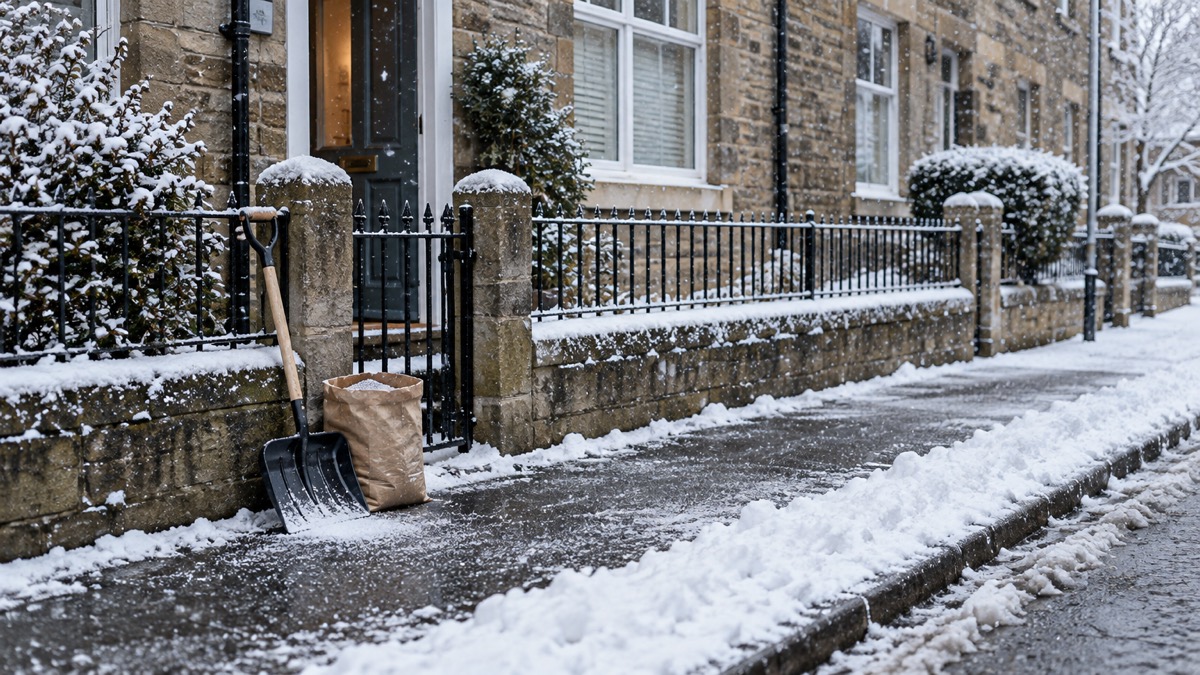
Yes, you can clear the snow and ice from the pavement outside your house. There is no law stopping you from clearing snow and ice on the pavement outside your home, on the pathways to your property or in public spaces1. Councils encourage it: anyone can clear snow and ice from the pavement outside their home or from public spaces to prevent slips and falls2.
The fear that stops most people is being sued. Government guidance is clear that it is unlikely you will be sued or held responsible if someone is injured on a path or pavement you have cleared carefully1. If an accident did happen, it is highly unlikely you would be sued as long as you are careful, use common sense and do not make the pavement or pathway clearly more dangerous than it was before3. People walking on snow and ice have a responsibility to be careful themselves4.
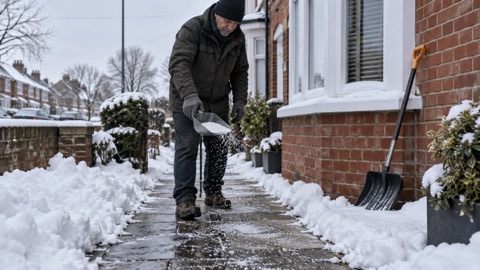
So the practical answer is to clear it, and to clear it well. Shovel a path down the middle first so you have a clear surface to walk on, then move the snow from the centre to the sides5. Use ordinary table or dishwasher salt, about a tablespoon for each square metre you clear5. Do not use hot water, which can refreeze into black ice6.
There is no law against clearing the pavement
The legal position is simpler than most people expect. There is no law stopping you from clearing snow and ice on the pavement outside your home or from public spaces4. The same applies to the pathways to your property and to public carriageways and footways7. You do not need anyone's permission, and you are not taking on a duty by picking up a shovel.
Councils go further than tolerating it. Scottish Borders Council says it encourages everyone to help play their part by clearing snow and ice from the public pavement near their properties during bad weather, and to help neighbours who may not be able to clear it themselves8. Argyll and Bute's severe weather guidance says there is no legal problem with clearing your own paths, driveways and pavements, while advising you to be mindful of your own safety, health issues and limitations9.
That last point matters. The guidance is permissive, not a instruction to overdo it. If you have a heart or breathing condition, or you are not steady on your feet, clearing a long stretch of pavement in the cold is physical work, and the advice to be mindful of your own limitations is part of the official position9.
Being sued for clearing snow is unlikely
This is the worry that keeps pavements icy, and the official answer is consistent across the UK. Government guidance states that it is unlikely you will be sued or held responsible if someone is injured on a path or pavement if you have cleared it carefully1. The Derbyshire Snow Code puts it the same way: it is unlikely you would be sued or held legally responsible if someone was injured on the path if you clear it carefully4.
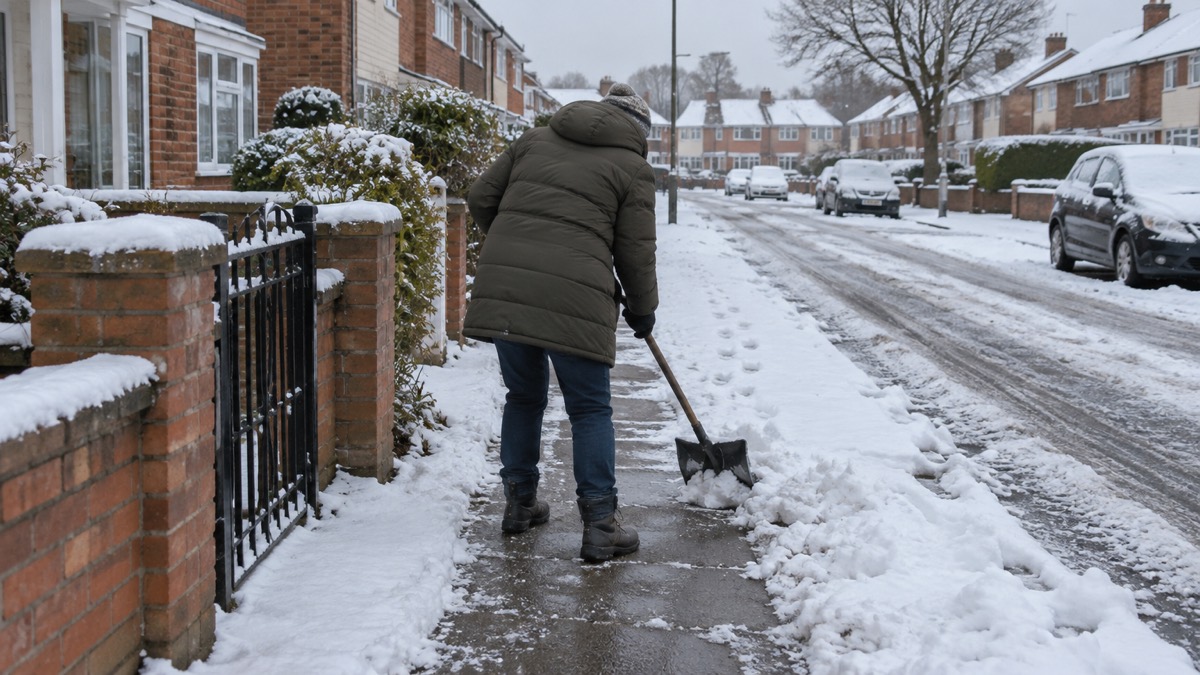
Warwickshire's snow warden guidance sets out the test in full. If an accident did happen, it is highly unlikely that you would be sued as long as you are careful, use common sense and do not make the pavement or pathway clearly more dangerous than before3. The Scottish Government's advice, quoted by Argyll and Bute, is that provided you are careful, use common sense and do not do anything likely to cause harm or distress to others, it is highly unlikely you will be found responsible for any accidents10.
Cheshire West and Chester adds the point that is easy to forget: do not be put off clearing paths for fear of being sued, because pedestrians on snow and ice have a responsibility to be careful themselves2.
"It's unlikely that you'll be sued or held responsible if someone is injured on a path or pavement if you've cleared it carefully."
What "carefully" means in practice is not leaving the pavement worse than you found it. Do not pile snow where it blocks a doorway, hides a kerb or covers a drain, and do not leave a surface that has refrozen into a sheet of ice6. Clear a usable width, put the snow at the edge, and grit what you have cleared.
Clearing snow from public spaces and shared paths
Anyone can clear snow and ice from the pavement outside their home or public spaces to prevent slips and falls2. That covers the stretch in front of your neighbour's wall, the path to the bus stop and the cut-through between streets, not just your own frontage.
How you clear it matters as much as whether you do. The Snow Code's method is to make a path down the middle of the area to be cleared first, so you have a clear surface to walk on, then shovel the snow from the centre of the path to the sides5. Lincolnshire's winter service plan, written for its own crews but useful as a model, says to work from the footway at all times and towards oncoming traffic wherever possible, and to place snow at the edges of footways next to the road so it forms a barrier between cars and pedestrians7.
- Keep the middle clear: shovel a walkable line through first, then widen it5
- Push snow to the edge: pile it at the side next to the road, not across entrances7
- Do not block access: do not obstruct accesses or footpaths with the snow7
- Do not hide hazards: do not conceal a hazard with piled up snow6
- Grit what you clear: put sand or ash down on cleared areas to give walkers grip7
- Stop in bad conditions: do not work in blizzard conditions7
Councils do not clear every pavement themselves, which is why household effort matters. Carmarthenshire County Council says it does not routinely salt footpaths or pavements, because it has to prioritise major roads to prevent the most serious accidents11. Argyll and Bute does no pre-treatment of pavements and only salts them in hazardous conditions of frost, ice and snow12. Scottish Borders does not carry out precautionary gritting of paths and pavements, only post treatment after ice or snow has fallen8. For how councils decide which roads get attention first, see which roads are gritted and how councils decide.
Table salt works on icy paths
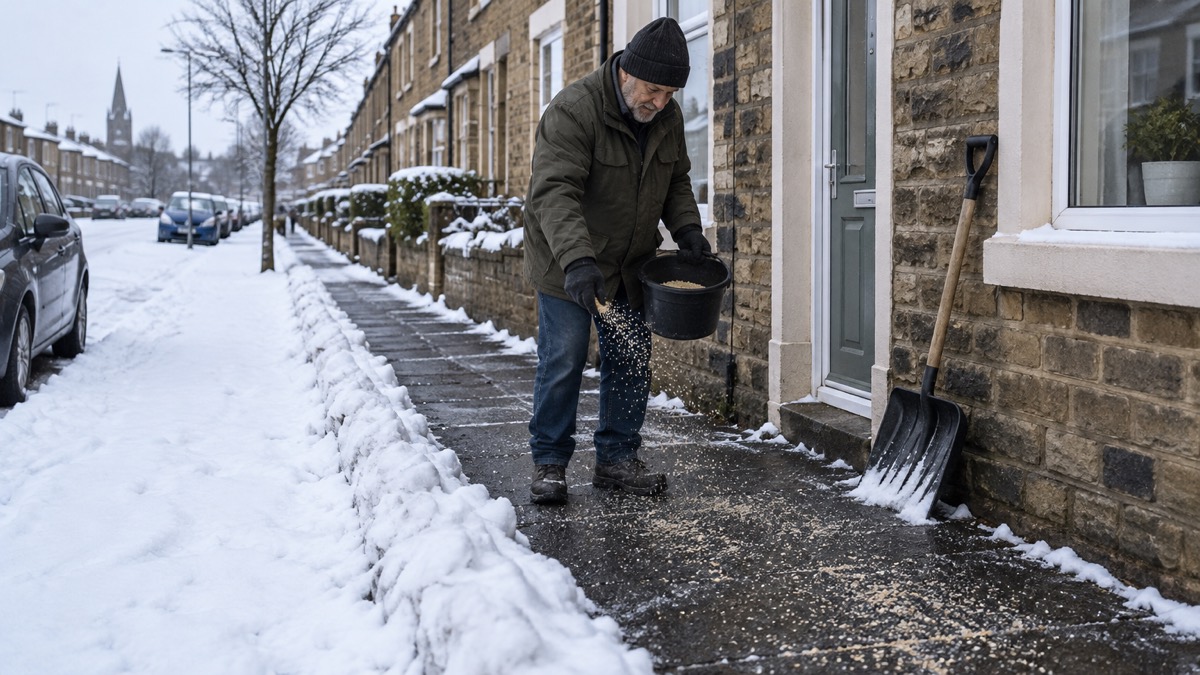
You do not need specialist products. Ordinary table or dishwasher salt can be used, and a tablespoon for each square metre you clear should work5. Lincolnshire's plan notes that you do not need to use a lot: a teaspoon of salt per square metre will defrost ice patches7.
Salt works because it lowers the freezing temperature of water, which prevents ice or frost forming13. Surrey County Council explains the mechanism: grit works by turning the ice or snow surrounding each grit granule into a saline solution, which has a lower freezing point than water14. On a road, salt relies on vehicle tyres to spread it and mix it in, so it needs traffic to be effective12. On a footpath there is no traffic, so you spread it yourself and walk it in.
| What you use | What it does | Watch for |
|---|---|---|
| Table or dishwasher salt | Lowers the freezing point; a tablespoon per square metre5 | Use more on steps and steep paths4 |
| Sand or ash | Gives grip underfoot but will not stop icing as effectively as salt15 | Keep some back for after clearing7 |
| Council grit bin salt | For roads and pavements around your home16 | Not for private property; taking it is theft7 |
| Hot water | Nothing good | Refreezes into invisible black ice6 |
A few cautions. Do not use the salt from council salting bins on your own property, as it is there to keep roads clear1. Northumberland County Council says grit from bins and heaps can be used to clear snow and ice from roads and pavements around your home, but should not be used on private property16. Rain can wash salt off surfaces, so a path treated before a shower may need doing again17. If you are short of salt, sand or ash will give grip, though they will not stop the path icing over as effectively15. The Red Cross suggests keeping a snow shovel or a supply of gritting salt ready, and notes sand or cat litter can be used instead of gritting salt18. For doses and quantities in more detail, see how much salt do I need to clear ice.
Clearing the pavement to prevent slips and falls
The reason to bother is straightforward: clearing snow and ice from the pavement outside your home or public areas can help prevent slips and falls19. Icy pavements are where people break wrists and hips, and the householder with a shovel is often the first line of defence on a street the council does not treat.
Timing helps. Clear and grit paths and pavements if you can, and clear fresh snow while it is easiest6. Nottinghamshire County Council suggests removing the top layer of snow in the morning so any sunshine during the day helps melt the ice beneath, then covering the path with salt before night to stop it refreezing15. That two-stage approach, clear in the morning and salt before dark, gets more out of a small amount of salt than a single application.
Pay extra attention to steps and steep pathways, which may need more salt4. These are where a fall does most damage, and where a thin scattering is not enough.
Helping neighbours' paths
Clearing your own frontage is the start, not the end. Councils and the Scottish Government advise being a good neighbour, because some people may be unable to clear snow and ice on paths from their property3. If your neighbour will have difficulty getting in and out of their home, offer to clear snow and ice around their property as well, especially if they are elderly or disabled and depend on social care services that need to reach them5.
That last point is practical, not sentimental. Derbyshire's keeping warm guidance says you can help by clearing snow and ice from paths and driveways so care services can reach people who need help21. A care worker who cannot get a walker or wheelchair up an icy path may not be able to make the visit at all. Argyll and Bute lists the clearing of snow from pathways of people who are unable to do this themselves as part of what a community emergency plan can cover22, and Scottish Borders lists clearing snow from pathways and community facilities among the things resilient communities do23.
- Ask first: offer rather than assume, and find out which route they use
- Clear the whole route: the path, the step and the bit between the gate and the door
- Salt as well as shovel: a cleared but icy path is still a fall risk5
- Check on them afterwards: a cleared path is also a reason to knock
If you are organising more than one household, the community resilience guide covers how neighbours and local groups can work together, and the extra help in an emergency guide sets out support for older, disabled and medically dependent households.
Doing it safely
The work itself carries risks, and the official plans are specific about them. Lincolnshire's guidance for its own crews is a sensible checklist for anyone: wrap up warm, wear a reflective coat if available, wear snow and ice grippers when walking especially when pushing snow, and beware of hypothermia and wind chill effects7. Do not lift too much snow or ice at one time, because compacted snow can be very heavy7.
A few more rules from the same guidance and the Snow Code:
- Do not use hot water: it refreezes into black ice6
- Do not obstruct or conceal: keep entrances clear and do not bury hazards under snow6
- Do not scrape hard surfaces: on a road, do not scrape the surface with a mechanical bucket, and do not obstruct accesses or footpaths with the snow7
- Use the right salt: table salt at a tablespoon per square metre, more on steps5
- Watch the refreeze: salt before night, and check the path in the morning15
For a step-by-step method, see how to clear snow and ice from a path safely, and for staying upright on surfaces you have not cleared, walking on ice: avoiding slips and falls.
Where to get help and supplies
If you need salt and have none, the first place to look is your own kitchen: ordinary table or dishwasher salt works5. If you want to know about the grit bins on your street, how to request or refill a grit bin explains the process, and which roads are gritted sets out what councils do and do not treat.
For the wider picture, the storms, snow and ice household guide covers warnings, travel and power cuts, and getting your home ready for cold weather and ice covers the household preparations that make a cold snap easier. If cold weather is affecting your health or your heating, staying well in cold weather and council help in severe weather set out who to contact.
Sources (23)
- Clear snow from a road, path or cycleway, GOV.UK, 2026-10-29
- Seasonal winter safety advice, Suffolk Fire and Rescue Service, 2026-10-29
- Snow wardens, Warwickshire County Council, 2026-10-29
- Snow Code, Derbyshire County Council, 2026-10-29
- Snow Code, Derbyshire County Council, 2026-10-29
- Cold, snow and ice, Scottish Government, 2026-03-25
- Winter service plan, Lincolnshire County Council, 2025-04
- Winter gritting FAQs, Scottish Borders Council, 2026-10-29
- Be prepared at home and in your community, Argyll and Bute Council, 2026
- Grit Bins and heaps | Argyll and Bute Council, Argyll and Bute Council
- Gritting, Carmarthenshire County Council, 2026-08-04
- Gritting priority routes, Argyll and Bute Council, 2026
- Common myths about gritting | Cheshire West and Chester Council, Cheshire West and Chester Council
- Salting, Surrey County Council, 2026-10-28
- Safe driving in winter, Nottinghamshire County Council, 2026-10-29
- Gritting and ploughing, Northumberland County Council, 2026-10-28
- Gritting, Somerset Council, 2026-10-28
- Snow and winter, British Red Cross, 2026-10-25
- Winter preparedness, Essex Prepared, 2026-10-29
- Extreme weather winter guide, London Fire Brigade, 2025-01
- Keeping warm in winter, Derbyshire County Council, 2026-10-29
- Why should your community prepare an emergency plan, Argyll and Bute Council, 2026
- Resilient communities, Scottish Borders Council, 2026-10-29
 Car Checks Before Winter
 Flood Warning Checklist
 First Steps After a Flood
 Bedroom Temperature at Night
 Hitting Black Ice
 Car Battery in Winter
 Car Stuck in Snow
 Clearing Snow and Ice Safely
 Using Fog Lights
 Signs of Frostbite
 Falling Through Ice
 De-Icing a Frozen Windscreen
 Request or Refill a Grit Bin
 Overtaking a Gritter
 Insulating a Loft Water Tank