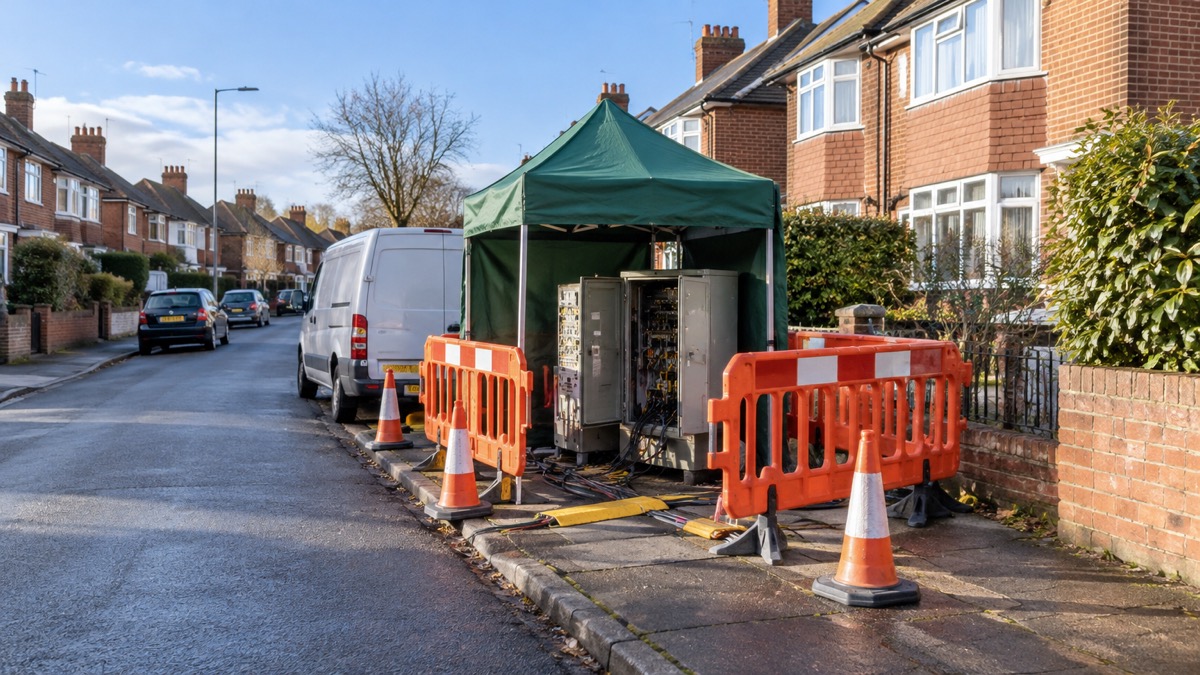
A planned power cut is a scheduled interruption of your electricity supply so that your network operator can carry out essential maintenance, upgrades or repairs1. Unlike a storm or a fault, you know about it in advance: the operator writes to you with the date and the times, and you have a chance to get ready. Most households get through one with nothing more than a torch, a charged phone and a bit of planning.
The work itself is the ordinary upkeep of the network that brings electricity to your street. It includes routine maintenance, described by one operator as "a bit like a car MOT", as well as replacing or installing new equipment, moving cables, repairing network faults, tree cutting, upgrading the network, and connecting new properties2. None of it is done for any other reason than keeping the supply safe, reliable and efficient1.
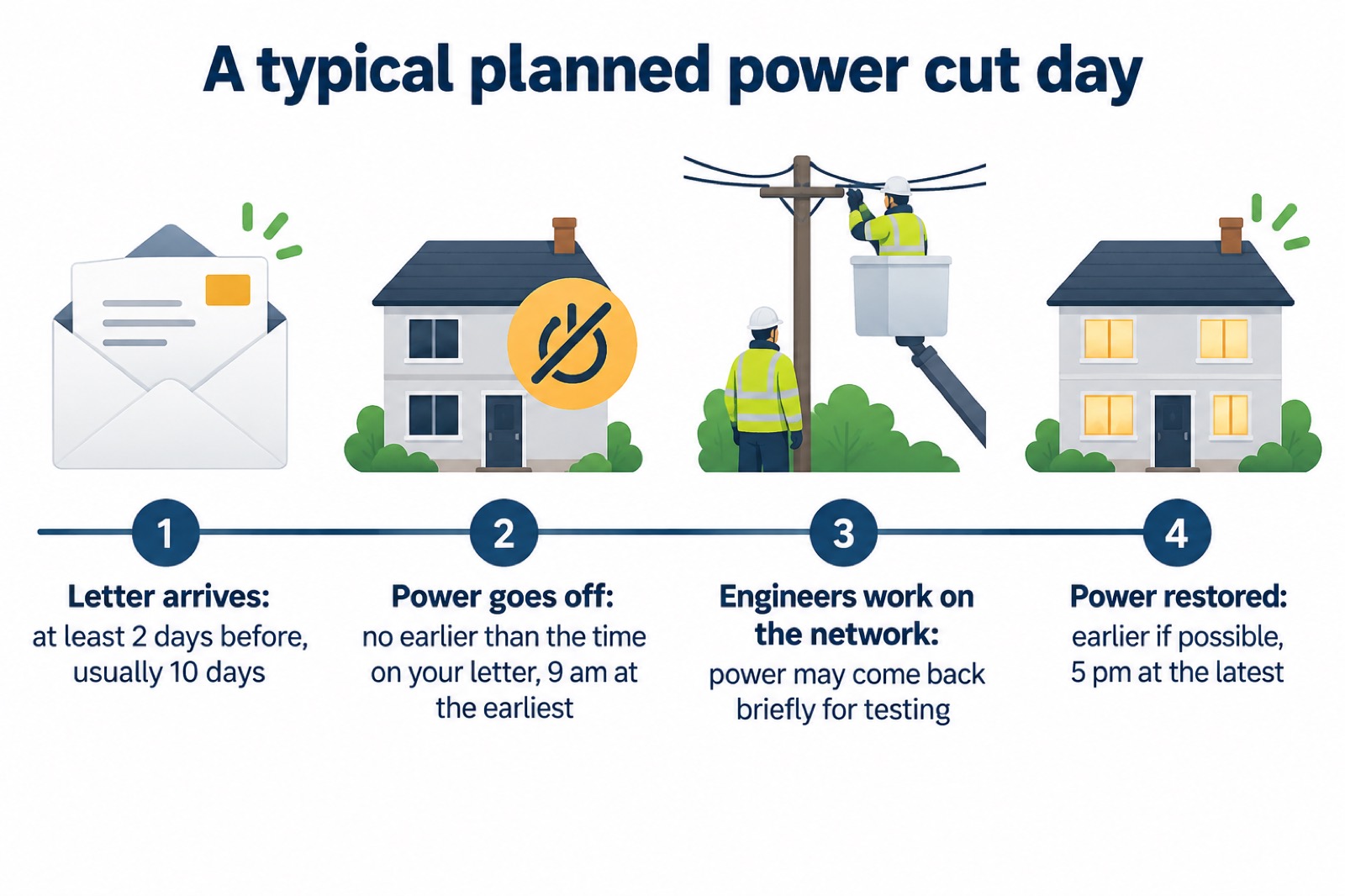
The essentials are simple. You should get at least 2 days' written notice, and usually 10 days3. The power normally goes off no earlier than 9 am and is back on by 5 pm at the latest1. If the rules on notice or the date are broken, you may be entitled to £404. And if anything is unclear, call 105, free, or the number on your letter5.
What a planned power cut is, and why your operator switches you off
Your electricity reaches you through a network of overhead lines, underground cables and substations owned by a regional network operator. That equipment ages, wears out and sometimes needs replacing, exactly like anything else. To work on it safely, the operator has to disconnect the supply for a period, and that disconnection is the planned power cut.
The work falls into two broad kinds. Maintenance and inspection covers inspecting, testing and maintaining equipment such as backup batteries, switchgear and transformers, cleaning and servicing components, and replacing parts that are worn or approaching the end of their life, at the local substation and the surrounding network3. Repair work replaces or repairs old or damaged equipment, and one operator describes needing to switch your power off for a short time to do exactly that5. Beyond these, planned interruptions also cover moving cables, tree cutting near lines, upgrading the network and connecting new properties2.
Trees deserve a mention of their own, because they are one of the reasons this work exists. Fallen trees in storms can knock out the overhead cables that carry electricity, and there are also high voltage underground cable faults8. Lightning, flooding and fallen trees can all damage cables and equipment9. Tree cutting near lines is therefore part of routine planned maintenance, reducing the chance of an unplanned cut later. Our page on why the electricity goes off explains the full range of causes.
If you rely on your energy supply for medical reasons, your network operator can tell you about planned power cuts, for example when they plan engineering work7. Households in that position should also read our guidance on relying on medical equipment that needs electricity.
How much notice you should get
The rules on notice are straightforward. Operators will let you know at least 2 days in advance, and whenever possible provide 10 days' notice3. One operator states it aims to give written notice at least 2 days before switching off the power, and gives 10 days' notice wherever possible2. Another aims to give at least five days' notice to help you prepare10, and a third gives a week's notice for its planned work11. The guaranteed minimum across operators is 2 days; the 10-day figure is what operators aim for whenever possible.
There is one important exception. Operators will always notify you in advance before they plan to interrupt your supply, unless it is an emergency1. A planned power cut is by definition not an emergency, so if you receive no notice at all and your power goes off, you are dealing with an unplanned cut, and the rules on reporting and compensation are different. Our page on how to report a loss of electricity covers that case.
Be careful not to throw the letter away. Operators report that their advance warning letters are sometimes dismissed as junk mail2. The letter is the document that sets your date, your times and your entitlement, so keep it somewhere you can find it.
How the notice reaches you
The standard method is a letter or card through the post. SP Energy Networks writes to customers giving the date and times of the planned interruption10. In Northern Ireland, anyone impacted by outages under the Big Network Rebuild is sent a planned outage notification card through the post with details of the dates and times12. Letters are delivered to each affected property a minimum of 2 days before the power cut2.
Some operators add electronic updates. You may be able to get direct messages to your mobile device that will update you about a power cut13. SSEN directs customers to its power cut map to track and register for updates on a planned power cut2. If your operator offers a text or app update service, it is worth signing up before the day, because it is one more way to hear about a cancellation or a change of time.
To check planned power cuts in your area, use your own operator's website or power cut map, since each operator publishes its own schedule. If you do not know who your operator is, the free 105 line will put you through to them14.
What time the power goes off, and when it comes back
The timing rules are the ones most people want to know. Electricity North West states that 9 am is the earliest it will turn your power off, and 5 pm is the latest time it will turn the power back on1. SSEN goes further and guarantees it will never turn your power off earlier than the time on your letter6. So the letter's stated start time is a floor, not an estimate: you will not be cut off before it.
Two things can still vary. The engineers may turn the power off later than the time advised on your letter, if they are still making the area safe before they start work5. And your power may be turned off and back on at different times to other customers on the same job, because the work moves along the network section by section5. In Northern Ireland, the majority of planned interruptions affect domestic customers and are carried out during daytime working hours12.
On restoration, operators work as quickly and safely as possible to get power back on, earlier in the day if possible3. Your power may come back on earlier than expected5. Treat the 5 pm figure as the latest likely restoration, not a promise of a full day without power.
Getting your home ready before the power goes off
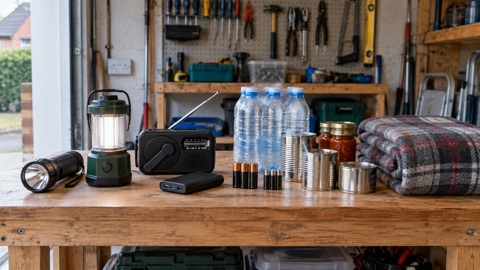
A planned power cut is the easy case: you know the day, so you can prepare for it. The Met Office's advice is that people cope better with power cuts when they have prepared for them in advance, and it is easy to do; it suggests gathering torches and batteries, a mobile phone power pack and other essential items15. The UK government's preparedness advice is to keep some basic supplies at home such as bottled water, a torch and batteries, which it notes is safer than candles, and a wind-up radio to get updates during a power cut16.
In the days before the cut:
- Charge phones, power banks and any battery packs you rely on, and consider what else needs charging, from a power cut kit point of view.
- Know where to turn off your electricity and/or gas if you need to17.
- Keep important documents safe and handy18.
- Check on relatives or neighbours who might need help during a power cut19.
- If you have technology-dependent children or others who need warmth, pre-heat your home, prepare to stay in a pre-warmed room, and ensure you have extra layers of blankets and clothing ready if needed20.
On lighting, the advice differs. Some official winter-readiness pages suggest you keep a supply of candles21, while the government's risk guidance states that a torch and batteries is safer than candles16. Where official guidance differs, take the safer option: torches first, candles only with care. Our pages on emergency lighting and staying safe in the dark cover fire, shock and falls in detail.
Think too about your landline before the day. A corded landline phone might still be working in a power cut, but if your landline will not work, your landline provider might offer you a free solution, such as a back-up battery unit, for a minimum of one hour, to enable you to call the emergency services if you needed to22. If your only way of making emergency calls is through a landline phone, or you have a telecare kit connected to your landline, contact your landline provider to understand whether your phone will work during a power cut22. If you have no back-up power to your landline and have a life-threatening emergency, attempt to call 999 or 112 using a mobile: emergency calls automatically roam onto all available networks7.
For the day itself, our page on what to do when the electricity goes off takes you through it step by step, and getting your home ready for a loss of supply covers the longer list of preparations.
The power may come back briefly during the work
This surprises people, so it is worth knowing in advance. During maintenance work, the engineers inspect, test and maintain equipment, and testing can mean the supply returns briefly before the work is finished3. Your power may be turned off and back on at different times to other customers5, so do not treat a brief return of power as the end of the job.
The safety point that follows from this is firm: do not do any internal electrical work while your power is off, because power may come back on earlier than expected3. That applies even if the supply has been off for hours and seems settled. If you want to check whether an outage has ended, check whether your neighbours are safe and whether they have power too; if they have power and you do not, your trip switch may have activated23. Our page on how to check whether it is just your trip switches explains that check.
Also worth knowing: most power cuts do not last very long8, and a planned interruption is scheduled work with a published end time, not an open-ended fault. If your power is not restored within an hour of when you expected it, report it, and check your operator's live power cuts page to see if your fault is listed24.
When the date changes or the work is cancelled
Planned work is sometimes moved or called off. The common reasons for cancellation are an emergency power cut elsewhere on the network, the work no longer being required because it was carried out without turning the power off, or severe or bad weather creating safety risks3. The time of your power cut can also change for reasons including weather conditions, the safety of engineers, and access problems2.
If the work has been cancelled, you will receive either a letter in advance or a text on the day of the planned power cut2. So a text on the morning itself is a normal channel, not a scam, though you should still be careful about unexpected callers, as our page on checking a caller from the electricity network is genuine explains.
Can you change the date yourself? Generally not. Once a date and time has been confirmed, SSEN states it is unable to make any changes2, and Electricity North West commits to agreed dates and not cancelling planned works1. If the date genuinely does not work for you, for example because of a medical dependency, call the number on your letter or 105 and ask what is possible; the answer may be no, but households on the Priority Services Register can expect extra help7.
Compensation if the notice or date rules are broken
The headline figure is £40. If you do not get two days' notice, or if the power cut happens on a different day to the one you were warned about, you can claim £404. This is the payment that applies specifically to the notice and date rules for planned cuts.
Northern Ireland has its own scheme. NIE Networks customers are entitled to claim £25 per home if the notice rules are not met, and the claim must be made within one month of the day of the power interruption4. The scheme there is run by NIE Networks rather than under the Great Britain rules, so check the letter's details if you think the notice was short.
| Situation | Payment | Where it applies |
|---|---|---|
| No 2 days' notice, or cut on a different day | £40 | Great Britain4 |
| Notice rules not met | £25 per home, claim within one month | Northern Ireland4 |
| Unplanned cut, normal weather, off 12 hours or more | £95 domestic, plus £40 for each additional 12 hours, up to £360 | Great Britain25 |
| Power off more than 4 times in a year, each cut at least 3 hours | Extra £100 | Great Britain25 |
The other rows are for context, because a planned cut can turn into something longer. If a planned cut overruns badly, or you suffer repeated cuts, the unplanned-cut payments may come into play: Ofgem's guidance sets out £95 for domestic customers off for 12 hours or more in normal weather, plus £40 for each additional 12 hours up to a total of £36025, and an extra £100 if your power has gone off more than 4 times between 1 April and 31 March the following year, each cut lasting at least 3 hours25. In normal weather, payment is normally sent within 10 working days of the operator becoming aware of the failure25. Our page on how long until the electricity comes back explains the timescales in more detail.
One operator, SSEN, states plainly that it does not offer compensation for planned power cuts and that it follows the standards set by its industry regulator, Ofgem2. That is consistent with the position above: the £40 is a regulatory entitlement when the rules are broken, not an automatic payment for every planned cut.
The Big Network Rebuild in Northern Ireland
Northern Ireland is in the middle of the largest case of repeat planned outages in the UK. In April 2025, NIE Networks launched a major six-year investment programme worth c.£250m to rebuild and future-proof the electricity network in Northern Ireland12. It will involve rebuilding and refurbishing approximately 14,000km of the electricity distribution network over the six years, including rebuilding approximately 1500km per year of 11kV overhead lines, and the work is being carried out in all six counties12.
Power outages are required as part of this work, meaning homes, farms and businesses may experience electricity supply interruptions, with some repeat outages on certain sections of network12. Some of the 11kV rebuild circuits may take up to 1 to 1.5 years to complete, and there are certain times of the year when land may not be accessible, during the sileage season, which increases the time to complete a circuit rebuild12. So a household in Northern Ireland can reasonably expect more than one planned cut over the programme's life, and possibly several on the same section of network.
NIE Networks is taking steps to reduce the disruption: detailed circuit analysis and plans, Live Line equipment and methods, reconfiguring the network to supply customers via other circuits, and coordinating vegetation management and new connections with the rebuild work12. New ways of working, such as high voltage and low voltage generation and live pole planting, are being explored to reduce outages further12. Anyone impacted will be sent a planned outage notification card through the post with the dates and times12.
For live information, nidirect advises that you can get information about electricity supply, including an updated list of areas affected by power cuts, on the NIE Networks website26. Our page on Northern Ireland: NIE Networks, reporting and help covers the arrangements there in full.
Who to contact
The first place to go is the letter itself: it carries the details of your specific interruption and usually a contact number for questions. Beyond that, the national number is 105. Call 105 free of charge to report a problem and get updates on when your power will be restored14. SSEN's teams are on hand to help 24/7 on 1052, and the same operator also takes questions by WhatsApp, Facebook Messenger or 0800 048 35042. If you need updates about outages in your area, or want to report a power cut or damage to power lines or substations, you can call 10527.
For households that need extra help, the Priority Services Register is the route in. Signing up lets your energy supplier know that you need additional support during a power cut16. For both planned and unplanned power cuts, network operators must offer customers on the register extra help, for example giving them battery packs so that they can still charge phones or medical equipment; what each company offers will be different28. Our page on the Priority Services Register explains who can join and how.
Finally, keep the distinction between planned and emergency cuts clear. Emergency power cuts, the rota-based disconnections used in a national shortage, are a different measure: operators state they are unlikely this winter and that no emergency power cuts are currently planned, and these measures would only be used in emergencies24. If you want to understand that system, our page on rota disconnections explains it. For the ordinary planned interruption in your letter, the answer is preparation, the times on the page, and 105 if anything is unclear.
Sources (28)
- Planned power cuts, Electricity North West
- Planned power cuts, SSEN
- Your planned power cut explained: network maintenance and inspection, SSEN
- How to find out if there's a power cut, Which?
- Your planned power cut explained: repairing our network, SSEN
- Being prepared for a power cut, SP Energy Networks
- Be informed about hazards: power cuts, UK government beready campaign
- Plan for a power cut, Ofgem
- Why do we experience power cuts, Electricity North West
- Planned interruptions leaflet, SP Energy Networks
- Planned work, NIE Networks
- The Big Network Rebuild FAQs, NIE Networks
- How we will let you know, Electricity North West
- Types of power cut, Power Cut 105
- What to do in a power cut, Met Office
- Be informed about hazards: power cuts, UK government prepare campaign
- Power cut: how to prepare, British Red Cross
- Make an emergency plan, Readiness campaign Scotland
- Support during a storm, British Red Cross
- Parental letter re power shortages, NHS North West Children's ODND Hub, 2022
- Winter ready, Anglesey County Council
- Your landline is going digital: here's how to stay connected, RNID, 2025
- Emergency power cuts, Electricity North West
- Emergency power cuts, Northern Powergrid
- Check if you can get payment for a power cut, Ofgem
- Strong winds weather warning information and advice, nidirect
- Power cut, Energy Networks Association
- Extra help for customers, Energy Networks Association
 Power Cut Kit Checklist
 What to Keep Charged
 Household Emergency Plan
 Reporting a Power Cut
 What to Do in a Power Cut
 Getting Ready for a Power Cut
 Fridge and Freezer Food
 Keeping Warm Without Electricity
 Central Heating Without Power
 Cold Homes and Health
 Carbon Monoxide Risks
 Staying Safe in the Dark
 Smoke and Carbon Monoxide Alarms
 How Long Until Power Returns
 When the Power Comes Back