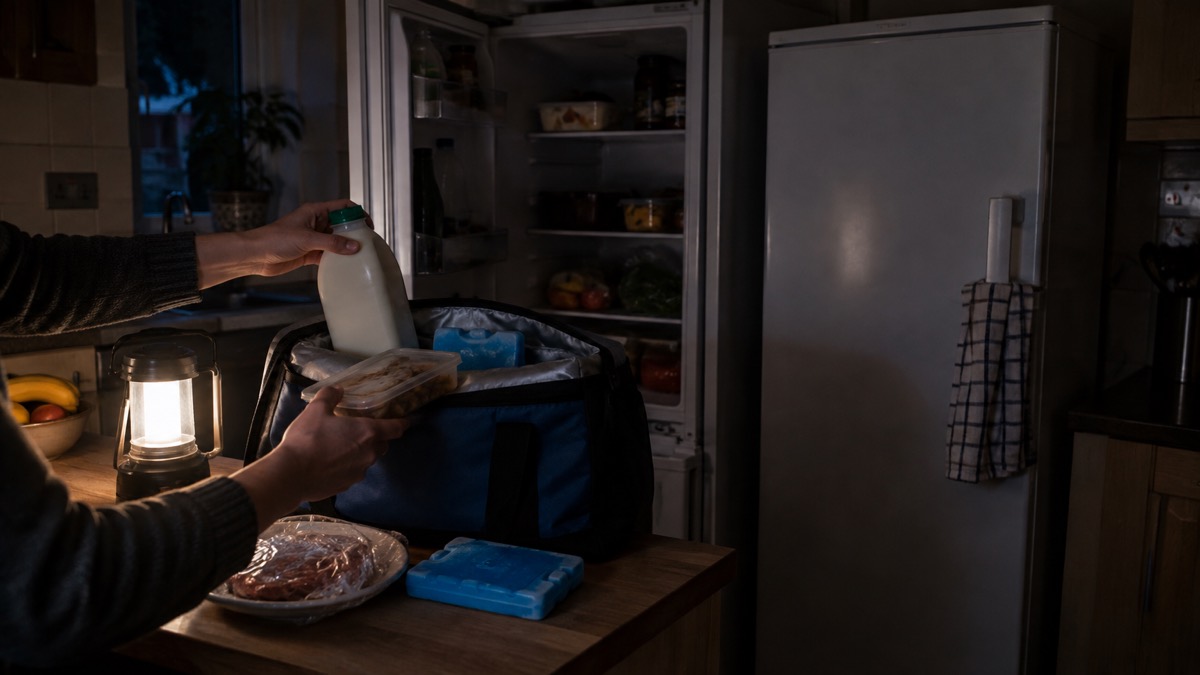
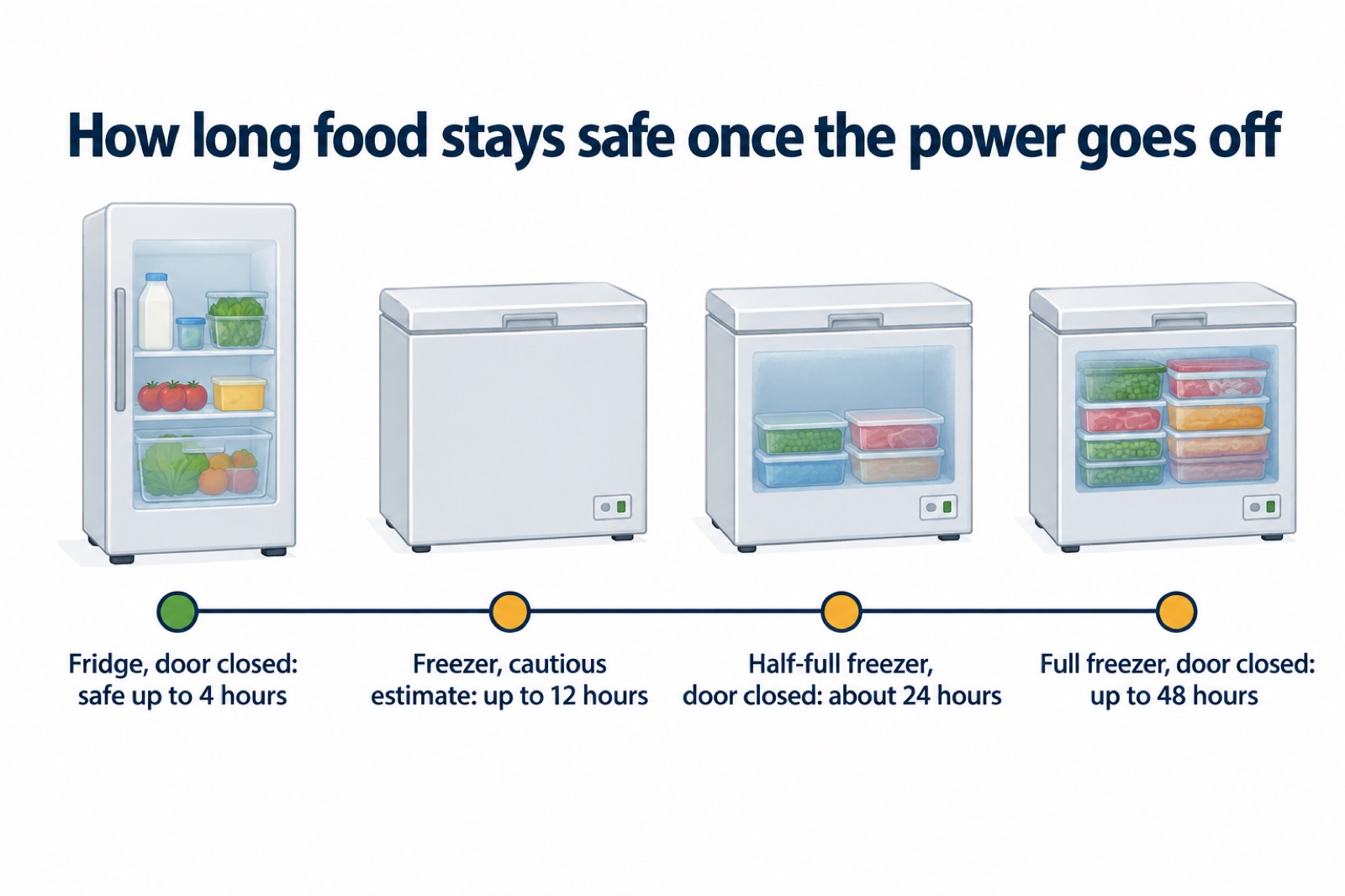
When the electricity goes off, the food in your fridge and freezer is not lost straight away. Food Standards Scotland guidance is that a fridge should keep food at a safe temperature for up to four hours, and a full freezer should stay frozen for up to 48 hours, or about 24 hours if it is half full, so long as the doors stay closed1. Northern Ireland's network operator, NIE Networks, gives the same figures: about 4 hours for a refrigerator with the door kept closed, and about 48 hours for a full freezer, 24 hours if half-full2.
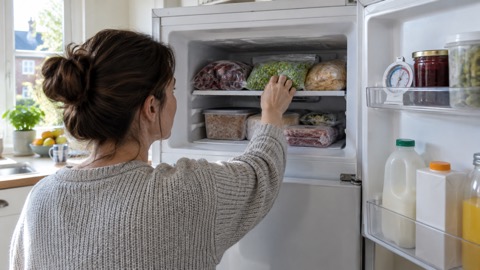
The single most important thing you can do, from the moment the power fails, is keep the fridge and freezer doors shut. Every network operator and food safety body in the UK says the same. If the electricity is off for less than four hours, Food Standards Scotland says it is unlikely to have an impact on the safety of your food1. Beyond that, the clock matters, and this page walks you through what to do as the hours pass, what to throw away, and how to check food safely once the supply returns.
First action: keep the doors shut
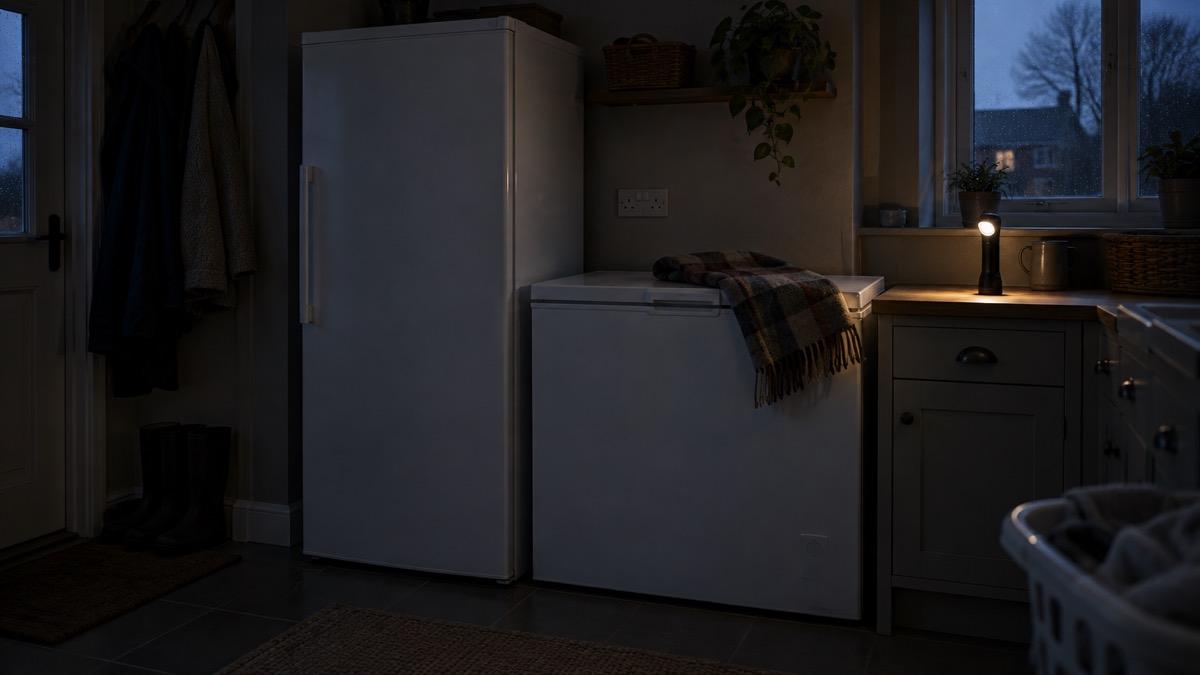
Every piece of official and network operator advice on power cuts starts with the same instruction. Food Standards Scotland: keep fridge and freezer doors closed as much as possible1. The Met Office: keep fridges and freezers closed, with a blanket over, as they will stay cold for many hours6. SSEN, the network operator for northern Scotland and central southern England: don't open the freezer door unless you have to, as this helps food stay frozen for longer7. NIE Networks, for households in Northern Ireland, puts it bluntly: keep the refrigerator and freezer doors closed2.
The reason is simple physics. A closed fridge or freezer is an insulated box, and the cold air inside it stays put so long as nothing lets it escape. Every time you open the door, cold air spills out and warmer room air replaces it, and the appliance cannot pump the heat back out because it has no power. Most fridges and freezers will maintain their temperature for up to 12 hours if the doors remain closed8, and network operators' advice is the same in principle: keep the doors closed, as this will ensure they stay cold for several hours8. So the rule for the first hours of any power cut is straightforward: shut the doors and leave them shut until the supply returns.
So the first minutes of a power cut matter. Decide what you need from the fridge before you open it, take everything out in one go, and shut the door firmly. If you need a torch, batteries or a phone charger, get them from elsewhere. Leave the fridge and freezer switched on at the wall with the door shut to keep a low temperature, as nidirect advises during storm warnings9, so that the moment supply returns they start cooling again without you having to notice first.
If you know the power cut is coming, because it is a planned interruption or a named storm, there is more you can do in advance, and that is covered below under preparing the freezer.
How long will food last in a freezer during a power cut?
The headline figures, repeated across official and independent guidance, are these. A full freezer will hold a safe temperature for approximately 48 hours if the door remains closed, and a half-full freezer for about 24 hours, according to the Food Standards Agency figures quoted by Energy Networks Association10, by National Grid's own tips page11 and by Which?12. Food Standards Scotland gives the same: up to 48 hours if full, about 24 hours if half full1. NIE Networks agrees: about 48 hours for a full freezer, 24 hours if half-full2.
How full the freezer is makes the single biggest difference. Frozen food packed tightly together acts like a block of ice: it holds the cold and shields itself. A freezer with air gaps loses its temperature much faster, which is why filling empty space before a cut matters so much.
Some sources give shorter figures, and it is worth knowing they exist so you are not caught out. National Grid's Winter Hub says that depending on the type of freezer you have, the contents can stay frozen for up to 12 hours13. National Grid's planned interruption leaflets say the same: depending upon the type, freezers could remain cold if unopened for up to 12 hours14. Northern Powergrid gives chest freezers up to 24 hours16. NIE Networks' support article says food should keep for between 4 and 6 hours in the fridge and 15 to 24 hours in the freezer if you can avoid opening it17.
The shorter figures of 12 to 24 hours are the cautious working estimates some operators use when they cannot know how full your freezer is or what condition it is in. Plan around the shorter figures, be pleasantly surprised by the longer ones, and check the food carefully before eating any of it.
| Freezer state | How long food stays frozen | Who says it |
|---|---|---|
| Full, door closed | Up to 48 hours | Food Standards Scotland1, NIE Networks2, Which?12 |
| Half full, door closed | About 24 hours | Food Standards Scotland1, NIE Networks2 |
| Chest freezer | Up to 24 hours | Northern Powergrid16 |
| Any type, cautious estimate | Up to 12 hours | National Grid Winter Hub13, planned interruption leaflets14 |
How long food lasts in the fridge
The fridge is the more urgent problem, because it holds less thermal mass and its food is less forgiving. Your fridge should keep your food at a safe temperature for up to four hours, according to Food Standards Scotland1, and the Food Standards Agency figures quoted by National Grid say the same: up to four hours during a power outage, provided you keep the door closed as much as possible11. NIE Networks gives about 4 hours for a refrigerator with the door kept closed2, and Energy Networks Association says food should keep for up to 4 hours in the fridge10.
After four hours, the position hardens. GOV.UK flood advice says to throw away food from a fridge if the electricity has been off for more than 4 hours4, and Runnymede Borough Council's flooding aftercare says the same: if your fridge has lost power for more than four hours, throw away the food18. Northern Powergrid gives most fridges up to 12 hours for keeping food fresh16, and NIE Networks' support article says 4 to 6 hours if you can avoid opening it17, so there is some variation, but the four-hour mark is the figure the official food safety and flood advice treats as the line.
There is one useful refinement. Food Standards Scotland says that during a power cut, it should be safe to store your food in the fridge as long as the temperature doesn't rise to 8°C1. If you have a fridge thermometer, that gives you a real measurement instead of a guess: below 8°C and the food is still in the safe zone; at or above it, treat the food as the throw-away rules describe. If you do not have a thermometer, work to the four-hour rule.
If the cut is short, you are likely fine. If your electricity is off for less than four hours, it's unlikely to have an impact on the safety of your food, Food Standards Scotland says1. For a fuller walk-through of the first hour of any outage, see what to do when the electricity goes off.
Preparing the freezer if you have warning
Planned power cuts, and storms with named warnings, give you time to stack the odds in your favour. National Grid's planned interruption leaflet sets out the steps: keep your freezer door shut while the electricity supply is off; placing a blanket over the freezer will help keep it cold; fill any spare space inside with newspaper before the electricity is switched off; and remove the blanket as soon as the power is restored14.
Filling the space matters because of the full-versus-half-full difference: newspaper, crumpled and packed into gaps, displaces the air that would otherwise warm up first, and every item of frozen food you add is another block of cold. If your freezer is half full and you have room, move frozen food from a smaller freezer into a larger one to consolidate the cold mass, or freeze what you can in advance.
SSEN's planned power cut guidance adds a step for when the supply returns: if the food is still hard and icy, leave it in the freezer and turn the freezer to its maximum setting for 24 hours before returning it to a setting that keeps it at -18°C19. That burst of maximum cooling pulls the food back down to a safe temperature quickly, and the -18°C figure is the normal storage temperature to return to.
A numbered list for the hours before a planned cut:
- Fill any spare space inside the freezer with newspaper14.
- Place a blanket over the freezer to help it hold its temperature14.
- Check the door seal is clean and closing fully.
- Plan meals that use fridge food first, so nothing needs the fridge door opening mid-cut.
- When power returns, remove the blanket as soon as it is restored14.
For how planned interruptions work and how much notice you get, see planned interruptions.
What to throw away, and when
The throw-away rules from official guidance are blunt, and deliberately so. GOV.UK's after-flood advice says to throw away food from a fridge if the electricity has been off for more than 4 hours, and food from a freezer if the electricity has been off for more than 24 hours4. Runnymede Borough Council repeats the fridge rule18. These are the figures to work to when you cannot verify the food's condition any other way.
Note the freezer figure carefully: the throw-away rule for freezer food is 24 hours, not 48. The 48-hour figure is how long a full freezer can stay frozen; the 24-hour rule is the point at which official advice says to stop judging and start binning. If your freezer is half full, the two figures meet, which is consistent: a half-full freezer holds about 24 hours, and at 24 hours the food has reached the limit of safe keeping either way.
NIE Networks adds a judgement rule for the in-between cases: contents should be safe for many hours but, if in any doubt, dispose of the food if it appears to have defrosted20. "If in any doubt" is doing real work in that sentence. Partial thawing is where the danger lives, because food that has begun defrosting and then re-frozen, or been held lukewarm for hours, can be unsafe while looking and smelling entirely normal.
For a fuller guide to sorting food item by item after an outage, see what food to throw away after an outage.
Why the sniff test is not a safe check
This is the point most people get wrong, and it is worth being direct about it. Food Standards Scotland's advice on use-by dates is unambiguous:
"It is not suitable to use the 'sniff test' to determine if food is safe to eat, even though food can look and smell normal past the use-by date, it could still contain harmful bugs."
The reason lies in how freezing works. Food Standards Scotland's chilling guidance explains that freezing food doesn't kill some harmful bacteria in food: bacterial growth can be "paused" at low temperatures but can start to grow again at higher temperatures21. A power cut is exactly that scenario. Bacteria that were held dormant at -18°C can begin multiplying as the food thaws, and they do not change the look, smell or texture of the food while they do it. By the time a thawed chicken smells off, it passed the point of being unsafe a long while before.
So do not open the freezer to check whether things smell all right. Opening the door costs you cold air, and the check itself tells you nothing. Judge by time and temperature: how long was the power off, how full was the freezer, and did the food stay hard and icy throughout.
One group needs extra care. nidirect's advice for households with a baby is that it is always safer to make up a fresh feed, and when this is not possible, feeds should never be stored for longer than 24 hours22. If you have a baby and the power has been off for hours, make feeds fresh with cooled boiled water rather than relying on stored ones.
Use-by and best-before dates after a power cut
The two dates on food labels mean different things, and the difference matters more than usual after an outage. Food Standards Scotland's guidance is:
"A use-by date is about food safety. After this date the food is not safe to eat."
A best-before date is about food quality: after that date the food will be safe to eat but its flavour, colour or texture might not be as good5. Use-by dates usually appear on foods that go off quickly, like raw meat or fish, cooked sliced meats, and some dairy products. Best-before dates appear on a wide range of foods, which can include frozen, dried and tinned foods, such as canned tomatoes, bread and cereal5.
Two consequences follow a power cut. First, a best-before date will only be valid if the food is stored according to the instructions on the label5, so frozen food whose label says to keep at -18°C has effectively lost its best-before guarantee if it partially thawed. Second, food past its use-by date should not be eaten even if it looks and smells fine, because it might contain harmful bugs that could make you sick5. A power cut does not reset either date, and thawing can shorten the real life of food that is still inside its dates.
| Date on the label | What it means | Typical foods | After a power cut |
|---|---|---|---|
| Use-by | Food safety; not safe to eat after this date | Raw meat or fish, cooked sliced meats, some dairy5 | Do not eat past the date, whatever it looks like5 |
| Best-before | Food quality; safe but possibly not at its best | Frozen, dried and tinned foods, bread, cereal5 | Only valid if stored per the label's instructions5 |
Refreezing and the freezer's maximum setting
When the power comes back, the question is what can be saved. The rule from Food Standards Scotland's flooding advice is firm: do not refreeze food that has thawed while the power was cut23. Thawed then refrozen food may have spent hours in the temperature range where bacteria multiply, and refreezing pauses the growth without undoing it.
Food that never fully thawed is different. SSEN's advice is that if the food is still hard and icy, leave it in the freezer and turn the freezer to its maximum setting for 24 hours, before putting it back to a setting that keeps it at -18°C19. The maximum setting drives the temperature down fast, closing the gap the outage opened, and the 24 hours gives it time to reach a safe, stable cold before you return to normal.
While the power is off, keep the appliance switched on at the wall with the door shut, as nidirect advises, so it resumes cooling the instant supply returns9. And when the supply does come back, there are checks worth doing across the whole house, from surge protection to switching appliances back on one at a time, covered in when the supply returns.
Can you store food outside in a power cut?
The official guidance does not advise moving food outdoors during a power cut, and there is good reason for that silence. Outdoor temperatures in the UK are rarely stable: a winter night below freezing can be followed by a daytime thaw, and food left outside is exposed to sunlight, animals and contamination. The official advice in every source is instead to keep the food where it is, inside the closed appliance, which is an insulated box designed for exactly this job, and to use blankets and newspaper to help it hold its temperature6.
The one related piece of official advice concerns flooding, not temperature: Food Standards Scotland's flooding guidance covers food safety when flood water has touched food or equipment, and its power cut rule against refreezing thawed food comes from the same page23. If your outage coincides with flooding, treat any food that may have been in contact with flood water as unfit to eat, and see the flooding guidance before salvaging anything.
Keeping the appliance itself safe
A power cut is also a moment when appliance safety deserves a thought, both during and after.
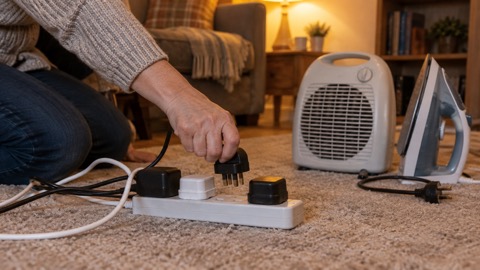
Extension leads. Electrical Safety First warns that fridges and freezers are large appliances that use a lot of power and may overload an extension lead if used with other large appliances, which can cause a fire24. The Scottish Fire and Rescue Service adds the hard limit: appliances connected to extension leads should never use more than 13 amps of electricity in total25. Plug your fridge or freezer into its own wall socket, not a lead shared with a kettle or a washing machine.
Fault signs. Watch out for scorching or burn marks, and check for loose or worn wires, on the appliance, its plug and its cable, Electrical Safety First says. If you find damage, unplug it and contact the retailer, the manufacturer, or a qualified repair technician24. The Northern Ireland Fire and Rescue Service advises checking all appliances, plugs, sockets and leads for damage such as scorch marks or exposed wiring, always using the correct fuse, and switching appliances off at night or when leaving the home unless they are designed to be left on, as fridges and freezers are26.
Plugs and buying. Fridges and freezers must be fitted with a UK 3-pin plug and fuse, and Electrical Safety First advises buying from a reputable retailer rather than a third-party seller online, as the appliance may not have passed all the necessary safety checks24.
Defrosting. Unless your model is frost free, defrost at least once a year to ensure it continues to work properly, and never use a hair dryer or other heating appliances to defrost the inside24. A freezer clogged with ice runs less efficiently and holds its temperature less well in a cut, so this yearly job is quietly part of power cut preparation.
When the power returns. The government's Prepare campaign advises turning off items such as irons, ovens, electric fires and fryers during a cut, and unplugging your TV and PC as they can be damaged if there is a surge when power goes back on27. Fridges and freezers are designed to be left on, so they can stay plugged in; the surge risk is about other equipment. North Yorkshire Fire and Rescue Service notes that for a short period of time food will remain safe in your fridge or freezer if kept closed28, which is the same closed-door rule carrying you through to restoration.
Running a fridge from backup power
Some households with a portable power station or generator consider running the fridge to stretch the safe window. It can be done, but the guidance on this page is about food safety rather than runtimes, and the safe-food rules above still apply even if the fridge is powered: the four-hour and 24-hour figures are your fallback if the backup runs out or was not running from the start.
The safety points that do bear on it are the ones above: never connect backup power into your home's wiring yourself, keep the fridge on its own socket rather than a shared extension lead24, and if you use a generator, keep it outdoors and away from windows because of carbon monoxide29. For what backup power can and cannot run, and for how long, see the backup power at home guide.
Where to get help and more information
Report the power cut by ringing 105, the free single number for power cuts anywhere in Great Britain, or 105 from a mobile; in Northern Ireland, NIE Networks is the network operator and its emergency power cut pages carry the local advice20. Power Cut 105's own guidance on types of power cut includes keeping fridge and freezer doors closed to preserve their contents30. If you or someone in your household relies on electricity for medical equipment or needs extra support during outages, the Priority Services Register exists for exactly that.
For the wider picture, the power cuts household guide covers preparation, the power cut kit checklist lists what to have ready, and how long until the electricity comes back explains what restoration times to expect, which is the other half of the food safety question: every hour of the estimate above depends on when the supply actually returns.
Sources (30)
- Food safety during power cuts, Food Standards Scotland, 2026-10-25
- How do I keep food safe during an unplanned power cut, NIE Networks, 2026-10-25
- 12 tips to prepare for a power cut, Horsted Keynes Parish Council, 2026
- What to do after a flood, GOV.UK, 2026-10-25
- Use-by and best-before dates, Food Standards Scotland, 2026-10-25
- What to do in a power cut, Met Office, 2026-10-25
- Planned power cuts, SSEN, 2026-10-25
- Repeat power cuts, SSEN, 2026-10-25
- Strong winds weather warning: information and advice, nidirect, 2026-10-24
- Power cut advice for customers, Energy Networks Association, 2026-10-25
- Hot weather power cut advice, National Grid Power Cut Aware, 2026
- What to do in a power cut, Which?, 2026-06-04
- Winter Hub: power cut advice, National Grid, 2026-10-08
- Planned interruption leaflet, National Grid, 2022-09
- Homeowner useful information, National Grid, 2021
- What to do in a power cut, Northern Powergrid, 2026-10-25
- Will food in my fridge or freezer be OK, NIE Networks, 2026-10-25
- Flooding aftercare, Runnymede Borough Council, 2026-10-26
- Your planned power cut explained: repairing our network, SSEN, 2026
- Emergency power cuts, NIE Networks, 2026-10-25
- Chilling: food safety in the kitchen, Food Standards Scotland, 2026-10-25
- Strong winds and heavy rain warning: information and advice, nidirect, 2026-01-27
- Food safety and flooding, Food Standards Scotland, 2026-10-25
- Fridges and freezers safety advice, Electrical Safety First, 2026-10-25
- Electrical safety at home, Scottish Fire and Rescue Service, 2025-02-27
- Home fire safety, Northern Ireland Fire and Rescue Service, 2026-10-14
- Be informed about hazards: power cuts, Prepare Campaign, 2026-10-21
- Steps after a fire, North Yorkshire Fire and Rescue Service, 2026-06-17
- Carbon monoxide: hazardous substances, Health and Safety Executive, 2026
- Types of power cut, Power Cut 105, 2026-10-25
 Power Cut Kit Checklist
 What to Keep Charged
 Household Emergency Plan
 Reporting a Power Cut
 What to Do in a Power Cut
 Getting Ready for a Power Cut
 Keeping Warm Without Electricity
 Central Heating Without Power
 Cold Homes and Health
 Carbon Monoxide Risks
 Staying Safe in the Dark
 Smoke and Carbon Monoxide Alarms
 How Long Until Power Returns
 When the Power Comes Back
 Fallen Overhead Lines