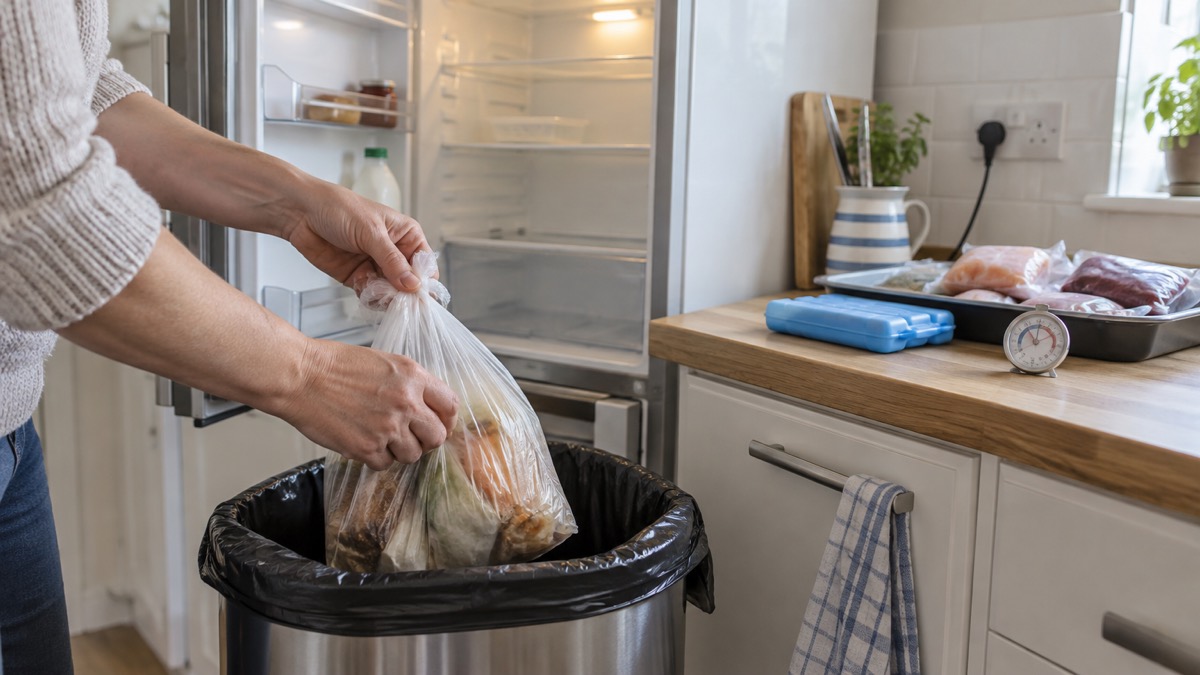
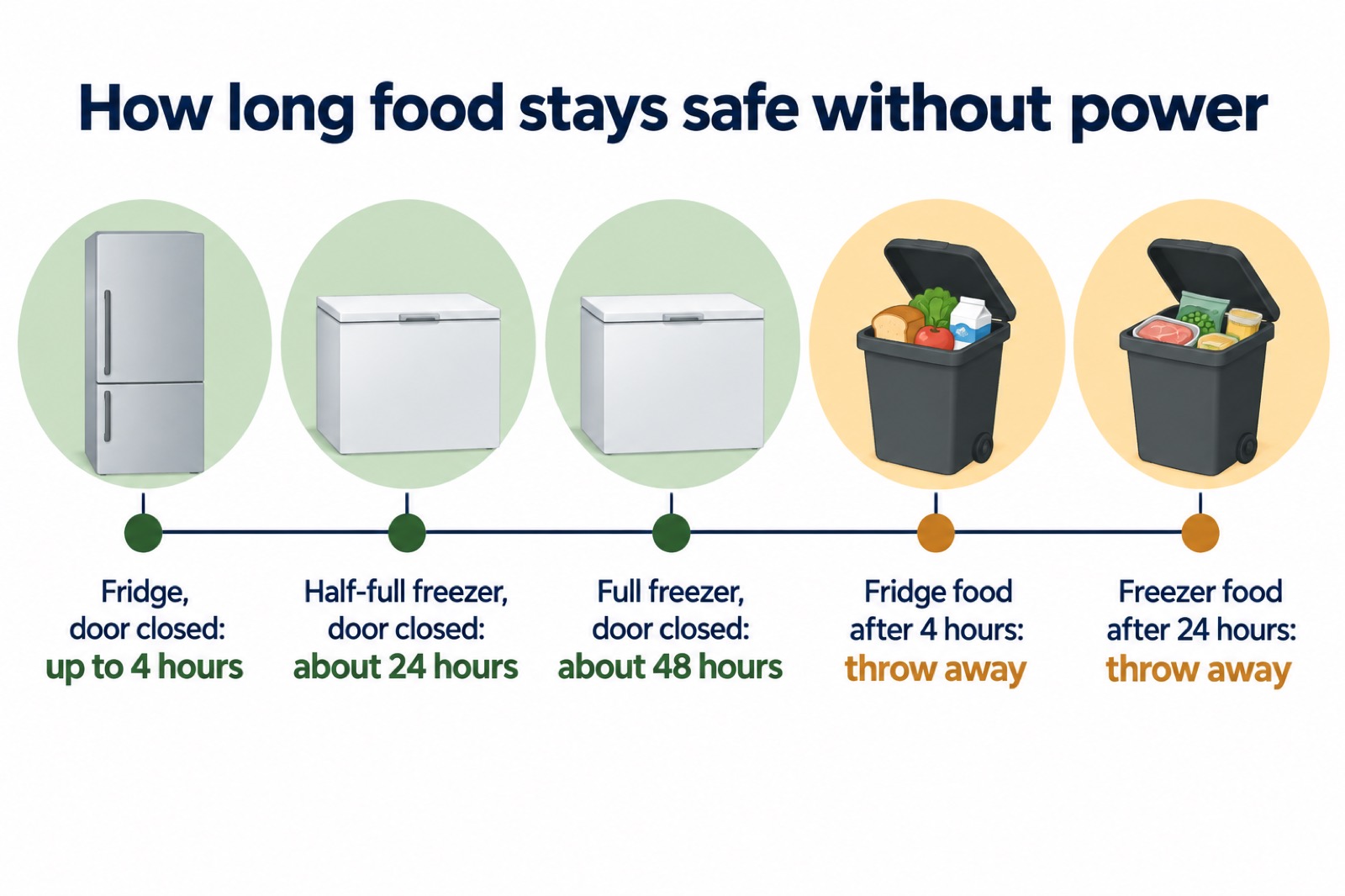
When the power goes off, the first question most households ask is whether the food in the fridge and freezer is still safe. The answer depends on how long the electricity has been off and how well you kept the doors shut. A closed fridge will usually stay cold for up to four hours1. A full freezer will hold its temperature for about 48 hours, or about 24 hours if it is half full, provided the door stays closed2.
Once the power returns, check the temperature and the state of the food before you eat anything. Throw away food from a fridge if the electricity has been off for more than 4 hours1. Throw away food from a freezer if the electricity has been off for more than 24 hours1. If meat, fish or foods containing them have started to get soft, throw them away too3. Never taste food to check whether it is safe4.
The sections below set out what to keep, what to throw, when refreezing is safe and where to get advice if you are unsure. The guiding rule from fire and rescue services is simple: if in doubt, throw it out5.
Food to throw away after a power cut
The first job when the electricity comes back is to sort the fridge and freezer contents into what can stay and what must go. The Food Standards Agency's rule, repeated by GOV.UK, is to throw away food from a fridge if the electricity has been off for more than 4 hours, and food from a freezer if it has been off for more than 24 hours1. Runnymede Borough Council gives the same fridge rule: if your fridge has lost power for more than four hours, throw away the food6.
Some foods need to go even sooner. The energy company SSE advises discarding any food you would eat when frozen, such as ice cream, if it has started to defrost, and not refreezing it3. If meat, fish or foods containing them have started to get soft, throw them away too3. Runnymede adds dairy to that list: throw away any meat, fish or dairy, or foods containing these, if they have started to get soft6.
If your freezer was not full, NIE Networks suggests grouping packages so they form an "igloo" to protect each other, and placing them to one side or on a tray so thawing juices will not get on other foods7. That is a tip for the next outage as much as this one.
| Appliance | How long food stays safe | What to throw away |
|---|---|---|
| Fridge | Up to 4 hours with the door closed1 | Food after more than 4 hours without power1 |
| Full freezer | About 48 hours with the door closed2 | Food after more than 24 hours without power1 |
| Half-full freezer | About 24 hours with the door closed2 | Food after more than 24 hours without power1 |
A fridge keeps food cold for about 4 hours if the door stays shut
The four-hour figure is not a guess. Food Standards Scotland states that your fridge should keep your food at a safe temperature for up to four hours2. National Grid Electricity Distribution, quoting the Food Standards Agency, says the same: your fridge will keep food safe for up to four hours during a power outage, provided the door is kept closed as much as possible8. The British Red Cross puts it plainly: a closed fridge will usually stay cold for up to four hours9.
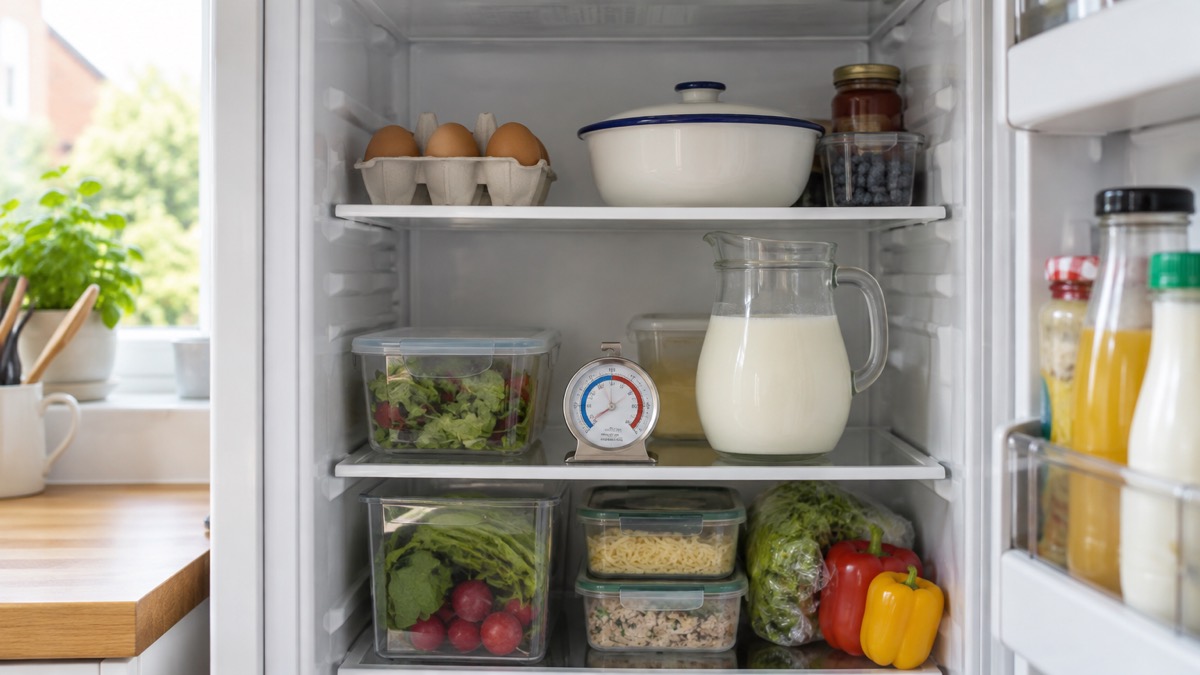
Which? gives a slightly wider range, saying food will typically stay safe in a fridge for four to six hours without power, as long as you keep the doors closed10. The difference matters if you are deciding at hour five. The safer course is to follow the four-hour rule and throw out anything that has been above 8°C.
Food Standards Scotland sets the safe limit at 8°C: during a power cut, it should be safe to store your food in the fridge as long as it does not rise to 8°C2. Which? advises throwing out meat, fish and dairy products if they have been above 4°C for more than a couple of hours10. The British Red Cross says that if the power cut lasts more than four hours, check refrigerated food carefully before eating it, and discard food that has been above 8°C for too long9.
The practical lesson is to keep the door shut. The Food Standards Agency advises that your fridge will keep food safe for up to four hours during a power outage, provided you keep the door closed as much as possible5. The Northern Ireland Executive's advice is to leave your fridge and freezer switched on with the door shut to keep a low temperature4.
A full freezer keeps food frozen for about 48 hours
A freezer holds its temperature far longer than a fridge, but only if it is full and the door stays shut. Food Standards Scotland states that the food in your freezer should stay frozen up to 48 hours if it is full, or about 24 hours if it is half full2. NIE Networks gives the same figures: a full freezer will keep its temperature for about 48 hours, or 24 hours if half full7. National Grid Electricity Distribution says a full freezer will hold its temperature for around 48 hours, or 24 hours if it is half full, so long as you keep the door closed11.
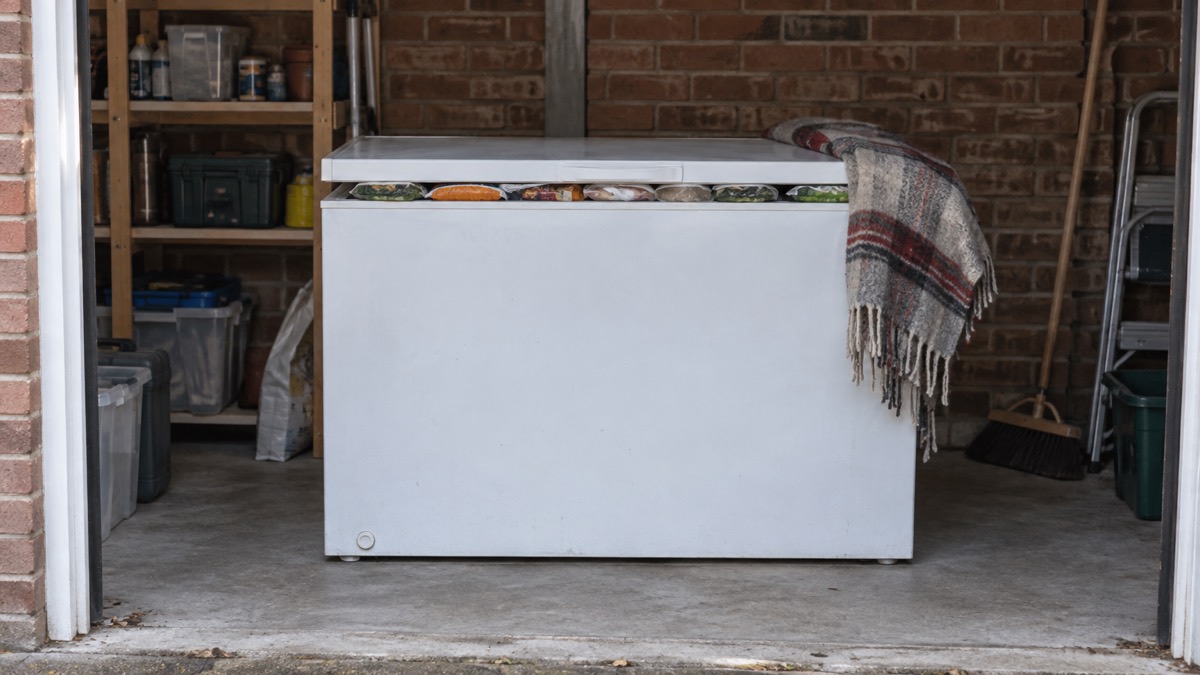
The Food Standards Agency and the network operators put a full freezer at up to 48 hours and a half-full one at about 24 hours, with the doors kept closed throughout2. One set of power cut guidance gives a much shorter figure, saying food should keep for about eight hours without power10. The difference may reflect how full the freezer is and how often the door is opened. Where the figures disagree, follow the more cautious course: if your freezer was not full, or the door was opened during the outage, treat the food as suspect sooner.
If the food is still hard and icy when the power returns, SSE advises leaving it in the freezer and turning the freezer to its maximum setting for 24 hours before returning it to a setting that keeps it at -18°C12. That helps the freezer recover its temperature quickly.
Refreezing thawed food: when it is safe and when it is not
Refreezing is the question that divides the guidance most sharply. Food Standards Scotland is clear: do not refreeze food that has thawed while the power was cut13. The fire and rescue service gives the same instruction after a fire or power loss: do not refreeze thawed food5. SSE advises discarding any food you would eat when frozen, such as ice cream, if it has started to defrost, and not refreezing these foods12.
The maker Jackery takes a more permissive line, stating that food that still has ice crystals, or reads 40°F (4.4°C) or below on a thermometer, can generally be refrozen safely, though texture and quality may suffer14. That is a maker's guidance, not official food safety advice. Where the two conflict, the official position should lead.
The practical rule for a household is this: if the food has fully thawed, do not refreeze it. If it still contains ice crystals and has stayed cold, you may refreeze it, but expect the quality to suffer. If you are unsure whether it thawed, treat it as thawed and throw it out.
| Situation | What to do | Who says so |
|---|---|---|
| Food that has thawed while the power was cut | Do not refreeze | Flooding food safety advice12 |
| Food still hard and icy, or at 4.4°C or below on a thermometer | Can generally be refrozen safely, though texture and quality may suffer | Refrigerator food safety guidance15 |
| Ice cream or other food you would eat frozen, once it has started to defrost | Discard it; do not refreeze | Freezer food during a power cut guidance10 |
| Thawed food generally | Do not refreeze | After a fire guidance13 |
Never taste food to check whether it is safe
Tasting food is not a safety test. Jackery states plainly that you should never taste food or rely on its appearance to determine its safety15. Its separate outage planning guidance repeats the point: never taste food to check if it is still good4. The same maker advises throwing away any food that has been exposed to higher temperatures, or that has an unusual odour, texture or colour15.
The official rule is simpler still. North Yorkshire Fire and Rescue Service says: if in doubt, throw it out5. Food Standards Scotland says: if you are not sure if food is safe to eat, throw it out13. Those two statements cover almost every case a household will face.
"If in doubt, throw it out."
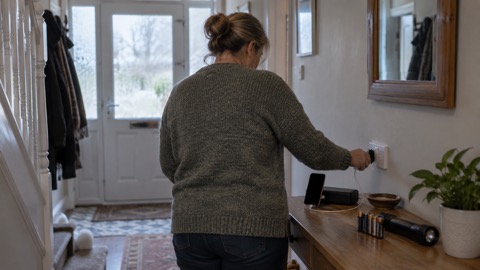
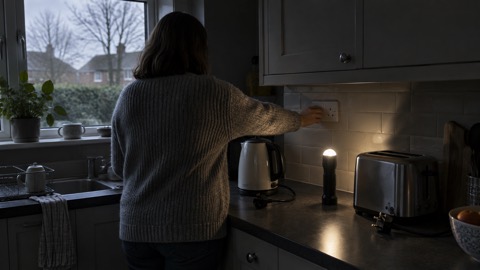
There is a second safety point that matters when you are clearing out the fridge. Before the power returns, switch off appliances that are not designed to run unattended, such as cookers, grills, chip pans, hair straighteners and electric fires, so they do not come on without you realising once the power is back16. The Met Office gives the same advice for irons, ovens, electric fires and fryers17. The national Prepare campaign adds that you should unplug your TV and PC, as they can be damaged if there is a surge when power goes back on18.
Where to get advice on food safety after an outage
If you are unsure about a particular food, there are several places to turn. Your local council's environmental health team can advise on food safety. The Food Standards Agency publishes guidance for households. Your electricity network operator can tell you how long the outage is expected to last, which helps you decide whether to move food to a neighbour's house.
North Yorkshire Fire and Rescue Service suggests considering transferring food to a neighbour's house if your fridge or freezer has lost power5. That is worth doing early, before the four-hour fridge window closes. In a widespread power outage, an emergency contact hub can share information on safe processes, such as how to keep food cool without a fridge19.
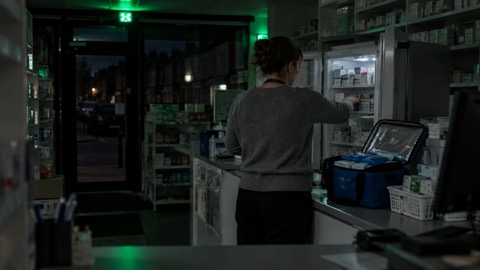
For medicines that need to be kept cold, United Lincolnshire Hospitals NHS Trust advises contacting your local pharmacy or the manufacturer of your medication for further information on what to do after a power cut or fridge breakdown20. Citizens Advice suggests considering a mini-fridge used only for medication, and notes that the longer a fridge or freezer door stays closed during a power cut, the longer it stays cold21.
If your home has been flooded as well as losing power, the advice changes. Any food that has come into contact with flood water should be disposed of immediately, preferably in plastic refuse sacks, double bagged if possible, and put out for your next refuse collection6. Food Standards Scotland adds that you should discard any food packaging that is punctured, torn, swollen or damaged13.
For households with a baby, the Northern Ireland Executive advises making sure you have a supply of pre-prepared formula baby milk, if you use it, and preparing a flask of hot water to heat bottles and baby food22. The national Prepare campaign adds that you should not drink milk or fresh fruit juice that smells as though it has gone off24.
If you need to report a power cut or find out when supplies will return, see our guide to reporting a loss of electricity. For more on keeping food safe during an outage, see fridge and freezer food when the electricity is off.
Sources (24)
- After a flood, GOV.UK, 2026-10-25
- Power cuts, Food Standards Scotland, 2026-10-25
- Repeat power cuts, SSE, 2026-10-25
- How to build a 72-hour household emergency power outage plan, Jackery, 2026-10-10
- Steps after a fire, North Yorkshire Fire and Rescue Service, 2026-06-17
- Flooding, Runnymede Borough Council, 2026-10-26
- How do I keep food safe, NIE Networks, 2026-10-25
- Tips to prepare for a power cut, National Grid, 2026-10-25
- Power cut, British Red Cross, 2026-10-25
- What to do in a power cut, Which?, 2026-06-04
- Hot weather advice, National Grid, 2026
- Planned power cuts, SSE, 2026-10-25
- Flooding, Food Standards Scotland, 2026-10-25
- How long does food last in the fridge without power, Jackery, 2026-10-10
- How to stay warm without power, Jackery, 2026-09-28
- 12 tips to prepare for a power cut, Horsted Keynes Parish Council, 2026
- What to do in a power cut, Met Office, 2026-10-25
- Power cuts, Prepare campaign, 2026-10-21
- Emergency contact hubs, Wiltshire and Swindon Prepared, 2026-10-25
- Storing medicines at home, United Lincolnshire Hospitals NHS Trust, 2026
- Prepare for a power cut, Citizens Advice, 2023-11-14
- Strong winds weather warning information and advice, Northern Ireland Executive, 2026-10-24
- Strong winds and heavy rain warning information and advice, Northern Ireland Executive, 2026-01-27
- Water supply interruptions or outages, Prepare campaign, 2026-10-12
 Power Cut Kit Checklist
 What to Keep Charged
 Household Emergency Plan
 Keeping One Room Warm
 Heating a Room With a Gas Hob
 Hot Water Bottles and Children
 Unplugging Appliances in a Cut
 Checking Your Trip Switches
 Vehicle Touches Overhead Line
 Reporting a Damaged Substation
 Protected Sites
 Heatwaves and Power Cuts
 Smart Meters and Power Cuts
 Keeping Medicine Cold
 Registering a Relative for Help