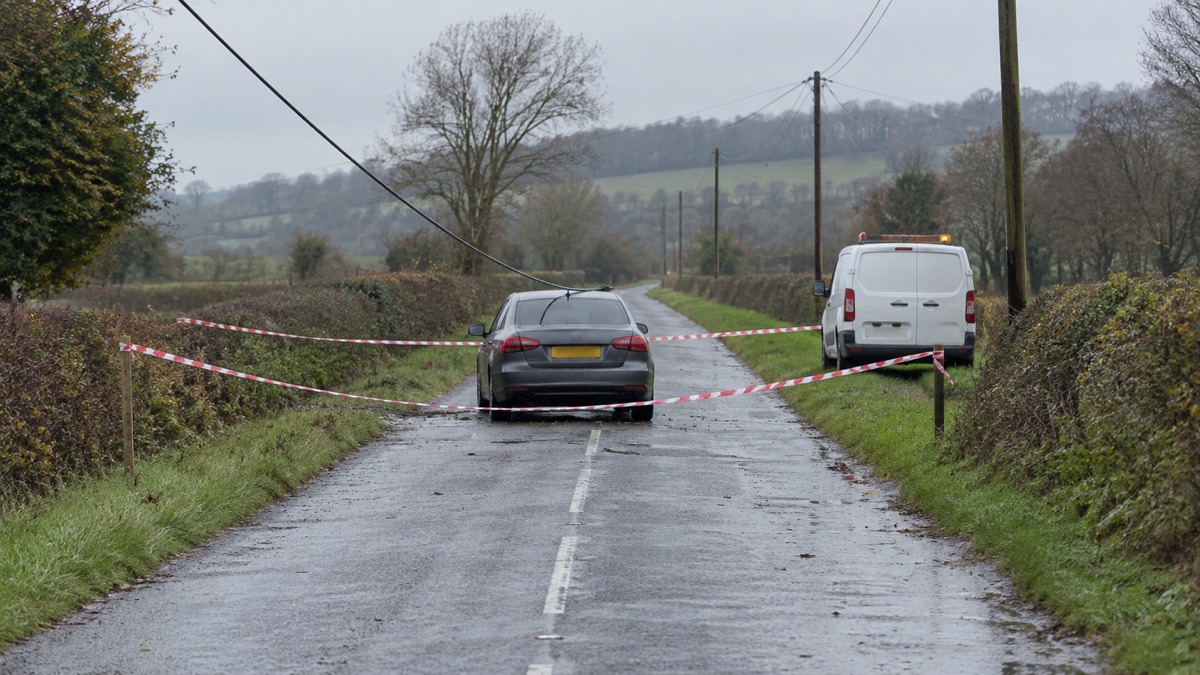
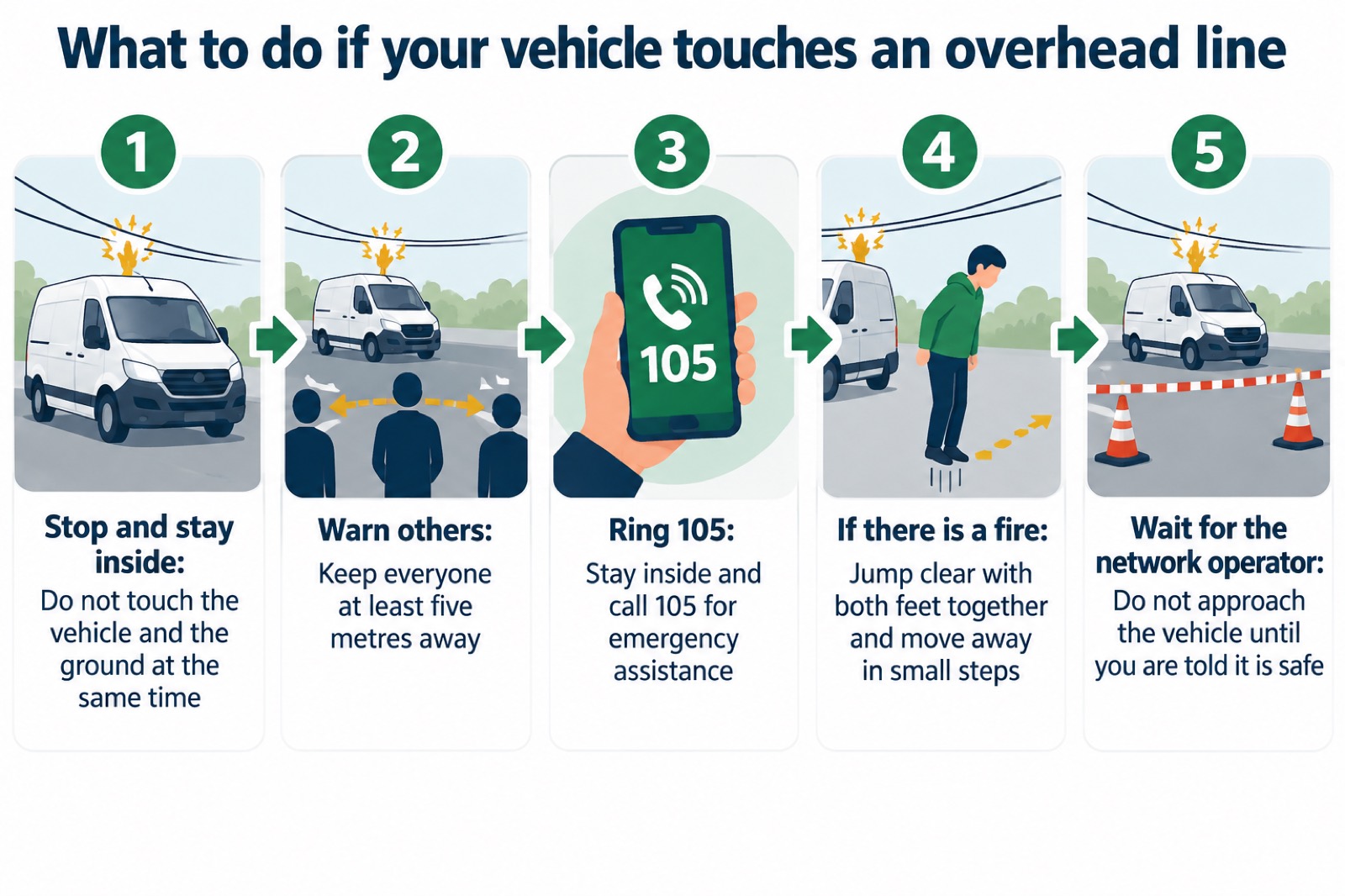
If your vehicle touches an overhead power line, the safest place is usually inside it. Touching the vehicle and the ground at the same time can create a deadly electric circuit, so stay put, warn everyone outside to keep away, and ring 105 for the network operator1. The metal body of the vehicle protects you as long as you do not step out and complete a path to earth.
The one exception is fire. If the vehicle catches fire, jump clear with both feet together and move away in small steps, keeping your feet close together1. Do not climb down touching the vehicle and the ground at once.
Every year, network engineers respond to hundreds of calls where members of the public have come into contact with overhead lines3. Most of these incidents are avoidable. Knowing what to do in the first minute, and what not to do, is what keeps a frightening moment from becoming a fatal one.
Stay in the vehicle if you can: touching the vehicle and the ground at the same time can kill
The reason to stay put is simple physics. If the vehicle is in contact with a live line, the metal body may be at a high voltage. As long as you stay inside and touch nothing outside, you are not part of a circuit. Step out and put one foot on the ground while a hand still touches the door, and the current can pass through you. Northern Powergrid puts it plainly: never touch the vehicle and the ground at the same time, as this could create a deadly electric circuit1.
This applies to cars, vans, lorries, tractors and any other vehicle. It applies whether the line is sparking or silent. It applies whether you feel a tingle or nothing at all. Electricity at high voltages can jump gaps with no warning, so the absence of a shock is not proof of safety5.
If you are in a car that has left the road, the fire and rescue service's general advice is to get off the road if you can and if it is safe to do so6. That advice is about ordinary breakdowns. When a power line is involved, the priority changes: stay inside and ring 1051.
For farm machinery, the advice is slightly different because the machine may be able to free itself. The network operator SSEN says that when machinery is in contact with an overhead line, stay in the cab and lower any raised parts in contact with the line, or drive the machinery out of the line if you can7. Do this only if you can do it from inside the cab without touching the ground.
Tell everyone outside to keep away from the vehicle and the line
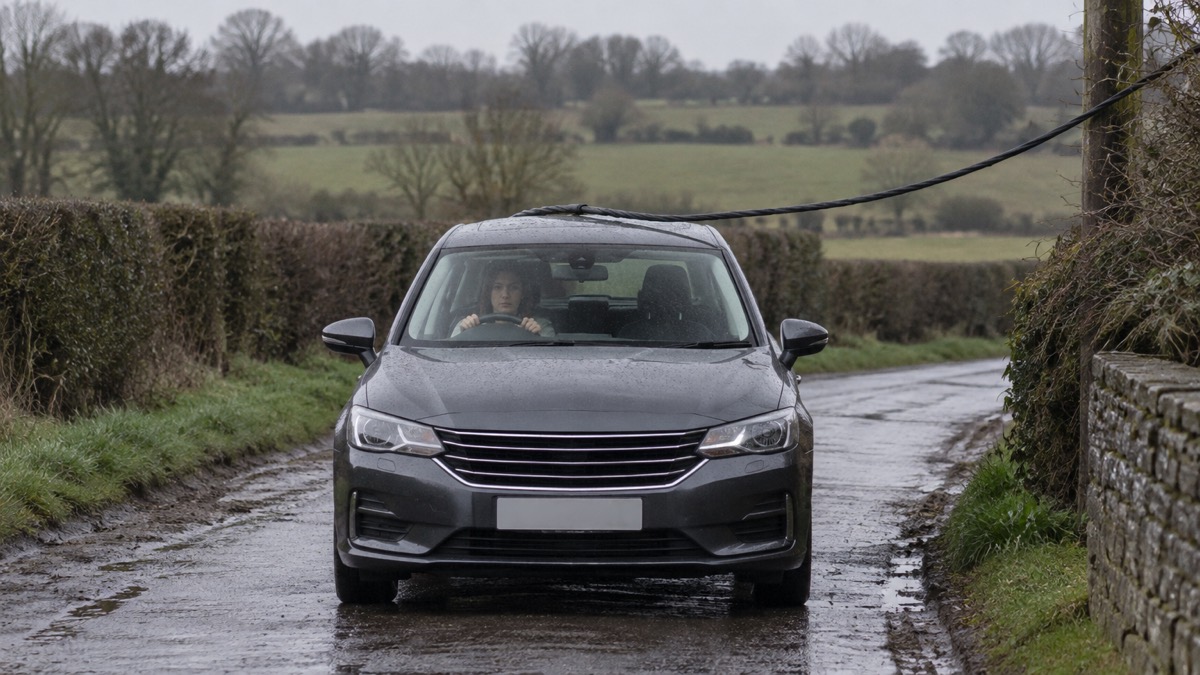
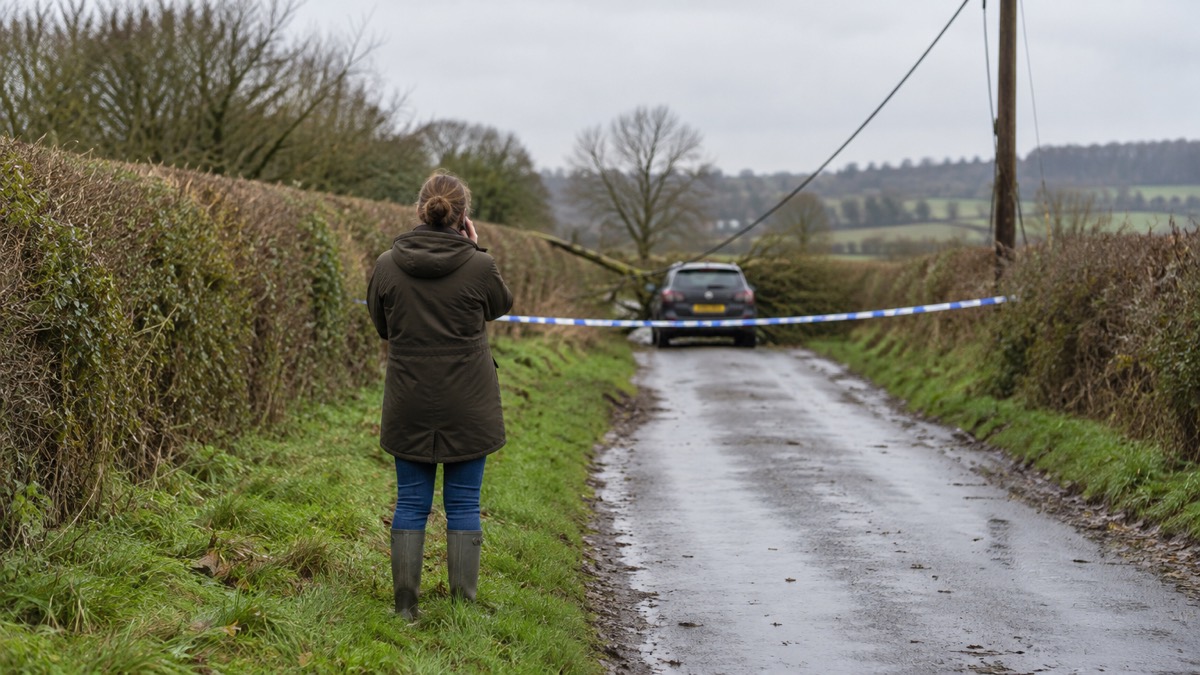
If you are the driver, your job is to stay inside and call for help. If you are a passer-by, your job is to keep everyone else back. SP Energy Networks advises keeping as far away from the hazard as possible and warning people in the vicinity to do the same2. Energy Networks Association adds a caution: keep other people as far away from the hazard as possible, but do not put yourself in danger8.
Distance matters because electricity can jump. Northern Powergrid says to stay at least five metres away from a damaged or fallen line and never attempt to move or touch it1. The Health and Safety Executive warns that electricity can flash over from overhead lines even though machinery or equipment may not touch them9. The Power Cut 105 service says the same: keep as far away from the hazard as possible, and remember that electricity can jump through the air10.
If someone is already in contact with the line, do not try to pull them free. The camping safety guidance from National Grid is clear: do not attempt to move camping equipment or a person if they are still in contact with a power line, and prevent third parties from entering an incident area3. The same principle applies at the roadside.
Who to call when a vehicle is touching an overhead line
Ring 105. That is the national number for power cuts and for damage to electricity lines and substations that could put someone in danger2. Northern Powergrid's advice for a vehicle in contact with a line is to stay inside and call 105 for emergency assistance1. SP Energy Networks says the same: report the problem to your network operator by calling 1052.
If there is a fire, or someone is injured, ring 999 first. The camping safety guidance from National Grid says to contact the emergency services through 999 and request an ambulance if required3. The fire and rescue service's advice for a car fire is to put your hazard lights on and get everyone out of the vehicle11. When a power line is involved, that changes: only leave the vehicle if it is on fire, and then jump clear with both feet together1.
In Northern Ireland, the number is different. The Northern Ireland Executive's weather warning advice says to report anything that looks dangerous to NIE Networks on 03457 64364312. The same number appears in NIE Networks' own public advice13. If you are in Northern Ireland and a vehicle is touching a line, ring 999 for the emergency services and NIE Networks on 03457 643643 for the network.
If a road or path is blocked by a fallen line, National Grid's safety advice says to call the police on 99914. It is an emergency, and they will respond immediately.
For non-urgent damage, such as a line that looks damaged but is not blocking anything, you can still ring 105. The service is there for exactly this: damage to power lines and substations that could put you or someone else in danger2.
Where it goes wrong: tall loads, raised machinery and radio aerials
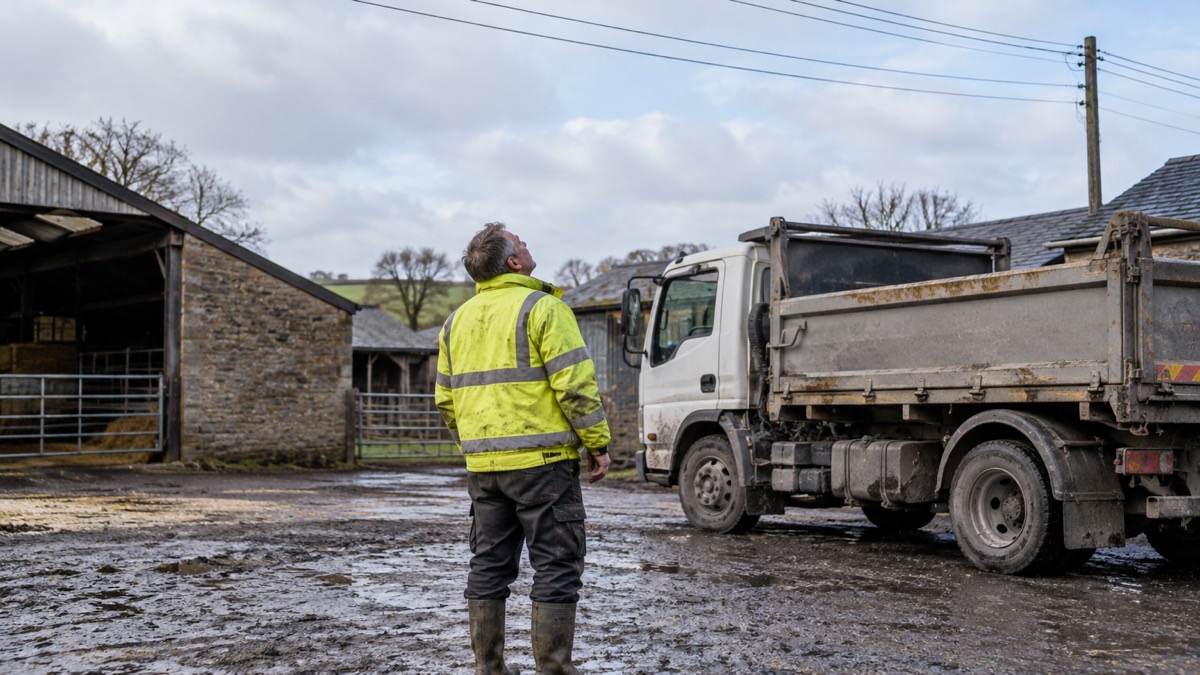
Most vehicle contacts with overhead lines happen because something tall was raised, extended or driven under a line without checking. Northern Powergrid's advice to tipper truck and lorry drivers is direct: check for overhead lines before raising beds or operating cranes1. The Health and Safety Executive says not to work under overhead lines when equipment such as ladders, a crane jib, a tipper-lorry body or a scaffold pole could come within a minimum of six metres of a power line without getting advice9.
Farm machinery is a particular risk. SSEN's safety message to farmers says that before you start work, always check for overhead lines and keep your machinery a safe distance away at all times15. The same operator says tiredness and time pressure are the primary reasons for accidents involving overhead power lines, according to feedback from farmers16. Harvest is a busy time, and the temptation to raise a tipper or extend a auger without looking up is strong.
Radio aerials, masts and other tall equipment on vehicles can also bring a vehicle into contact with a line. National Grid warns that it is dangerous to climb on top of high vehicles parked or passing under overhead electricity wires17. The same guidance says to avoid operating tall equipment or lifting gear beneath an overhead electricity line17.
The risk is not only from direct contact. Electricity can jump gaps and travel down strings, causing serious injury18. If you are flying a kite, a model aircraft or a drone, or handling a long conductive object near a line, let go immediately if it blows towards a line18. The same principle applies to anything long and metal on or near a vehicle.
Look out, look up: checking for overhead lines before you move
The best way to deal with a vehicle touching an overhead line is to avoid it happening. Before you raise a tipper, extend a crane, erect a mast or drive a tall load under wires, stop and look up. SSEN's campaign phrase is "Look out, look up": before you start work, always check for overhead lines and keep your machinery a safe distance away at all times15.
If you need to work near an overhead line, ask for advice first. UK Power Networks offers free safety advice and a visit from an expert when you need to work near an overhead power line19. The Health and Safety Executive says to speak to the line owner, such as the electricity company, railway company or tram operator, before any work begins9. Your local electricity distribution company can generally supply stickers detailing emergency procedures and contact numbers, which can be stuck in the cabs of vehicles likely to be used near overhead power lines20.
For farmers and contractors, the advice is to plan the job around the lines. Avoid operating tall equipment or lifting gear beneath an overhead electricity line17. Check for overhead lines before raising beds or operating cranes1. Keep machinery a safe distance away at all times15.
For campers and festival goers, the advice is to stay away from anything that looks as though it may be electrical, and to avoid pitching tents or caravans directly under overhead power lines3. National Grid warns that campers and festival goers are at risk of serious injury and even death if they ignore the dangers posed by overhead power lines3.
Sources (20)
- Power lines safety, Northern Powergrid, 2026
- What to do in a power cut, SP Energy Networks, 2026
- Camping safety, National Grid, 2026
- Winter ready, Isle of Anglesey County Council, 2026
- Power cuts: be informed about hazards, Prepare campaign, 2026
- In an emergency, London Fire Brigade, 2026
- Look out, look up: SSEN Distribution safety message to farmers, SSEN Distribution, 2025
- Power cut advice, Energy Networks Association, 2026
- Introduction to electricity, Health and Safety Executive, 2026
- Report a power cut, Power Cut 105, 2026
- Strong winds weather warning information and advice, Northern Ireland Executive, 2026
- Safety for kids, SSEN, 2026
- Public advice, NIE Networks, 2026
- Safety first, National Grid, 2026
- Safety, SSEN, 2026
- SSEN reminds farming community to look out, look up, look after yourself, SSEN, 2023
- Electricity emergencies and safety advice, National Grid, 2026
- Power, gas and water: what if they fail, Surrey County Council, 2026
- Safety advice and resources, UK Power Networks, 2026
- Electricity safety FAQs, Health and Safety Executive, 2026
 Power Cut Kit Checklist
 What to Keep Charged
 Household Emergency Plan
 Food to Throw Away After a Cut
 Keeping One Room Warm
 Heating a Room With a Gas Hob
 Hot Water Bottles and Children
 Unplugging Appliances in a Cut
 Checking Your Trip Switches
 Reporting a Damaged Substation
 Protected Sites
 Heatwaves and Power Cuts
 Smart Meters and Power Cuts
 Keeping Medicine Cold
 Registering a Relative for Help