
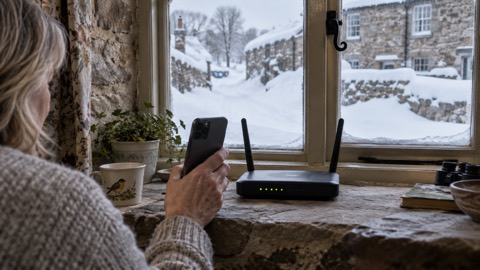
Most modern landlines stop working when the power goes off. If your phone service now runs over a digital line, it needs mains electricity, so a power cut takes the router and the phone line down with it1. The old analogue line carried its own power and often kept a simple phone working, but that network is being retired.
The practical answer is to check now, before a cut. If you have a corded phone plugged into a working analogue line, it might still work in a power cut3. If your line is digital, you need a battery back-up, and if you depend on your landline your provider must make sure you can still reach the emergency services1. In some circumstances that back-up is free.
This page explains what happens to each kind of phone, who is entitled to a free battery unit, and what to do if the power goes off and you need to call for help.
Digital landlines stop working when the power goes off
A digital landline is a phone service that runs over your broadband connection rather than the old copper telephone line. It needs mains electricity to work, so when the power fails the router goes off and the phone goes with it1. South Gloucestershire Council puts it plainly: digital landlines "cannot carry an electrical power connection, so in the event of a power cut they will not work"2.
This is the single biggest change for households. The old analogue line carried a small amount of power of its own, which is why a basic phone could sometimes keep working through a cut. A digital service has no such supply. National Grid's switchover guidance notes that the new digital landline "will need mains electricity to work"6.
The same applies to anything else that hangs off your broadband: internet services, landline phones and some mobile phone networks may not work during a power cut7. Gas boilers and heating, electrical appliances and your home's internet and landline connections will also stop8. If you have a smart meter display, a home hub or a connected thermostat, expect those to go dark too.
What this means in practice is that the phone in the hall is no longer a guaranteed way to call for help. That does not make a digital line unsafe, but it does mean the back-up question matters. Ofcom's position is that if you depend on your landline, your provider must make sure you can contact the emergency services during a power cut1. The rest of this page is about how that works and what you need to do.
Why a corded phone might still work in a power cut
A corded phone is the old-fashioned kind: a handset on a coiled lead, plugged straight into the wall socket, with no base unit and no mains plug. If you have a corded landline phone, this might still be working in a power cut3. Cordless phones won't work during a power cut, so keep a corded phone plugged in or have one ready to use5.
The key word is "might". Government guidance says that "if you have a corded landline phone, this might still be working in a power cut"3. It is not a guarantee, and it depends on your line still being analogue rather than digital. Once your service moves to a digital line, a corded phone plugged into the old socket will not help, because the line itself has no power.
Cordless phones are a different matter. They take their power straight from the mains through their base unit, and most have no battery back-up, so they probably will not work during a power cut4. That is why the advice is consistent across official and independent guidance: keep a corded phone plugged in, or have one ready to plug in4.
The practical step is simple. Find one corded phone, check it has a standard plug that fits your wall socket, and keep it somewhere you can reach in the dark. If you have already moved to a digital line, a corded phone is no substitute for a back-up battery, but it costs nothing to keep one as a spare for the day the line changes back or for a second socket.
Battery back-up: the free help your provider might offer
If your landline will not work during a power cut, your provider might offer you a free solution, such as a back-up battery unit, for a minimum of one hour, so you can call the emergency services if you need to5. That one hour is the floor, not the limit: for vulnerable customers with an analogue landline, the free back-up battery unit means the landline would work for at least an hour during a power cut, and many batteries now last much longer10.
The entitlement is stronger than "might" in some cases. Ofcom states that if you do not have a working mobile phone or a reliable mobile signal, your landline provider must offer you a free back-up solution such as a battery back-up unit1. Vulnerable customers, for example telecare users who still have an analogue line and have not yet moved to a digital network, must also be given a free back-up battery unit, which means the line would work for at least an hour during a cut10.
| Situation | What the provider should do |
|---|---|
| You depend on your landline for emergency calls | Make sure you can contact the emergency services during a power cut1 |
| No working mobile and no reliable signal | Offer a free back-up solution such as a battery unit1 |
| Vulnerable customer, for example a telecare user on an analogue line | Provide a free back-up battery unit, working for at least an hour10 |
| Telecare user in Scotland | Provider will assess your needs and may provide a free battery backup and have engineers test it11 |
The battery unit itself is usually a small box that sits between the wall socket and your phone or router, holding a charge so the line stays live for a while. It does not power your whole home, and it will not keep the lights on. Its job is narrow and important: to keep the phone working long enough to make a call.
If you think you qualify, ask. The entitlement is not automatic in the sense that providers know your circumstances; they rely on you telling them. Say clearly that you have no working mobile or no reliable signal, or that you rely on a telecare alarm, and ask for the free back-up unit. For more on what providers can offer, see Extra Help From Phone and Broadband Providers and Getting a Free Battery Backup for a Digital Landline.
The switch from analogue lines to digital
Telephone providers across the UK are switching traditional landlines to digital phone lines. This is being carried out by the telecoms industry, not by the electricity networks, but it changes how you reach help during a power cut6. The old analogue network is being retired, and the replacement runs over broadband.
The change is not meant to cost anyone their service. The phone number stays the same, and most handsets will work fine with the new system12. What changes is the power arrangement: a digital line needs mains electricity, so a power cut now affects the phone as well as the lights.
The timetable matters if you are deciding when to act. Telephone providers across the UK are switching traditional landlines to digital phone lines, and this is being carried out by the telecoms industry, not by National Grid13. The new, digital landline will need mains electricity to work14. The exact date your own line changes depends on your provider and your area, so the safe assumption is that it will happen, and plan for it now.
There is a wider concern behind the switch. Citizens Advice has reported that the digitalisation of communications infrastructure, including analogue landlines being phased out, is making it more likely that people cannot call for help in a power cut15. That is why the back-up entitlement exists, and why it is worth checking your own setup rather than assuming the phone will always work.
If you want the full picture of what changes and when, see The Digital Landline Switchover: What Changes for Your Home Phone and When Does the Analogue Phone Network Switch Off?.
Check with your provider before a power cut
The single most useful thing you can do is contact your landline provider and ask a direct question: will my phone work during a power cut? The Centre for Sustainable Energy advises exactly this, because your provider can tell you whether your phone would work in a cut16. Government guidance adds that you should do this if your only way of making emergency calls is through a landline, or if you have a telecare kit connected to your line5.
When you call, have these details ready:
- Your account number and the phone number on the line.
- Whether you have a working mobile phone and a reliable signal at home.
- Whether you use a telecare alarm, fall detector or medical pendant.
- Whether anyone in the household depends on the line for medical or mobility reasons.
Ask specifically whether you qualify for a free back-up battery unit, and if so, how it will be fitted and tested. If you are a telecare user, the provider may assess your needs and have engineers test the back-up so your alarm keeps working during a cut11.
That warning comes from National Grid's switchover guidance, and it applies to anyone who relies on an alarm to summon help. The alarm may be connected to your phone line, and if the line is digital and unpowered, the alarm may not be able to raise the call. The fix is to confirm compatibility with the alarm supplier and, where you qualify, to get the back-up battery in place.
If you have a telecare alarm, the dedicated pages Telecare and Personal Alarms When Phone Lines Go Digital and Will a Burglar Alarm Work After the Digital Switchover? go further. For the wider question of keeping in touch when networks fail, see What to Do When Phones and the Internet Go Down.
Calling 999 when the line is dead
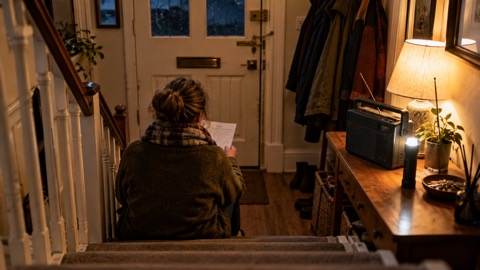
If you have a power cut, no back-up power to your landline, and a life-threatening emergency, you should attempt to call 999 or 112 using a mobile5. You might get a signal from a nearby area that is not affected, because emergency calls automatically roam onto all available networks5. That roaming behaviour is the reason a mobile with no apparent signal can still sometimes connect an emergency call.
This is a fallback, not a plan. Mobile networks can also be affected in a power cut, and you may lose signal entirely7. If you have a mobile, keep it charged and keep the numbers you might need written down on paper, because a dead phone cannot show you a contact list17. A non-mains powered landline telephone will also help you stay in touch during any disruption to your power supply18.
"If you have a power cut and you don't have back-up power to your landline phone (or have a corded landline) and have a life-threatening emergency, you should attempt to call 999 or 112 using a mobile."
For the mechanics of emergency calls, including what happens when you ring and how to give your location, see Calling 999 and 112: What Happens When You Ring and How to Call 999 When Your Mobile Network Is Down. If you cannot speak, What to Do If You Dial 999 but Cannot Speak explains the options.
Extra help if you rely on your line
Some households need more than a battery unit. If you are older, disabled or medically dependent, there are schemes that put you on a list for extra support during a power cut. The Priority Services Register is the main one: it is a free service from energy suppliers and network operators that flags your needs so you can be contacted and helped first19.
You can ask to join if you are of pensionable age, disabled, have a long-term medical condition, have children under five, or rely on medical equipment11. The register is run by energy suppliers and network operators, and you can sign up through your supplier or your local network operator20. It is separate from anything your phone provider offers, and it is worth doing both.
In Scotland, the arrangements are similar but the advice is published separately. Ready Scotland's guidance for disabled people and carers covers what to do before, during and after a power cut, including keeping a non-mains powered phone to hand11. In Wales, the same Ofcom back-up entitlement applies, and the Welsh-language version of the guidance confirms that if you have no working mobile or reliable signal, your provider must offer a free back-up solution such as a battery unit21. In Northern Ireland, nidirect advises having the phone numbers you might need to hand, as well as mobile phones, and notes that a non-mains powered landline telephone will help you stay in touch during any disruption to your power supply17.
| Nation | Where to get the extra help |
|---|---|
| England | Priority Services Register through your energy supplier or network operator19 |
| Scotland | Ready Scotland guidance for disabled people and carers11 |
| Wales | Ofcom guidance, including the Welsh-language version21 |
| Northern Ireland | nidirect power cut advice17 |
For a fuller picture of support for households that need it, see Extra Help in an Emergency: Older, Disabled and Medically Dependent Households. If you are preparing generally, Power Cuts: A Household Guide covers the wider kit and steps.
Sources (22)
- Future of landline calls, Ofcom, 2026-08-26
- Switchover to digital landlines, South Gloucestershire Council, 2026
- Power cuts, UK Government, 2026-10-21
- What to do in a power cut, SP Energy Networks, 2026-10-26
- Power cuts, UK Government, 2026-10-21
- The landline switchover, National Grid, 2026-10-25
- Power cut, British Red Cross, 2026-10-25
- Storms and bad weather, Energy Networks Association, 2026-10-25
- Tips to prepare for a power cut, Electricity North West, 2026-10-25
- Loss of essential services, Greater Manchester Combined Authority, 2026-10-29
- Disabled people and carers, Ready Scotland, 2026-10-25
- The digital switchover, Suffolk County Council, 2026-10-29
- Analogue phone lines, Openreach, 2027-01-31
- Digital Voice, BT, 2027-01
- Lights out: improving people's experience of power cuts, Citizens Advice, 2026-03-19
- Preparing for a power cut, Centre for Sustainable Energy, 2026-08
- Strong winds weather warning information and advice, nidirect, 2026-10-24
- Get prepared, Carmarthenshire County Council, 2026-10-28
- Priority services, National Grid, 2026
- Priority Services Register, National Grid, 2026
- Stay connected in severe weather, Ofcom, 2026-10-13
- Strong winds and heavy rain warning information and advice, nidirect, 2026-01-27
 Free Alert Services
 Emergency Apps
 Digital Switchover Checklist
 Silent 999 Calls
 Giving Your Exact Location
 When to Call 999
 Calling 999 With No Signal
 999 by Wi-Fi Calling
 When You Get an Alert
 Alerts While Driving
 Spotting a Genuine Alert
 Phones That Get Alerts
 Emergency Alerts On or Off
 Emergency Alert Privacy
 Emergency Alert Tests