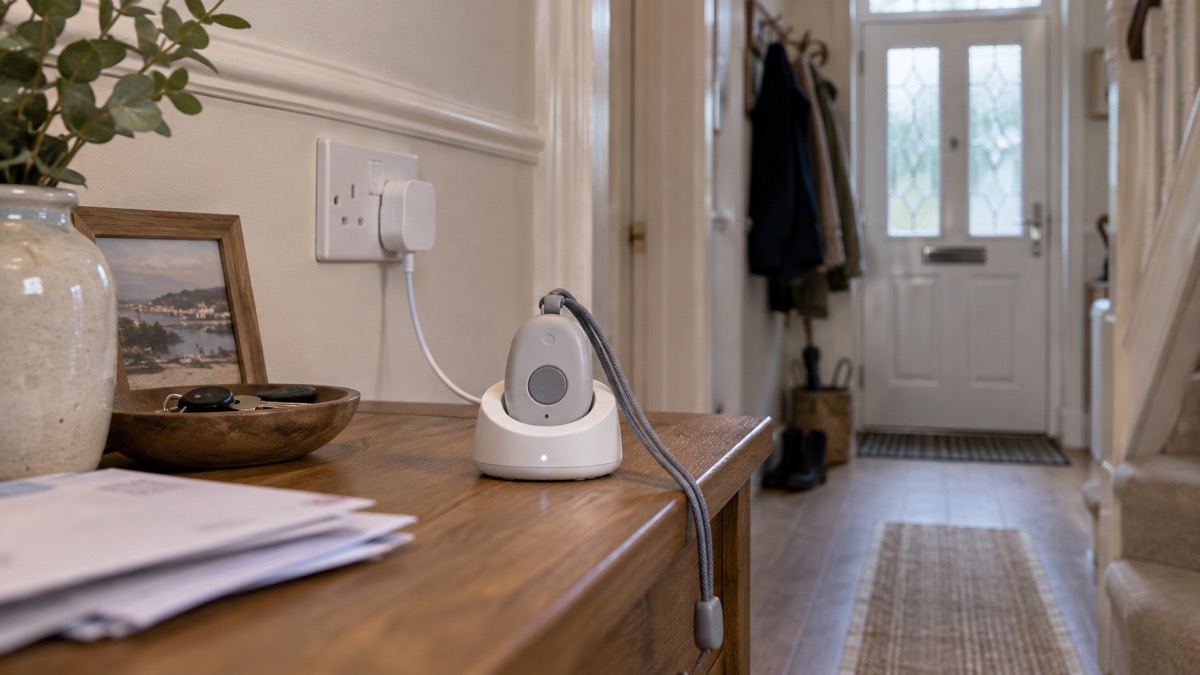
A fall detector is a small sensor worn on the body that sends an alert by itself if the wearer falls, without anyone pressing a button1. It is built for the fall nobody plans for: the person who is unconscious, badly injured, or simply cannot reach a phone. Carers UK describes it simply as a sensor the person wears, which sends an alert if the person falls2. The reason it matters is blunt. The maker Taking Care warns that without assistance, someone who has fallen may not be found until a carer visit or welfare check, in some instances days later, and that hypothermia, dehydration, blood loss and fractures are a real danger1.
This page explains how automatic fall detection actually works, what happens when an alert is raised, which falls a detector can miss, why false alarms happen, and how a fall detector compares with a smartwatch. It sits alongside our wider guides to personal alarms, what happens when you press an alarm and falls at home.
What a fall detector does
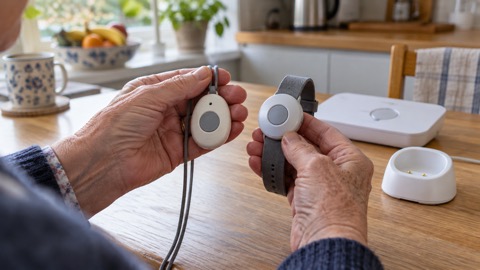
A fall detector is not the same thing as a standard pendant alarm. A standard pendant or wristband has a button you press to call for help if you fall4. A fall detector adds a layer on top of that: it senses the fall itself and raises the alert even if the wearer is unconscious or unable to move1. Taking Care's Digital Fall Alarm is described by the maker as a home and garden alarm with automatic fall detection that can raise an alert if the wearer falls, even if they are unable to press the button5.
Councils describe the same thing in their telecare services. Anglesey's Telecare service, for example, offers a neck-worn fall detector designed to identify a serious fall that leads to unconsciousness and immobility, and to raise an automatic call to the monitoring centre6. Warwickshire Council lists lifeline pendant and wrist-worn alarms that can be used to alert a family member, carer or call centre following a fall7. So the alert may go to a professional monitoring centre, or to a family member or carer, depending on the service you choose.
The value is in the gap it fills. A pendant button only works if the wearer can press it. A mobile phone only works if it is within reach and the person can use it. NHS inform's guidance on what to do if you fall lists the ways to call for help: a community alarm, a phone call to a relative, friend or neighbour, a smart speaker, or shouting and banging on a wall8. A fall detector covers the situations where none of those is possible.
How automatic detection works
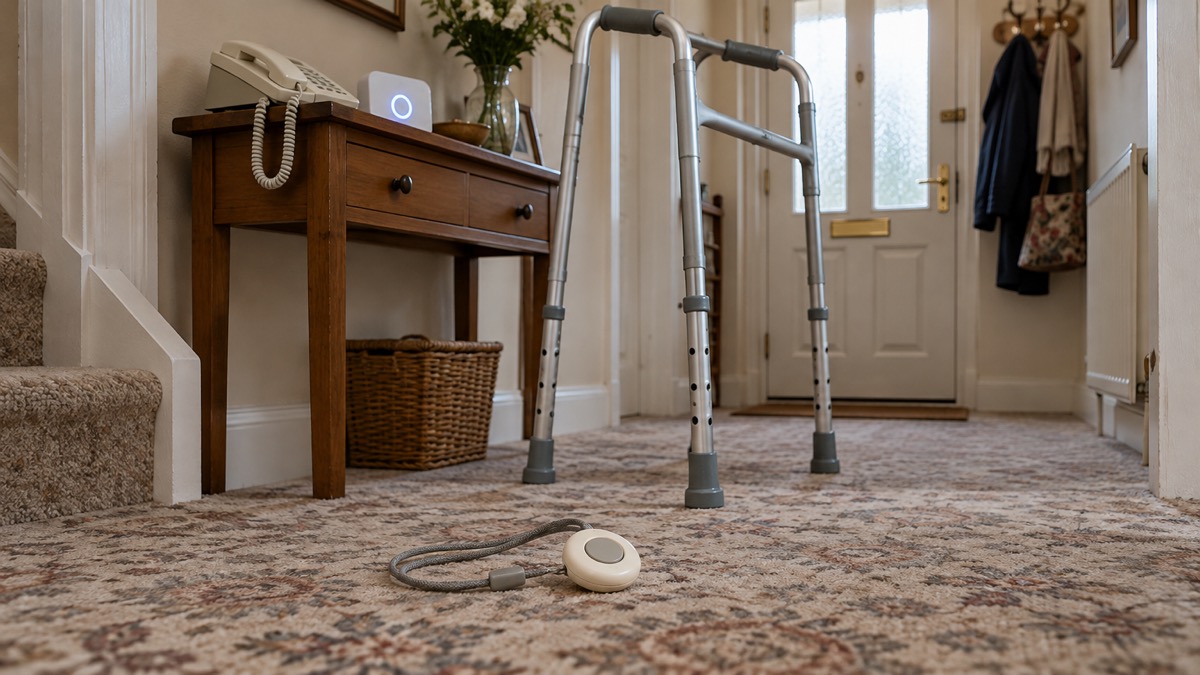
Inside a fall detector are motion sensors, typically accelerometers and gyroscopes, running a sophisticated algorithm designed to react to a sudden free fall from a standing position, followed by a significant impact and no movement1. In plain terms, the device is looking for three things in sequence: the drop, the landing, and then stillness.
Each part matters. The free fall is the signature of the body dropping rather than lowering itself. The impact is the landing. The stillness afterwards is what separates a fall from everyday movement: someone who has deliberately sat or lain down usually moves again within moments, while someone injured or unconscious does not. Taking Care's Digital Fall Alarm uses an algorithm to recognise the difference between what the maker calls "hard" falls and other movements5.
Because the detection is a pattern match, not a camera or a human eye, it has limits baked in. The same maker states plainly that the fall detector may not detect every fall, as it is designed to detect hard, unobstructed falls5. That single sentence should shape how the household uses the device: it is a safety net, not a guarantee, and the button on the device still matters. We cover the falls it can miss in detail below, and in our page on which falls a fall detector may miss.
One practical point in the buyer's favour: Taking Care states that its fall alarms work straight out of the box and do not need to be specifically configured for each user1. There is no fitting appointment or calibration session to arrange before the device is protecting someone.
What happens after an alert
When a fall is detected, the pendant itself will beep as it makes the alarm call, so the wearer knows the alert is under way1. With Taking Care's service, the Emergency Resolution Team answers the alarm call and will know who is calling and where they are1. That last part is the heart of a monitored service: the person answering does not need the caller to explain who they are or give an address, which matters when the caller is confused, breathless or unable to speak at all. Our page on what happens if you press your alarm but cannot speak covers this situation.
What happens next depends on the service and where you are in the UK. In Wales, the Welsh Ambulance Service describes a Falls Desk where expert clinicians remotely assess the caller's needs and provide tailored advice designed to get help quickly to people who have fallen9. In Scotland, the Scottish Ambulance Service explains that if call details require further clarification, the call is passed to a clinician, potentially a paramedic, who asks questions to identify what the patient requires; the response could be an ambulance or referral to community services10. So an alert does not automatically mean an ambulance is dispatched: a trained person assesses first, which can mean a more appropriate response.
The monitoring centre will also have the wearer's details on file, including who to contact. This is why setting the service up properly, with correct information about the wearer and their nominated contacts, is worth doing carefully even though the device itself needs no configuration. A key safe outside the home is often paired with an alarm so that responders can get in without breaking a door.
Falls a detector may miss
This is the section to read twice. Automatic detection is a pattern match, and some real falls simply do not match the pattern. Taking Care identifies the falls its device may not detect: slumping or falling from a sitting position, and falls that are broken, such as when the wearer holds on to something on the way down1. A slow slide from a chair, or a fall cushioned by a hand on a doorframe, may not produce the sharp free fall and impact the algorithm is looking for.
How the device is worn changes what it catches. The maker states that backward falls are less likely to be detected when the pendant is worn around the neck, because the pendant is protected by the body1. Wrist-worn fall alarms may be affected if the arms are cradled to the chest or covered by clothing during a fall1. Neither is a reason to avoid either style, but it is a reason to think about which falls are most likely for the individual wearer.
There is also a height limit. The algorithm may not trigger an alarm call if the person wearing the fall alarm is less than 1.2 metres, about 4 feet, tall1. The detection is built around the physics of a fall from standing height, and a shorter drop may not register as one.
Other telecare sensors can fill some of these gaps. Anglesey's Telecare service offers a bed or chair occupancy sensor that provides an early warning by alerting that the user has left their bed or chair and not returned within a preset time period, indicating a potential fall6. For falls the worn detector cannot see, that kind of environmental sensor is the usual complement.
Press the button whenever you can
Because detection has limits, the single most important habit for anyone wearing a fall alarm is this: press the button. Taking Care's own guidance is unambiguous, and it is worth quoting directly.
"we always recommend pressing the button on the fall alarm pendant to call for help if possible."
The reason is the list of falls the algorithm may miss. If you slip from a chair, or break your fall against a worktop, or you are simply able to reach the button, pressing it is faster and more certain than waiting to see whether the sensor has registered the fall. The button and the detector are two routes to the same help, and the button is the one that always works when the wearer can use it.
For households arranging support around an alarm, the same principle extends outward. The Stay Steady and Safe home safety checklist from the NHS in Norfolk and Suffolk advises people to consider a personal alarm or falls detector if it would help, and to arrange for someone to check in regularly if this support is needed11. A detector plus a daily check-in call covers more ground than either alone. Our page on living alone sets out the wider picture.
Neck pendant, wrist-worn or GPS
Fall detectors come in three broad styles, and the right one depends on where the wearer goes and how they live.
| Style | How it is worn | Where it works | Best suited to |
|---|---|---|---|
| Home fall alarm pendant | Neck chain or wrist strap5 | Home and garden, up to 300 metres from the base unit5 | Someone who spends most time at home |
| GPS fall alarm | Neck worn5 | Home and out and about, shares GPS location in an emergency5 | Someone who walks, shops or gardens away from home |
| Standard pendant or wristband | Wrist or around the neck4 | Wherever the alarm service covers | Someone who can press a button and wants a simpler device |
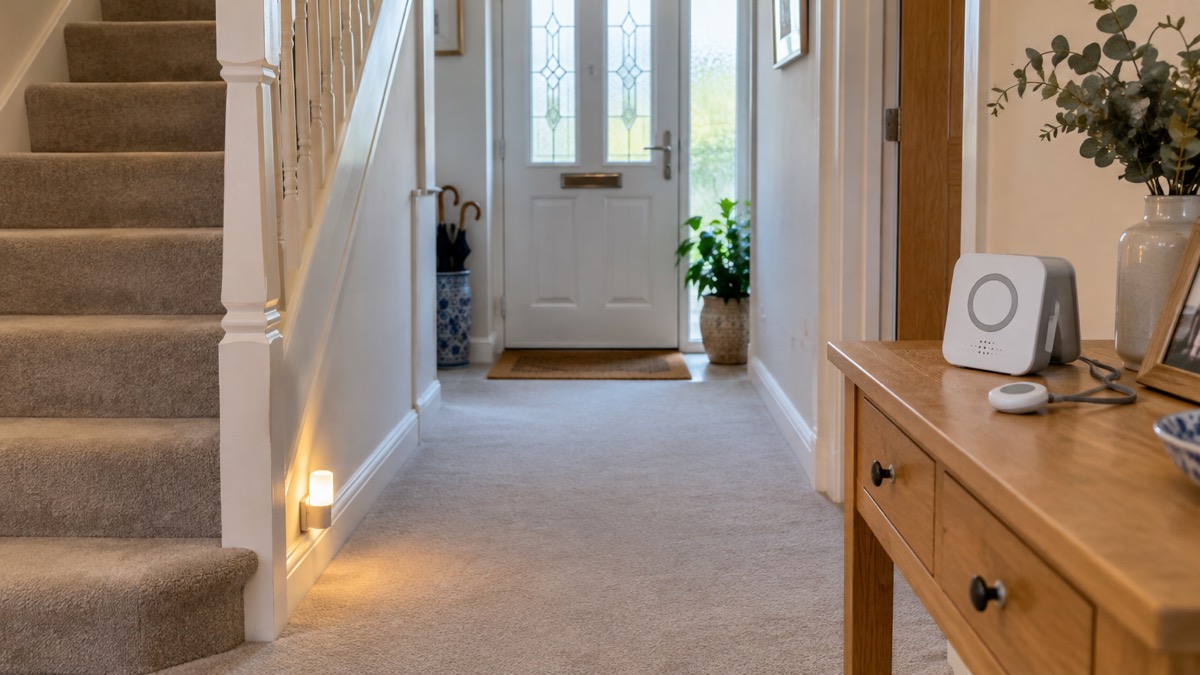
The home pendant is the common choice. Taking Care's Digital Fall Alarm can be worn on a hypoallergenic neck chain or wrist strap, and works throughout the home and garden up to 300 metres, about 984 feet, from the base unit5. Our page on how far from the base unit a pendant alarm works explains the range in practice.
The GPS style suits people who are out and about. Taking Care's Anywhere product is described by the maker as a GPS personal alarm for support at home and out and about, with fall detection for reassurance on the move; it shares GPS location in an emergency and can be spoken through at the pendant or base unit5. NHS inform in Scotland notes that GPS tracking devices can also be worn on the wrist, carried on a keychain or put into shoes, particularly for people at risk of getting lost4. Our comparison of home personal alarms and GPS alarms works through the choice.
A simpler option remains valid. Independent Age describes telecare as a pendant or wristband you wear, with a button to call for help if you fall12, and Manchester Fire and Rescue Service describes pendant and bracelet devices you press to alert a contact centre that assistance is required13. If the wearer can reliably press a button, a standard alarm without automatic detection may be enough, and it avoids the false-alarm issues covered below.
False alarms and what causes them
False alarms happen, and knowing why reduces both their frequency and the annoyance they cause. Taking Care lists the causes: movement that is similar to a fall, not wearing the fall alarm as recommended, and, very rarely, faulty equipment1. In practice, that means a sharp lowering into a chair, vigorous housework, or a pendant worn loose under layers of clothing can all look, to the algorithm, like a fall.
There is a parallel worth drawing from fire alarms, because the lesson is the same. Warwickshire County Council advises that all false alarms should be investigated to identify the cause and any necessary remedial action taken [34 is not cited here; see 14]. The fire and rescue principle applies directly: do not just sigh and reset. If a fall alarm goes off when nobody fell, work out which of the known causes it was, and fix the wearing habit or the movement pattern behind it.
One group needs particular attention. Taking Care warns that someone with tremors, epilepsy or Parkinson's may accidentally cancel an alert, and that for some customers a digital personal alarm without fall detection may be more suitable5. The cancellation step exists so a conscious person can stop an unwanted call, but a tremor can press it by accident after a real fall. If the wearer has one of these conditions, raise it with the provider before choosing a device.
On sensitivity: it is not possible to adjust the fall alarm sensitivity yourself. The maker's advice is to contact customer services if the alarm seems too sensitive, and a faulty device will be replaced free of charge1. Cleaning is similarly simple: wipe the pendant with a dry cloth if it becomes dirty, because water or cleaning products may damage it1.
Who benefits most from a fall alarm
The clearest fit is someone who lives alone or has a history of falls. Taking Care states that fall alarms and elderly fall alerts are particularly valuable in exactly those circumstances1. Carers UK adds two groups: people who are living independently, and carers who spend periods of time away from the person they care for2. For a carer who cannot be present every hour, a detector that raises its own alert is the difference between knowing within minutes and knowing at the next visit.
Age is the other marker. Somerset Council notes that because of the more severe health outcomes, people aged 60 years and over are considered the most vulnerable age group for falls on level surfaces14. Cheshire Fire and Rescue Service adds the reason: as we age, our reactions slow down and bones become more fragile, so even a small trip can lead to a serious injury15. Falls also compound other risks. The same fire service warns that falls can increase the risk of fire, because someone who has fallen or is unsteady may find it harder to react quickly, turn off appliances or respond to a smoke alarm15. Our page on fire risk for older and disabled people develops this.
Some alarm services are aimed squarely at the people most at risk. Taking Care states that fall alarms are particularly valuable to someone who lives alone or has a history of falls5, and the numbers bear that out: falls affect 40% of people over 805, and people aged 60 and over are considered the most vulnerable age group for falls on level surfaces because of the more severe health outcomes. NHS inform's telecare self-check tool in Scotland can help a household work out whether telecare would help them16, and the UK Government publishes guidance on finding a telecare provider17. Local council telecare services, like Anglesey's6 and Staffordshire's18, are often the route to a monitored service at home.
Reducing the risk of falling at home
A fall detector gets help quickly; it does not prevent the fall. Both matter, and the prevention steps are mostly small changes around the home.
- Remove trip hazards: clutter, trailing wires and frayed carpet15
- Clear clutter away from floors or stairs, move small furniture and pet bowls, and get rid of loose mats or rugs19
- Pay attention to rugs, loose carpets, especially on the stairs, and slippery floors; remove trailing flexes, unsteady furniture and objects lying on the floor20
- Keep your home well lit and consider motion-activated lights12
- Improve lighting, in the advice of the North West Ambulance Service21
- Wear shoes with good grip, advice the South Western Ambulance Service gives for older neighbours in winter22
- Use a rucksack for shopping, so your hands are free outdoors12
- If incontinence is a problem, speak to your GP, because many older people fall when rushing to the toilet12
None of this is expensive or complicated, and most of it can be done in an afternoon. The NHS preventing falls guidance for North Cheshire and Mersey frames it as clearing the things that catch feet and eyes19, and the fire and rescue services frame it as removing the things that catch feet15. For the bathroom specifically, see our guide to making a bathroom safer against falls.
After a fall: always tell a health professional
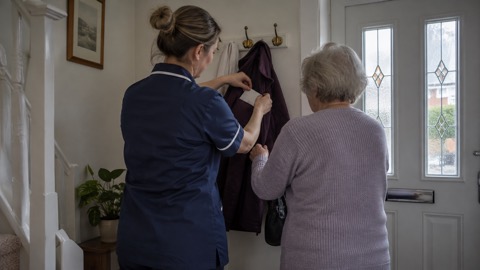
Whether or not the alarm worked, a fall should be reported. NHS guidance says to see a GP if you are worried about your balance or mobility or you have had a fall23, and Cheshire Fire and Rescue Service says to contact your GP if you have had a fall, are worried about balance or mobility, feel dizzy, unsteady or have blacked out, or think your medicines could be affecting your balance15. NHS inform in Scotland adds that many underlying causes of falls can be treated or corrected8.
The Stay Steady and Safe checklist widens the list of who to speak to: a pharmacist, GP or another appropriate health or care professional if you have fallen, feel increasingly unsteady, are worried about falling, have repeated dizziness, are finding it harder to move around your home, or think your medicines may be affecting your balance11.
A GP can check your balance, review your medication and refer you to services that help reduce your risk15. Independent Age advises asking your GP to refer you to a falls service, for example a Falls Clinic, which can help find out why you fell and get help such as physiotherapy12. The NHS describes what a specialist falls service offers: checking for problems such as muscle weakness, osteoporosis or eyesight problems, strength and balance training, home safety checks and adaptations, and medicine reviews23. You may even be able to refer yourself directly, by asking at your GP surgery reception, checking the surgery website, contacting your local integrated care board, or searching online23. If you have not exercised for a while or have a medical condition, talk to your GP first12.
Smartwatch fall detection compared with a monitored alarm
Many households already own a smartwatch, and Apple Watch in particular has built-in fall detection, so the question "do we need a fall alarm as well?" comes up often. Our full comparison is at smartwatch fall detection or a monitored fall alarm; the essentials follow.
Apple's own support guidance states that if Fall Detection is turned on and you have been immobile for about a minute, Apple Watch automatically attempts to call emergency services3. After an emergency call ends, the watch alerts your emergency contacts with a text message including your current location, unless you choose to cancel, and continues sending updates when your location changes for a period afterwards3. The watch can also be used manually: press and keep holding the side button until the watch issues a warning sound and starts a countdown, and when the countdown ends it calls emergency services3. You can ask Siri to call or text your local emergency number, such as 9993.
The requirements are the practical limits. Standard emergency calls need the Apple Watch or a nearby iPhone to have a cellular connection or Wi-Fi calling with an internet connection3. If emergency services cannot locate you, they go to the emergency address set on the iPhone, which you can update in Settings under Phone, Wi-Fi Calling, Update Emergency Address3. And if an emergency call has been made but you do not need emergency services, Apple's advice is not to hang up: wait until a responder answers, then explain you do not need help3.
The difference from a monitored alarm is who answers. A smartwatch calls the emergency services directly; a monitored fall alarm reaches a team that already knows who is calling and where they are1, and in Wales and Scotland that call is assessed by clinicians who can send an ambulance or refer to community services9. A watch also needs charging and wearing consistently, and its automatic call depends on the wearer being immobile for about a minute3. For many households the two work together: the watch for the person who already wears one, the monitored alarm as the service that knows their name.
The digital switchover: check an older alarm now
If the household already has a fall alarm or telecare device connected to a landline, there is a deadline worth knowing about. As the UK's phone network moves from analogue to digital, official guidance warns that some older telecare alarms may stop working if they are not updated18, and that some analogue telecare devices are not digitally compatible or do not perform as reliably on digital networks and may need to be upgraded17. South Gloucestershire Council advises checking whether devices connected to your landline, such as telecare sensors, are compatible with digital lines24.
The practical steps are simple. Devices such as fall monitors and personal alarms may require checks or upgrades before the switchover25, so contact the alarm provider and ask. If you care for a vulnerable person, Argyll and Bute Council advises keeping an eye out for correspondence notifying a switchover date26. Taking Care states that its Digital Fall Alarm is unaffected, while many older personal alarms relying on analogue phone lines may need adapters or upgrades to continue working5. Our page on whether telecare works in a power cut covers the other technical question households ask.
Where to get help choosing and getting a detector
Start with the GP. NHS inform advises that your GP can check your balance, review your medication, and refer you to services that help reduce your risk of falls22, which makes a GP appointment the natural first step before buying or arranging any detector. That referral matters because, as NHS inform notes, reactions slow down and bones become more fragile with age, so even a small trip can lead to a serious injury22. If a monitored alarm or telecare service is the right route, the GP or practice team can point you towards what is available locally.
Charities are the other route for independent advice. Carers UK covers fall detectors and other smart technology for the home2, and Independent Age covers telecare and falls advice for older people12. Both are useful when working out whether a detector is the right answer for a particular person, or whether a simpler alarm, a check-in arrangement, or a GP referral to a falls service would serve them better. For the wider picture of support available to older and disabled households, see our guide to extra help in an emergency, and for energy and water companies' priority services, our page on signing up to Priority Services Registers.
Sources (26)
- How fall alarms work, Taking Care, January 2026
- Smart tech and handy devices for the home, Carers UK, 25 October 2026
- Contact emergency services with Apple Watch, Apple, 2026
- Telecare: help and support, NHS inform, 13 August 2024
- Fall alarm for elderly, Taking Care, 29 October 2026
- What's available from the Telecare service, Isle of Anglesey County Council, 29 October 2026
- Assistive technology, Warwickshire County Council, 29 October 2026
- What to do if you fall, NHS inform, 30 April 2026
- Some of the reasons people call 999, Welsh Ambulance Service, 29 October 2026
- Falls: emergency care, Scottish Ambulance Service, 29 October 2026
- Stay Steady and Safe home safety checklist, NHS Norfolk and Suffolk, 2026
- How to stay safe at home: falls, Independent Age, 2026
- Additional advice for people with reduced mobility, Manchester Fire and Rescue Service, 29 October 2026
- Accident hazards, Somerset Council, 28 October 2026
- Slips, trips and falls, Cheshire Fire and Rescue Service, 20 May 2026
- Telecare self-check online tool, NHS inform, 23 August 2023
- Find a telecare provider, UK Government, 13 May 2025
- Telecare, Staffordshire County Council, 20 July 2025
- Preventing falls, NHS North Cheshire and Mersey, 12 December 2024
- Dementia fire safety, North Wales Fire and Rescue Service, 29 October 2026
- Handling falls, North West Ambulance Service, 22 October 2024
- Neighbour and vulnerable people support, South Western Ambulance Service NHS Foundation Trust, 29 October 2026
- Falls, NHS, 6 March 2025
- Switchover to digital landlines, South Gloucestershire Council, 2026
- National Grid - The Landline Switchover, National Grid (customer.nationalgrid.co.uk)
- Digital phone switchover, Argyll and Bute Council, 2026
 Carer's Emergency Plan
 Herbert Protocol Form
 In Case of Emergency Card
 Energy and Water Company Duties
 Personal Alarms
 What Happens When Alarm Pressed
 Home Oxygen Therapy Safety
 Airflow Mattress Fire Risk
 Fire Risk at Home
 Dementia and Emergencies
 Falls at Home
 Living Alone Safely
 Sight Loss and Emergencies
 Deaf and Hard of Hearing Safety