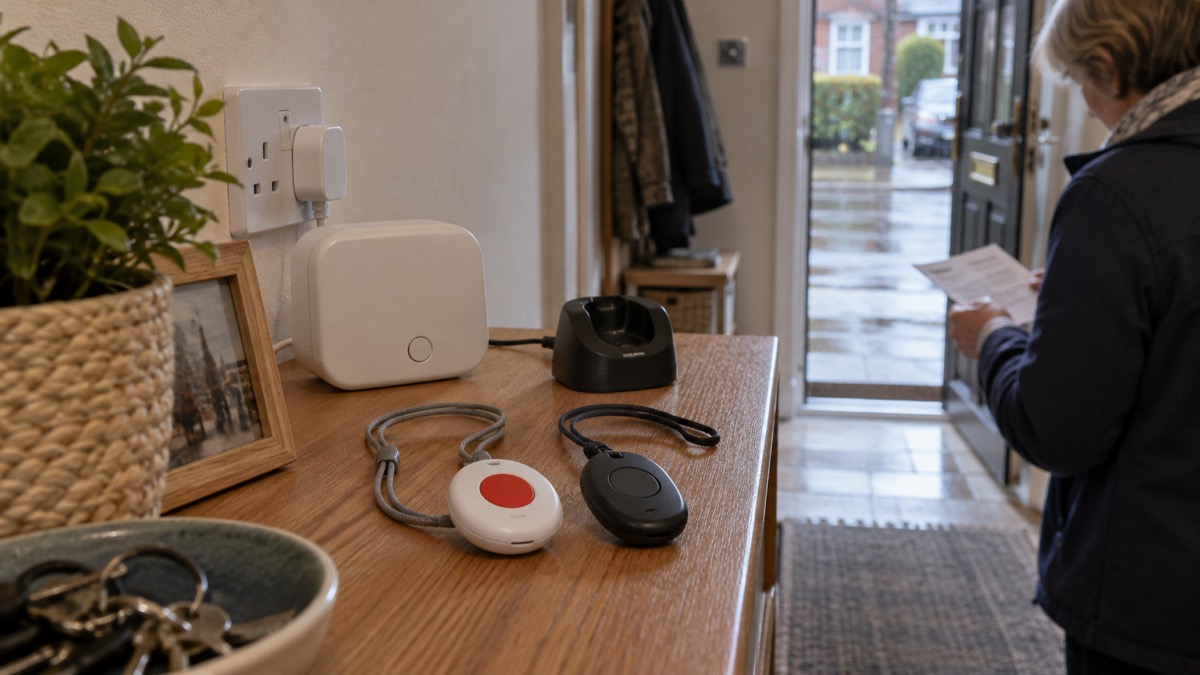
If someone in your household needs to be able to call for help, the choice usually comes down to two kinds of device. A home alarm, often called a telecare or lifeline alarm, keeps a base unit in the house and a pendant or trigger on the person, so a call can be raised from home or garden at the press of a button. A GPS alarm is a mobile pendant that uses the mobile network to raise help wherever the person is, and some systems now include GPS tracking for when you go out, for extra peace of mind1.
The first thing to settle is whether an existing alarm still works. Do not assume it will keep working after the switch to digital phone lines, or during a power cut2. Contact the company that supplies your alarm and ask them to confirm it is compatible with the new digital phone network, and what happens to it if the power goes off2. If your phone provider is moving you to a digital service, they should ask you to confirm whether you have a telecare system or personal alarm; if they do not ask, you should tell them, and tell them whether it is compatible3.
The second is where help is needed. A GPS alarm calls for help anywhere with mobile network reception, but that is also its limit: no signal, no call. A home alarm reaches a monitoring service or a named contact from the house, but generally not from the shops or the park. Which one suits depends on whether the risk is mostly at home, mostly out and about, or both.
The in-home classic personal alarm and the digital phone switch
The traditional in-home alarm connected to a monitoring centre through the phone line. That arrangement is changing across the UK as phone providers move customers from analogue lines to digital services, and the change affects personal alarms, fall detectors and medical pendants. The advice is blunt: don't assume it will keep working after the switch to digital phone lines, or during a power cut2.
The action is straightforward. Contact the company that supplies your alarm and ask them to confirm it is compatible with the new digital phone network and what happens to it if the power goes off2. When your phone provider contacts you about the switch, they should ask you to confirm if you have a telecare system or personal alarm; if they don't ask, you should tell them, and tell them if it's compatible3.
If you have already switched to a digital provider, before purchasing a personal alarm service, check with the supplier if they offer one that is compatible with a broadband-based service in the first instance7. That is the pattern for the newer generation of home alarms: they run over the home broadband router rather than the old phone socket.
This is not a reason to give up on a home alarm. It is a reason to ask the supplier the right questions before you depend on one, and to know what your fallback is. If the person you care for has a mobile phone as well, some mobile devices can use Emergency SOS (iOS) and Satellite SOS (Android) to contact emergency services via satellite if no mobile networks are available9. That is a backstop, not a substitute for a monitored alarm.
A GPS alarm calls for help anywhere with mobile network reception
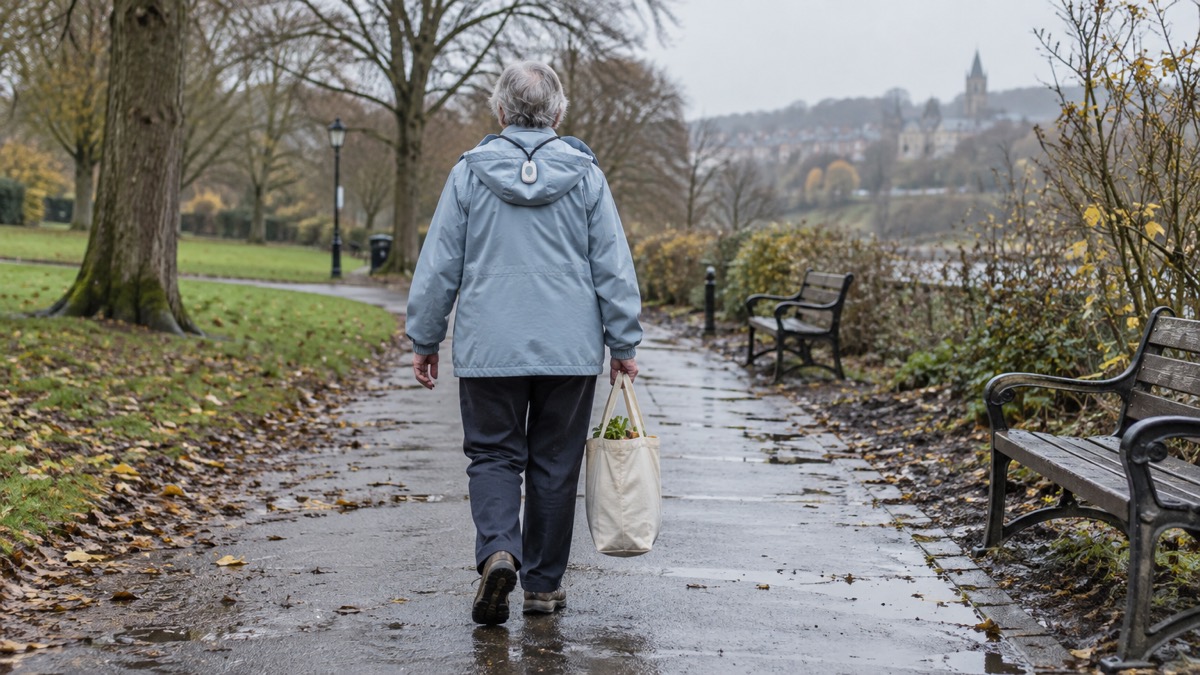
A GPS alarm is worn like a pendant or watch and raises a call over the mobile network, using GPS to establish where the wearer is. The principle is the same one used by responder apps: the system uses GPS to match life-threatening emergencies with the closest trained responders10. For a household, the appeal is simple: the person is covered when they are out, not just when they are at home.
That coverage has conditions. The device needs a mobile signal, a charged battery, and a monitoring arrangement at the other end. A personal alarm linked to your phone will only work if the phone has battery5. If the alarm is a standalone pendant with its own SIM, the same logic applies to its own battery and to the network it uses.
A GPS alarm suits someone who goes out alone, walks to the shops, uses public transport or spends time away from the house where a base-unit alarm cannot reach. It does not suit someone who never leaves home, or who lives somewhere with no usable mobile signal, unless the supplier can confirm otherwise.
Home alarm or GPS alarm: how each one behaves
The two types behave differently in use, and the differences matter more than the specifications. A home alarm is fixed to a place; a GPS alarm travels with the person. A home alarm usually has a speaker and microphone in the base unit, so the wearer can talk to the responder without holding anything. A GPS alarm is a small device, and how the call is handled depends on the supplier.
| What matters | Home alarm (base unit and pendant) | GPS alarm (mobile pendant) |
|---|---|---|
| Where it works | Home and garden, with one council service describing a 300 metres radius from the unit4 | Anywhere with mobile network reception1 |
| What it depends on | Phone line or broadband, mains power, and the monitoring arrangement | Mobile signal, battery charge, and the monitoring arrangement5 |
| Best suited to | Someone whose risk is mostly at home, including falls and getting up | Someone who goes out alone and wants cover away from home1 |
| What to check first | Compatibility with digital phone lines and behaviour in a power cut2 | Signal where the person lives and goes, and battery life |
Whichever you choose, make sure you know how your house or personal alarm works, including any passwords or codes6. A device nobody in the household understands is a device that will not be pressed in time. The same guidance appears in fire safety advice for people who use mobility aids, and it applies just as much to a pendant6.
There is also a simpler community option worth knowing about. In a community alarm, you keep a transmitter on you and another person has a receiver; that person could be a relative, friend, neighbour or monitoring service11. It is less formal than a commercial service, but it can be arranged quickly and at little cost, and it works where the neighbour is.
Where a GPS alarm cannot reach help
A GPS alarm is only as good as the network it uses. Where mobile reception is poor, indoors, in a basement flat, in a valley or in some rural areas, the call may not get through. The same applies during a local outage. The government's preparedness advice is to check with the provider or manufacturer how your device works if the network is down8.
There are other limits. A GPS alarm cannot help someone who has fallen and cannot press the button, unless it has automatic fall detection, and even then the device has to be worn. It cannot help if the battery is flat. It cannot help if the wearer is confused and does not press it. And it cannot help if the monitoring centre cannot reach the person or their keyholder.
For someone who cannot mobilise or evacuate in response to a sounding alarm, make sure they have a suitable plan in place to aid escape, including the introduction of assistive technology if required14. That plan should say who comes, how they get in, and what the person does while they wait. A key safe is one way to let responders in without breaking a door; the key safes guide explains where to fit one.
A home alarm has its own blind spots. It will not reach the person in the garden beyond its range, and it will not work if the phone line or broadband is down and the unit has no mobile backup. The alarm response guide sets out what happens at the monitoring centre when a call arrives.
Choosing for your household
Start with the question of where the person spends their time. If the risk is falls at home, getting up in the night, or being alone during the day, a home alarm with a pendant is the natural fit, provided it is compatible with your phone or broadband service1. If the risk is going out alone, a GPS alarm covers ground a base unit cannot.
Then check the practicalities:
- Signal: ask the supplier what network the GPS alarm uses and whether coverage is good where the person lives and walks.
- Power: ask what happens in a power cut, for both types2.
- Response: ask who answers the call, what they do, and how they get in.
- Codes: make sure you know how the alarm works, including any passwords or codes6.
For a household where the person lives alone, the alarm is one part of a wider plan. The fire service advises people living alone to install a smoke alarm on all levels, never remove the battery or take the alarm off its back plate unless replacing the battery or installing a new alarm, install a heat alarm in the kitchen rather than a smoke alarm, never overload sockets with one plug per socket, make a fire escape plan, and have a bedtime routine13. The living alone guide develops that plan.
If the person has dementia, an alarm button near the front door or beside the bed can be used in the event of a break-in or if someone threatening approaches the front door7. The dementia guide covers going missing and the Herbert Protocol.
Cost is not the deciding factor, but it is worth knowing that some help is free. A Home Fire Safety Visit can include linked alarms, monitored alarms connected to Telecare, personal fire protection systems and fire suppression systems, depending on needs15. Ask your local fire and rescue service about a visit through the fire check referral guide.
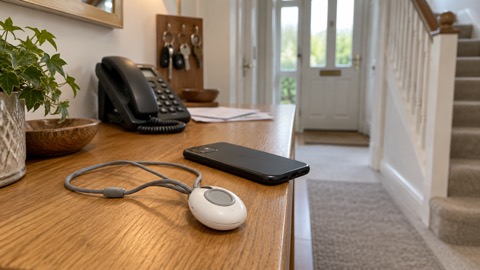
For the wider picture of alarm types, including fall detectors and pendant range, see Personal Alarms: Types and How to Choose One. If the choice is really between an alarm and a mobile phone, the comparison guide sets the two side by side.
Sources (15)
- Telecare, Age UK, 2026
- Landlines, National Grid, 2026
- Check your personal alarm will work after the landline switch off, Citizens Advice, 2025
- What's available from the Telecare service, Isle of Anglesey County Council, 2026
- Prepare for a power cut, Citizens Advice, 2023
- Fire safety for people with mobility difficulties, Devon and Somerset Fire and Rescue Service, 2026
- Technologies to make life easier, Carers UK Scotland, 2026
- Phone and broadband outages, UK Government Prepare campaign, 2026
- Stay connected in severe weather, Ofcom, 2026
- GoodSAM app, London Ambulance Service, 2026
- Creating a falls plan, NHS Inform, 2024
- Smoke alarms, Cheshire Fire and Rescue Service, 2026
- Home fire safety, Northern Ireland Fire and Rescue Service, 2026
- Additional advice for carers, Greater Manchester Fire and Rescue Service, 2026
- Smoke alarms and heat alarms, London Fire Brigade, 2026
 Personal Alarm or Mobile Phone
 Smartwatch or Fall Alarm