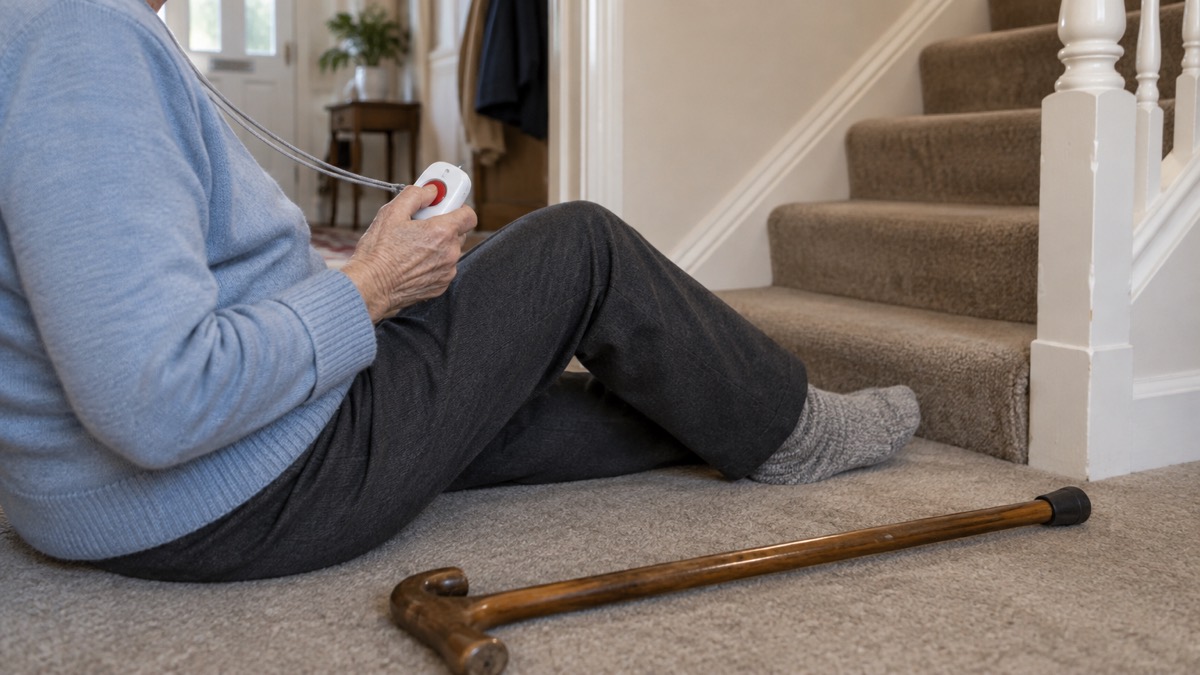
A fall at home is frightening, but the first few minutes have a clear pattern: work out whether anyone is hurt, call for help at the right level, and keep the person who has fallen warm and comfortable until help arrives. Call 999 if the person who has fallen cannot get up even with help, is confused, drowsy or vomiting, or may have injured their head, neck, back or hip, or has severe bleeding1. If they may be in pain, injured or unwell but it is not an emergency, get help from NHS 111 by calling 111 or using 111 online2.
If you fall and cannot get up, the Welsh Ambulance Service and NHS inform both give the same core advice: call for help first, then keep warm and keep moving. Reach for a phone, a lifeline alarm or a pendant, or bang on the floor or wall to attract a neighbour1. Then pull something over yourself to cover you, move as much as you can, and drink if you can reach fluid1. After a fall on a cold floor there is a real risk of hypothermia, so move onto a carpet or rug if you can, cover yourself with anything nearby and keep your body moving3.
Most falls do not need an ambulance, but every fall needs reporting. The North West Ambulance Service is blunt about it: if you have a fall, do not ignore it, and let your GP or local pharmacist know4. A specialist falls service can then check for problems such as muscle weakness, osteoporosis or eyesight problems, provide strength and balance training, check home safety and review medicines2. This page covers what to do in the first hour, how to cut the risk of the next fall, and the free checks and repair schemes available to people aged 65 and over.
If you fall and cannot get up
The danger of a fall where nobody comes is not just the injury. It is the hours on a cold floor. NHS inform states plainly why warmth comes first once you have called for help: "After calling for help, it's important to keep warm as you may be at risk of developing hypothermia."3
Work through these steps in order:
- Call for help. Use a community alarm if you have one, use a phone to call a relative, friend or neighbour, or ask your smart speaker to call someone who can help3. If you cannot reach any of these, try shouting or banging on a wall to attract your neighbour's attention3. The Welsh Ambulance Service adds that if you are hurt or unable to get up, you should call out, bang on the wall or floor, or use a personal alarm, and if possible crawl to a telephone and dial 999 for an ambulance1.
- Get warm. Move onto a carpet, rug or other soft surface, cover yourself with a nearby duvet, blanket or clothing, and move away from draughts3.
- Keep moving. Keep your body moving while you wait, and drink fluid if you can reach it1.
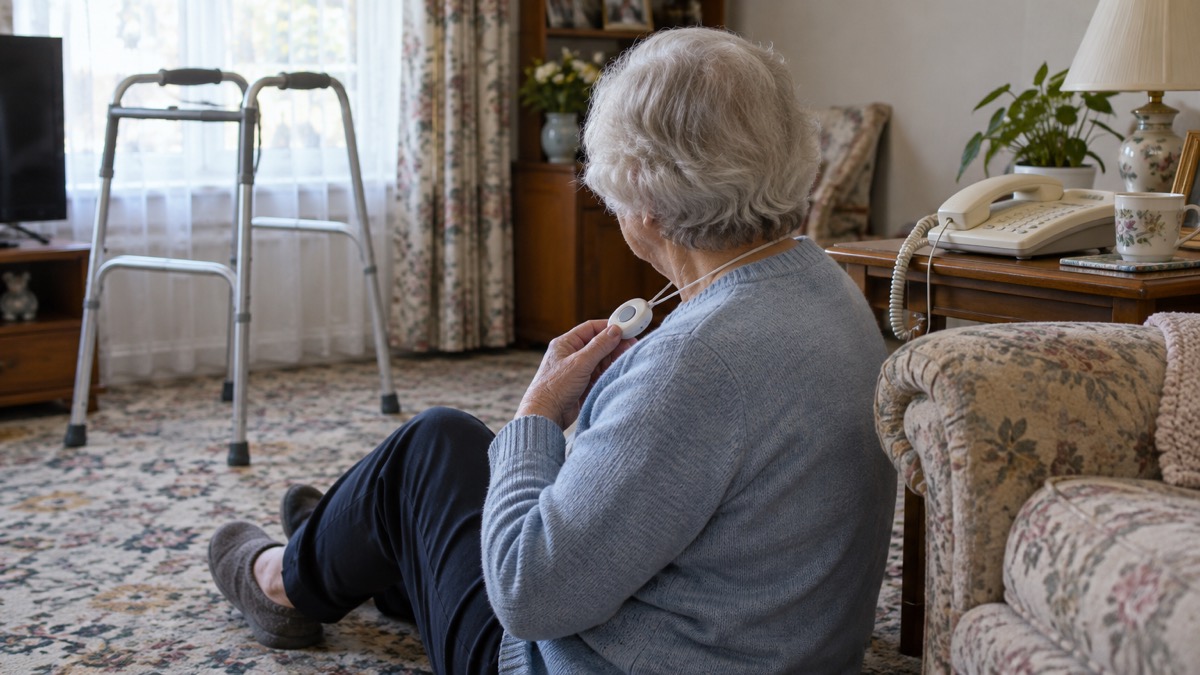
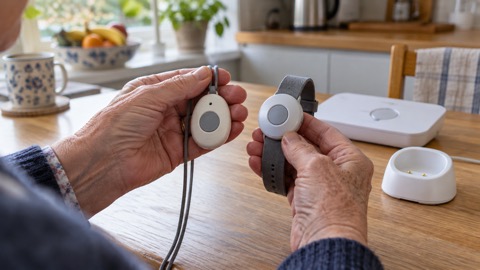
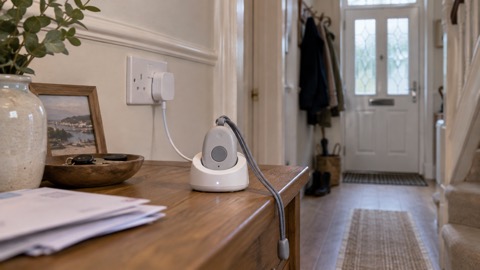
A personal alarm or pendant removes the hardest part of this, the reaching, and official guidance on what to do if you fall includes using a community alarm if you have one. If you are choosing one, our pages on personal alarms and fall detectors set out the options, including what happens when you press the alarm but cannot speak. If you live alone, or are alone for long periods, NHS inform advises planning ahead for exactly this situation, which is covered in the falls plan section below.
If someone else has fallen and the fall seems serious, North Wales Fire and Rescue Service's dementia fire safety guidance applies to any serious fall: do not try to move them and do not give them anything to eat or drink. Keep them warm and call for an ambulance6.
First aid for injuries after a fall
Your first job is to judge how serious it is. The NHS's rule is to call 999 if the person may have injured their head, back, neck or hip, or has severe bleeding, or cannot get up even with help, or is confused, drowsy or vomiting1. Any of those means an ambulance, not a lift.
If the fall seems minor, the NHS advises: carefully help them get up if they can, but do not try to lift them yourself2. Lifting someone is a job for two trained people, and a well-meaning attempt can injure both of you. Keep them comfortable and warm while you help2.
For a child who has had an accident, NHS first aid advice is to lie them down if they look pale or feel unwell, and keep them covered up and warm, but not too hot7. If a child has a fit, let your GP know even if it is not the first time and they recover quickly8. For the wider picture on bleeding, burns and head injuries, see our guide to first aid at home.
See your GP after any fall, even a small one
This is the step most people skip, and it is the one that prevents the next fall. Cheshire Fire and Rescue Service advises contacting your GP if you have had a fall, are worried about your balance or mobility, feel dizzy, unsteady, or have blacked out, or think your medicines could be affecting your balance9. Your GP can check your balance, review your medication, and refer you to services that help reduce your risk9.
The Stay Steady and Safe home safety checklist from NHS Norfolk and Suffolk widens the list slightly: speak to a pharmacist, GP or another appropriate health or care professional if you have fallen, feel increasingly unsteady, are worried about falling, have repeated dizziness, are finding it harder to move around your home, or think your medicines may be affecting your balance10. A pharmacist is often the easiest first stop, because medicine side effects are a common and fixable cause of falls.
You may not even need a GP appointment to get help. The NHS says that if you have had a fall, you might be able to refer yourself directly to services that can help, without seeing a GP, by asking at your GP surgery reception, checking the surgery website, contacting your local integrated care board, or searching online2. A specialist falls service can then check for problems such as muscle weakness, weak bones (osteoporosis) or eyesight problems, provide strength and balance training, carry out home safety checks and adaptations, and review your medicines2.
If you have fallen, are struggling to move around your home, or are unsure which equipment or adaptations are suitable, the Stay Steady and Safe checklist advises seeking advice from an appropriate health, care, housing or equipment professional rather than guessing10.
Why a small trip can mean a serious injury in later life
Ageing raises the stakes of a simple trip. NHS guidance on falls notes that muscles get weaker with age, and that conditions affecting mobility or balance such as arthritis, stroke or Parkinson's disease, the side effects of some medicines, and problems with eyesight or hearing all make falls more likely, particularly in older people. A trip over a loose rug that a 40-year-old would laugh off can break a hip at 80.
The NHS lists the underlying causes that build with age: muscles getting weaker, conditions affecting mobility or balance such as arthritis, stroke or Parkinson's disease, side effects of some medicines, and problems with eyesight or hearing2. NHS North Cheshire and Mersey adds weak muscles or poor balance, health conditions like dementia, the side effects of medication, trip hazards in the home and cold weather as things that increase someone's chances of falling11.
Where these injuries happen is worth knowing. Salisbury NHS Foundation Trust's burns prevention booklet notes that most of these injuries are accidental and occur at home12. The government's How to rent a safe home guidance adds that older people and children under 5 may be more vulnerable to trips and falls13. Cold weather compounds the risk: UK Health Security Agency guidance for adult social care managers notes that cold weather increases the probability of complications from existing disease, and of injury due to falls14.
The countermeasure is activity. The NHS physical activity guidelines for older adults recommend being active every day, and doing activities that improve strength and balance at least twice a week2. Local falls prevention classes, which your GP or falls service can refer you to, are built around exactly this.
Clearing trip hazards room by room
Most of this is an hour's work with a bin bag. Cheshire Fire and Rescue Service's list is the core: remove trip hazards like clutter, trailing wires and frayed carpet9. Staffordshire's falls prevention guidance says the same in plainer terms: remove trip hazards such as loose rugs, cables and clutter15.
Go room by room:
- Floors: clear clutter away from floors or stairs, move small furniture and pet bowls, and get rid of any loose mats or rugs11. Use non-slip mats and rugs where you keep any16.
- Wires: trailing flexes are a named hazard in dementia fire safety guidance too, which also flags unsteady furniture and objects lying on the floor6.
- Stairs and carpets: pay particular attention to rugs and loose carpets on the stairs, and to slippery floors6. Frayed carpet is a named trip hazard9.
- Spillages: mop them up immediately16.
- Lighting: make sure all rooms, passages and staircases are well lit16.
- Layout: organise your home so that climbing, stretching and bending are kept to a minimum, and to avoid bumping into things16.
- Clothing and feet: do not walk on slippery floors in socks or tights, do not wear loose-fitting trailing clothes that might trip you up, wear well-fitting shoes in good condition that support the ankle, and take care of your feet, trimming toenails regularly and seeing a GP or podiatrist about any foot problems16.
- Asking for help: get help to do things you are unable to do safely on your own16.
Staffordshire's maintaining your home guide frames the same job as part of general upkeep: reduce clutter and clear floors and walkways to prevent trips and falls17. The bathroom deserves its own pass, and our page on making a bathroom safer against falls covers it.
Outside the home: paths, steps and lighting
The approach to your front door carries as much risk as any room. Oxford Health's falls guidance, reviewed in September 2026, advises making sure stairs, hallways and walkways are well lit during the darker months18. Its companion weather safety guidance adds a simple habit: turn on outside lights when leaving home or coming back after dark19. Staffordshire's winter advice is to keep paths and steps clear and well lit to reduce slips20.
Shropshire's home safety check booklet, produced by the Shropshire Falls Prevention Service, gives the practical detail for the outside areas21:
- The path: keep it free from slippery leaves, moss or overhanging branches21.
- Lighting: a security light near the path and door is described as a wise investment21.
- Steps: paint a white line on the edge of a step if it is hard to see. A grab rail can help, and it must be strong and well fitted21.
- The hall: consider a pendant alarm for emergencies, so the telephone is never the only way to call for help21.
In winter, snow and ice change the calculation. Scottish Borders Council's resilient communities guidance includes clearing snow from pathways and community facilities as something local groups do to help22, so it is worth knowing whether a neighbours' group near you does this. If no one has cleared the path, the safest answer is to wait, or ask someone to clear it for you, rather than take an icy route to put the bins out. Our winter checks for an older relative's home page gathers this into a single list.
A key safe lets trusted people get in quickly
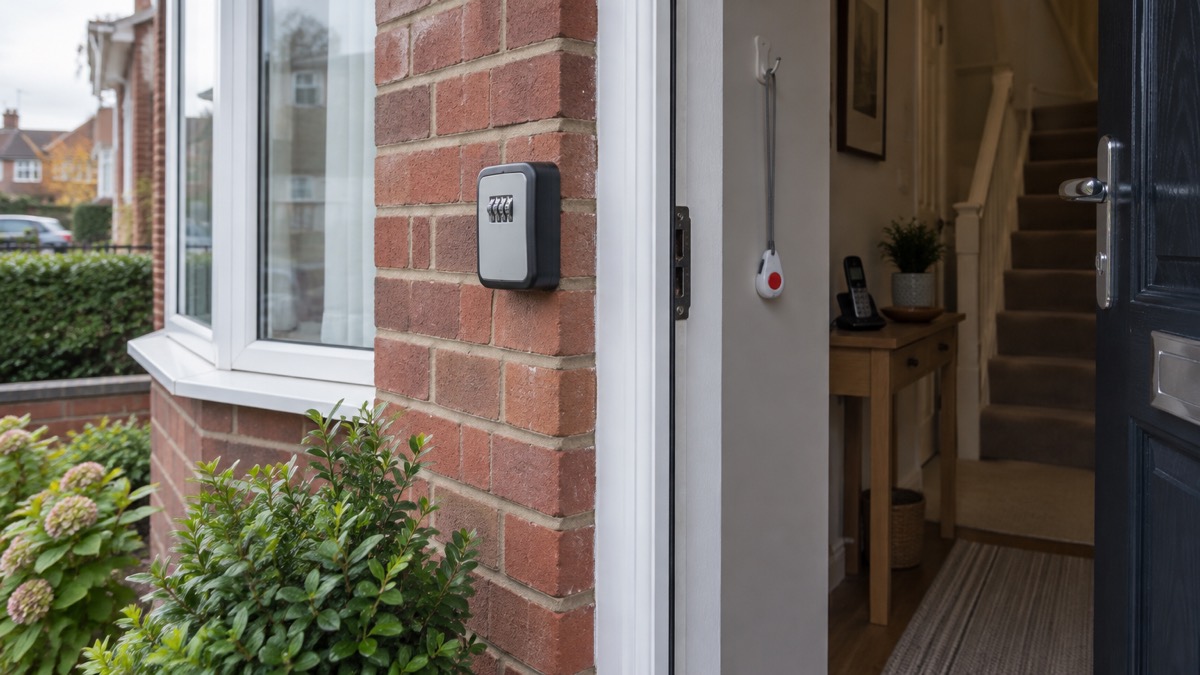
If you have fallen and cannot get to the door, help that cannot get in is no help at all. NHS inform's falls plan guidance covers both routes: leave a spare key with a friend, neighbour or relative you trust that lives nearby, or leave a spare key in a key safe23.
A key safe is a lockable box that holds a key, fixed to an outdoor wall with a chosen code set to it, which means carers, family or emergency services can get into the home if they need to24. Some key safes are police-approved24. Our page on key safes compares the types, and where to fit a key safe for emergency access covers placement.
Keys matter for getting out as well as getting in. Mid and West Wales Fire and Rescue Service advises that keys for windows and doors should be in an accessible place where everyone can find them, so you can get out quickly in the event of a fire25. Devon and Somerset Fire and Rescue Service's advice for flats is the same: keep door keys where everyone you live with can find them easily26. Staffordshire Fire and Rescue Service adds a small habit for households with visitors: tell overnight guests where the keys are kept27.
The same fire service guidance also suggests thumb turn locks, which offer increased safety should you need a quick exit from the building, such as in the case of a fire or other emergency, because you do not need to locate the key first to unlock the door24.
Falls and fire: why being unsteady raises the risk
Falls and fire feed each other. Cheshire Fire and Rescue Service states the connection directly: falls can increase the risk of fire, because someone who has fallen or is unsteady may find it harder to react quickly, turn off appliances or respond to a smoke alarm9.
That works in both directions. Someone who has fallen or is unsteady may find it harder to react quickly, turn off appliances or respond to a smoke alarm, which is why falls can increase the risk of fire12. And a person on the floor cannot reach a cooker switch or a smoke alarm. This is why fire services treat falls prevention as fire prevention, and why the same clutter advice appears in both sets of guidance.
Two habits close most of the gap:
- Keep a phone by your bed. Fire safety guidance for older people and people with mobility issues advises considering keeping a phone by your bed to call 999 if you cannot get out, so a fall in the night does not leave you without a way to call for help.
- Do not disable alarms. If your smoke alarm keeps going off accidentally while you are cooking, Mid and West Wales Fire and Rescue Service says do not remove the batteries. Instead move the alarm or change it for one with a silencer button25.
If escaping is ever needed and you are trapped on the ground floor, Devon and Somerset Fire and Rescue Service advises escaping out of a window and throwing bedding or cushions to break your fall28. For anyone with reduced mobility, our pages on fire risk for older and disabled people and testing smoke alarms if you have reduced mobility go further, and how to refer a vulnerable person for a fire safety check explains the referral route.
Free home safety checks and repair schemes for people aged 65 and over
Belfast City Council runs the clearest example of a combined scheme. If you are over 65, you can request a free home safety check and use its repair scheme5. The check is a room-by-room inspection which can include energy saving and security advice, help from a vetted handyperson at a reduced rate, and free helping-hand aids and equipment subject to stock availability5. The council partners with Bryson Pathways and the Public Health Agency to provide the scheme5.
The handyperson tasks are exactly the jobs that become fall hazards when left undone: fitting curtain rails, repairing doors, fitting door chains, fixing floorboards, changing light bulbs, draught-proofing windows or doors, adjusting heating timers, fitting carbon monoxide alarms, and clearing and laying salt on paths during winter5.
| Who | Home safety check | Repairs |
|---|---|---|
| Aged 65 and over | Free | £15 per hour5 |
| Aged 65 and over, in receipt of benefits | Free | £10 per hour5 |
All materials need to be supplied by the older person, except general items including glue, nails and sandpaper, which are provided free of charge5. To ask about the service or to book, email the council or freephone 08001 422 8655. Belfast's stay warm in winter page also gives a number for a free home safety check: 028 9091 871529.
Similar help exists elsewhere, in different forms. Staffordshire's falls prevention service offers home safety visits for eligible residents15. In Northern Ireland, the Home Fire Safety Check is an easy-to-follow self-assessment involving answering a series of questions, which produces a personalised fire safety action plan identifying potential causes of fire in the home with safety advice to help reduce the risk of fire30. Homes identified as greater risk get a visit: NIFRS personnel will visit your home to give further practical advice on fire safety30. Ask your own council, GP surgery or fire service what runs locally: the names differ, but most areas have something.
Making a falls plan
NHS inform's guidance on creating a falls plan, published in June 2024, is aimed at exactly the households this page is for: if you live alone, or are alone for long periods, you should plan what you'll do, who you'll contact and how they'll get to you23.
A workable plan answers three questions:
- How will you call for help? A phone within reach of the floor, a community alarm, a pendant, or a smart speaker3. NHS inform's self-check tool for telecare in Scotland can help you work out what would suit your home31.
- How will help get in? A spare key with a trusted neighbour or relative, or a key safe23.
- Who needs to know? Share the plan with everyone named in it, so the first person you call already knows what to do23.
If you care for someone who might fall, the same thinking goes into a carer's emergency plan, and our pages on living alone and carers cover the wider arrangements. For someone with dementia, who may not remember a plan under stress, the dementia and emergencies page sets out the additional steps.
Sources (31)
- Some of the reasons people call 999, Welsh Ambulance Service NHS Trust, 2026-10-29
- Falls, NHS, 2025-03-06
- What to do if you fall, NHS inform, 2026-04-30
- Handling falls, North West Ambulance Service NHS Trust, 2024-10-22
- Home safety check and repair scheme for seniors, Belfast City Council, 2026-10-29
- Dementia fire safety, North Wales Fire and Rescue Service, 2026-10-29
- What to do if your child has an accident, NHS, 2025-12-18
- Safety and accidents in pregnancy, NHS 111 Wales
- Slips, trips and falls, Cheshire Fire and Rescue Service, 2026-05-20
- Stay Steady and Safe Home Safety Checklist, NHS Norfolk and Suffolk Integrated Care Board, 2026
- Preventing falls, NHS North Cheshire and Mersey, 2024-12-12
- Burns prevention booklet 2024, Salisbury NHS Foundation Trust, 2024-12
- How to rent a safe home, HM Government, 2020-12-10
- Supporting vulnerable people before and during cold weather, HM Government, 2025-09-24
- Falls prevention, Staffordshire County Council, 2026
- Winter preparedness, South East Coast Ambulance Service NHS Trust, 2025-10-22
- Maintaining your home, Staffordshire County Council, 2026
- Falls guidance: at home, Oxford Health NHS Foundation Trust, 2026-09-15
- Falls guidance: weather safety, Oxford Health NHS Foundation Trust, 2026-09-18
- Stay warm and safe, Staffordshire County Council, 2026
- Home Safety Check booklet, Shropshire Community Health NHS Trust, 2016-12
- Resilient Communities, Scottish Borders Council, 2026-10-29
- Creating a falls plan, NHS inform, 2024-06-18
- Equipment for carers, Devon and Somerset Fire and Rescue Service, 2026
- Older person safety, Mid and West Wales Fire and Rescue Service, 2026-10-29
- Fire safety in flats and high-rise buildings, Devon and Somerset Fire and Rescue Service, 2026
- Plan your escape, Staffordshire Fire and Rescue Service, 2026-10-29
- Escape plan, Devon and Somerset Fire and Rescue Service, 2026
- Stay warm at winter, Belfast City Council, 2026-10-29
- Ten lives lost in accidental house fires in Northern Ireland this year, Northern Ireland Fire and Rescue Service, 2025-10-13
- Telecare self-check online tool, NHS inform, 2023-08-23
 Carer's Emergency Plan
 Herbert Protocol Form
 In Case of Emergency Card
 Energy and Water Company Duties
 Personal Alarms
 What Happens When Alarm Pressed
 How Fall Detectors Work
 Home Oxygen Therapy Safety
 Airflow Mattress Fire Risk
 Fire Risk at Home
 Dementia and Emergencies
 Living Alone Safely
 Sight Loss and Emergencies
 Deaf and Hard of Hearing Safety