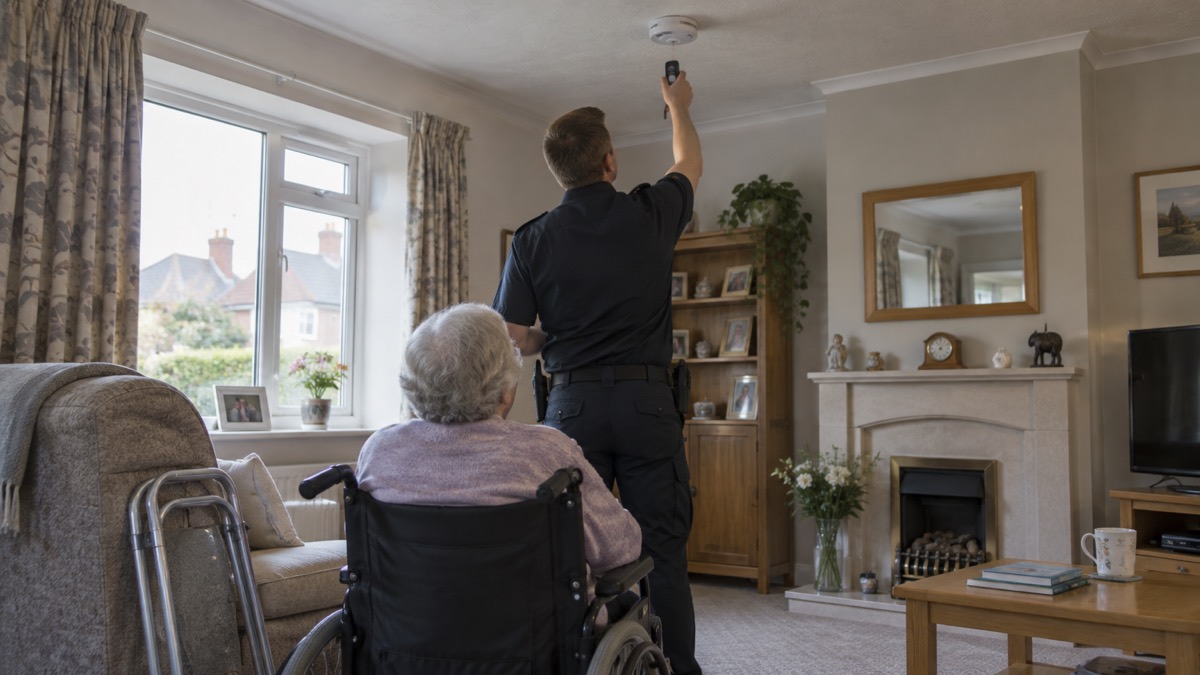
If reaching up to press the test button on a ceiling smoke alarm is hard for you, the first and simplest answer is to ask someone else to do it. Fire and rescue services across the UK give the same advice: if you find it hard to test your smoke alarm, ask someone to help1. That could be a family member, friend, neighbour or carer, and it is a perfectly good arrangement rather than a second-best one2.
The second answer is to change the alarm rather than the person. Easy access alarms, also called remote controlled alarms, can be tested from the wall rather than the ceiling, so you never have to stretch upwards4. If you also have a hearing difficulty, alarms that use a strobe light and vibrating pads are available5.
Whichever route you take, the testing itself still needs to happen. Most fire services advise testing at least once a month by pressing the test button until the alarm sounds6. A working smoke alarm is the single most useful piece of safety equipment in the home, and a monthly test is how you know it will still work when it matters.
Ask somebody to test your smoke alarm for you
The advice from fire and rescue services is consistent and direct. Tyne and Wear Fire and Rescue Service says: "If you find it hard to test your smoke alarm, ask someone to help"1. Mid and West Wales Fire and Rescue Service puts it the same way: "If it is difficult to test your alarm ask somebody to do it for you"2. Greater Manchester Fire and Rescue Service adds a practical step: "If you are unable to test your alarms, consider whether a family member, friend or carer can test them for you"3.
That last word, carer, matters. If you receive care or support at home, the person providing it has a role in keeping your alarms working. Greater Manchester Fire and Rescue Service advises carers that if the person they support cannot test and maintain their smoke and heat alarms, they should test the alarms for them at least every month, or help identify somebody who can7. The same instruction appears in the service's guidance for carers of people who use home oxygen, where the advice is to test the alarms at least monthly or help identify somebody who can do this9.
If you smoke, or someone you care for smokes, the advice is even more pointed. Carers are told to ensure the smoker has smoke and heat alarms that meet their needs and that they are able to test their alarms at least monthly; if they cannot, the carer should test for them or identify someone who can11.
A simple way to make the arrangement reliable is to fix a day. The first of the month, or the day the bins go out, gives whoever is helping a prompt they will not forget. It also means the test happens even in a busy week.
Easy access alarms: smoke alarms made to be simpler to test
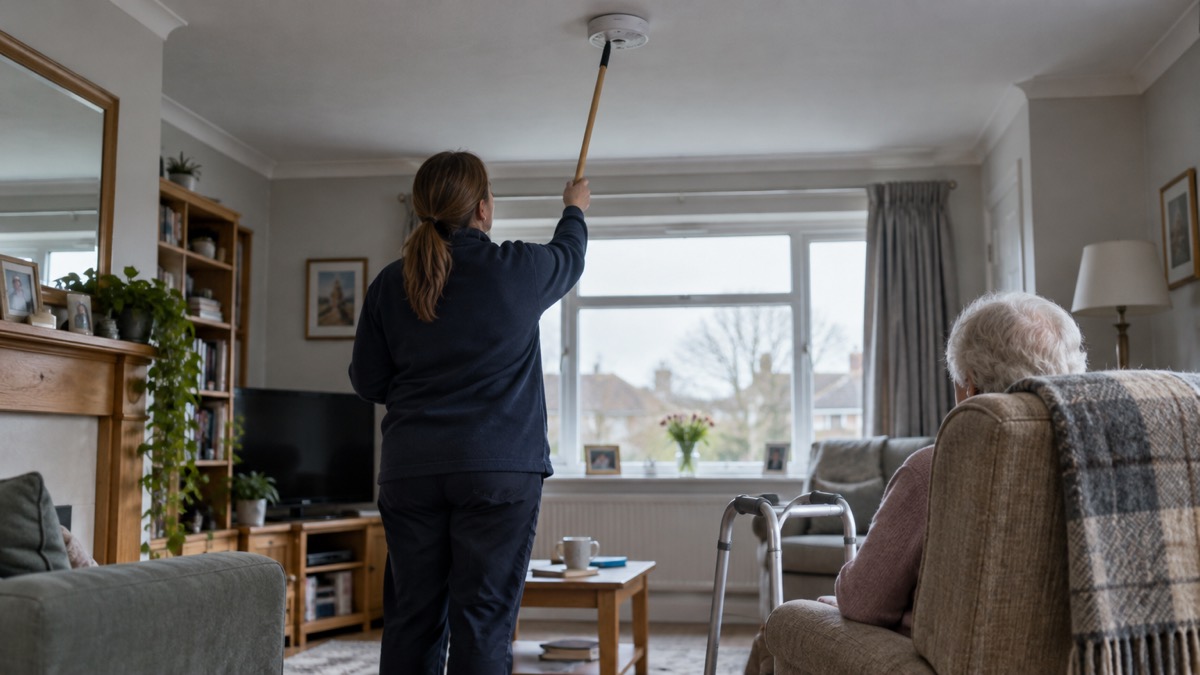
If asking for help is not practical, or you would rather be able to check the alarm yourself, easy access alarms are the answer the guidance points to. The government's fire safety guidance for people with sight, hearing or mobility difficulties says: "You can also get remote controlled or easy access alarms, which can be tested from the wall rather than the ceiling"4. The same wording appears in the accessible version of that guidance12, and Devon and Somerset Fire and Rescue Service gives it for people who use mobility aids13.
The point of the design is simple: the part you press is within reach, at wall height, while the alarm itself stays on the ceiling where smoke collects. You test it without a step, a stretch or a helper.
There are other adjustments that make an alarm easier to live with and to test:
- A coloured sticker or cover. If you have trouble seeing the alarm to test it, put a brightly coloured sticker on it, or ask your local fire and rescue service if they can provide a coloured cover12. Tyne and Wear Fire and Rescue Service suggests a coloured sticker to make the alarm easier to locate and test1.
- An alarm where you sleep. For those with limited mobility, an alarm should be fitted where they sleep, so it is close by14.
- A linked system. Consider linking the alarm system, which can alert you to any danger15.
For more information on remote controlled or easy access alarms, the government guidance points to the Disabled Living Foundation4.
| What you need | What helps | Who it suits |
|---|---|---|
| To test without reaching up | Easy access or remote controlled alarm, tested from the wall4 | Anyone who cannot safely reach a ceiling alarm |
| To see the alarm to test it | Coloured sticker or cover16 | People with sight difficulties |
| To hear the alarm | Strobe light and vibrating pad5 | People who are Deaf or hard of hearing |
| To be alerted close by | Alarm fitted where you sleep5 | People with limited mobility |
If you cannot hear the alarm as well as reach it
Reduced mobility often comes with reduced hearing, and the two together change what you need. The test is not only whether the alarm sounds, but whether you would hear it from where you sleep. Greater Manchester Fire and Rescue Service advises carers to check whether the person can hear a sounding alarm from the place where they usually sleep; if they cannot, arrange interlinked smoke and heat alarms and an interlinked strobe light and vibrating pad, providing a vibrating and visual alert if any alarm in the home activates17.
Smoke alarms that use a strobe light and vibrating pads are widely available for people who are Deaf or hard of hearing5. Some services advise contacting your GP to arrange an assessment5. Others say the alarms are available following an assessment20.
If you live alone, or with others who are also Deaf or hard of hearing, you can get a smoke alarm suited to that situation21. Where someone lives in sheltered type accommodation, consideration should be given to how the alarm system links to the individual's smoke detector22.
Where to get help with smoke alarm testing
You do not have to sort this out alone. Fire and rescue services run home safety visits, and they are free. South Wales Fire and Rescue Service says that during a home safety visit they will provide and install free smoke alarms and heat detectors where risk is identified, plus alarms for people who are Deaf or hard of hearing8. London Fire Brigade says its home fire safety visits can fit free smoke alarms, and specialist alarms for people with visual or hearing impairments23.
To arrange one, contact your local fire and rescue service. In Scotland, Fire Scotland advises contacting your local community fire station in the first instance; local organisations, or arrangements with local authorities, can assist with providing specialist alarms24.
Neighbours and family have a part to play too. Northern Ireland Fire and Rescue Service, in a safety plea after two house fire fatalities in one day, asked households to check in on vulnerable family, friends, neighbours, and anyone who may need support, to ensure they have working smoke alarms and carbon monoxide alarms in rooms with fuel-burning appliances25.
If you are arranging care or support for someone else, our guide to referring a vulnerable person for a fire safety check explains how that works. For the wider picture on fire risk at home, see Fire Risk for Older and Disabled People at Home, and for households where hearing is the main issue, Deaf and Hard of Hearing Households in an Emergency.
Making the monthly test a habit
The test itself is quick. Press the test button until the alarm sounds6. Most services say at least once a month6. South Wales Fire and Rescue Service advises testing weekly19. If you can manage weekly, do; if not, monthly is the minimum most services give.
A few practical points make the habit stick:
- Pick a fixed day and, if someone else tests for you, agree it with them.
- Test every alarm, not just the one nearest the kitchen.
- Test carbon monoxide alarms too. Devon and Somerset Fire and Rescue Service advises testing smoke and carbon monoxide alarms once a month as a minimum26.
- Familiarise yourself with the sound. Greater Manchester Fire and Rescue Service suggests testing smoke alarms with the individual to help them become aware of and used to the sound, gradually increasing the volume and exposure27.
If you have a hearing difficulty and are not sure whether your alarm would wake you, ask for advice. The difference between an alarm you can hear and one you cannot is the difference between warning and no warning.
Sources (26)
- For people with disabilities, Tyne and Wear Fire and Rescue Service
- Home safety advice for people with disabilities, Mid and West Wales Fire and Rescue Service
- Additional advice for people with reduced mobility, Greater Manchester Fire and Rescue Service
- Fire safety for people with sight, hearing or mobility issues, GOV.UK
- Other safety, Northern Ireland Fire and Rescue Service
- Smoke alarms, Devon and Somerset Fire and Rescue Service
- Additional advice for carers, Greater Manchester Fire and Rescue Service
- Request a home safety visit, South Wales Fire and Rescue Service
- Additional advice for carers of home oxygen users, Greater Manchester Fire and Rescue Service
- Additional advice for carers of home oxygen users, Greater Manchester Fire and Rescue Service
- Additional advice for those providing care and support to smokers, Greater Manchester Fire and Rescue Service
- Fire safety for people with sight, hearing or mobility difficulties, GOV.UK
- Fire safety for people using mobility aids, Devon and Somerset Fire and Rescue Service
- Home Fire Safety - Northern Ireland Fire & Rescue Service, Northern Ireland Fire & Rescue Service
- Fire safety for people with sight, hearing or mobility difficulties, Mid and West Wales Fire and Rescue Service
- Fire safety for people with sight difficulties, Devon and Somerset Fire and Rescue Service
- Additional advice for carers, Greater Manchester Fire and Rescue Service
- Hearing and sight impairments, North Wales Fire and Rescue Service
- Smoke alarms, South Wales Fire and Rescue Service
- Fire safety for people with hearing difficulties, Devon and Somerset Fire and Rescue Service
- Home safety partnerships, Devon and Somerset Fire and Rescue Service
- Booking a home fire safety visit, London Fire Brigade
- Deaf awareness, Fire Scotland
- Safety plea following two house fire fatalities in one day, Northern Ireland Fire and Rescue Service
- Tenants, Devon and Somerset Fire and Rescue Service
- Test and practice, Greater Manchester Fire and Rescue Service
 Carer's Emergency Plan
 Herbert Protocol Form
 In Case of Emergency Card
 PSR After Moving House
 Telecare Alarm in a Power Cut
 Pressing Alarm but Cannot Speak
 Falls a Fall Detector May Miss
 Alarm Pendant in Bath or Shower
 Pendant Battery Life
 Free Locking Cooker Valves
 Herbert Protocol
 Cared-For Person Missing
 Refer for a Fire Safety Check
 Electric Blankets and Dementia
 Bathroom Falls Prevention