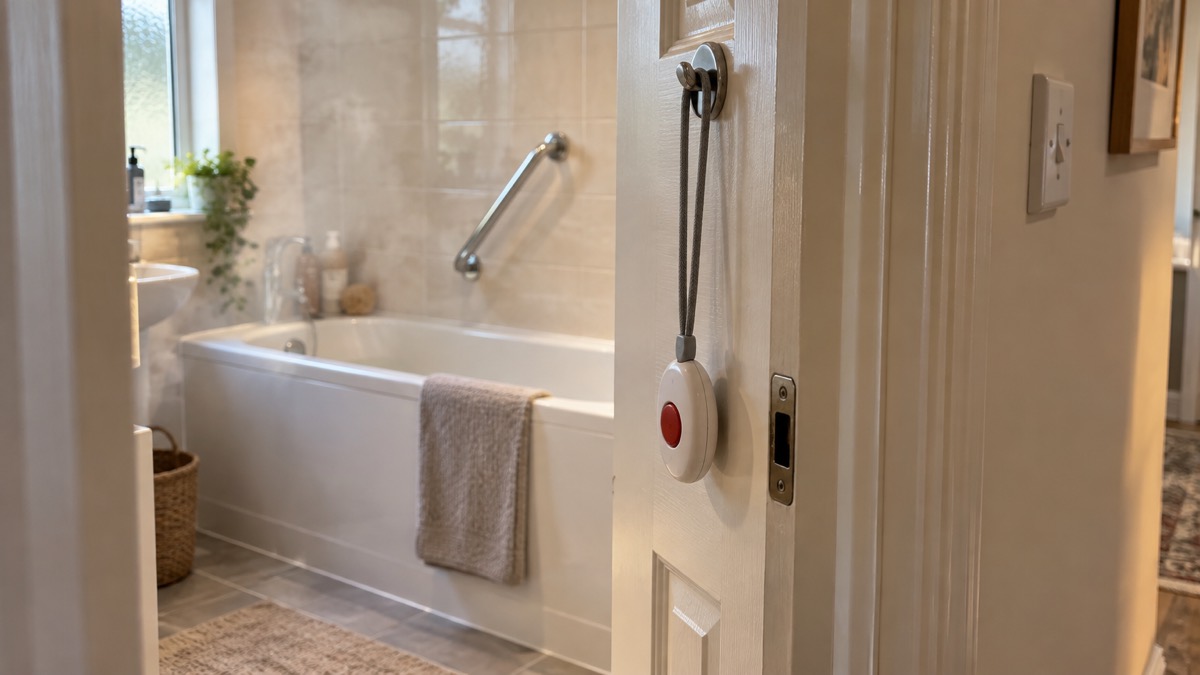
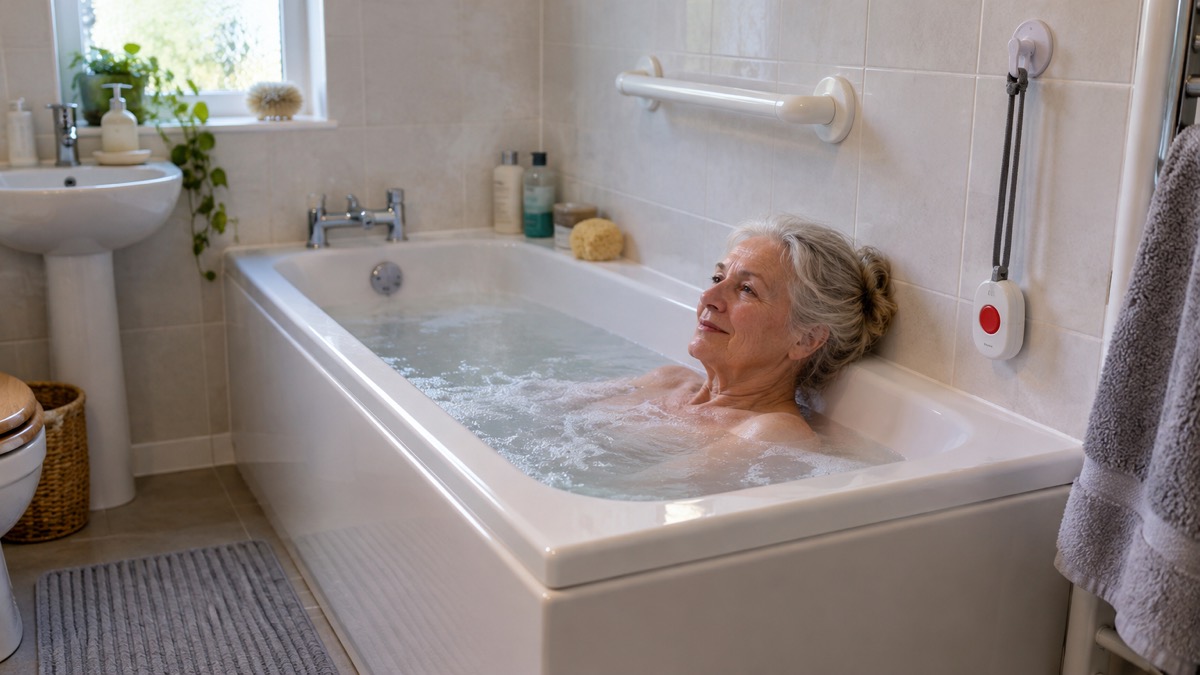
Most personal alarms can be worn in the bathroom, but whether yours can go in the bath or shower depends on your own model. Independent guidance says most personal alarms are waterproof so you can take them in the bathroom1, and one maker states that its pendant is waterproof up to 1.5 metres for 30 minutes to the IP68 standard and can be worn in the bath and shower2. That is a statement about one product, not a rule for every alarm.
The safe approach is to check your own device before you rely on it. A pendant alarm is something you wear on your wrist or hang around your neck, and if you fall or need help you press a button to trigger a call to the response centre3. If it is not with you in the bathroom, it cannot help you there, and the bathroom is a place where falls happen. Official figures show that cuts or lacerations account for 27% of injuries from falls associated with a bath, shower or similar facility4.
So the answer is usually yes, with conditions: check the rating, keep the alarm out of very hot or soapy water where you can, and make sure it is charged and tested. The sections below set out what each maker says, where an alarm should not go, and how to check before you depend on it.
Most pendants can be worn in the shower, but check your own model
A personal alarm is only useful if it is with you when something happens. Alarms come as a pendant button, brooch, watch or mobile phone app, and the user presses it for help if they need assistance; these can contact a response centre or a carer directly6. Because the device has to be on you to work, the question of whether it can go into the bathroom matters more than it first appears.
The general position is reassuring. Independent Age, an older people's charity, says most personal alarms are waterproof so you can take them in the bathroom1. That is a broad statement covering the common types of pendant, and it means that for many households the answer is simply yes.
But "most" is not "all", and the detail sits with your own device. Ratings vary between products and between makers, and the only reliable source is the instructions that came with your alarm or the service that supplied it. A pendant that is fine in a steamy bathroom may not be designed to be submerged, and a watch-style alarm may have a different rating again.
If you are choosing an alarm and know you want to wear it in the bathroom, make that a question you ask before you sign up. The page on personal alarm types and how to choose one sets out the main kinds, and the page on what happens when you press a personal alarm explains the response. For the specific question of water, ask the provider directly and get the answer for your model.
Water-resistant is not waterproof: what each maker says
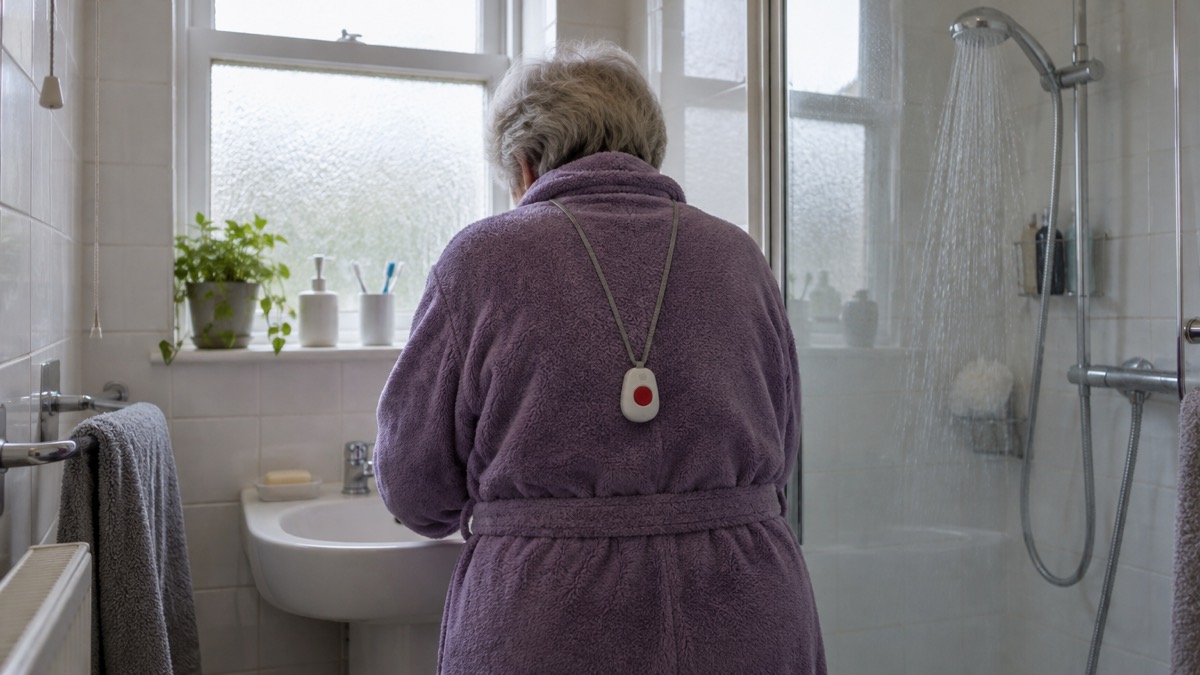
The words on the box matter. "Water-resistant" and "waterproof" are not the same claim, and a device described as water-resistant may cope with splashes but not with being submerged. Where a maker gives a rating, it usually comes with a depth and a time, and that is the figure to look for.
The clearest example in the public guidance is the Taking Care digital personal alarm. The maker states that the pendant alarm is waterproof up to 1.5 metres for 30 minutes (IP68 standard) and can be worn in the bath and shower2. That is a specific, testable claim: a depth, a duration and a standard. It tells you the pendant is designed to be submerged briefly, not just splashed.
Local authority telecare services make similar claims for their own equipment. The Isle of Anglesey telecare service describes a Lifeline unit with a personal trigger that can be worn around the neck or wrist and is waterproof8. Again, the claim is about that service's own device.
| What the source says | Device | What it means for you |
|---|---|---|
| Waterproof up to 1.5 metres for 30 minutes (IP68) and can be worn in the bath and shower2 | Taking Care digital personal alarm pendant | Designed to be submerged briefly; follow the maker's instructions |
| Waterproof, worn around the neck or wrist8 | Isle of Anglesey telecare Lifeline trigger | The service states it is waterproof; confirm with your provider |
| Most personal alarms are waterproof so you can take them in the bathroom1 | Personal alarms generally | A general statement, not a rating for your model |
The lesson is to look for a stated rating rather than a general word. If your alarm's instructions give a depth and a time, you know what it is built for. If they do not, treat it as not designed for water and keep it out of the bath and shower.
Where an alarm should not go: salt water, chlorine, hot soapy water and steam
A bathroom is a gentler environment than a swimming pool or the sea, and the guidance reflects that. A pendant rated for the bath or shower is not automatically rated for chlorinated pool water or salt water, and no source here says otherwise. If you want to wear an alarm while swimming, ask the provider first and do not assume the bathroom rating carries over.
Steam is a separate issue, and it is well documented for smoke alarms. Fire and rescue services are consistent: do not fit a smoke alarm in the bathroom, as steam may trigger the alarm9. Staffordshire Fire and Rescue Service says not to fit smoke alarms in kitchens or bathrooms where smoke or steam could set them off accidentally, and to install a heat alarm in the kitchen instead9. Surrey County Council advises heat alarms in rooms such as kitchens, garages and immediately outside a bathroom, as these will not be triggered by steam and dust10. London Fire Brigade says smoke alarms can be fitted in most other rooms except the bathroom, as steam from the hot water could cause false alarms11.
That advice is about smoke alarms, not personal alarms, but the underlying point carries: steam and moisture are hard on electronics and can cause nuisance triggers. Fire services also advise keeping bathroom doors closed, as steam from showers could trigger a false alarm5.
Hot, soapy water is another thing to think about. The NHS advises making sure your bath or shower is not too hot before you get in, and using a thermometer to check rather than your hands or feet13. That advice is about preventing scalds, but it also means the water your alarm is exposed to should not be scalding. Rinse and dry the pendant as the maker instructs after it has been in soapy water.
Bath or shower: why a pendant may cope with one and not the other
A shower and a bath expose an alarm to different things. A shower means running water, steam and a wet strap or cord. A bath means the possibility of full immersion, soapy water and a longer period of heat and moisture. A device rated to 1.5 metres for 30 minutes is built for the second, which covers the first2. A device described only as water-resistant may cope with the first and not the second.
There is also the question of what you are wearing it for. The bathroom is a high-risk room for falls, and the injuries are often cuts. Official guidance records that cuts or lacerations account for 27% of injuries from falls associated with a bath, shower or similar facility4. A pendant you have taken off to keep it dry cannot summon help for that fall.
The Stay Steady and Safe home safety checklist, aimed at preventing falls, includes considering a personal alarm or falls detector if it would help, and arranging for someone to check in regularly if you need that support14. If you are weighing up an alarm that detects falls automatically, the page on how automatic fall alerts work explains what they can and cannot do, and the page on which falls a fall detector may miss is honest about the limits.
For most households the practical answer is to wear the alarm in both, provided the maker's rating covers it, and to keep it within reach on the side if it does not.
Checking your alarm's water rating before you rely on it
Before you depend on an alarm in the bathroom, do four things.
- Find the instructions. Look for a stated rating, such as a depth and a time or an IP number. The Taking Care pendant, for example, is rated to IP68, waterproof up to 1.5 metres for 30 minutes2.
- Ask the provider. Contact the service that supplied the alarm and ask whether your model can be worn in the bath and shower. Local authority telecare services describe their own equipment, such as a waterproof trigger worn around the neck or wrist8, so they can tell you what yours is.
- Test it as the maker instructs. Follow the maker's advice on testing and charging. Do not open the case or dry it on a radiator.
- Check the strap or cord. A pendant worn around the neck or wrist depends on its strap. If it is frayed or damp, replace or adjust it before you rely on it.
There is one more thing to check if your alarm is a telecare device connected to a phone line. Devices such as fall monitors and personal alarms may require checks or upgrades before the digital phone switchover16. If your alarm is one of them, ask your provider whether it has been checked, and do not assume it will keep working through the change.
Where to get help and what to do next
If you do not yet have an alarm and think one would help, start with your local council's telecare service or a charity. Independent Age and Carers UK both describe the range of devices, including pendant buttons, brooches, watches and phone apps that contact a response centre or a carer directly6. The page on personal alarms: types and how to choose one sets out the options, and the page on a personal alarm or a mobile phone for an older person living alone compares the two.
If you already have an alarm, the single most useful step is to ask your provider the water question directly and write down the answer. Keep the instructions somewhere you can find them, and check the alarm is charged and tested.
For the wider picture, the Extra Help section covers older, disabled and medically dependent households, including falls at home and how to make a bathroom safer against falls. If you are caring for someone, the page on carers: planning for when you cannot be there is a sensible next read.
Sources (16)
- Home safety quiz, Independent Age, 2026
- Digital alarm product FAQs, Taking Care, 2026
- Telecare, NHS Inform, 2026
- Accident hazards, Somerset Council, 2026
- Student fire safety, Scottish Fire and Rescue Service, 2025
- Technology to keep you safe at home, Independent Age, 2026
- Smart tech and handy devices for the home, Carers UK, 2026
- What's available from the Telecare service, Isle of Anglesey County Council, 2026
- Smoke alarms, Staffordshire Fire and Rescue Service, 2026
- Detectors, Surrey County Council, 2026
- Alarms, London Fire Brigade, 2026
- Equipment, Devon and Somerset Fire and Rescue Service, 2026
- Burns prevention booklet 2024, Salisbury NHS Foundation Trust, 2024
- Stay Steady and Safe home safety checklist, NHS Norfolk and Suffolk ICB, 2026
- Bathroom electrical safety, Electrical Safety First, 2026
- Switchover to digital landlines, South Gloucestershire Council, 2026
 Carer's Emergency Plan
 Herbert Protocol Form
 In Case of Emergency Card
 PSR After Moving House
 Telecare Alarm in a Power Cut
 Pressing Alarm but Cannot Speak
 Falls a Fall Detector May Miss
 Pendant Battery Life
 Free Locking Cooker Valves
 Herbert Protocol
 Cared-For Person Missing
 Refer for a Fire Safety Check
 Testing Alarms With Mobility
 Electric Blankets and Dementia
 Bathroom Falls Prevention