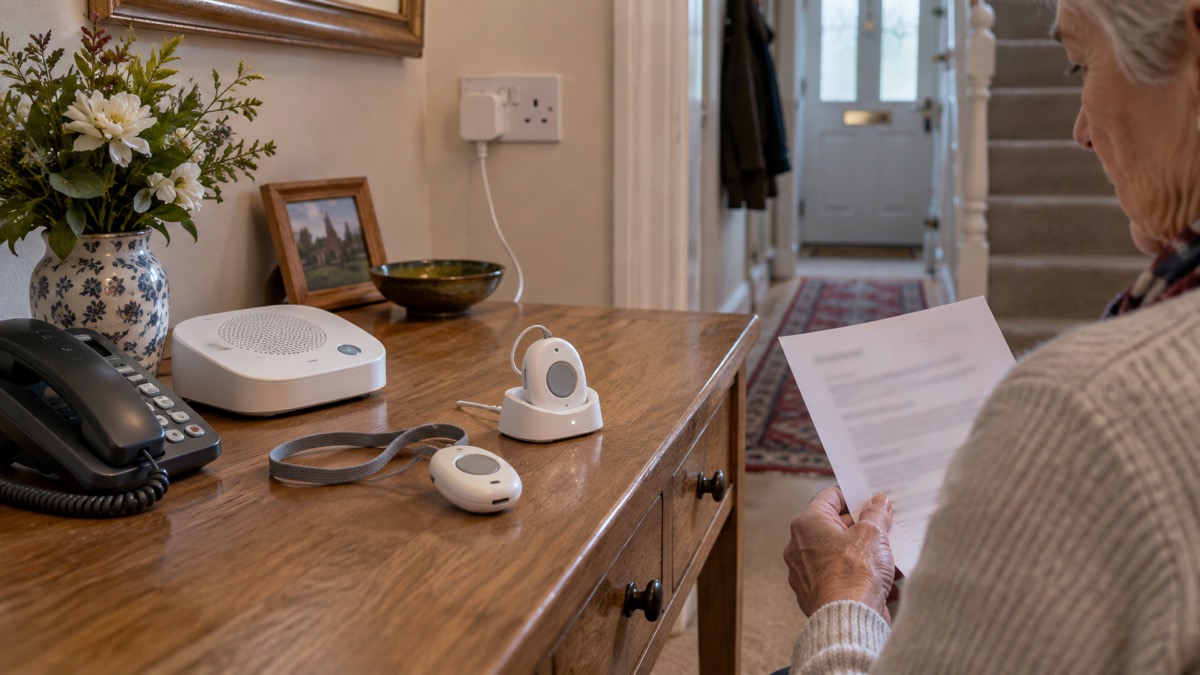
Most personal alarm pendants worn at home have a battery that lasts for years, not months. The common figure is five years, and the pendant is sealed: you do not charge it and you do not change the battery yourself. A fall alarm pendant is usually quoted at up to two years. Pendants that work away from home, using GPS, are the exception: they need charging every one to two months1.
So the answer to "how long does a fall alarm pendant battery last" depends on which pendant you have. A button-pressed personal alarm pendant typically runs five years. An automatic fall alarm pendant runs up to two years. A GPS pendant or alarm watch needs regular charging. Whichever you have, the provider normally monitors the battery and arranges replacement, so the household's job is to know which type is on the wall and keep the provider's contact details up to date.
This page sets out what each type lasts, why makers quote different figures for what looks like the same pendant, what "no recharging" means in practice, and how to plan for the day the battery reaches the end of its life.
Most pendant batteries last two to five years
The range across the common types of monitored pendant is two to five years. Taking Care, which supplies telecare alarms in the UK, describes its pendant alarms as having a long five-year battery life and being worn around the neck or wrist1. Its Digital Fall Alarm pendant is quoted at up to two years2.
That range is not a coincidence. A pendant that only has to press a button and send a radio signal to a base unit uses very little power, so a sealed lithium battery can run for years. A pendant that continuously watches movement to detect a fall uses more, so the battery is smaller in life terms. A pendant that also carries GPS and a mobile connection uses far more again, which is why those need charging every month or two3.
For context, long-life batteries of this kind are normal in home safety equipment. Scottish Government guidance on smoke alarms describes sealed tamper-proof units with long-life lithium batteries that can last up to 10 years11. The principle is the same: a sealed battery sized to the device's job, replaced on the maker's schedule rather than charged.
| Pendant type | Quoted battery life | Charging needed |
|---|---|---|
| Personal alarm pendant (button) | Five years4 | No |
| Fall alarm pendant | Up to two years2 | No |
| GPS pendant | One to two months3 | Yes |
| Alarm watch | Two to three days8 | Yes |
If you are choosing between types, the personal alarms page sets out what each does and who it suits.
Digital Personal Alarm pendant: five-year battery, no charging
The Taking Care Digital Personal Alarm is the clearest example of the long-life type. Its pendant is described as having a five-year battery life in the maker's support articles5, and the product page's technical specifications give the same figure4.
The pendant works up to 300 metres or 984 feet from the alarm unit, and it is waterproof to IP68, meaning up to 1.5 metres for 30 minutes, so it can be worn in the bathroom4. Because the battery is sealed and not rechargeable, there is nothing for the household to plug in or top up. The maker states that if the battery becomes low, the system alerts the provider automatically so it can be replaced before it stops working4.
That automatic alert is the part that matters for an ordinary household. You do not need to remember a charging routine or a replacement date. What you do need is for the provider to hold correct contact details and for the alarm to stay connected to its base unit and phone line or mobile signal. If the pendant is moved out of range, or the base unit loses power, the battery is fine but the call may not get through. The page on whether a telecare alarm works in a power cut explains the base unit's backup.
Digital Fall Alarm pendant: up to two years

The Taking Care Digital Fall Alarm pendant is quoted at a two-year battery life, both on the product page's specifications and in the maker's support articles2. It detects a hard fall automatically and raises the call, and the pendant beeps as it makes the alarm call14.
The shorter life reflects the extra work. The pendant performs a daily self-test and has a low battery reporting function, so the maker says there is no need to worry about the battery running out unnoticed6. It is water-resistant to IP67, up to 1 metre for 30 minutes, so it can be worn in the bath and shower2. Range from the base unit is up to 300 metres or 984 feet2.
Two limits are worth knowing. First, the maker states the fall detector may not detect every fall, because it is designed to detect hard, unobstructed falls9. Second, the base unit's backup battery keeps the service going for approximately 40 hours in a power cut if fully charged6. Neither is a battery-life issue in the pendant itself, but both affect whether the alarm works when you need it. The fall detectors page covers how detection works and the fall detector limits page covers which falls may be missed.
Why makers quote different battery lives for the same pendant
You may see more than one figure for what looks like the same product. The clearest case is the Digital Personal Alarm. Its product page headline says the pendant has a long-lasting six-year battery with no need for regular charging, while the technical specifications section of the same page gives a five-year battery life4. The maker's support articles give five years5.
If you are planning around a replacement date, the five-year figure is the one repeated across the specifications and support material, so it is the safer basis for planning. Ask the provider which applies to the unit you have.
There are other reasons figures vary between products and makers:
- What the pendant does. A pendant or wrist-worn alarm can be used to alert a family member, carer or call centre following a fall1. A fall detector may not detect every fall, as it is designed to detect hard, unobstructed falls2.
- How it connects. The alarm can be used to alert a family member, carer or call centre following a fall1.
- How the maker measures. Some quote a headline life, others a specification figure, and some quote "up to" a period rather than a typical one3.
None of this is a reason to distrust the alarm. It is a reason to check the figure on your own paperwork and to ask the provider if you are unsure. The guide to what happens when you press a personal alarm explains the call side, which does not depend on the pendant's battery chemistry.
No recharging needed: what that means for your household
A sealed, non-rechargeable pendant changes the household routine in a useful way. There is no nightly or weekly charging to remember, no dock to keep by the bed, and no risk of the pendant being left off while it charges. The pendant is worn continuously and the battery is the provider's responsibility.
Taking Care's GPS product includes a backup in-home pendant with a five-year battery that does not need recharging, and the maker arranges battery replacement3. The same principle applies to the in-home alarms: the battery is sized to outlast the wear and is replaced on the provider's schedule, not the household's4.
The contrast is with devices you do charge. A GPS pendant lasts one to two months between charges depending on usage, with low battery notifications3. The Taking Care alarm watch lasts two to three days on a full charge8. The Taking Care GO pendant lasts one to two months with standard use before it needs recharging15. If your household has one of these, charging is a routine to build into the week, not a one-off.
Fall alarm pendant or personal alarm pendant: which have you got?
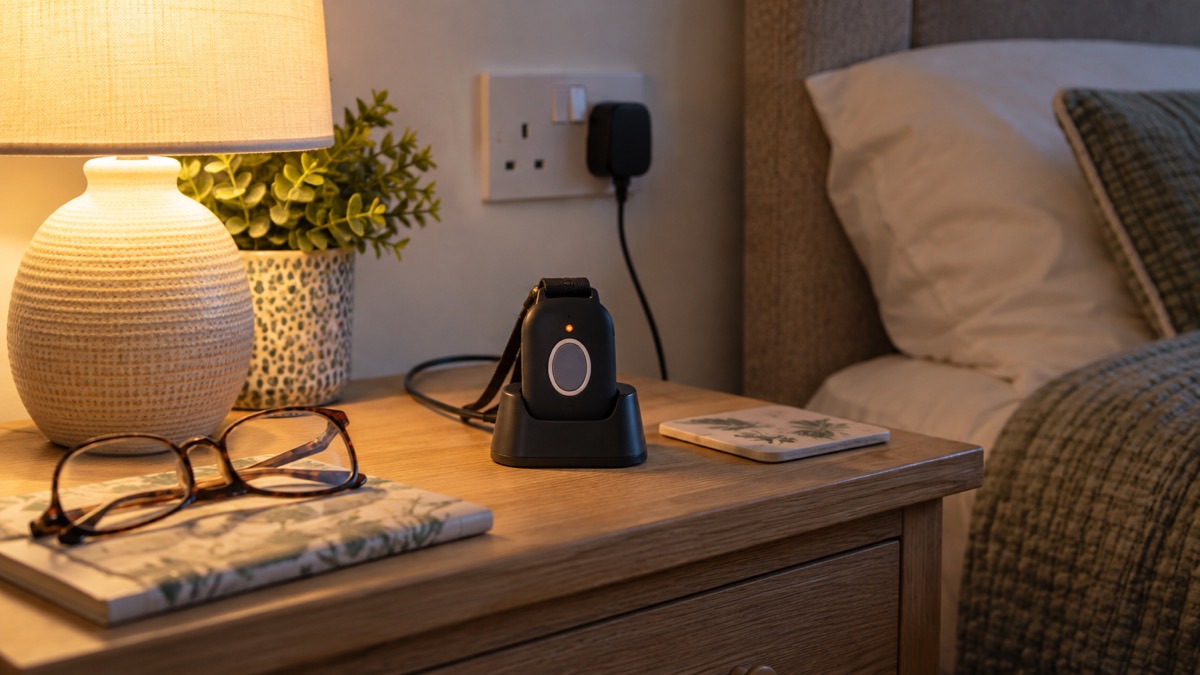
The quickest way to know what battery life to expect is to identify the pendant. The two in-home types look similar but behave differently.
A personal alarm pendant is worn on the wrist or around the neck and you press a button to trigger a call to the response centre16. Age UK describes a personal alarm as something you wear as a pendant or bracelet that lets you call for help if you have a fall, connecting you to a call centre where you can talk to someone who can help17. A fall alarm pendant adds automatic detection: it senses a hard fall and raises the call without you pressing anything, and the maker states it may not detect every fall9.
A GPS pendant is for use away from home. Taking Care describes its range as 300 metres of home coverage for pendant alarms, with GPS alarms with fall detection for beyond the home18. The comparison of home and GPS alarms helps if you are deciding between them.
| What you see | Likely type | Battery expectation |
|---|---|---|
| Button only, worn at home | Personal alarm pendant | Five years4 |
| Button plus automatic fall detection | Fall alarm pendant | Up to two years2 |
| Works away from home, charging dock | GPS pendant | One to two months3 |
| Worn on the wrist, charging dock | Alarm watch | Two to three days8 |
If you cannot tell from the pendant, check the provider's paperwork or call them. The model name is usually on the base unit or the welcome pack.
Pendant battery replacement and planning ahead
In most cases you will not replace the battery yourself. The provider does it, often by sending a replacement pendant. Taking Care states that if the battery in your fall detector needs replacing, it will replace it free of charge9. Its Digital Personal Alarm alerts the provider automatically when the battery is low so it can be replaced before it stops working4. For the backup pendant in its GPS package, a low battery report is sent automatically when the battery reaches 20% capacity, and a replacement backup pendant is sent free when the battery needs replacing10.
Planning ahead is mostly about records and contacts:
- Note the date the pendant arrived and the battery life the provider quoted.
- Keep the provider's contact details with your other household paperwork.
- Make sure the provider has a current phone number and address.
- Test the alarm as the provider instructs, and report any fault.
- If you are moving home or changing provider, check what happens to the alarm and its battery.
The page on registering for priority services explains how energy and water companies record household needs, which can matter if a power cut affects the base unit. The Extra Help section brings together the wider arrangements for older, disabled and medically dependent households.
Charging a pendant: what to do if it will not switch on
For the pendants that do charge, a flat battery is usually obvious. Taking Care's troubleshooting advice for the GO pendant says that if no charging lights show immediately, leave it on the charger for at least half an hour to see if the blue light around the edge turns on; this means the battery had run flat and it needs to be left until fully charged20.
If a pendant does not respond to a button press, check it is charged and in range before assuming a fault. For in-home alarms, check the base unit has power and the phone connection is working. The troubleshooting guidance for the Anywhere alarm covers the GPS model's common issues.
"If no charging lights show immediately, leave it on there for at least half an hour to see if the blue light around the edge turns on."
A charged pendant is only half the system. The other half is the response: what happens when the call is made. The alarm response page explains who answers and what they do.
Sources (20)
- What is telecare, Taking Care, 2026
- Fall Alarm for Elderly, Taking Care, 2026
- Taking Care Anywhere FAQs, Taking Care, 2026
- Digital No Landline Personal Alarm, Taking Care, 2026
- Digital Alarm FAQs, Taking Care, 2026
- Falls Detector FAQs, Taking Care, 2026
- Taking Care Anywhere GPS Fall Alarm, Taking Care, 2026
- Personal Alarm Watch, Taking Care, 2026
- Falls Detector Package FAQs, Taking Care, 2026
- GPS Fall Detector FAQs, Taking Care, 2026
- Fire and smoke alarms in Scottish homes: where and what to buy, Scottish Government, 2024
- Digital Personal Alarm FAQs, Taking Care, 2026
- Digital Fall Alarm FAQs, Taking Care, 2026
- How fall alarms work, Taking Care, 2026
- Taking Care GO FAQs, Taking Care, 2026
- Telecare, NHS inform, 2024
- Telecare, Age UK, 2026
- Taking Care, Taking Care, 2026
- Button batteries: where are they, CAPT, 2024
- Troubleshooting your Taking Care Anywhere, Taking Care, 2026
 Carer's Emergency Plan
 Herbert Protocol Form
 In Case of Emergency Card
 PSR After Moving House
 Telecare Alarm in a Power Cut
 Pressing Alarm but Cannot Speak
 Falls a Fall Detector May Miss
 Alarm Pendant in Bath or Shower
 Free Locking Cooker Valves
 Herbert Protocol
 Cared-For Person Missing
 Refer for a Fire Safety Check
 Testing Alarms With Mobility
 Electric Blankets and Dementia
 Bathroom Falls Prevention