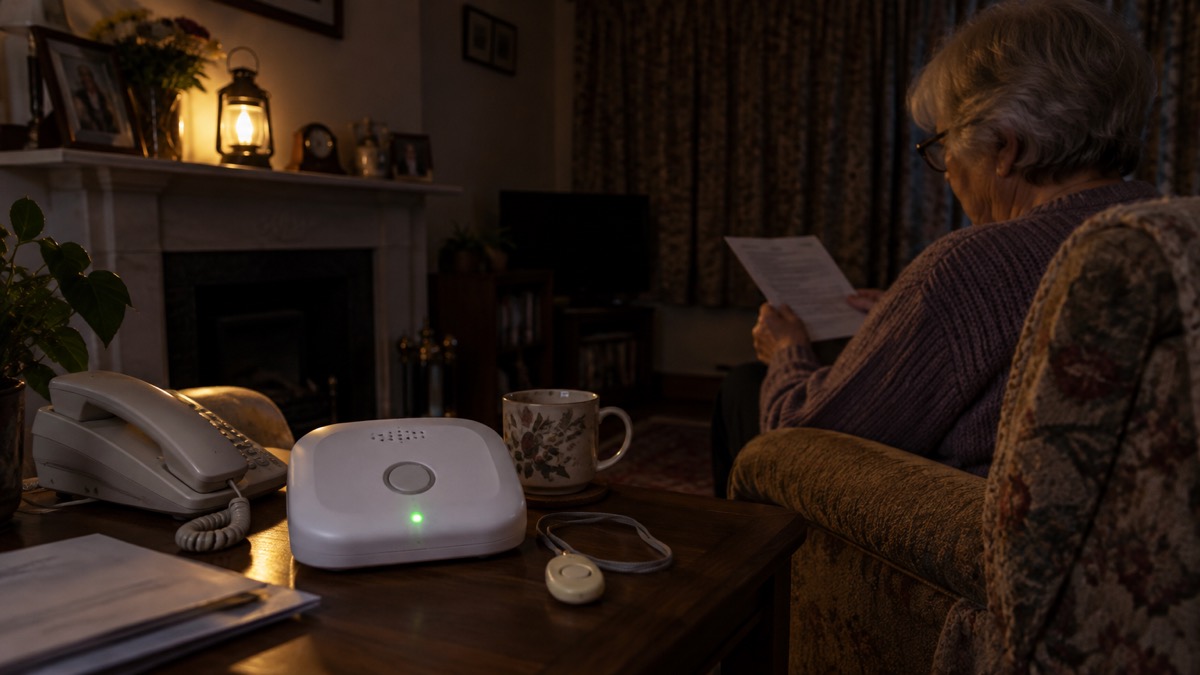
The Taking Care Digital Fall Alarm is a home and garden alarm with automatic fall detection. It raises an alert if the wearer falls, even if they are unable to press the button1. The pendant works up to 300 metres (984 feet) from the base unit, is water-resistant to IP67 (1 metre for up to 30 minutes) and runs on a battery the maker describes as lasting up to two years1. The base unit needs a mains socket within about 3 metres and no telephone line, because it connects over mobile networks1.
What makes it different from a button-only pendant is the fall detection. The maker says the sensor uses an algorithm to tell "hard" falls from other movements, and that it may not detect every fall1. So the first rule is simple: if you fall and you can press the button, press it. The maker says you must press the emergency button each time you fall if you are able to3.
This page sets out what happens when a fall is detected, which falls it can miss, how to cancel a false alarm, what you need at home to set it up, how it behaves in a power cut, and how to get support. It is written for the household deciding whether this kind of alarm suits them, and for the person who will wear it.
What happens when the Digital Fall Alarm detects a fall
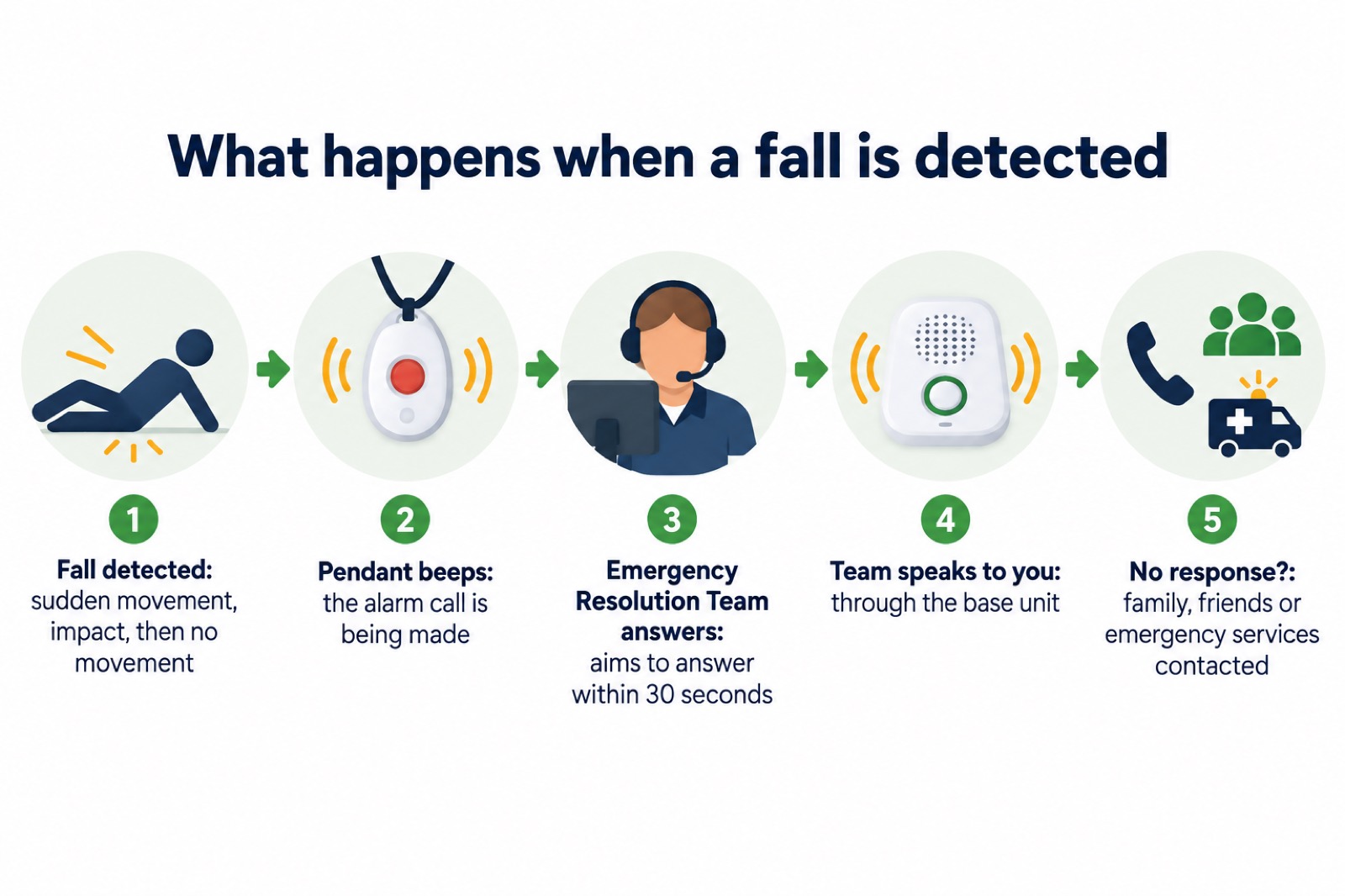
The pendant beeps as it makes the alarm call4. The maker's description of how fall detection works is specific: sensors, typically accelerometers and gyroscopes, feed an algorithm designed to react to a sudden free fall from a standing position, followed by a significant impact and no movement4. The product page puts it more simply: the sensor recognises the difference between "hard" falls and other movements1. The support pages describe the trigger as a sudden and rapid movement followed by a lack of activity, calibrated to distinguish normal movement from an actual fall2.
Once triggered, the alarm automatically calls the 24-hour Emergency Resolution Team. The team will attempt to contact the user, then family, friends or the emergency services if there is no response2. They know who is calling and where they are4. The maker aims to answer alarm calls within 30 seconds1. You speak through the base unit rather than the pendant5.
This matters because of what a fall can mean if nobody knows. The maker states that without assistance someone may not be found until a carer visit or welfare check, in some instances days, and that hypothermia, dehydration, blood loss and fractures are a real danger4. The NHS in Scotland's advice for someone who cannot get up is to reach for a phone, lifeline alarm or pendant and call for help, to keep warm by pulling something over yourself, and to move as much as you can6. A fall alarm is one way of making that call possible when you cannot reach a phone.
The service is a monitoring service, not a medical one. It contacts people and the emergency services; it does not treat you. If you are badly hurt, the team will get the right help to you.
Falls it may not detect: always press the button if you can
Automatic detection is a backstop, not a guarantee. The maker is clear that the detector may not detect every fall because it is designed to detect hard, unobstructed falls, and that you must press the emergency button each time you fall if you are able to1. The maker's guidance also says it always recommends pressing the button on the pendant to call for help if possible4.
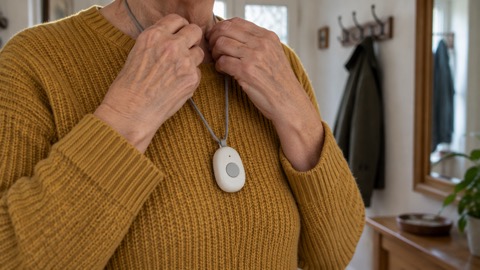
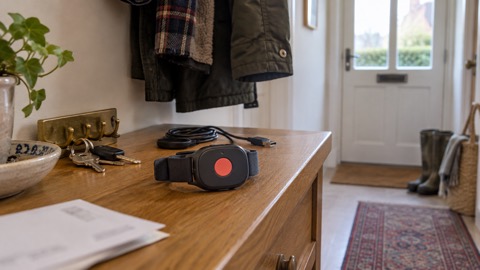
Some falls are known to be harder to catch. The maker lists slumping or falling from a sitting position, and a fall that is broken, such as when the wearer holds on to something4. Backward falls are less likely to be detected when the pendant is worn around the neck, because the pendant is protected4. Wrist-worn alarms may be affected if the arms are cradled to the chest or covered by clothing during a fall4. The algorithm may not trigger an alarm call if the wearer is less than 1.2 metres (4 feet) tall4.
| Situation | What the maker says |
|---|---|
| Hard, unobstructed fall | The type the detector is designed to catch1 |
| Slumping or falling from sitting | May not be detected4 |
| Broken fall, holding on to something | May not be detected4 |
| Backward fall, pendant at the neck | Less likely to be detected4 |
| Wrist alarm, arms cradled or covered | May be affected4 |
| Wearer under 1.2 metres (4 feet) tall | Algorithm may not trigger a call4 |
The practical response is to treat the button as the main way to call for help and the detection as a second line. If you fall and can move your hand, press. If you cannot, the alarm may still call for you, but it may not. That is why the maker recommends a key safe, so responders can get in if you cannot reach the door2.
Cancelling a false alarm by shaking the pendant
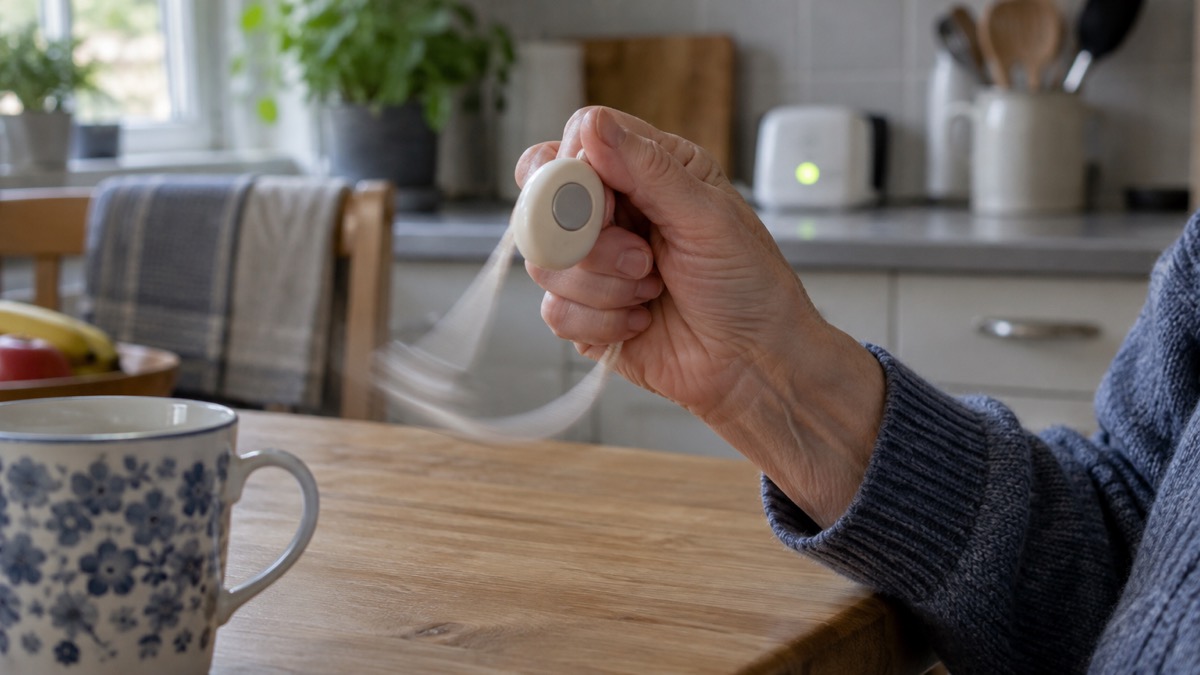
If the alarm calls when you are fine, you can stop it yourself. The maker says the call can be cancelled during the first 15 seconds by shaking the pendant from side to side until it is silent4. You can also simply let the Emergency Resolution Team know you do not need assistance, or cancel the call yourself with a quick shake2. A detected-fall alert can be cancelled by shaking the pendant1.
If you do nothing, the team will check that you are safe. The maker says that if the button is pressed accidentally, the Emergency Resolution Team will simply check that you are safe5. There is no cancellation fee1.
False alarms have causes worth knowing. The maker lists movement that is similar to a fall, not wearing the alarm as recommended, and, very rarely, faulty equipment4. It is not possible to adjust the sensitivity of the fall alarm; if it seems too sensitive, contact Customer Services, and a faulty device will be replaced free of charge4.
"The call can be cancelled during the first 15 seconds by shaking the pendant from side to side until it is silent"
Tremors, epilepsy or Parkinson's: when fall detection can be turned off
Shaking is the cancel gesture, and that creates a problem for some people. The maker warns that someone with tremors, epilepsy or Parkinson's may accidentally cancel an alert by shaking the pendant2. For some customers, the maker says, the Digital Personal Alarm without fall detection may be more suitable1.
If you want the alarm but not the automatic detection, the fall detection feature can be disabled to prevent false alarms. Taking Care asks you to call 0800 085 7371 when ordering to request this option2. That gives you a button alarm with monitoring, without the automatic trigger.
This is a decision to make with the person who will wear it, and with their GP or care team where there is any doubt. The trade-off is plain: fall detection off means no automatic call if you cannot press the button, but no accidental cancellations either. If you are unsure, the maker's customer services can talk it through before you order.
Setting up: a mains socket within 3 metres and no landline needed
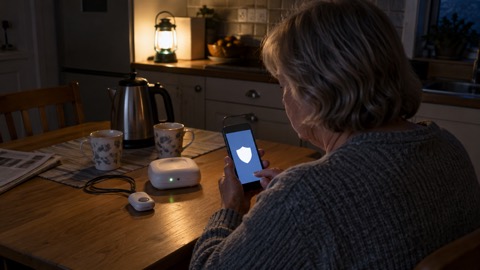
Setup is designed to be done by the household. You need a mains electricity socket within around 3 metres of where you plan to place the base unit1. The power adapter has a 3-metre cable1. The base unit measures 189mm x 119mm x 50mm1.
There is no telephone line requirement. The alarm uses a built-in mobile connection with two pre-fitted multi-network SIMs, so it does not need a telephone line1. That matters because the UK's old analogue phone network is being switched off, with most customers expected to be on digital lines by January 20278. Digital personal alarms work on mobile networks and do not need a landline or internet connection5.
To set it up, plug in the base unit and follow the voice-guided instructions; there is no need for an engineer visit1. Most alarms simply need to be plugged in and tested by pressing the button to connect to the Emergency Resolution Team5. The maker says fall alarms work straight out of the box and do not need to be configured for each user4.
- Place the base unit where it can hear you and where you can hear it, within reach of a mains socket1
- Plug in the power adapter and follow the voice prompts1
- Test by pressing the pendant button to connect to the Emergency Resolution Team5
- Choose your wearable, wrist or pendant, when ordering online3
- Tell the maker your key safe location and code if you have one3
Delivery is free next working day in England and Wales for orders before 1pm, Monday to Friday, with 48-hour delivery for other areas1. One support page words it slightly differently, saying next working day to all postcodes in England and Wales and 48-hour delivery for other UK areas that cannot be delivered to within 24 hours; the two documents disagree on the detail, so check when you order3.
Power cuts: about 40 hours on the base unit's backup battery
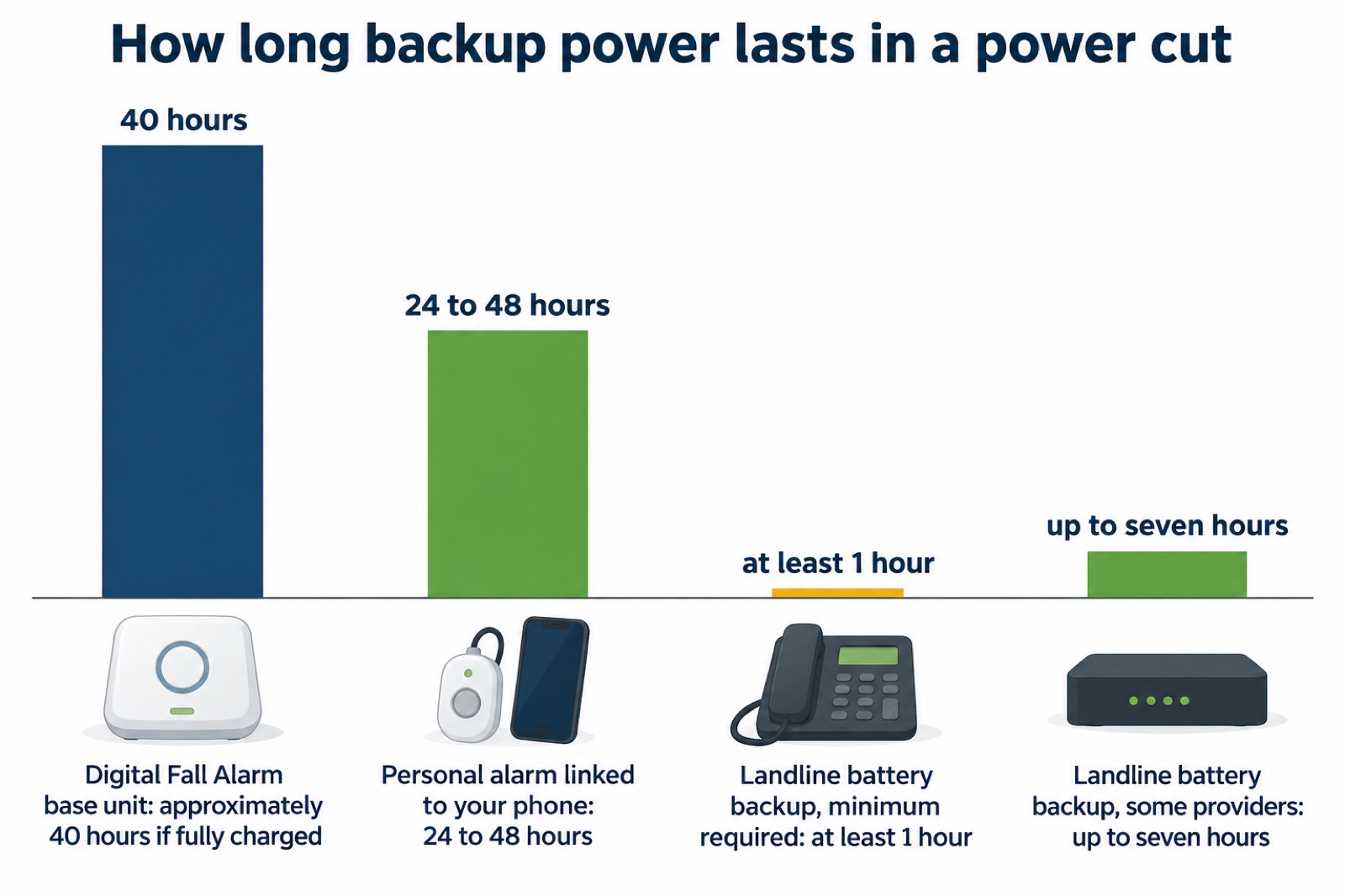
The base unit has a built-in battery backup, so the alarm continues to work during a power cut for approximately 40 hours if fully charged1. The unit also sends a signal to the monitoring centre if your power goes off3.
That is a long backup by the standards of the wider telephone network. Ofcom says a landline provider's battery backup must last at least one hour in a power cut, though some providers have backups lasting up to seven hours8. Citizens Advice says a backup battery for a personal alarm linked to your phone usually lasts from 24 to 48 hours9. The Digital Fall Alarm's approximately 40 hours sits within that range, but it depends on the battery being fully charged, so keep the base unit plugged in.
A power cut is also a moment to check other safety equipment. If you have mains-powered smoke alarms, check that the battery backup is working10. Energy networks advise customers with medical equipment at home to make sure backup systems work and that the battery lasts at least 3 hours during a power cut11. Northern Powergrid reminds medically dependent customers that an emergency power cut can last at least three hours each time, once or twice a day12. If you rely on the alarm, tell your network operator you are on their Priority Services Register; our guide to signing up to Priority Services Registers explains how.
Pendant range, battery and water resistance
The pendant works up to 300 metres (984 feet) from the base unit, which the maker says helps ensure fall detection works reliably throughout the home and garden1. Taking Care describes the product as a home and garden alarm5. If you need coverage beyond the home, the maker offers GPS alarms that work wherever you go in the UK as long as there is mobile network coverage5; our comparison of a home personal alarm or GPS alarm sets out the difference.
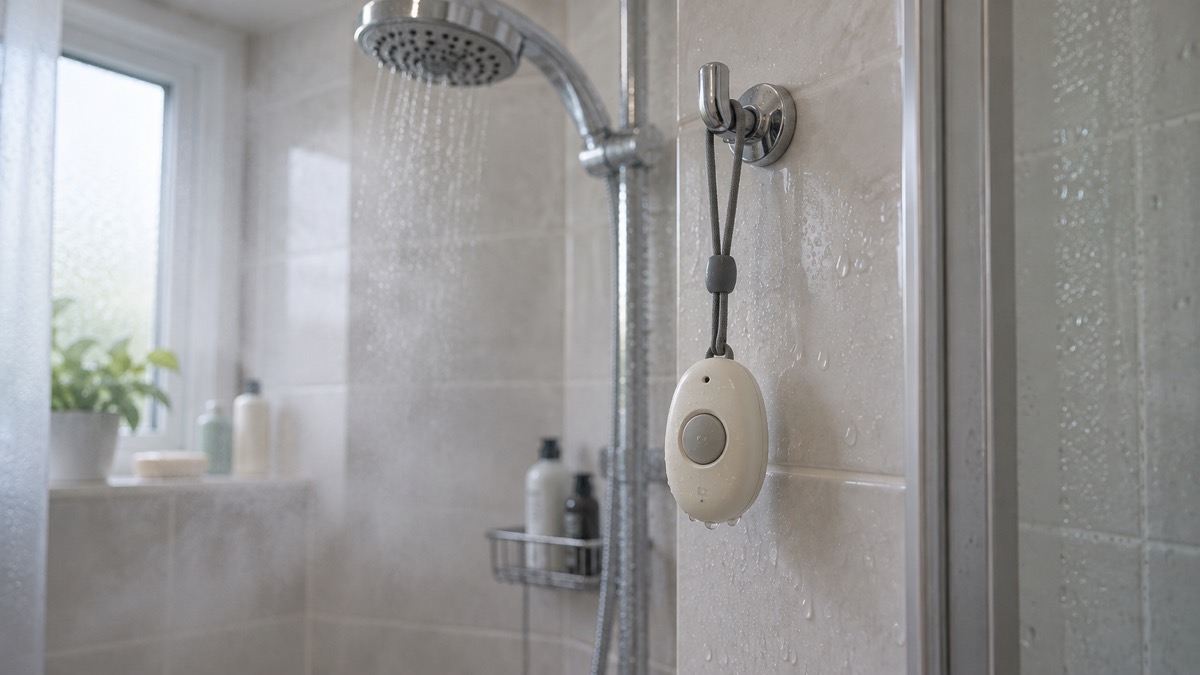
The pendant is water-resistant to IP67, meaning up to 1 metre for up to 30 minutes, and can be worn in the bath and shower1. Most personal alarms are water-resistant so they can be worn in the shower or bathroom5.
Battery life is where the maker's documents disagree. The product page gives a 2-year battery life in the specifications, and elsewhere on the same page says the pendant has a long-lasting 5-year battery and does not need to be recharged1. The support pages say up to two years2. Treat two years as the figure to plan around and ask the maker to confirm the battery arrangement for your unit when you order.
| Specification | Figure |
|---|---|
| Pendant range | up to 300 metres (984 feet) from the base unit1 |
| Pendant battery | up to two years; one page also states 5 years1 |
| Water resistance | IP67, 1 metre for up to 30 minutes1 |
| Base unit size | 189mm x 119mm x 50mm1 |
| Power adapter cable | 3 metres1 |
| Mobile connection | two pre-fitted multi-network SIMs1 |
| Alarm call answer target | within 30 seconds1 |
Warranty, repairs and returning the alarm
The equipment is provided on a rental basis as part of the subscription, and if it is faulty it is repaired or replaced at no additional cost1. The subscription includes a free lifetime warranty and repairs1. Calls, data and repairs are included, with no additional phone or data charges, and the SIM cards and data usage are part of the subscription1.
If you change your mind, you can return the alarm within 30 days of ordering for a full refund, including both the set-up cost and subscription1. Taking Care also advertises a 30-day money back guarantee and pro-rata refunds with no long-term commitment5.
For faults or advice, call freephone 0800 085 73712. The maker's pages disagree on opening hours: one says Monday to Friday, 9am to 6pm, with 9am to 5pm for subscription payments2; another lists Monday to Friday, 8am to 5pm1. Call in the morning if you are unsure. One support page also gives an alternative number, 0800 0121 321, and an email address, enquiries@ppptakingcare.co.uk3.
If your alarm is an older analogue model, check whether it needs upgrading. Taking Care has told customers that current analogue personal alarms will not work with the digital switchover and has offered a reduced upgrade fee or an alternative analogue alarm with a landline exclusion until January 202713. The switch from analogue to digital phone lines is expected to be complete for most customers by January 20278.
Where to get help and how this fits with other support
A fall alarm is one part of a wider plan. The NHS in Scotland's telecare guidance describes a pendant alarm as something you wear on your wrist or around your neck, with a button to trigger a call13. Carers UK describes a fall detector as a sensor the person wears that sends an alert if they fall, notifying you or a 24-hour monitoring and response centre as soon as it happens14. Carers Trust notes that telecare sensors can also detect events such as a seizure, getting up or leaving the house and not returning, or being very cold15.
For the household, the practical steps are:
- Consider a personal alarm or falls detector if it would help, and arrange for someone to check in regularly if you need that support11
- Give the maker a key safe location and code so responders can get in2
- Register for your energy and water companies' Priority Services if anyone in the home is older, disabled or medically dependent; our guide to what registered customers get explains the help available
- Keep the base unit plugged in so the backup battery is charged1
Falls also raise fire risk. Cheshire Fire and Rescue Service says falls can increase the risk of fire, because someone who has fallen or is unsteady may find it harder to react quickly, turn off appliances or respond to a smoke alarm16. If you are setting up an alarm for someone who lives alone, it is worth reviewing their home fire safety at the same time; our guide to fire risk for older and disabled people covers what to check.
If you are weighing this alarm against other options, our pages on personal alarms and how to choose one and on what happens when you press a personal alarm set out the wider picture. For the maker's own range, see taking.care.
Sources (16)
- Fall Alarm for Elderly, Taking Care, 2026-10-29
- Digital Fall Alarm FAQs, Taking Care, 2026-10-29
- Falls Detector FAQs, Taking Care, 2026-10-29
- How fall alarms work, Taking Care, 2026-01
- Taking Care, Taking Care, 2026-10-29
- Some of the reasons people call 999, Welsh Ambulance Service, 2026-10-29
- What to do if you fall, NHS Inform Scotland, 2026-04-30
- Future of landline calls, Ofcom, 2026-08-26
- Prepare for a power cut, Citizens Advice, 2023-11-14
- Winter safety, North Wales Fire and Rescue Service, 2026-10-29
- Stay Steady and Safe Home Safety Checklist, NHS Norfolk and Suffolk ICB, 2026
- Emergency power cuts, Northern Powergrid, 2026-10-25
- Telecare, NHS Inform Scotland, 2024-08-13
- Technologies to make life easier, Carers UK Scotland, 2026-10-25
- Emergencies, adaptations and telecare, Carers Trust, 2024-08-13
- Slips, trips and falls, Cheshire Fire and Rescue Service, 2026-05-20
 Taking Care Digital Alarm
 Taking Care Anywhere GPS Pendant
 Taking Care Alarm Watch