The Taking Care Digital Personal Alarm is a care alarm that works in and around your home, giving quick access to help at the touch of a button1. You wear a pendant on a neck chain or wrist strap, and when you need help you press it. The base unit, plugged into a mains socket, makes the call over a built-in mobile connection using two pre-fitted multi-network SIMs, so no landline is needed2. A team answers around the clock, speaks to you through the base unit, and calls your nominated contacts or the emergency services if you need more help3.
The practical points to know before you order are these. The pendant works up to 300 metres from the base unit, in the home and garden only2. The base unit keeps working for approximately 40 hours in a power cut if fully charged2. The pendant has a long-life battery that is monitored automatically, so you do not charge it yourself3. There is no automatic fall detection: you press the button2.
This page sets out what the alarm does, its specifications, how it copes with the digital phone switchover and power cuts, how to set it up and test it, what happens when you press the button, how to keep your details current, and what the warranty and returns arrangements are. It is one product among several kinds of personal alarm, and the right choice depends on your household.
What the Taking Care Digital Personal Alarm does
Taking Care describes the Digital Personal Alarm as a simple care alarm that works in and around your home, giving quick access to help at the touch of a button1. It is rented from Taking Care for the duration of your contract rather than bought outright3. The company has been providing personal alarm services for more than 30 years5.
The alarm covers more than medical emergencies. Taking Care states it can be used for feeling unwell, injuries, feeling unsafe or distressed, and home emergencies such as a fire, flood, burst pipe or suspected intruder6. That breadth matters for a household planning around emergencies: the same button that brings help after a fall also brings help when something in the home goes wrong.
It suits someone who spends long periods at home, lives independently, has trouble getting around, or is likely to fall or have a health emergency. Independent guidance describes pendant alarms in exactly these terms: worn on the wrist or around the neck, pressed to trigger a call to a response centre7. It is an in-home alarm, not a tracker. If the person you are thinking of needs help when out and about, that is a different kind of device.
Taking Care also includes free wellbeing calls with the service. If something seems different or worrying, such as the alarm being used more than usual, the company gets in touch to check everything is okay6. For a family keeping an eye on a relative from a distance, that is part of what the subscription provides.
Pendant and base unit specifications
The two parts work together: the pendant you wear sends a radio signal to the base unit, and the base unit makes the call. The specifications that decide whether it suits your home are the range, the power supply and the way you speak to the response team.
| Feature | Specification | Source |
|---|---|---|
| Wearing options | Hypoallergenic neck chain or wrist strap, lightweight neck or wrist option | 2 |
| Pendant range | Up to 300 metres from the base unit, home and garden only | 2 |
| Base unit antenna | Large internal antenna to improve reception | 3 |
| Power | Mains electricity socket within around 3 metres of the base unit | 2 |
| Power adapter | Supplied with a 3-metre cable | 2 |
| Backup battery | Approximately 40 hours in a power cut, if fully charged | 2 |
| Pendant battery | Five-year battery life, daily self-test, low battery reported automatically | 3 |
| Communication | Two-way speaker and microphone built into the base unit | 2 |
| Waterproofing | IP68, waterproof in the shower and bath | 2 |
| Fall detection | None | 2 |
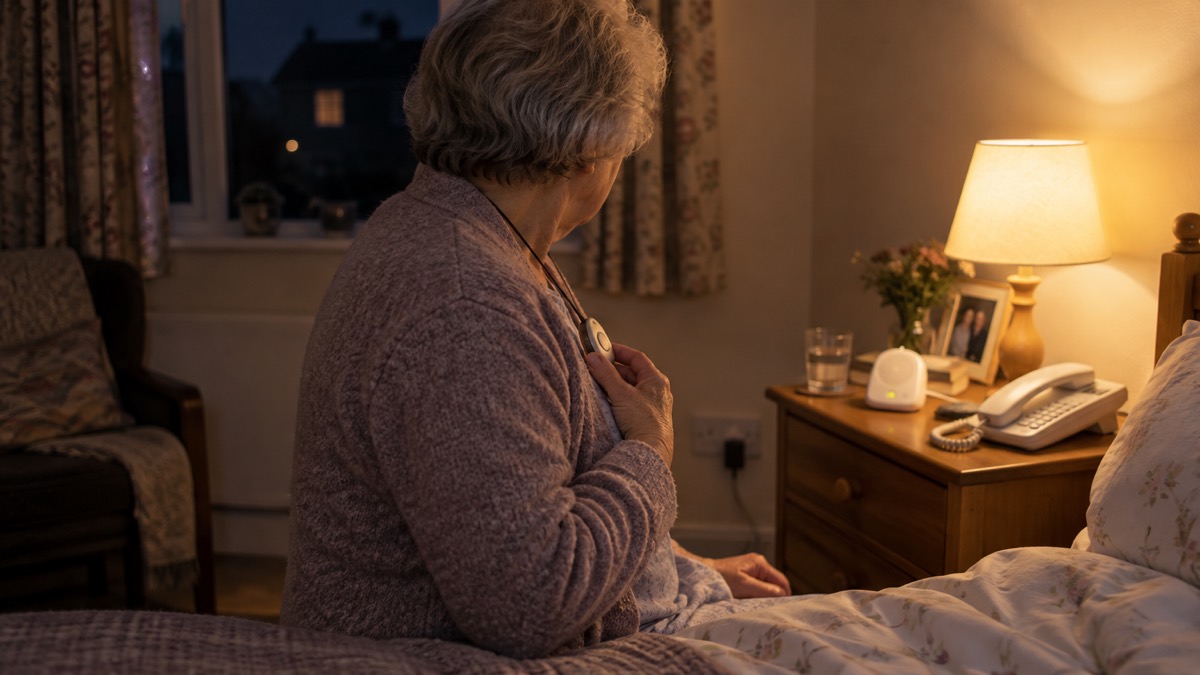
Two of these figures are worth pausing on. The 300-metre range is generous for a typical home and garden, but it is a radio range, not a promise that every corner of every building will be covered; walls and construction affect radio signals, which is why the setup includes a range test. The pendant battery is described as a five-year battery in Taking Care's support article3, while the maker's product page describes a six-year battery2. The two figures differ; either way, the pendant is not something you recharge, and the system reports a low battery so it can be replaced before it stops working2.
The waterproof rating also differs between Taking Care's pages. The product page gives IP68 as up to 1 metre for 30 minutes2, while the support article gives up to 1.5 metres for 30 minutes3. Both describe a pendant that can be worn in the bath and shower, which is when many falls happen. If you want the wider picture on wearing an alarm in water, there is a separate guide to personal alarm pendants in the bath or shower.
Works without a landline: two multi-network SIMs and the digital switchover
The Digital Personal Alarm uses a built-in mobile connection with two pre-fitted multi-network SIMs for added reliability, and needs no landline2. It does not require Wi-Fi or a personal mobile plan; the SIM cards and data are included in the subscription2. Taking Care describes its digital alarms as digital-ready and designed to work during the digital switchover, with no landline worries1.
That matters because the UK's phone network is changing. Landlines across the UK are being switched to a new digital system, which may affect telecare devices and personal alarms8. Ofcom, the communications regulator, warns that a care alarm or telecare device might not work properly on a digital landline9. The government's telecare national action plan notes that many digital telecare alarms have an in-built roaming SIM, meaning they will connect to a mobile phone mast in the event of a mains power cut10.
If you already have an alarm that runs over a traditional phone line, independent guidance is clear: check with your provider that they are making arrangements to upgrade to a digital phone service11. National Grid's landline guidance goes further and says not to assume an alarm will keep working after the switch to digital phone lines, or during a power cut, and to ask the supplier to confirm compatibility and what happens if the power goes off12.
For this alarm, the switchover question is largely settled by design: it does not use a telephone landline at all3. The reassurance for a household is simple. You are not waiting for a phone line to be upgraded, and a fault on your broadband does not take the alarm down with it. What the alarm does depend on is mobile coverage at your address and mains power, with the backup battery covering the second.
Power cut backup: about 40 hours from a fully charged base unit
A power cut is one of the situations a personal alarm exists for, so the backup battery is a central specification rather than a footnote. Taking Care states that the alarm will continue to work during a power cut for approximately 40 hours if fully charged2. The support article puts it the same way: the battery in the base unit will keep the service going for approximately 40 hours3. The alarm unit also sends a signal if your power goes off13.
That figure compares well with the general picture for phone-line backup. Ofcom states that a landline backup battery must last for at least one hour in a power cut, though some providers have back-ups that last up to seven hours9. The government's guidance for vulnerable customers on analogue landlines says the same: a free backup battery unit giving at least an hour, and many batteries now last much longer14. Citizens Advice gives a typical range of 24 to 48 hours for the backup battery in alarm phone systems15.
The 40 hours is a figure for a fully charged unit, so the state of the battery when the power goes is what decides it. The base unit is mains powered and charges as it sits; there is nothing for you to switch on. If a power cut runs longer than the backup, the alarm stops being able to make calls, so a household with someone at risk should treat a long outage as a reason to check on that person directly.
For anyone whose needs go beyond a personal alarm, the wider question of how long equipment lasts without mains power is worth planning for. Energy network operators advise households with medical equipment to know how long its backup supply will work, remembering that an emergency power cut can last at least three hours each time, once or twice a day16. SP Energy Networks advises making sure backup systems work properly and that equipment has a backup battery lasting at least 3 hours during a power cut17. Our guide to whether a telecare or personal alarm works in a power cut covers the general position.
Setting it up: a mains socket within 3 metres and a range test
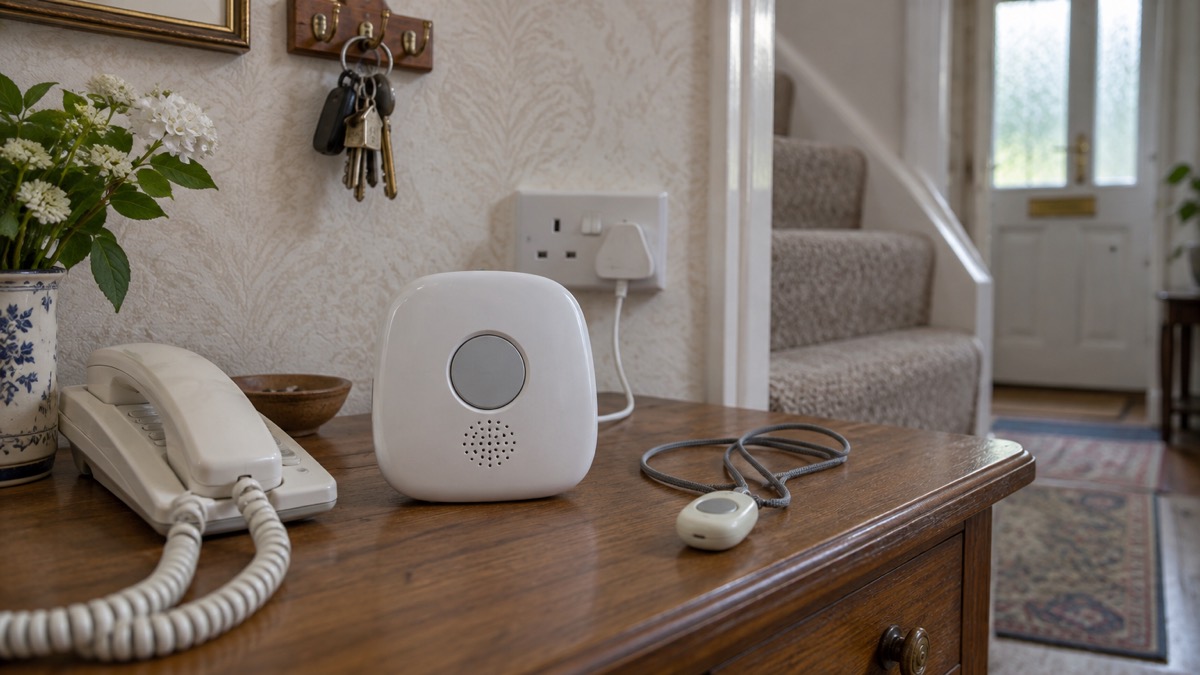
Setup is deliberately simple. Taking Care states you just need a mains electricity socket within around 3 metres of where you want to place the base unit2. The power adapter comes with a 3-metre cable2. Most alarms simply need to be plugged in and tested by pressing the button to connect to the Emergency Resolution Team18.
The step that is easy to skip is the range test. Taking Care states the Digital Personal Alarm will guide you through a range test so you can be confident the pendant will work around your home3. Do it properly: walk to the rooms and the parts of the garden where the wearer is likely to be, press the button as instructed, and confirm the base unit picks up the signal. A pendant that works in the living room but not the back bedroom is a problem worth finding on the day it arrives, not on the night it is needed.
Where you put the base unit matters too. It needs to be somewhere with mains power, within range of the places the wearer spends time, and somewhere the response team's voice can be heard through the speaker and your voice picked up by the microphone2. A hallway or living room usually works; a cupboard does not.
A few practical checks while you are setting up:
- Confirm the socket is not one you switch off at the wall out of habit.
- Run the range test in every room the wearer uses, and in the garden if it will be worn there.
- Make sure the wearer knows to press the pendant, not to shout for the base unit.
- Check the wearer can reach the base unit easily, as you may need to bend down to reach the socket7.
If you are comparing this with other options, our guide to personal alarm types and how to choose one sets out the wider field, and how far a pendant works from its base unit explains range in more detail.
What happens when you press the button
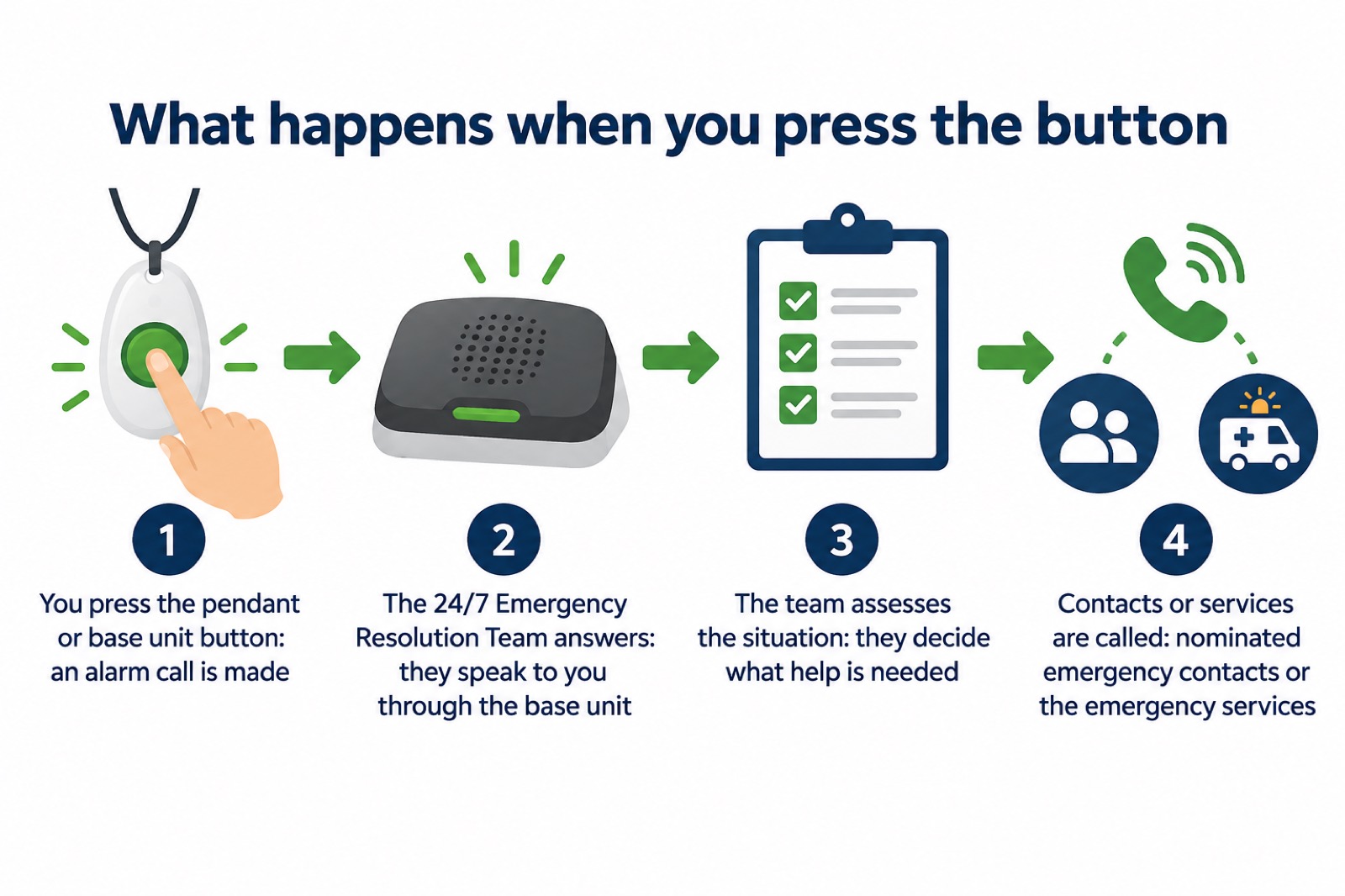
Pressing the emergency button on the pendant or the base unit makes an alarm call to Taking Care's 24/7 Emergency Resolution Team, who talk with you over the alarm unit and assess the situation. If you need further help, they call your nominated emergency contacts or the emergency services3. You speak through the base unit, using the built-in speaker and microphone, without needing to hold anything2.
This is the same pattern independent and official guidance describes for monitored alarms generally. Warwickshire County Council explains that pressing a personal alarm, or a sensor detecting a problem, makes the lifeline call the control centre, where a trained member of staff assesses the situation, checks if you are okay and takes appropriate action, which could include calling a family member, a friend or the emergency services19. Independent Age describes devices connecting to a monitoring service outside your home, which triggers a call for help when activated20.
A few things follow from this that are worth knowing before you rely on it. The team can only call people whose details you have given them, so the quality of your emergency contact list directly affects the quality of the response. The pendant does not detect a fall for you, so if someone is unconscious or unable to press the button, the alarm cannot raise the call on its own2. And if you press it by mistake, nothing terrible happens: Taking Care states the team will simply check that you are safe18, and independent guidance notes that support centres are used to accidental alarms and do not mind20.
If speaking is difficult, the team still has the call. Our guide to what happens if you press your alarm but cannot speak covers that situation, and what happens when you press a personal alarm explains the response process in general.
Keeping your details and emergency contacts up to date
The alarm is only as useful as the information behind it. After placing your order, Taking Care sends a link to an online form where you provide your emergency contacts and medical details, and changes should be reported as soon as possible2. The company recommends providing emergency contacts, key safe details if you have one, and GP details and medical conditions, so the right help can be arranged in an emergency3.
There are three ways to update emergency contacts: online via the account setup link in your order confirmation email, by post using the form in your welcome pack, or by phone on freephone 0800 023 4301, Monday to Friday, 9am to 5pm3. For other changes, such as moving home, changing your phone number, or updates to medical conditions or keyholder contact details, Taking Care asks you to call Customer Services on 0800 085 73713.
Keep the list current as circumstances change:
- A contact who has moved, changed number or died should be replaced straight away.
- If you fit a key safe, tell the provider so responders can use it; our guide to key safes explains how they help.
- Tell the provider about new medical conditions, so the team knows what it is dealing with.
- If you move house, update your address before the alarm is needed at the new one.
Warranty, repairs and returning the alarm
The Digital Personal Alarm comes with a free lifetime warranty and repairs2. Taking Care states that if the alarm develops a fault or stops working at any time while you are a customer, it will attempt to repair or replace it, and the long-life pendant battery is replaced free of charge3. Because the alarm is rented for the duration of your contract3, repairs and battery replacement sit with the provider rather than the household.
If you change your mind, Taking Care offers a 30-day money back guarantee: you can return your personal alarm free of charge within 30 days and receive a full refund of the cost of your order6. The company also describes simple, pro-rata refunds with no long-term commitment1.
For faults, contact Customer Services on 0800 085 7310 and describe what the alarm is doing13. If the pendant battery is running low, the system alerts the provider automatically so it can be replaced before it stops working2, so you should not need to report it yourself. If the base unit has lost power or the SIM connection is not working, the team can talk you through what to check.
Where this alarm fits in a household plan
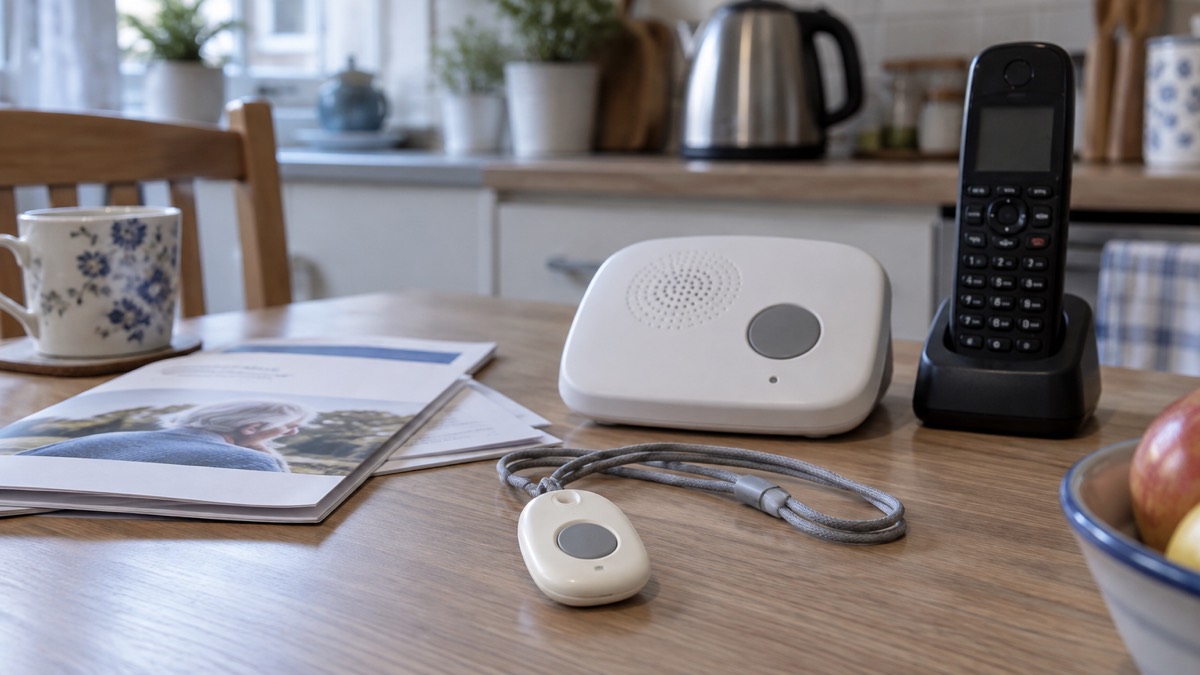
A personal alarm is one layer of a household's arrangements, not the whole of them. Staffordshire County Council's falls prevention guidance advises keeping a phone or alert device nearby in case you need help21, and public health guidance for Northern Ireland recommends regular home safety checks, fitting smoke and carbon monoxide alarms, keeping emergency contact numbers accessible and seeking advice about hazards at home22. Age UK notes that if you have a community alarm, you can press the button on your pendant to call for help, including during a heatwave23.
For households with someone at higher risk, the wider extra help section covers priority services registers, key safes, fall detectors and planning for when a carer cannot be there. If you are weighing up whether a home alarm or a GPS alarm suits your circumstances, our comparison of a home personal alarm or GPS alarm sets out the difference, and the Taking Care brand page lists the maker's other products.
Sources (23)
- Why choose Taking Care personal alarms, Taking Care, 2026-10-29
- Digital No Landline Personal Alarm, Taking Care, 2026-10-29
- Digital Personal Alarm FAQs, Taking Care, 2026-10-29
- FAQs - Falls Detector Package, Taking Care
- What is telecare, Taking Care, 2026-10-29
- Blue Light personal alarms from Taking Care, Taking Care, 2026-10-29
- Telecare | NHS inform, NHS inform
- Telecare, Age UK, 2026-08-11
- Future of landline calls, Ofcom, 2026-08-26
- Telecare national action plan, GOV.UK, 2025-02-11
- Smart tech and handy devices for the home, Carers UK, 2026-10-25
- Landlines, National Grid, 2026-10-26
- Digital Personal Alarm FAQs, Taking Care, 2026-10-29
- Phone and broadband outages, Prepare campaign, 2026-10-12
- Prepare for a power cut, Citizens Advice, 2023-11-14
- Emergency power cuts, Northern Powergrid, 2026-10-25
- Important information: preparing for a power cut, SP Energy Networks, 2026-10-26
- Taking Care, Taking Care, 2026-10-29
- Assistive technology, Warwickshire County Council, 2026-10-29
- Technology to keep you safe at home, Independent Age, 2026
- Falls prevention, Staffordshire County Council, 2026
- Home accident prevention, Public Health Agency, 2026
- Staying cool in a heatwave, Age UK, 2026-06-25
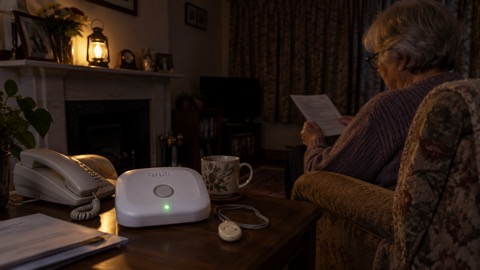 Taking Care Digital Fall Alarm
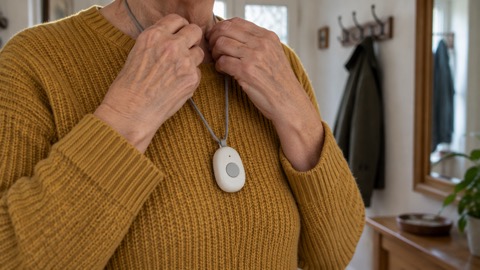 Taking Care Anywhere GPS Pendant
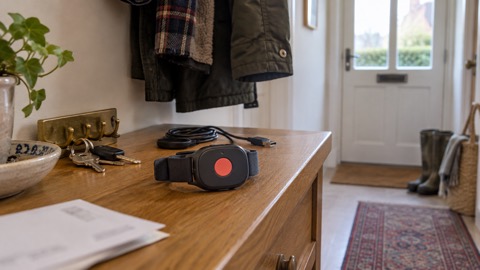 Taking Care Alarm Watch