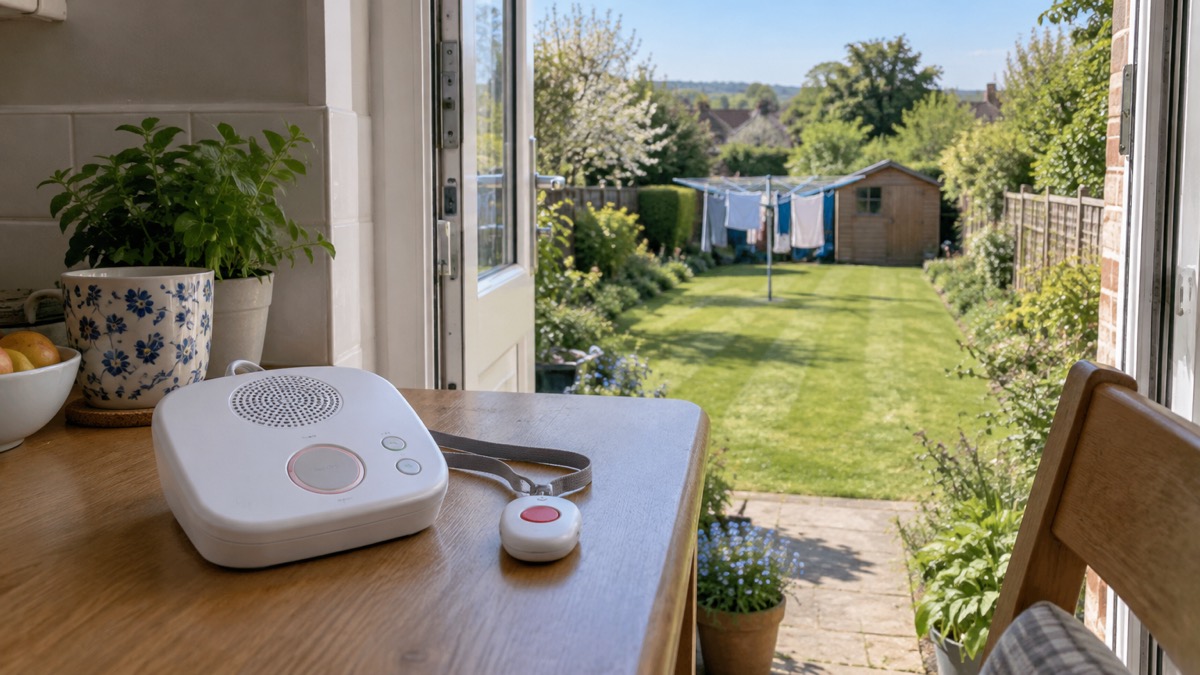
If you are choosing a personal alarm, the question that decides most is simple: will it still work where you actually go? For most home pendants the answer is up to 300 metres from the base unit, which typically covers the house and garden1. A fall sensor pendant is different: Taking Care states that the alarm works up to 75 metres from the base unit2. Beyond that range, a home pendant stops working, because it sends its alarm call through the base unit rather than over a mobile network3.
That single limit shapes how you use the alarm. A pendant that reaches the end of a long garden is useful; one that does not will fail silently at the moment you need it. Taking Care asks customers to test their alarms on a quarterly basis, and recommends choosing an easy to remember date such as your birthday or another memorable event, with a reminder or calendar note4. If you need help beyond the home, a GPS alarm is the option designed for it5.
Pendant range: up to 300 metres from the base unit
The standard figure for a home pendant alarm is 300 metres from the base unit. Taking Care lists its Digital Personal Alarm as working up to 300 metres / 984 feet from the alarm unit, and describes the pendant as working in the home and garden only, up to that distance1. Its backup pendant carries the same figure, up to 300 metres / 984 feet from the alarm unit, so it should work in your garden3.
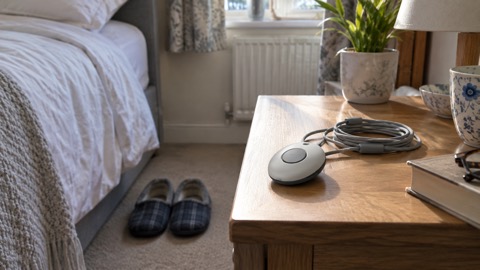
What that means in practice is that the range is a radio link between two pieces of equipment in your home, not a connection to the outside world. The pendant sends its signal to the base unit, and the base unit makes the call to the response centre. That is why the distance matters and why the base unit's position matters just as much as the pendant's.
Several things reduce the range in a real house. Walls, floors and the position of the base unit all affect it, and Taking Care advises checking that the base unit is not close to other electrical devices such as a computer, television, fan or mobile phone, moving the equipment away if a reduced radio range warning appears6. If you move the base unit, re-check the range afterwards7.
The 300 metres is a maximum, not a promise for every corner of every garden. Treat it as the outer limit and confirm your own coverage by testing. If your garden is long, or your base unit sits at the front of the house, the far end of the garden may be outside it even though the figure sounds generous.
Fall sensor pendants reach about 75 metres
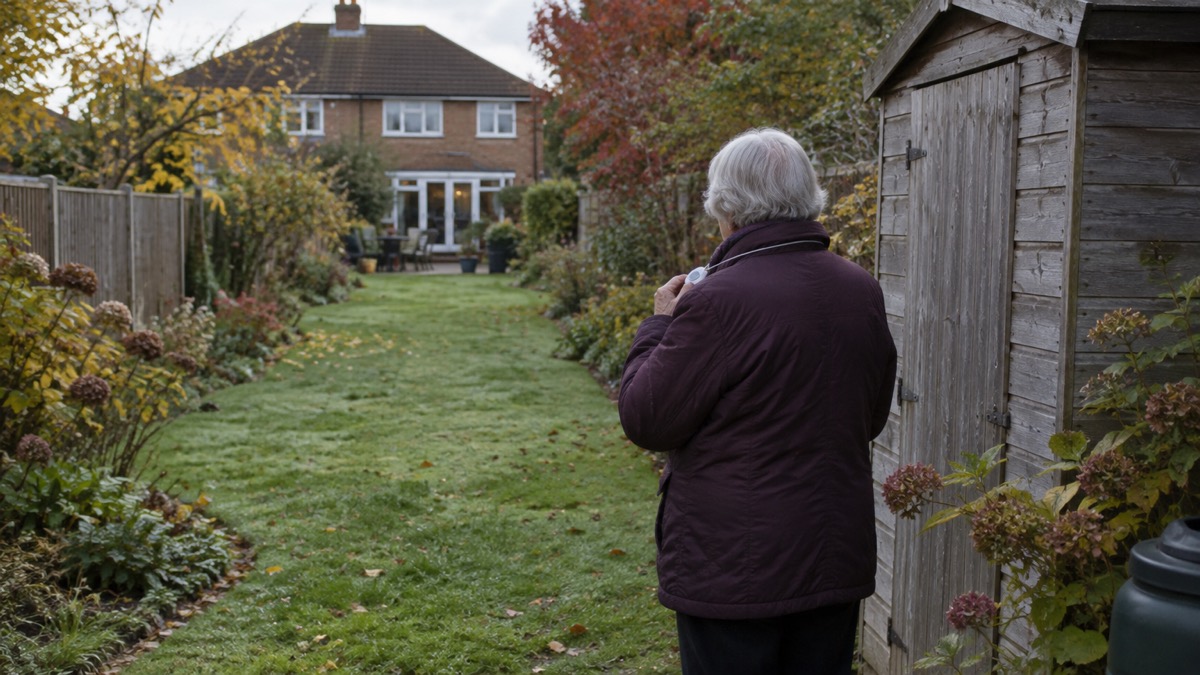
A pendant with automatic fall detection works over a shorter distance. Taking Care states that the fall sensor pendant alarm works up to 75 metres from the base unit2, and its Falls Detector Package documentation gives the same figure, up to 75 metres / 246 feet from the alarm unit, for use in the home and garden8. The Age UK Personal Alarm it supplies also works up to 75 metres from the alarm base unit9.
That is a real difference from the 300 metres of a standard pendant, and it changes where a fall detector is useful. A detector that covers the house and the near garden is doing its job; one expected to cover a large garden at the far end may not. If the garden is the reason you are choosing, check which pendant you are being offered before you rely on it.
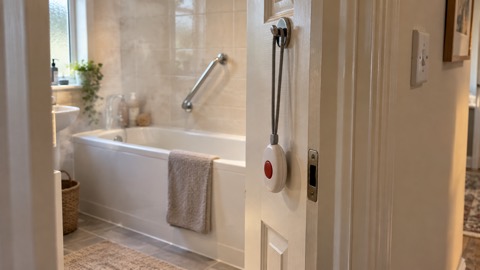
The fall alarm pendant is built for wear near water as well: Taking Care lists it as IP67, water resistant up to 1 metre for up to 30 minutes10. The Digital Personal Alarm pendant goes further, described as waterproof up to 1.5 metres for 30 minutes to IP68 and able to be worn in the bath and shower1. Its product page lists IP68 as up to 1 metre for 30 minutes, so the maker's own documents give two depths for the same rating11.
| Pendant type | Range from base unit | Notes |
|---|---|---|
| Standard home pendant | Up to 300 metres / 984 feet1 | Home and garden only1 |
| Backup pendant | Up to 300 metres / 984 feet3 | Needs the base unit to work3 |
| Fall sensor pendant | Up to 75 metres2 | IP67, water resistant to 1 metre for 30 minutes10 |
| Age UK Personal Alarm | Up to 75 metres9 | Taking Care offers optional fall detection and GPS location features9 |
A home pendant stops working once you leave the base unit's range
The limit is not a warning tone or a degraded service. A home pendant depends on the base unit to send its alarm call, so once you are out of range the call does not go. Taking Care states plainly that the backup pendant requires the alarm base unit to work and sends its alarm call to the Emergency Resolution Team using the alarm unit3. The same logic applies to the standard pendant.
This is why the range question matters more than it first appears. A pendant worn to the bottom of the garden, to the allotment or to the shop is not a mobile alarm. It is a device that works within a measured distance of a box in your house. If you need help away from home, the answer is a different kind of alarm, not a longer walk with the same one.
Power is the other dependency. Taking Care warns that if the backup battery is exhausted the alarm unit stops working until mains power is restored6. A base unit that has lost power and used up its backup is no longer a base unit, whatever the pendant's range. For how this plays out in an outage, see Will a Telecare or Personal Alarm Work in a Power Cut?.
Battery level in the pendant matters too. Taking Care states that its GO alarm pendant may not work, or may stop functioning during an alert for help, if it does not have sufficient battery level7. A pendant at the edge of its range with a low battery is the worst combination, so report any low battery warning rather than waiting.
Testing your pendant from the furthest point you use
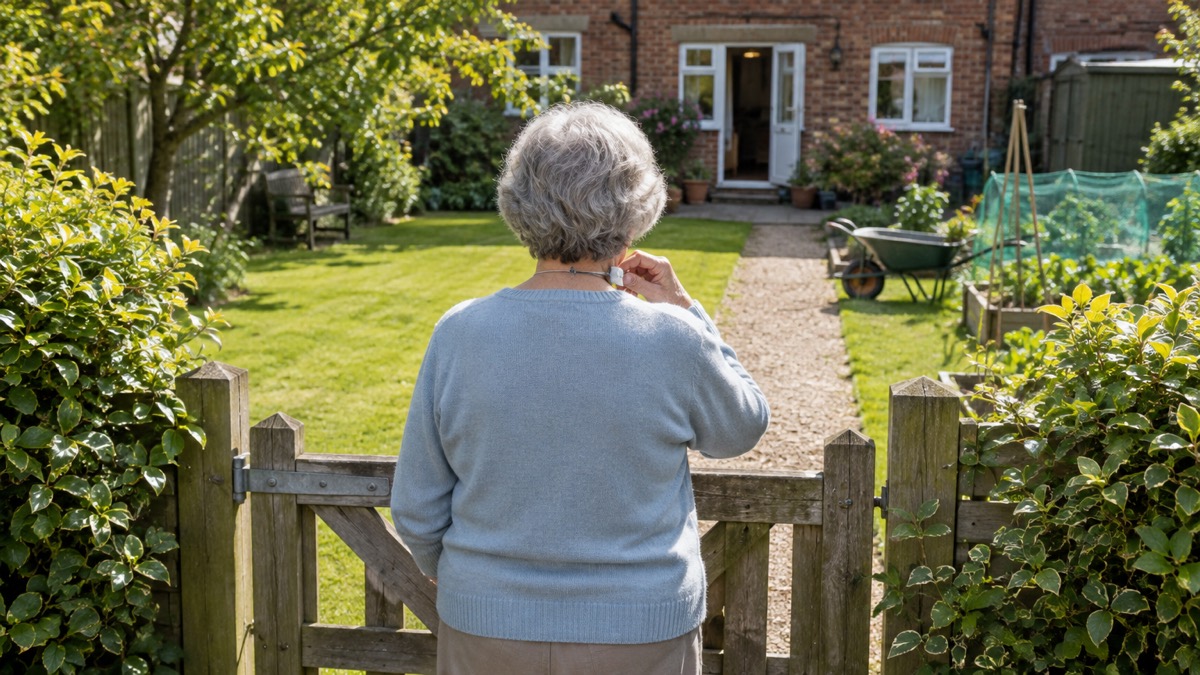
The only reliable way to know your coverage is to test it where you will stand. Taking Care's set-up process guides you through a range test so you can be confident the alarm pendant will work around your home1, and the Digital Fall Alarm does the same12. For a location-aware GPS pendant, Taking Care says it will ask you to test the equipment from different locations in your home and garden so the range and signal is fully tested13.
Testing is simple and should be done properly. Taking Care's guidance is to press the button on your pendant or wristband just once and wait a moment to be connected, then tell the Emergency Resolution team you are testing; they will test the alarm, check the signal and close the call4. That last step matters: the team knows it is a test, so no one is dispatched unnecessarily.
How often? Taking Care is currently asking customers to test their alarms on a quarterly basis4. It recommends choosing an easy to remember date, such as the day of your birthday or another memorable event, and setting a reminder or calendar note4. The same page notes that pandemic circumstances meant the frequency of alarm testing had to be reduced, which is why the routine is worth re-establishing.
A short checklist for the test:
- Test the equipment from different locations in your home and garden so the range and signal is fully tested13.
- Press once and wait to be connected4.
- Tell the team it is a test, and let them check the signal4.
- Note any spot where the call does not connect, and move the base unit or avoid that spot.
- Re-check the range if you move the base unit7.
If the alarm does not connect, the base unit's surroundings are the first thing to check. Taking Care advises checking that the base unit is not close to other electrical devices such as a computer, television, fan or mobile phone, turning off or moving the equipment away and checking whether this stops the warning6.
GPS alarms for help beyond the home
If the person you care for needs help outside the house, a GPS alarm is the tool for it. Taking Care states that to get help away from the home, a personal alarm with GPS provides a way to call for help from any location with a mobile network reception5. That is the key condition: it works where there is a mobile signal, not everywhere.
The GPS pendant does not continuously track the wearer. Taking Care states that the GPS personal alarm does not continuously track your location, and that location information is sent when an alarm is raised14. That is a privacy point worth knowing, and it also tells you what the alarm is for: a call for help, not a tracking device.
At home, a location-aware GPS pendant can fall back on the base unit. Taking Care states that if a mobile signal cannot be found, the location-aware GPS pendant will switch to using the alarm unit to call the Emergency Resolution Team3. That gives a household one device that covers both the house and the outside, provided the base unit is set up and tested.
The GPS option also carries the network question. Taking Care states that if your personal alarm only uses 2G or 3G, it may stop connecting to its Emergency Resolution Team once the changes happen15. Ask your provider which network your alarm uses and what happens when older networks close.
For a pacemaker wearer, the maker's instruction is specific: the MindMe GPS Alarm pendant must be kept at a minimum distance of 25cm from your pacemaker at all times16. Taking Care also advises attaching the location-aware GPS pendant to the supplied split ring, which can be attached to a belt clip or keys17. Check the maker's instructions for your own model before wearing it.
Choosing between a home pendant and a GPS alarm
The choice comes down to where the person spends their time. A home pendant with 300 metres of range covers a house and a typical garden, and a fall sensor pendant covers up to 75 metres1. A GPS alarm covers anywhere with mobile reception, and falls back to the base unit at home5. Neither is better in the abstract; they suit different circumstances.
| What you need | Home pendant | GPS alarm |
|---|---|---|
| Help in the house and garden | Yes, up to 300 metres1 | Yes, with base unit fallback3 |
| Help out and about | No1 | Yes, where there is mobile reception5 |
| Fall detection | On fall sensor models, up to 75 metres2 | Available as an option18 |
| Speaking through the pendant | Through the base unit on the Digital Personal Alarm18 | Through the pendant or base unit19 |
| Location sent when alarm raised | No | Yes14 |
Taking Care has supported older people and their families with personal alarms for over 30 years, and offers optional fall detection and GPS location features18. Its range includes the Taking Care Digital Personal Alarm, the Taking Care Digital Fall Alarm, the Taking Care Anywhere GPS Pendant and the Taking Care Out-and-About Personal Alarm Watch. For the wider picture of types and how to choose, see Personal Alarms: Types and How to Choose One.
What happens when you press it, and what the service adds
Pressing the pendant connects you to a response team, and what happens next depends on the service. Taking Care's Emergency Resolution Team takes the call, checks the signal and can close a test call4. For the full sequence, see What Happens When You Press a Personal Alarm.
The service also watches for changes in use. Taking Care includes free wellbeing calls with its personal alarm service, and if something seems different or worrying, such as using the alarm more than usual, the team gets in touch to check everything is all right11. It explains there has been a change to the pattern of personal alarm use that may indicate a potential concern, so family can decide if further support is needed20.
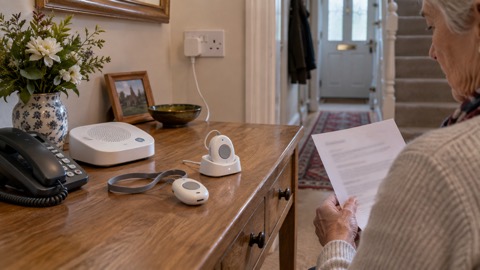
The pendant's battery is designed to last. Taking Care states that its pendant alarms have a long five-year battery life and can be worn comfortably around the neck or wrist5, and that the Digital Personal Alarm pendant has a five-year battery life1. The backup pendant has a five-year battery life and does not need recharging, with battery replacement arranged by the service19. For more detail, see How Long a Personal Alarm Pendant Battery Lasts.
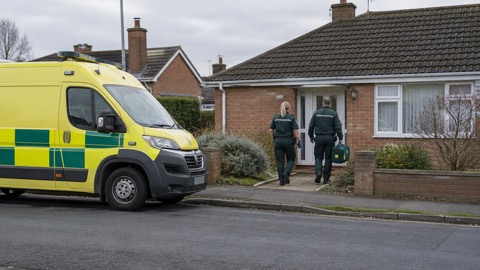
If the wearer cannot speak, the alarm still works, but the response depends on the information you have given the service. See What Happens If You Press Your Alarm but Cannot Speak? for how to prepare for that.
Sources (20)
- Digital Personal Alarm FAQs, Taking Care, 2026-10-29
- Falls Detector Package FAQs, Taking Care, 2026-10-29
- Taking Care Anywhere v2 FAQs, Taking Care, 2026-10-29
- Why Test Your Personal Alarm, Taking Care, 2026-10-29
- What Is Telecare, Taking Care, 2026-10-29
- Troubleshooting Your No Landline GSM Personal Alarm, Taking Care, 2026-10-29
- Troubleshooting Your Taking Care Anywhere, Taking Care, 2026-10-29
- Falls Detector Package v2 FAQs, Taking Care, 2026-10-29
- Age UK Personal Alarm FAQs, Taking Care, 2026-10-29
- Fall Alarm for Elderly, Taking Care, 2026-10-29
- Digital No Landline Personal Alarm, Taking Care, 2026-10-29
- Digital Fall Alarm FAQs, Taking Care, 2026-10-29
- GPS Fall Detector FAQs, Taking Care, 2026-10-29
- Taking Care Anywhere GPS Fall Alarm, Taking Care, 2026-10-29
- 2G and 3G Alarm FAQs, Taking Care, 2026-10-29
- MindMe GPS Alarm FAQs, Taking Care, 2026-10-29
- Taking Care Anywhere FAQs, Taking Care, 2026-10-29
- Why Choose Taking Care Personal Alarms, Taking Care, 2026-10-29
- Taking Care Anywhere GPS Fall Alarm, Taking Care, 2026-10-29
- Wellbeing Calls ActiveAlert FAQs, Taking Care, 2026-10-29
 Carer's Emergency Plan
 Herbert Protocol Form
 In Case of Emergency Card
 PSR After Moving House
 Telecare Alarm in a Power Cut
 Pressing Alarm but Cannot Speak
 Falls a Fall Detector May Miss
 Alarm Pendant in Bath or Shower
 Pendant Battery Life
 Free Locking Cooker Valves
 Herbert Protocol
 Cared-For Person Missing
 Refer for a Fire Safety Check
 Testing Alarms With Mobility
 Electric Blankets and Dementia