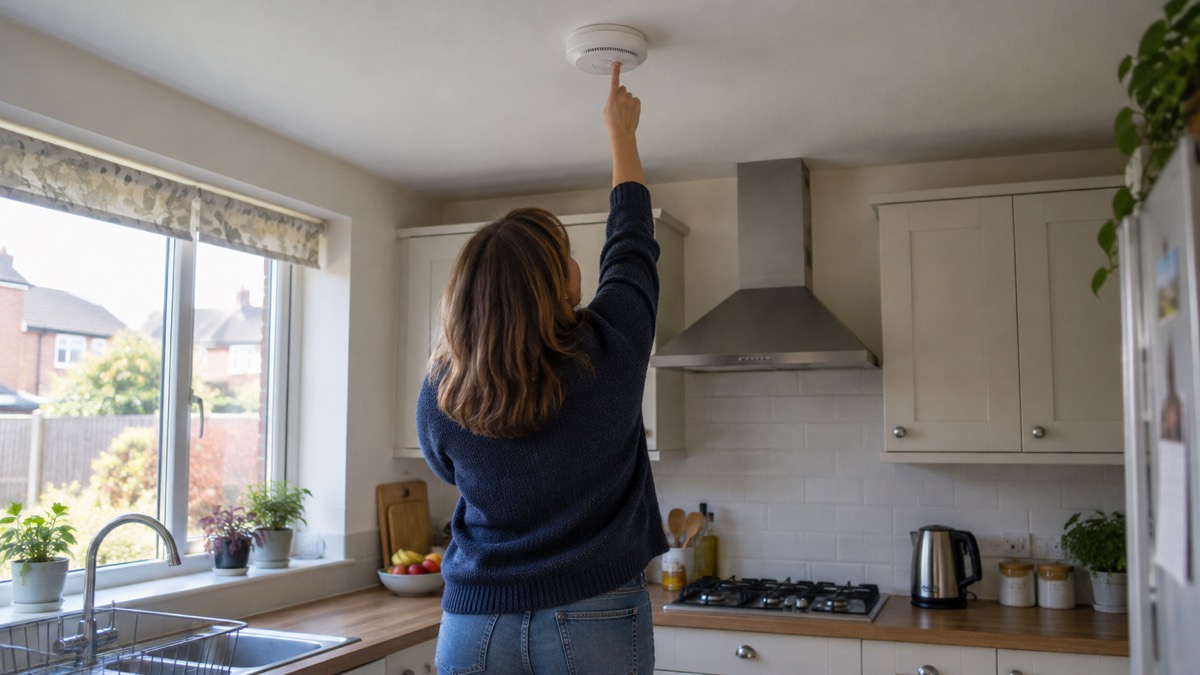
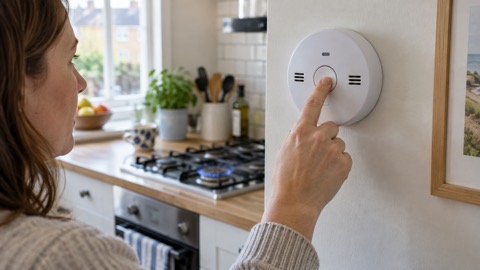
Test your smoke alarms at least once a month, and weekly if you can manage it. Press the test button until the alarm sounds, and do the same for any carbon monoxide alarm in the house. That monthly press is the single most useful thing you can do for your household's fire safety, and it takes seconds.
The rest of the routine runs on two longer clocks. Change the battery once a year unless your alarm has a sealed ten-year battery, and replace the whole alarm every ten years or when its replace-by date is reached. Fire and rescue services across the UK give the same core advice, with the monthly test as the minimum and weekly as the better habit1.
If an alarm stays silent when you test it, treat that as a fault to fix, not a quirk to live with. The usual causes are a flat battery or a detector head that needs cleaning or replacing, and the answer is a new battery, a clean, or a new alarm4.
Test every alarm at least once a month, or weekly if you can
The national Fire Kills campaign, run by the Government, tells households to test smoke alarms at least once every month1. Individual fire and rescue services set the same floor and often nudge it higher. Staffordshire Fire and Rescue Service says to test the alarm every week2, and South Wales Fire and Rescue Service asks residents to remember to test weekly3. Somerset's household fire safety guidance advises testing regularly, once a week5.
Independent safety bodies land in the same place. Electrical Safety First advises testing alarms at least once a month6, and Age UK suggests testing regularly, about once a month, and keeping alarms clean10. The practical difference between monthly and weekly is small: a weekly test catches a developing fault sooner, and a monthly test is far better than none.
Pick a fixed day. The first of the month, bin day, or the day the clocks change all work, because the point is that the test happens without anyone having to remember it. Test every alarm in the house on that day, not just the one nearest the kitchen. If you have a carbon monoxide alarm, test it in the same sweep.
How to test: press the button until the alarm sounds
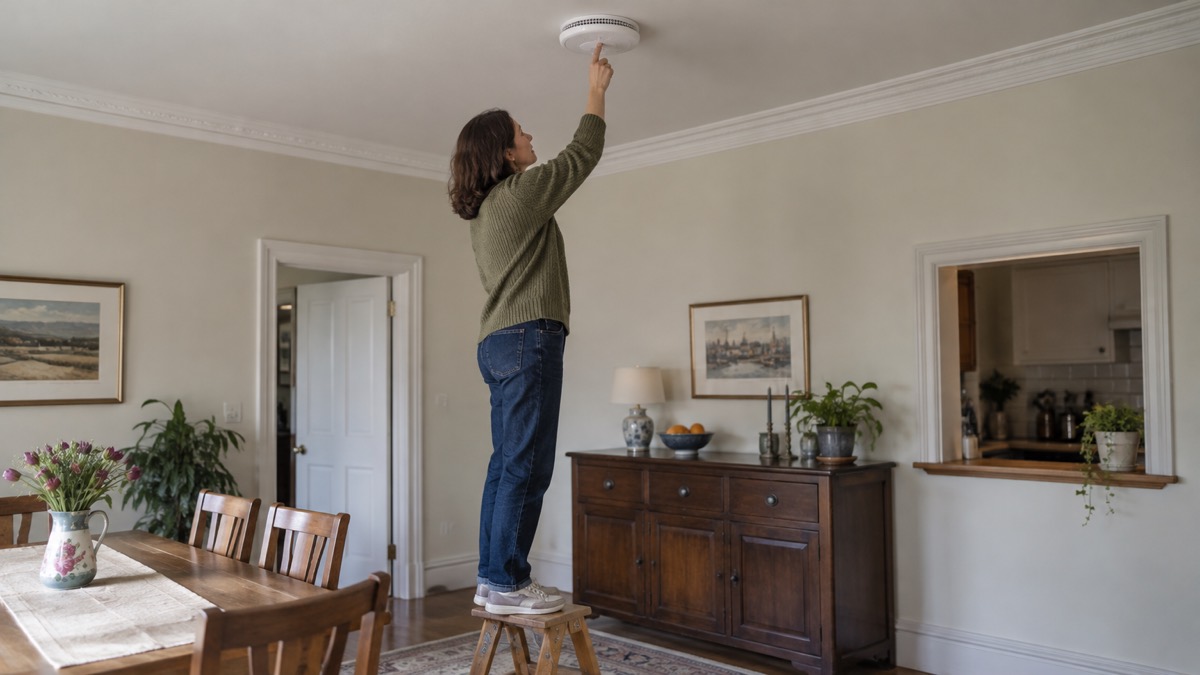
Testing is not a mystery. Press the test button and hold it until the alarm sounds. Dorset and Wiltshire Fire and Rescue Service says to test at least once a month by pressing the test button until the alarm sounds12. Manchester Fire and Rescue Service gives the same instruction for homes and flats: test at least monthly by pressing the button until it beeps13.
Cheshire Fire and Rescue Service adds a useful detail: press for 3 seconds to test, and check the manual for more information7. That last point matters, because alarms vary. Some need a short press, some a longer hold, and some have a test function that also checks the interconnection between linked alarms. Your alarm's own instructions are the authority for your model.
A few habits make the test worth doing:
- Use the button, not a match or a candle. The test button checks the alarm's electronics and sounder. Smoke from a flame tests nothing useful and adds a fire risk.
- Listen for the full sound. A weak, stuttering or intermittent sound is a fault, not a pass.
- Test linked alarms together. If your alarms are interlinked, pressing one should set off the others. If it does not, the link has failed.
- Keep a note. A date written on the inside of a cupboard door, or a reminder on a phone, stops the routine slipping.
If you are unsure which alarm you have or how it should behave, the guide to smoke alarm types and how to choose one explains the differences, and the page on interlinked alarms covers what linking should do when you test.
Battery changes: once a year unless it is a ten-year alarm
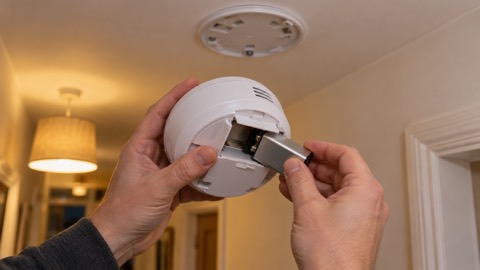
The yearly battery change is the second clock. Electrical Safety First advises replacing the battery every year unless it is a ten-year sealed battery6. Somerset's guidance says the same: change the battery every year unless it is a ten-year alarm, or when you need to5. Northern Ireland's official fire safety guidance says to replace the battery once per year if your alarms are designed for battery replacement15.
The Government's fire safety guidance for the home is precise about one-year battery alarms: make sure the battery is changed every year, and only take the battery out when you need to replace it16. Manchester Fire and Rescue Service repeats the instruction for flats, adding that you should only remove the battery when replacing it13. Taking the battery out to stop a false alarm, and forgetting to put it back, is one of the classic ways a working alarm becomes a dead one.
| Alarm type | Battery routine | Whole-alarm replacement |
|---|---|---|
| One-year battery | Change every year16 | Every ten years6 |
| Sealed ten-year battery | No change needed6 | Every ten years16 |
| Mains-connected with backup | Follow maker's instructions | Every ten years17 |
Suffolk Fire and Rescue Service's factsheet sets out the routine: test your smoke alarm every week, change the battery once a year unless it is a ten-year alarm, and after 10 years get a whole new alarm13. If your alarm starts chirping between scheduled changes, that is usually the low-battery warning, and the answer is a fresh battery rather than a wait until the calendar date. The page on why a smoke alarm keeps chirping covers the other causes.
Replace the whole alarm every ten years or by its replace-by date
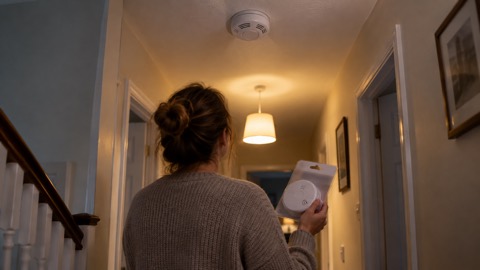
Alarms wear out. The sensor inside degrades with age, and an old alarm can fail silently even though it still beeps when tested. That is why the advice is to replace the whole unit, not just the battery. Dorset and Wiltshire Fire and Rescue Service says most smoke alarms need replacing after 10 years, and advises checking your warranty and replacing the alarm every 10 years12. Manchester Fire and Rescue Service says smoke alarms usually need replacing after ten years13.
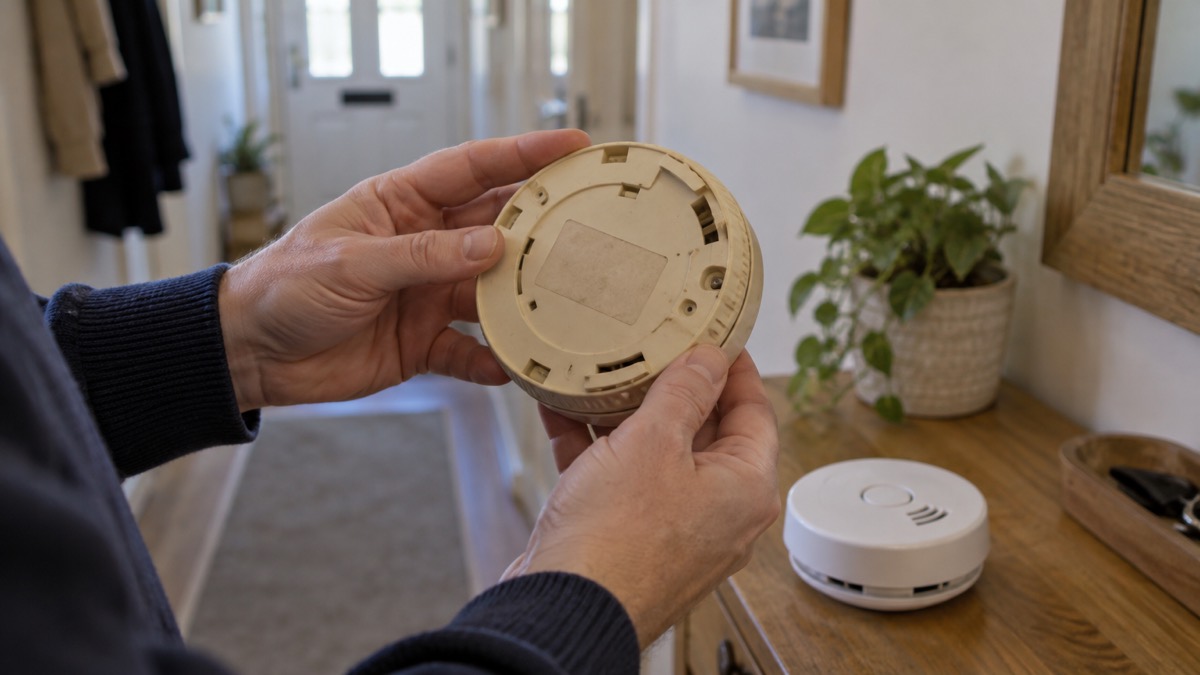
Electrical Safety First gives the same rule for smoke and heat alarms: replace them every ten years or when the replace-by date is reached7. Cornwall Fire and Rescue Service adds that ten-year alarms and mains-connected alarms need replacing every ten years, and that the date can usually be found on the alarm itself17. Age UK advises that hard-wired smoke alarms should still be tested monthly and replaced every 10 years10.
The replace-by date is the practical anchor. It is marked on the alarm, and it is the date the maker expects the sensor to be past its reliable life. Check it when you move into a home, when you test, and whenever you cannot remember how old an alarm is. If the date has passed, replace the alarm even if it still sounds when tested.
For a ten-year sealed alarm, the two clocks coincide: you never change the battery, and you replace the whole unit at ten years16. The page on when to replace a smoke, heat or CO alarm goes through the signs that an alarm is at the end of its life, and the comparison of sealed ten-year or replaceable battery alarms helps if you are choosing a replacement.
Carbon monoxide alarms need the same monthly test
A carbon monoxide alarm is tested the same way and on the same schedule as a smoke alarm. Dorset and Wiltshire Fire and Rescue Service says to test smoke and carbon monoxide alarms once a month8. Warwickshire Fire and Rescue Service says to test alarms at least once per month using the test button, following the manufacturer's instructions for testing procedures19. Tenants are advised to test smoke and carbon monoxide alarms once a month as a minimum11.
North Wales Fire and Rescue Service, writing about chimney fires, says to test your smoke alarms regularly and make sure you have a working carbon monoxide alarm20. Mid and West Wales Fire and Rescue Service says testing your smoke alarms and carbon monoxide detectors regularly should be one of your top priorities21. Northern Ireland Fire and Rescue Service asks the public to test smoke and carbon monoxide alarms regularly, and to ensure smoke alarms are fitted on all levels of the property22.
The reason CO alarms get the same treatment is that carbon monoxide is invisible and has no smell. A CO alarm that has quietly failed gives no warning of its own failure, so the monthly button press is the only routine check that it will still raise the alarm when it matters. If a CO alarm sounds, do not treat it as a false alarm. The page on what to do if your CO alarm sounds sets out the steps, and the guide to CO poisoning symptoms explains what to look for in people.
Heat alarms in the kitchen and alarms that will not sound
Heat alarms belong in the kitchen, where a smoke alarm would be set off by cooking. They are tested in the same way as smoke alarms: press the button until the alarm sounds, at least monthly. Manchester Fire and Rescue Service advises testing smoke and heat alarms at least monthly23, and its Pesach safety guidance says to test the batteries in your smoke and heat alarms at least monthly24. Electrical Safety First advises testing smoke and heat alarms regularly, ideally every week25. Fire Scotland says to test smoke and heat alarms weekly to make sure they have not developed a fault26.
If an alarm does not sound when tested, the fault is usually one of three things. Dorset and Wiltshire Fire and Rescue Service says that if it does not sound as it should, it is likely you may either need to replace the battery, or clean or replace the detector head4. Work through it in that order: fit a fresh battery if the alarm takes one, clean the alarm as the maker instructs, and test again. If it is still silent, replace the alarm. A silent alarm is not protecting anyone.
The same logic applies to e-cigarettes and smoking. Manchester Fire and Rescue Service's smoking safety guidance says to test your smoke alarm regularly27, and its advice for people who vape or smoke is to keep alarms working. Vapour is not smoke, but the routine is unchanged: test the alarm, and never take the battery out to stop it sounding.
Where to get help and what to check
If you are unsure whether your alarms are working, or you care for someone who cannot test their own, help exists. Fire and rescue services offer home fire safety visits, where crews or trained staff check alarms and give advice; Staffordshire Fire and Rescue Service runs them28. Age UK's staying safe guidance covers alarm testing for older people10, and the page on fire risk checks for a vulnerable person's home sets out what to look at.
For the wider picture, the home emergencies section covers fire, carbon monoxide, gas leaks and burst pipes, and the fire safety checklist for your home puts the testing routine alongside the other checks worth doing. If you are choosing alarms for the first time, the guides to heat alarms and where they go and where to fit smoke alarms explain placement, and the fire safety checklist for flats covers rented and high-rise homes.
Sources (28)
- Fire safety prevention, Fire Kills
- Smoke alarms, Staffordshire Fire and Rescue Service
- Smoke alarms, South Wales Fire and Rescue Service
- Working from home, Dorset and Wiltshire Fire and Rescue Service
- Household fire safety, Somerset Council
- Fire prevention tips, Electrical Safety First
- Safe and well booklet, Cheshire Fire and Rescue Service
- Advice for parents and guardians, Dorset and Wiltshire Fire and Rescue Service
- Smoke alarms and CO detectors, Warwickshire Fire and Rescue Service
- Staying safe, Age UK
- Tenants, Dorset and Wiltshire Fire and Rescue Service
- Smoke alarms for vulnerable people, Dorset and Wiltshire Fire and Rescue Service
- Fire safety advice in your flat, Manchester Fire and Rescue Service
- Fire safety advice in your flat, Manchester Fire and Rescue Service
- Fire safety and prevention, nidirect
- Fire safety in the home, GOV.UK
- Smoke alarms, Cornwall Fire and Rescue Service
- Smoke alarms factsheet, Suffolk Fire and Rescue Service
- Safe home heating, Warwickshire Fire and Rescue Service
- Chimney fires, North Wales Fire and Rescue Service
- Winter safety, Mid and West Wales Fire and Rescue Service
- A safer Christmas starts at home, Northern Ireland Fire and Rescue Service
- Smoking safety, Manchester Fire and Rescue Service
- Celebrating safely: Pesach, Manchester Fire and Rescue Service
- Home office safety, Electrical Safety First
- Escape plan | Scottish Fire and Rescue Service, Scottish Fire and Rescue Service
- Smoking fire safety tips, Mid and West Wales Fire and Rescue Service
- Home fire safety visits, Staffordshire Fire and Rescue Service
 Home Fire Safety Checklist
 Bedtime Fire Safety Checks
 Fire Risk Checks for Carers
 Why a CO Alarm Is Beeping
 Smoke Alarm Keeps Chirping
 Replacing Smoke and CO Alarms
 Where to Fit Smoke Alarms
 How Many Smoke Alarms
 Where to Put a CO Alarm
 Do I Need a CO Alarm
 Can a CO Alarm Detect a Gas Leak
 Trapped by Fire What to Do
 Putting Out a Chip Pan Fire
 Electrical Fire Safety
 Appliances Left On Overnight