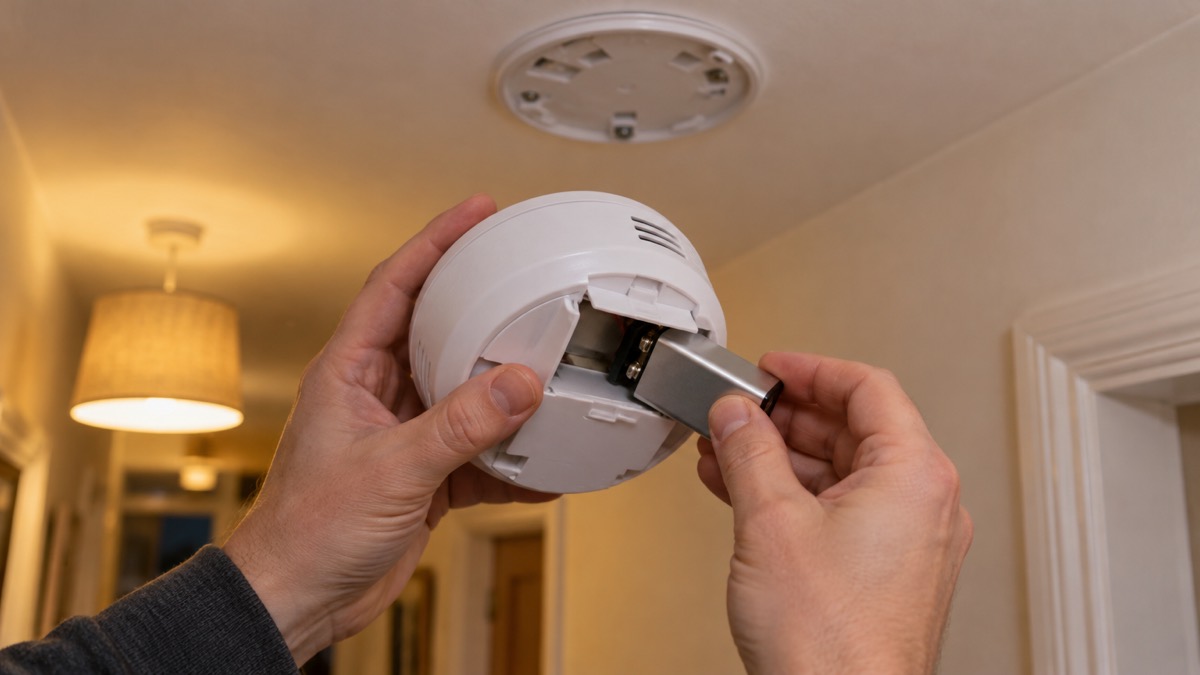
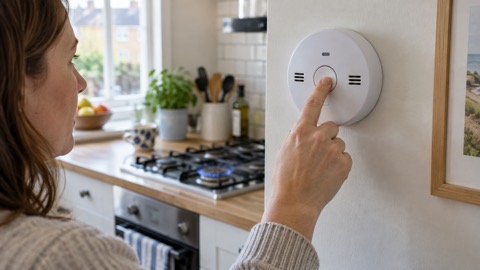
A smoke alarm that chirps every minute or so is almost always telling you one thing: its battery is running low. Fire and rescue service guidance is consistent on this. If it beeps every minute or so this could be a "low battery" warning, and you should replace the battery as soon as possible1. The same is true of mains-powered alarms, because there is often a battery backup inside in case of a power cut2.
So the first thing to do is not to take the alarm down and forget about it. It is to get a fresh battery in, or, if the alarm has a sealed battery, to work out whether the alarm itself has reached the end of its life. A chirping alarm is a working alarm that is asking for attention. A silent one with no battery is no protection at all.
This page covers what the chirp means, why it so often starts at night, what to do with each type of alarm, and when a beep is something more serious than a flat battery. If you are choosing alarms in the first place, the smoke alarms guide sets out the types side by side.
What the chirp is telling you
Smoke alarms are built to make a noise. A conventional smoke alarm works by emitting a loud noise when smoke is detected, providing the vital early warning of fire and aiding escape7. The short, regular chirp is a different signal from the full alarm, and it is designed to be annoying enough that you deal with it.
The most common cause is a failing battery. Fire and rescue services across the country say the same thing: a beep every minute or so is a low battery warning, and the battery should be replaced as soon as possible1. It is not a fault in the alarm and it is not a false alarm from cooking. It is the alarm telling you it is losing the power it needs to protect you.
That matters because the alarm cannot warn you if it has no power. A smoke alarm with a flat battery looks identical on the ceiling to one that works. The chirp is the only difference, which is why it is worth acting on the same day rather than waiting.
There is a second possibility, less common but worth knowing. If the chirp is occasional and single rather than regular, the maker may treat it as a fault. The FireAngel manual for its RF-BW module states that an occasional single chirp with no amber flash indicates a problem with the Smoke/Heat/CO alarm, and that you should refer to its owner's manual8. In other words, a regular chirp is usually the battery; an irregular one may be the alarm itself.
Why the chirping often starts at night
There is a simple reason a chirp so often arrives at two in the morning: that is when the house is quiet. During the day the sound is masked by conversation, the radio, the washing machine and traffic. At night it is the only thing in the room, and a chirp designed to be noticed does its job.
There is also a technical reason. Batteries recover slightly when they are warm and under no load, and a smoke alarm draws very little current most of the time. A battery that is on the edge can hold enough voltage through the day and then dip when the temperature falls overnight, which is exactly when the alarm decides to warn you. The result is a chirp that starts in the small hours and sometimes stops again by morning, which makes it easy to dismiss.
Do not dismiss it. The same low battery that chirps at night is the one that will be flat in the coming days. Fire and rescue service guidance is to replace the battery as soon as possible1, and the simplest approach is to keep a spare of the right type in the house so that a night-time chirp can be dealt with there and then rather than endured until the shops open.
If you are woken by a chirp, deal with it properly rather than silencing it and going back to bed. Taking the battery out to get some sleep leaves you without a working alarm for the rest of the night, which is when a fire is most dangerous. Fit a fresh battery, test the alarm, and go back to bed knowing it is working.
Replaceable battery or sealed for life
What you do about a chirp depends entirely on which kind of alarm you have. The two types need opposite handling, and getting it wrong can destroy the alarm.
| Alarm type | What the chirp means | What to do |
|---|---|---|
| Replaceable battery | Battery running low1 | Fit a fresh battery of the correct type, then test the alarm9 |
| Mains with backup battery | Backup battery failing3 | Change the backup battery, which should be done every year4 |
| Sealed for life (10 year) | Battery or alarm nearing end of life | Do not open it; replace the whole alarm10 |
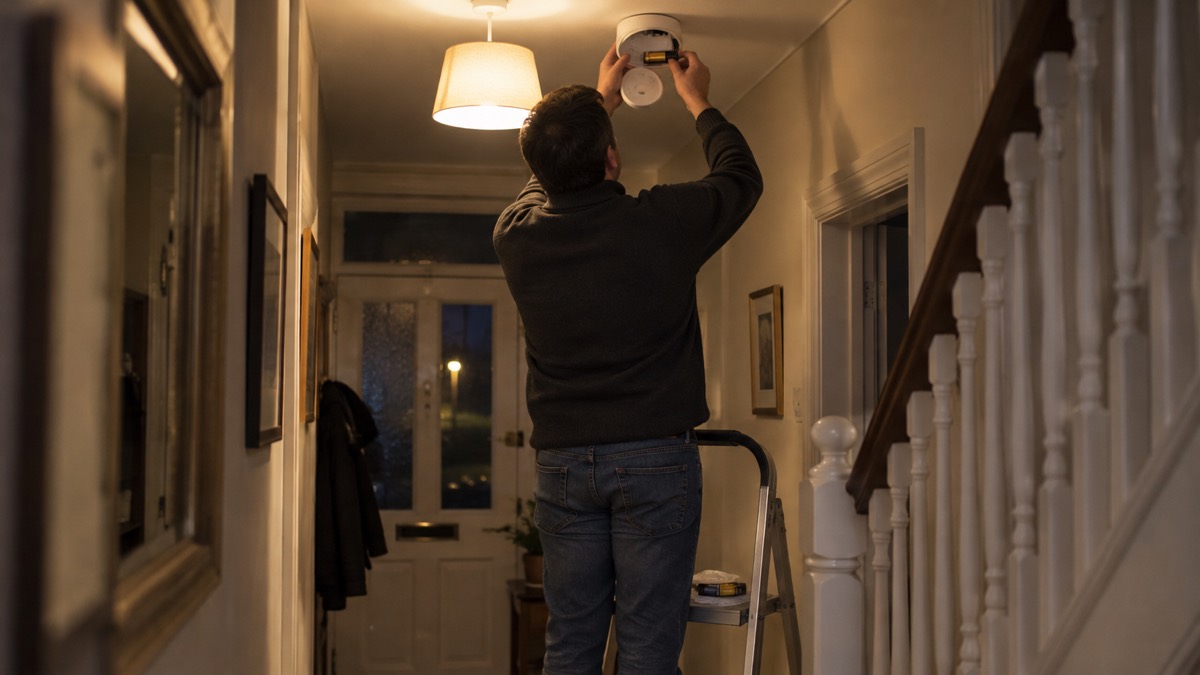
For a replaceable-battery alarm, the routine is straightforward. Change the battery every year unless it is a ten-year alarm, or when you need to10. Somerset Council's household fire safety guidance puts it plainly: change the battery every year (unless it's a ten-year alarm) or when you need to10. Suffolk Fire and Rescue Service's factsheet lists "once a year: replace the battery" as part of the annual routine11. Test the batteries in your smoke detector every week9.
For a sealed alarm, the advice is the opposite. Some alarms are fitted with 10 year or long-lasting sealed batteries, and these should not be removed or replaced, as doing so will damage the alarms beyond repair5. If a sealed alarm chirps, it is telling you it has reached the end of its service life and the whole unit needs replacing. That is not a fault you can fix with a screwdriver.
If you are choosing between the two types, the sealed or replaceable battery alarms comparison sets out the trade-offs. For rented homes, Cherwell District Council's housing standards guidance is clear that where battery powered alarms are selected, alarms with "sealed for life" batteries rather than alarms with replaceable batteries are the better option12.
Hardwired mains alarms that chirp
A mains-powered alarm should not chirp, because it has mains electricity. When it does, the cause is almost always the backup battery inside it. Many hard-wired smoke alarms also have a back up battery that will need to be replaced when they fail3, and signs of this include your alarm making frequent little beeps3. South Wales Fire and Rescue Service advises that this backup should be changed every year and can make your alarm beep if it is running out4.
Hardwired alarms are common because they are the preferred arrangement. Ideally alarms should be hardwired and interlinked, and this is a legislative requirement for rented accommodation13. Interconnected smoke alarm systems are mains-powered14. That means a chirp from one of these is a battery warning, not a wiring fault, and it is a job you can usually do yourself by changing the backup battery.
There is a limit, though. Hard-wired (mains-powered) smoke alarms should be replaced as per the manufacturer's guidelines, and they should also be tested weekly15. If you have changed the backup battery and the chirp continues, the alarm may be at the end of its life. The replacing alarms guide covers how to judge that.
If your home has interlinked alarms and one chirps, deal with it promptly. The interlinked alarms guide explains how the system works, and the battery or mains alarms comparison helps if you are deciding what to fit.
When a beep is more serious than a flat battery
Most chirps are batteries. But not every alarm on your ceiling is a smoke alarm, and a beeping carbon monoxide alarm must never be treated as a nuisance.
Fire and rescue service guidance is blunt: carbon monoxide alarms rarely beep as a false alarm, so if the detector is beeping you should act fast and get out of the property6. That is a different instruction from the one for a smoke alarm chirp, and it is the one to follow if the beeping unit is a CO alarm.
There are two other CO alarm signals worth knowing. A chirp or beep every minute is your cue to replace the batteries if your detector uses replaceable batteries16. And chirping every 30 seconds is the sign that your alarm is ready to be replaced17. Which one you are hearing matters: a regular minute-by-minute chirp is a battery warning, while a 30-second chirp is an end-of-life signal.
Chirping can also mean that the alarm isn't working properly16, which is another reason not to ignore a CO alarm that will not settle after a battery change. The CO alarm beeping guide goes through the signals in more detail, and the CO alarms guide covers choosing one. Make sure any CO alarm complies with British Standards BS EN50291-1 and carries the BSI Kitemark logo18.
Getting help from Aico and FireAngel
If you have changed the battery and the chirp continues, the next step is the maker's own instructions for your model. Both major makers publish manuals, and the maker's guidance for its own product is the place to start.
For FireAngel alarms, the RF-BW manual is explicit that an occasional single chirp with no amber flash indicates a problem with the Smoke/Heat/CO alarm, and that you should refer to the Smoke/Heat/CO alarm owner's manual8. That is your cue to look up the specific model rather than guess. The site's FireAngel pages, such as the FireAngel ST-632 and the FireAngel FA6611, cover individual models.
For Aico, the Ei3014 Heat Alarm product page states that it is compatible with other Aico mains powered devices, uses AudioLINK+ data extraction technology, and carries a 10 Year Guarantee19. AudioLINK+ is worth knowing about if your alarm will not stop chirping: it lets the alarm's own data be read, which can help establish whether the unit is faulty. The Aico Ei3016 and Aico Ei3024 pages cover other models in the range.
If your alarm was fitted by the fire and rescue service, go back to them rather than the maker. Alarms provided by Mid and West Wales Fire and Rescue Service have a 10-year battery life, and at the end of its life the alarm will bleep once every minute for a minimum of one month20. That long, persistent bleep is a signal to ask for a replacement. North Yorkshire Fire & Rescue Service says all the alarms it supplies come with a 10 year warranty21.
What each room needs, and how to keep alarms quiet
A chirping alarm is a prompt to check the whole system, not just the one unit. The national minimum is simple: every home should have a minimum of one working smoke alarm per floor, and a heat alarm in the kitchen22. Northern Ireland's "STOP" fire advice adds that you should think about extra alarms in the most used rooms such as living rooms and bedrooms23. In Scotland, one smoke alarm should be in every circulation space on each storey, such as hallways and landings24.
Placement affects how often alarms go off for the wrong reason. Try not to fit smoke alarms too close to the kitchen door, because steam and cooking fumes are the most common cause of false alarms25. If your alarm is chirping and also going off when you cook, the false alarms guide and the smoke alarm positions guide will help. The how many smoke alarms guide works through the numbers room by room.
When you buy a replacement, look out for the British Standard Kitemark and Loss Prevention Certification Board (LPCB) symbols, which show the alarm is approved and safe26. Whichever model you choose, look out for one which has a British Standard Kitemark symbol22. Staffordshire Fire and Rescue Service advises fitting an optical multi sensor smoke alarm with a ten-year life span, with a sealed battery compartment, where possible27. The alarm standards guide explains what the marks mean.
For people who cannot hear a standard alarm, specialist equipment exists. Fire and rescue services point to mains-powered smoke alarms with back-up batteries, and vibrating pads and flashing lights that warn people who cannot hear well, for people with sight, hearing, mobility issues or other special needs25. A vibrating pad is placed under a mattress or pillow at night, and when smoke is detected the pad vibrates and the strobe light flashes to alert the sleeper13. The deaf alarms guide covers the options, and the extra help guide covers wider support for households that need it.
Sources (27)
- Smoke alarms, Devon and Somerset Fire and Rescue Service, 2026-02-17
- Problems with smoke alarms, Devon and Somerset Fire and Rescue Service, 2026
- Smoke alarms, Cheshire Fire and Rescue Service, 2026-07-27
- Smoke alarms, South Wales Fire and Rescue Service, 2026-08-20
- Fire safety in the home, Westminster City Council, 2017-01
- Carbon monoxide, Devon and Somerset Fire and Rescue Service, 2026
- Smoke alarms for the hard of hearing - Surrey County Council, Surrey County Council
- RF-BW-T manual, FireAngel, 2026
- Home safety advice, Essex Prepared, 2026-10-29
- Household fire safety, Somerset Council, 2025-01-30
- Smoke alarms factsheet, Suffolk Fire and Rescue Service, 2014-01-09
- Housing standards, Cherwell District Council, 2026-10-29
- Other safety, Northern Ireland Fire & Rescue Service, 2026-10-22
- Smoke alarm systems, RNID, 2026-08-21
- Smoke Alarms, Cheshire Fire and Rescue Service
- Carbon monoxide symptoms, Which?, 2026-07-14
- What to do when a carbon monoxide detector goes off, Which?, 2026-07-14
- Carbon monoxide leaflet, Bedfordshire Fire and Rescue Service, 2026
- Ei3014 Heat Alarm, Aico, 2026-10-28
- Smoke alarm maintenance and problems, Mid and West Wales Fire and Rescue Service, 2026-10-29
- Smoke and carbon monoxide alarms, North Yorkshire Fire & Rescue Service, 2026-02-20
- Home fire safety, Greater Manchester Fire and Rescue Service, 2026-10-29
- Avoiding accidental fires at home, nidirect, 2025-10-16
- Chimneys, Scottish Fire and Rescue Service, 2026-10-25
- Smoke and heat alarms, Scottish Fire and Rescue Service, 2025-04-14
- Fire alarms and carbon monoxide detectors, Lincolnshire County Council, 2026-10-29
- Smoke alarms, Staffordshire Fire and Rescue Service, 2026-10-29
 Home Fire Safety Checklist
 Bedtime Fire Safety Checks
 Fire Risk Checks for Carers
 Why a CO Alarm Is Beeping
 Testing Smoke and CO Alarms
 Replacing Smoke and CO Alarms
 Where to Fit Smoke Alarms
 How Many Smoke Alarms
 Where to Put a CO Alarm
 Do I Need a CO Alarm
 Can a CO Alarm Detect a Gas Leak
 Trapped by Fire What to Do
 Putting Out a Chip Pan Fire
 Electrical Fire Safety
 Appliances Left On Overnight