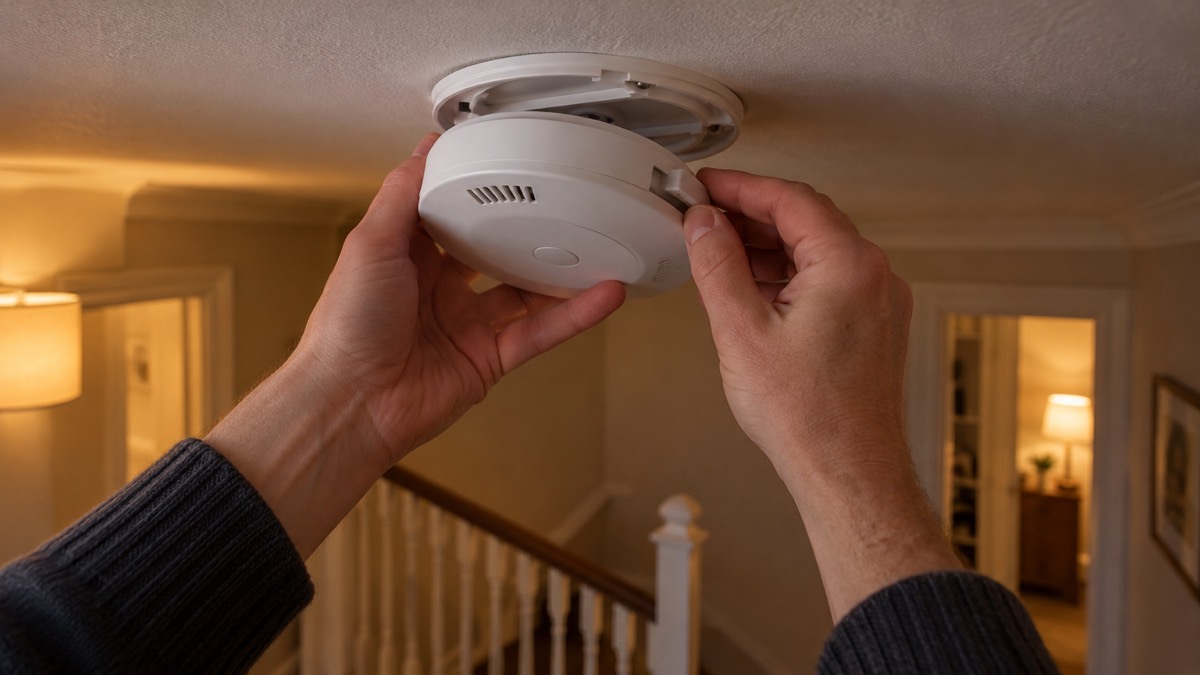
The FireAngel ST-632 is a sealed, battery powered smoke alarm with a built in lithium battery that the maker says lasts 10 years. It is a multi sensor alarm, combining an optical sensing chamber with thermal enhancement, and it is certified to EN 14604:2005+AC:20081. There is nothing to wire in and no battery to change: you fix a base plate to the ceiling, twist the alarm on, and test it once a month with the button.
Most of what people search for about this alarm is about its signals. A chirp every 45 seconds with the amber LED flashing at the same time means the battery is low, and the maker's current manual says to replace the alarm immediately and certainly within 30 days1. A yellow LED flashing at a different time from a short beep means a fault, and the alarm should be replaced1. An amber LED flashing twice points at the wireless module, not the battery2.
This page sets out what the ST-632 is, where to fit it, how to install and test it, what every beep and light means, how to silence it, how to link it to other alarms, and how to clean and dispose of it. It is a battery alarm for existing homes: the maker states plainly that it cannot substitute for the hard wired system required in new build properties1.
What the FireAngel ST-632 is and who it suits
The ST-632 is a single, self contained smoke alarm. Its sensor is what FireAngel calls Thermoptek, which the maker describes as combining an optical sensing chamber with thermal enhancement2. In plain terms it responds to smoke and is also nudged along by a rise in heat, which is the arrangement the maker uses to keep false alarms down in kitchens and hallways without losing speed on a real fire.
The specifications that decide whether it suits a household are these:
| Specification | Detail |
|---|---|
| Type | 10 Year Life Multi Sensor Smoke Alarm1 |
| Power | Internal lithium battery, sealed, 10 year life1 |
| Standard | EN 14604:2005+AC:2008 Smoke Alarm Devices1 |
| Sensor | Thermoptek, optical chamber with thermal enhancement2 |
| Operating temperature | Rooms normally between 4°C and 38°C1 |
| Interlinking | Optional Smart RF Module on FireAngel's Wi-Safe 2 protocol1 |
| Warranty | 5 years from date of purchase1 |
It suits an existing house, bungalow, flat or bedsit where you want a long life alarm without an electrician, and the maker states it is suitable for use in mobile homes and caravans1. It does not suit a new build as the primary system, and the maker states it is not intended for any non-residential, commercial or industrial application1.
If you are still deciding what kind of alarm you need at all, the guide to smoke alarms and how to choose one sets the types side by side, and sealed or replaceable battery alarms explains the trade off this alarm makes.
Where to fit it: one on every floor, 300mm from walls and lights
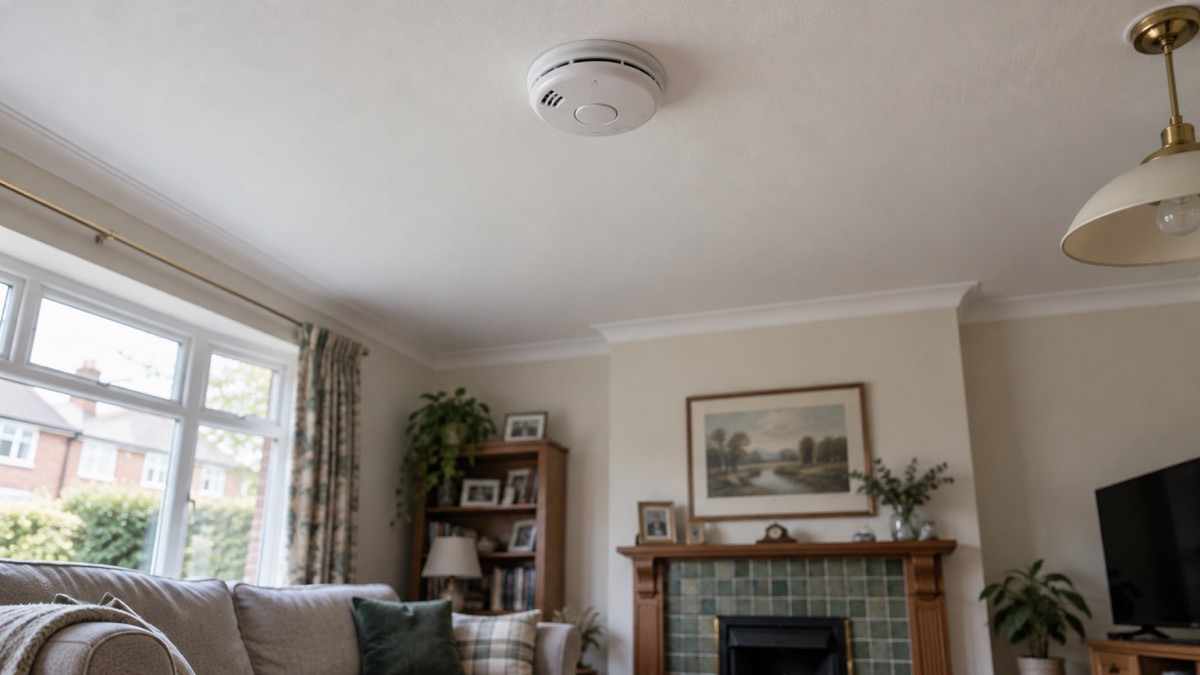
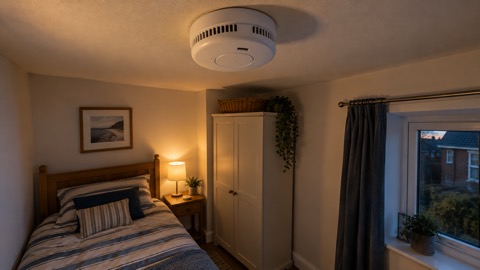
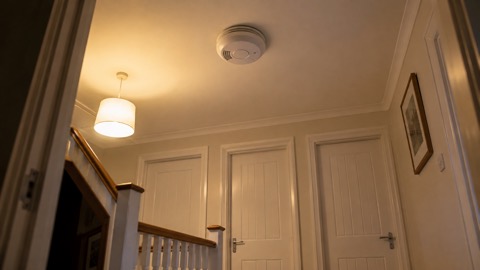
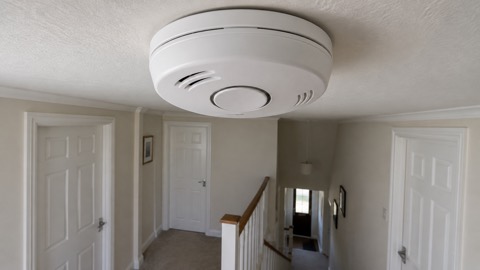
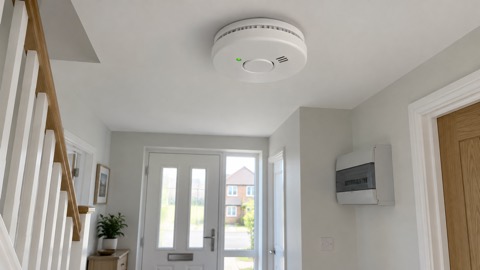
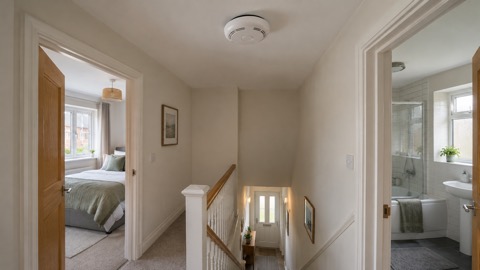
Fire and rescue services across the UK give the same placement advice: fit the alarm as close to the centre of the room as possible, but at least 30 centimetres (12 inches) away from any wall or light fitting, screwed to the ceiling3. Staffordshire Fire and Rescue Service puts it the same way, and Suffolk Fire and Rescue Service adds that it should normally be on the ceiling rather than the wall4. Greater Manchester Fire and Rescue Service describes the gap as keeping the alarm out of the dead airspace where the ceiling joins the walls, and away from light fittings and obstructions7.
The ST-632 manual matches that with its own figures. Site the alarm at least 300mm from light fittings and walls, ideally as central as possible in the room, and no more than 600mm vertically below the highest point in the room1. If you must wall mount it, the top of the detection element should sit between 150mm and 300mm below the ceiling and at least 300mm from a wall1.
For coverage, the maker's minimum is at least one unit on each floor or level of the property1. That is a floor, not a room: a hall and a landing alarm will not cover a bedroom door that is shut at night, so most households fit more than the minimum. The guide to how many smoke alarms a house or flat needs works through the rooms, and where to fit smoke alarms covers the awkward spots such as kitchens and bathrooms.
Two placement rules matter more than any other:
- Do not fit it in a new build as the main system. The maker states it cannot be used as a substitute for a hard wired system as required in new build properties1.
- Keep it out of the bathroom and away from steam, and out of rooms where the normal temperature falls outside 4°C to 38°C1.
For flats, the maker's position is that the alarm can be used in individual flats and bedsits where a primary fire detection system already meets the regulatory requirements for common areas such as lobbies and corridors2. If you live in a block, the guide to fire in your block of flats explains how the building's system and your own alarm work together.
Installing the alarm on its base plate
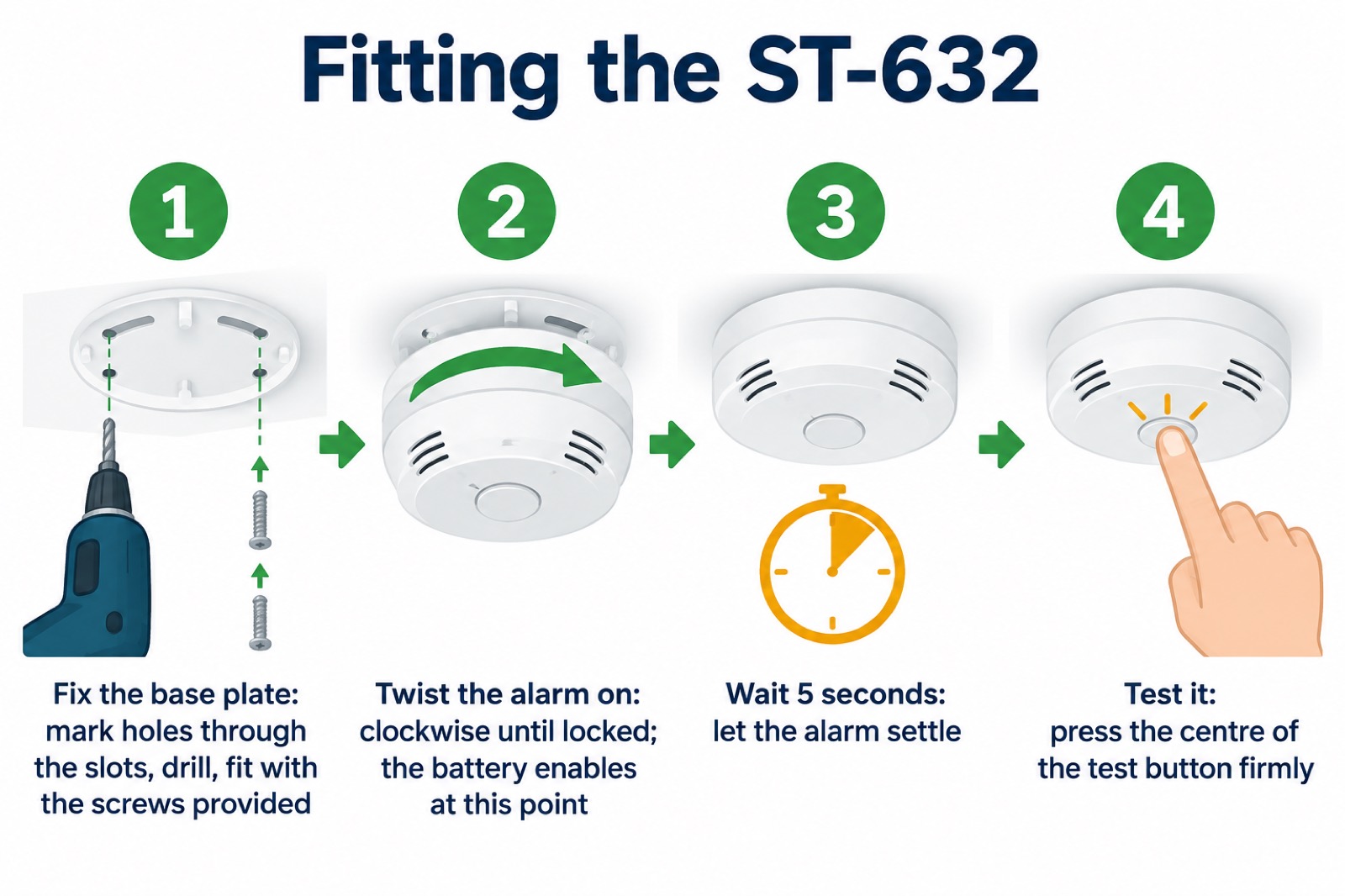
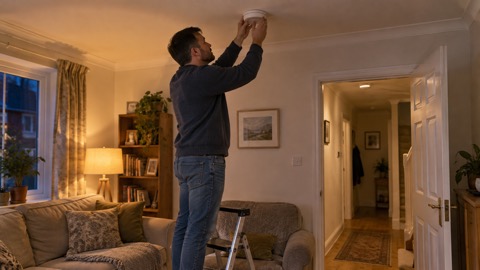
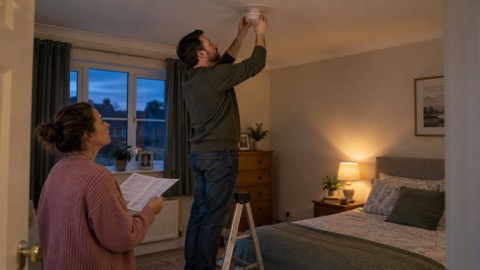
Fitting the ST-632 is a screwdriver job. The maker's sequence is: attach the base plate to the ceiling or wall, break out the tabs, use the fixing slots to mark the drill holes, drill and insert the plastic fixing anchors if needed, fit the base plate with the screws provided, then position the alarm on the base plate and twist it clockwise until it is locked in position1. FireAngel's own installation advice for its alarms is to turn the alarm as far as possible on the base plate to make sure it is engaged and secure, and to expect a snug base plate to need extra force8.
Two things happen at that final twist. The battery is automatically enabled when the alarm is fully locked on to the base plate, so a new alarm is dormant until it is fitted1. And the alarm will not work off its plate: the maker warns that removing the smoke alarm from its base plate will deactivate the unit and prevent it from detecting smoke2.
After fitting, wait 5 seconds for the alarm to settle, then test it1. If the test does not sound, the maker's checklist is to check the alarm is rotated clockwise fully onto the base plate, push the centre of the test button firmly, and check the LED flashing pattern; if the unit has been silenced and is in low sensitivity mode it may not test, so wait 15 minutes and try again1. Greater Manchester Fire and Rescue Service gives the same first check for any alarm with a base plate: make sure the unit is attached firmly to the base plate7.
If you are fitting several alarms, or adding a heat alarm to a kitchen, the guide to heat alarms and where they go explains which rooms want which type.
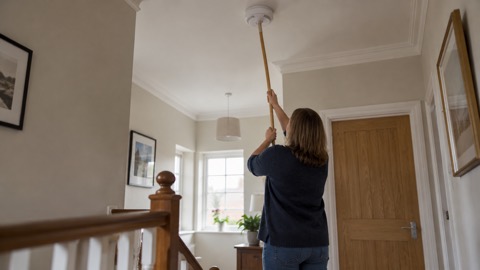
Test it every month with the button, no smoke needed
The maker's instruction is blunt: you should test your smoke alarm every month1. You do not need a match, a candle or a smoking piece of paper. The maker states that the test button accurately tests the alarm's smoke sensing circuit and that there is no need to test your alarm with smoke1. Testing with smoke only dirties the sensor and teaches nothing extra.
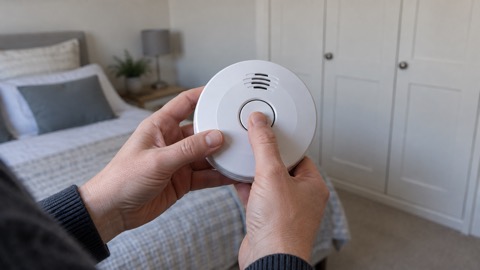
To test, press the test button in the centre and release. The unit gives two cycles of three loud beeps and then stops automatically, with the red LED flashing rapidly during the audible signal1. During normal operation the LED does not flash and the alarm does not sound1.
If the ST-632 has been fitted with a Smart RF Module and linked to other alarms, the button does two jobs. Pressing it briefly, for 1 second or less, initiates a test of the entire Smart RF network, including the other devices1. Holding it down for longer than 1 second initiates a self test of that individual alarm only, and the rest of the network stays mute1. Know which one you are pressing before you set off every alarm in the house.
Fire and rescue services give the same monthly rhythm for alarms generally, and the guide to how often to test smoke and CO alarms sets out a routine you can keep to. A monthly test is also the moment to look at the alarm properly: check it is still twisted fully home on its base plate, and check the LED is behaving as the manual describes.
What the beeps and lights mean
Almost every query about this alarm is really a question about one of four signals. The table below sets them out as the maker describes them.
| Signal | What you hear and see | What it means | What to do |
|---|---|---|---|
| Alarm | 3 loud beeps, repeating until the cause is found and resolved, red LED flashing once per second1 | Smoke has reached the sensor | Get out, follow your escape plan, call 999 |
| Low battery | Chirp once every 45 seconds, amber LED flashing at around the same time1 | Battery is near the end of its life | Replace the alarm within 30 days1 |
| Fault | Yellow LED flashing with a short beep at a different time1 | The unit may not detect smoke or sound an alarm | Replace the alarm immediately1 |
| Wireless module fault | Amber LED flashing twice2 | The fault is with the wireless module | Contact Technical Support about replacing the W2-Module2 |
The distinction between the low battery chirp and the fault beep is timing. If the yellow LED flashes at the same time as the chirp, the battery is low. If it flashes at a different time from the chirp, that is a fault, and the maker states the alarm should be replaced as soon as possible1. The two sound similar from the bottom of a staircase, so watch the light rather than counting beeps.
If the alarm is part of a linked network, a chirp once every 4 hours means another alarm in the network has a low battery, and that alarm should be replaced within 30 days2. You then have to find which one it is, which is easier in daylight than at 3am.
A sounding alarm is not a fault to be silenced and forgotten. If it goes off for real, the guide to what to do if a fire starts in your house sets out the order of actions, and how to make a fire escape plan is the job to do before you ever need it.
Low battery: replace the alarm within 30 days
The ST-632 has no user replaceable battery. When the internal lithium cell runs down, the alarm is replaced, not recharged. The maker states that the alarm will continue to warn of the low battery condition for at least 30 days, and recommends replacing the alarm immediately and certainly within 30 days, because after that it may not have enough power to warn you of a real fire1.
That 30 day window is the maker's figure for this sealed alarm. Fire and rescue guidance for alarms generally is tighter: Dorset and Wiltshire Fire and Rescue Service advises replacing your alarm or its battery immediately, and certainly within seven days, as it may not have enough power to warn you of a real fire after that time6. The two documents give different periods because they are describing different things, a sealed 10 year alarm with a long warning tail and an alarm with a changeable battery. Treat the shorter period as the safer habit and the 30 days as the outside limit the maker allows.
The maker's own documents disagree on the replacement period for the same low battery signal: one edition of the ST-632 manual says the unit should be replaced within 7 days2, while the other recommends replacing it immediately and certainly within 30 days1. Where the maker's own documents disagree, the newer manual's 30 days is the figure to work to, and there is no reason to wait that long.
The guide to when to replace a smoke, heat or CO alarm covers the wider question of alarm age, and why your smoke alarm keeps chirping deals with chirps that are not the low battery signal.
Silencing a false alarm or a low battery chirp
The ST-632 has two different silences, and they do different things.
Silencing a false alarm. The alarm has a smart silence feature. Press the button and the alarm drops to reduced sensitivity, then returns to full sensitivity automatically within 10 minutes1. During the reset cycle the red LED flashes approximately once every 10 seconds, then reverts to flashing once every 45 seconds1. The silence has a limit built in: if the level of smoke reaching the alarm is very high, the silence is overridden and the alarm continues to sound1. In a linked network, an alarm that has sensed smoke cannot be remotely silenced, and if it is not silenced after 2 to 4 minutes all the other alarms start sounding again2.
Silencing a low battery chirp. You can silence the audible chirp for a period of 8 hours by pressing the test button, and the smoke alarm will still detect smoke during that time1. This is a night's sleep, not a repair. The alarm still needs replacing within 30 days, and the chirp will return.
There is one silence you cannot use. The maker states the alarm cannot be silenced if the chirp is indicating a fault, and in that case the unit should be replaced immediately1.
If false alarms are a regular event rather than a one off, the cause is usually position or dust. The maker's own troubleshooting is to check the location of the alarm and clean it1. The guide to how to stop smoke alarm false alarms goes further, and kitchen fires and cooking safety explains why a smoke alarm close to a hob will keep interrupting dinner.
Linking alarms with a Smart RF module
The ST-632 can be fitted with a Smart RF Module, which operates on FireAngel's Wi-Safe 2 networking protocol1. With modules fitted, alarms can be linked so that when one sounds, the others do too, which matters most at night when bedroom doors are shut. The guide to interlinked alarms and how linking works explains the principle, and wireless or wired interlinked alarms covers the choice between the two.
FireAngel's Specification range, which uses the same Smart RF technology, supports wireless networks of smoke, heat and carbon monoxide alarms, and the maker's data sheet describes interlinking up to 50 Smart RF devices with a simple 2 step process9. The pairing procedure in the ST-632 manual is: push and release the learn button on the back of the second alarm, watch the red LED flash briefly then light for approximately five seconds, and during those five seconds briefly press the test button on the first alarm2. To unlearn an alarm, push and release then push and hold the learn button, release when the red LED goes out, and wait until the LED has flashed 5 times; allow several minutes before rebuilding the network2.
Linked alarms can also be monitored. The ST-632 permits a Wi-Safe 2 Mesh Monitor to remotely test the alarm's sounder and check that the alarm is connected to its base plate, and if interlinked with a FireAngel Wireless Gateway it will report its alarm status into the gateway1. That is a feature for landlords, social housing and assisted living rather than most households, but it explains why a housing provider may ask for access to test your alarm remotely.
If you are adding carbon monoxide cover at the same time, the guide to combined or separate alarms explains why a smoke alarm and a CO alarm are not interchangeable, and carbon monoxide alarms and how to choose one covers the CO side.
Cleaning, disposal and the 5 year warranty
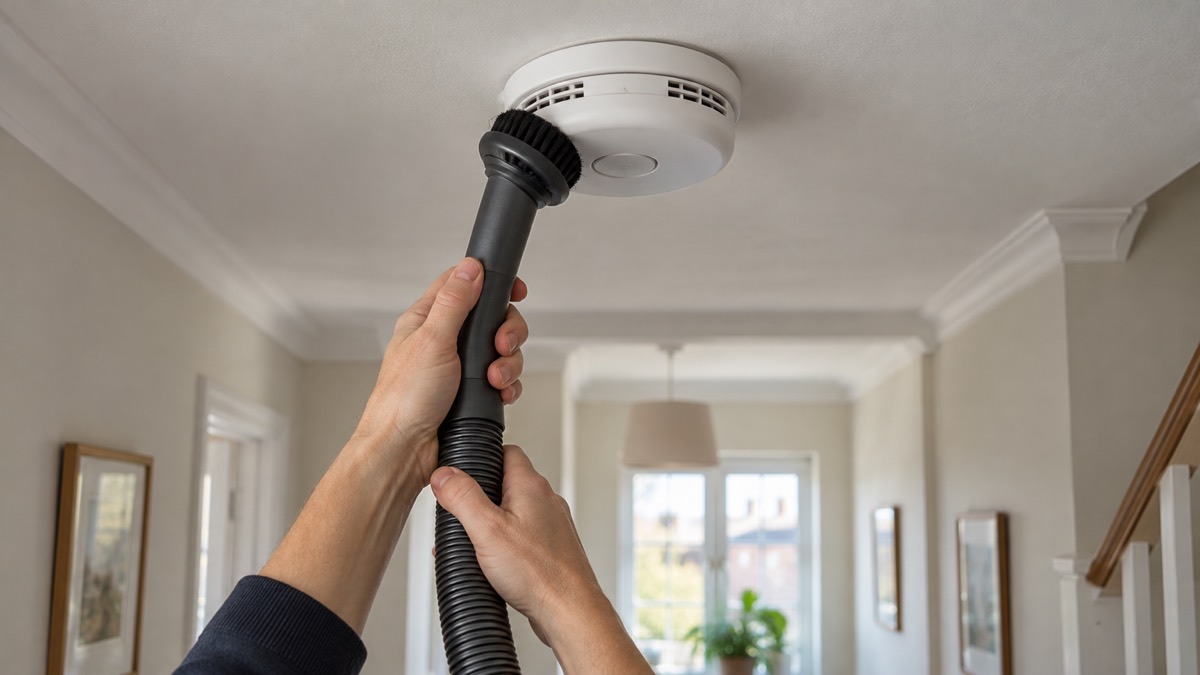
Cleaning. The maker's instruction is to clean the alarm once every 3 months using a vacuum cleaner with the soft brush attachment2. Expect the alarm to false alarm while you do it, and do not use solvents or cleaners, as they may damage the sensor or circuitry; wipe with a slightly damp cloth instead, and never paint the alarm1. The case is sealed: attempting to open it will invalidate your warranty1.
Heat. The maker warns that lithium batteries must not be exposed to excessive heat1. Keep the alarm away from hot appliances and do not store a spare one on a radiator or in a hot loft.
Disposal. The alarm is ideally suited for disposal within the waste electronic and electrical equipment (WEEE) recycling scheme1. Do not open it and do not burn it. Check with your local authority, the retailer or FireAngel technical support, because regional variations apply1.
Warranty. FireAngel warrants the ST-632 to the original purchaser to be free from defects in materials and workmanship under normal residential use for 5 years from the date of purchase1. Proof of purchase is required, the warranty is not transferable, and a replacement alarm lasts for the remainder of the original warranty period; if the model is no longer available FireAngel may offer an alternative similar product1. It does not cover damage from accident, misuse, disassembly, abuse or lack of reasonable care, applications not in accordance with the user manual, or Acts of God2.
Support. FireAngel Technical Support is on 0330 094 5830, with the maker's manuals listing 9am to 5pm Monday to Friday11. The same manuals give the email address technicalsupport@fireangeltech.com and the web address www.fireangeltech.com/support12. Fire and rescue customers have a separate freephone number, 0800 141 25611. Greater Manchester Fire and Rescue Service gives that freephone number for FireAngel alarms it fitted and which are still covered by its guarantee7. FireAngel states that its customer support specialists are based in the UK and can help with product advice, installation queries and troubleshooting by phone, email or live chat13.
The manual is available in large text and other formats; call 0330 094 5830 for further information1. If someone in the household is deaf or hard of hearing, a sounder alarm alone may not wake them, and the guide to smoke and CO alarms for deaf and hard of hearing people covers the alternatives.
If you cannot remove the alarm from its base plate, the locking mechanism may have been engaged; the maker warns that undue force may damage the alarm or the base plate, and advises contacting the installer or the FireAngel Technical Support Team1. Do not lever it with a screwdriver.
Sources (13)
- ST-632 User Manual, FireAngel, 2021-06
- FP2620W2-R Manual, FireAngel, 2019-04
- Smoke alarms, Warwickshire County Council
- Smoke alarms, Staffordshire Fire and Rescue Service
- Smoke alarms factsheet, Suffolk Fire and Rescue Service, 2014-01-09
- Smoke alarms, Dorset and Wiltshire Fire and Rescue Service
- Problem with your smoke or heat alarm, Greater Manchester Fire and Rescue Service
- RF-BW-T Interlink Push Fit Base, FireAngel, 2026-08-21
- FireAngel Specification range, FireAngel, 2026-10-29
- Smart RF Data Sheet, FireAngel, 2024-09
- Spec+ Combined Manual, FireAngel, 2026
- HW1-R Manual, FireAngel, 2024-09
- Carbon monoxide safety, FireAngel, 2026-07-31
 FireAngel FP2620W2-R Alarm
 FireAngel ST-750 Smoke Alarm
 FireAngel SW1 Smoke Alarm
 FireAngel SW10 Smoke Alarm
 FireAngel SB1 Smoke Alarm
 FireAngel SM-SN-1 Smoke Alarm
 FireAngel FA6611 Smoke Alarm
 FireAngel FA6615 Smoke Alarm
 FireAngel FA8620BW Alarm
 Kidde 2030-DSR Smoke Alarm
 Kidde 2030-DCR CO Alarm
 Kidde 10Y29 Smoke Alarm