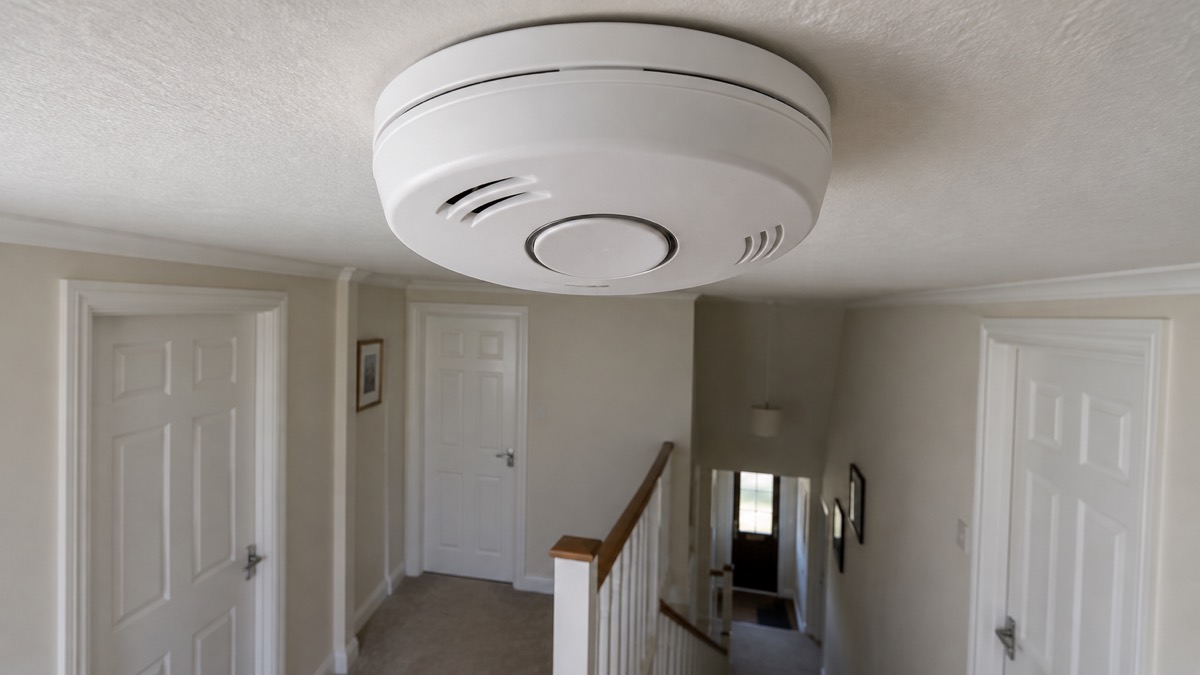
The FireAngel SW1 is a 230V mains powered optical smoke alarm with a 9V battery back-up, made by FireAngel. It is wired into the home's lighting-style circuit so it runs from the mains, and the battery keeps it working if the power fails. The maker says the optical sensor suits slow smouldering fires, the alarm sounds at 85dB at 3 metres, and the unit is 126mm across and 42mm deep1.
If you already have one, the things that matter most are simple. Test it every month, vacuum it every 3 months and replace it every 10 years2. If it chirps every 32 seconds with no red LED flash, that is a fault, not a low battery, and FireAngel says to contact Technical Support2. If it sounds and you are not absolutely certain of the source of smoke, get everyone out of the house immediately2.
If you are thinking of fitting one, plan for an electrician. FireAngel says wiring should be installed by a qualified electrician in accordance with local building standards, and the circuit must be a 24 hour voltage circuit that cannot be turned off by a switch2. The alarm can be linked to up to 12 FireAngel smoke, heat and carbon monoxide alarms on a single network, so one alarm sounding sets them all off1.
What the SW1 is and what it suits
The SW1 is a mains powered smoke alarm with a high performance optical sensor and a 9V battery back-up, described by the maker as a 230V smoke alarm with zinc carbon battery back-up1. It is sold as the SW1-R, a mains powered optical smoke alarm, and FireAngel lists it for the hallway, landing, bedroom and living room3. The manual adds the dining room to that list2.
Optical sensing is the reason it suits those rooms. FireAngel says optical smoke alarms are suitable for detecting slow smouldering fires2, the kind that build from a smouldering cable or a settled cigarette rather than a fast flame. The maker also says optical technology reduces nuisance alarms and is suitable for use in areas adjacent to where cooking fumes are present1, which is why a hallway outside a kitchen is a sensible position rather than the kitchen itself.
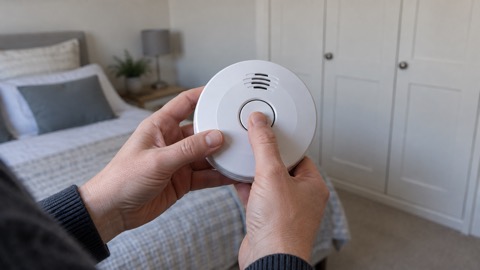
Two design details matter in daily use. There is a safety clip feature to prevent installation of the smoke alarm without a battery installed1, so the back-up cannot be left out by accident. And there is a large central test and silence button, which the maker says makes testing and silencing easy1.
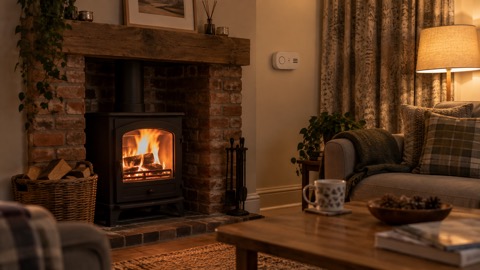
It is a household alarm, not a commercial one. FireAngel states that the alarm is not intended for any non-residential, commercial or industrial application2. It is also not a carbon monoxide alarm: if your concern is a boiler, fire or solid fuel stove, you need a separate CO alarm, and FireAngel sells a variety of carbon monoxide alarms alongside water leak and temperature and humidity sensors3. For the wider question of which alarm type goes where, see Smoke Alarms: Types and How to Choose One.
Specifications
The figures below are the ones FireAngel publishes for the SW1 and the SW1-PF1.
| Specification | Figure |
|---|---|
| Product type | 230V mains powered smoke alarm with 9V battery back-up1 |
| Sensor | Optical1 |
| Operation | AC/DC, mains with battery back-up1 |
| Alarm sound level | 85dB at 3 metres1 |
| Dimensions | 126mm diameter x 42mm depth1 |
| Installation position | Ceiling1 |
| Battery type | 9V PP3 zinc carbon1 |
| Battery life | Approximately one year under normal use2 |
| Operating temperature | 5°C to 38°C1 |
| Operating humidity | 10% to 85% relative1 |
| Warranty | 5 years1 |
| Standard | EN 14604: 20051 |
The data sheet lists sensitivity as not applicable1, so there is no sensitivity figure to compare. FireAngel's wider alarm range carries the BSI Kitemark and is described as independently certified, with a compliant range for England, Wales and Scotland4.
Where to fit it
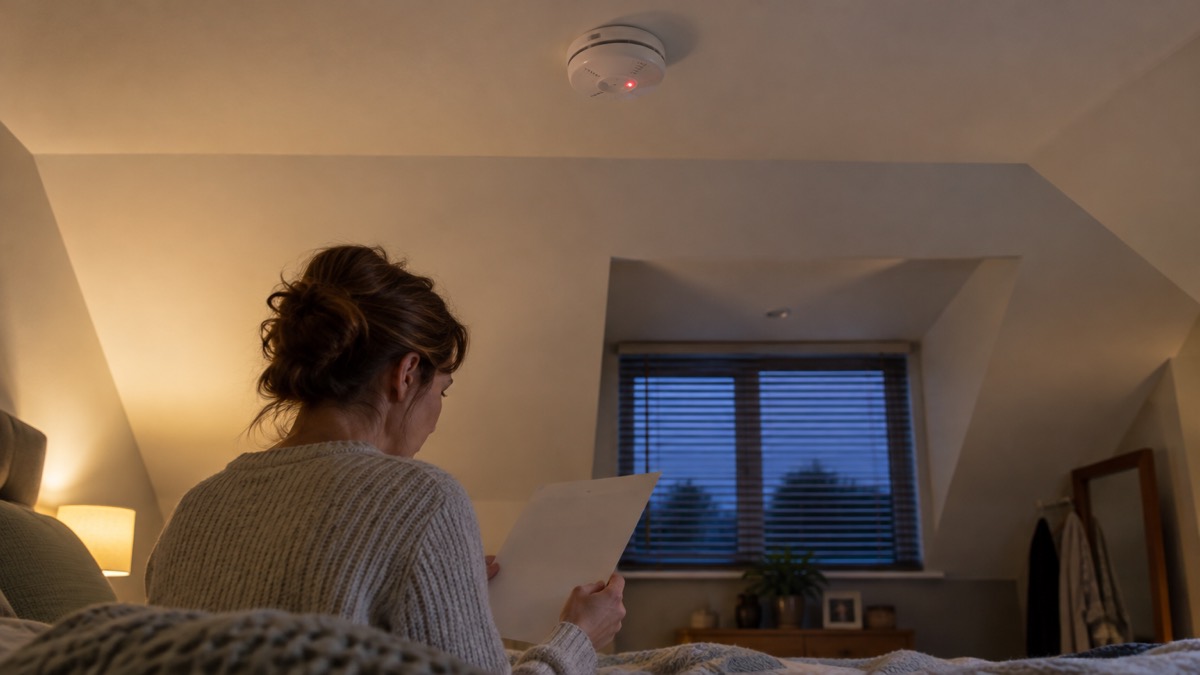
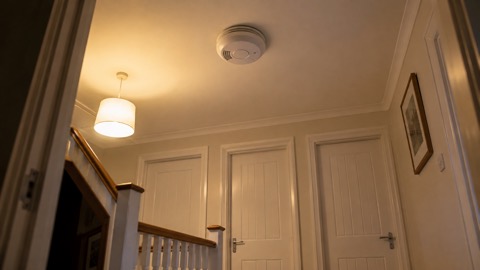
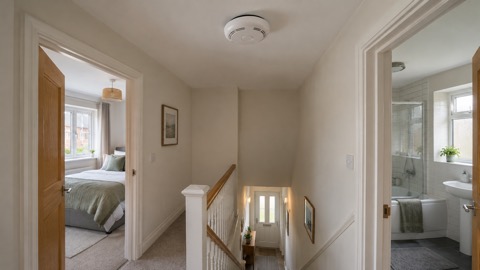
Fit the SW1 on the ceiling, at least 300mm from light fittings and walls2. That clearance keeps the sensor out of the dead air close to a wall and away from the heat and glare of a light fitting. The maker's suitable rooms are the landing, hallway, bedroom, living room and dining room2.
Keep it away from bathrooms. FireAngel warns that, like other smoke alarms, optical alarms can be subject to nuisance alarms from steam and should not be placed near bathrooms5. A landing outside a bathroom door is a common compromise, but not inside the room itself.
The circuit matters as much as the position. FireAngel says not to use circuits containing fluorescent light fittings or dimmer switches2. A dimmer circuit can be switched off at the wall, which defeats a mains alarm, and fluorescent fittings can interfere with it.
For a household working out how many alarms a home needs and where each one goes, the general guidance is on Where to Fit Smoke Alarms and How Many Smoke Alarms Does a House or Flat Need?. If you are choosing between mains and battery only, Battery or Mains Smoke Alarms sets out the trade-offs.
Wiring: a qualified electrician and an unswitched circuit
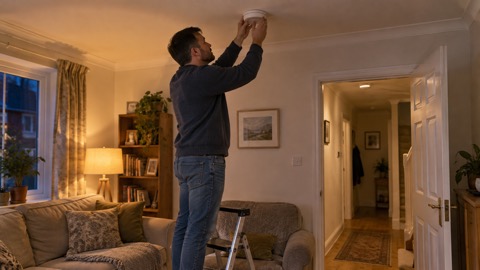
The SW1 is not a DIY fitting. FireAngel states that wiring should be installed by a qualified electrician in accordance with local building standards2, and that the circuit used to power the alarm must be a 24 hour voltage circuit that cannot be turned off by a switch2. The same requirement appears in FireAngel's guidance for its mains powered heat alarms, which adds that installation should follow BS76716.
In Scotland, the advice on choosing an electrician is specific: a registered electrician works to the BS7671 safety standard, their work is regularly assessed, they are insured, and registration is a legal requirement for certain electrical work7. That is a useful check wherever you are, and it is the standard FireAngel names for its own mains alarms6.
The interconnect wiring has its own rules. Where alarms are linked, FireAngel specifies a minimum 0.75 mm2 cable, treated as Live, insulated and sheathed, using a three core and earth style cable between alarms2. The wiring colours are brown for live, blue for neutral, and black or grey for the interlink, with the house wiring earth terminated in the earth terminal2. The push-fit manual adds that the house wiring earth must only be terminated in the terminal marked for it5.
Linking up to 12 alarms
One SW1 can be interconnected with up to 11 other smoke, heat or carbon monoxide alarms from the FireAngel range through the interlink connector, giving up to 12 on a single network2. The data sheet puts the same limit plainly: multi-alarm interconnect up to 12 smoke, heat and CO units, and when one sounds they all sound1.
The network is not limited to smoke alarms. FireAngel's manuals describe a single network of up to 12 FireAngel mains smoke (SW1 or SW10), heat (HW1 or HW10) or carbon monoxide (CW1) alarms, and say not to connect more than 12 devices8. That means a hallway smoke alarm, a kitchen heat alarm and a CO alarm near a boiler can all sit on one system, so a fire in the kitchen or carbon monoxide in the utility room raises the alarm throughout the house.
There is a behaviour detail worth knowing. On an interconnected network, only the alarm that senses the fire will sound and flash its LED; the other connected alarms will sound a warning but not flash their LED5. So the alarm with the flashing red light is the one near the problem.
After fitting, test every alarm and make sure each connected alarm sounds within 10 seconds2. If you are weighing up wired against wireless linking, Wireless or Wired Interlinked Alarms covers the difference, and Interlinked Alarms: How Linking Works explains the principle. For heat alarms in kitchens, see Heat Alarms: What They Do and Where They Go and the HW1.
What the red LED and chirps mean
The SW1 tells you its state through the red LED on the front and through sound. In normal monitoring the red LED flashes once every 32 seconds approximately, showing the sensor is active2. When the alarm senses smoke it sounds continuously and the red LED flashes every second2. In silence mode the red LED flashes once every 8 seconds2.
A chirp is a different signal depending on what the light does. When the battery is low, the alarm chirps and the LED flashes once every 32 seconds5. If the alarm chirps every 32 seconds without a red LED flash, a fault is indicated, and FireAngel says to contact Technical Support2.
| What you see and hear | What it means | What to do |
|---|---|---|
| Red LED flashes every 32 seconds | Normal monitoring2 | Nothing |
| Continuous alarm, LED flashing every second | Smoke sensed2 | Get out if not certain of the source2 |
| Chirp with LED flash every 32 seconds | Low battery5 | Replace the 9V battery2 |
| Chirp every 32 seconds, no LED flash | Fault2 | Contact Technical Support2 |
| LED flashes every 8 seconds | Silence mode2 | Wait for it to return to full sensitivity2 |
If the alarm sounds and you are not absolutely certain of the source of smoke, get everyone out of the house immediately2. FireAngel's push-fit manual is blunter still: never ignore any alarm, and ignoring it may result in injury or death5. What to do next is set out in What to Do If a Fire Starts in Your House, and if you cannot get out, What to Do If You Cannot Escape a Fire.
Testing, cleaning and replacing it
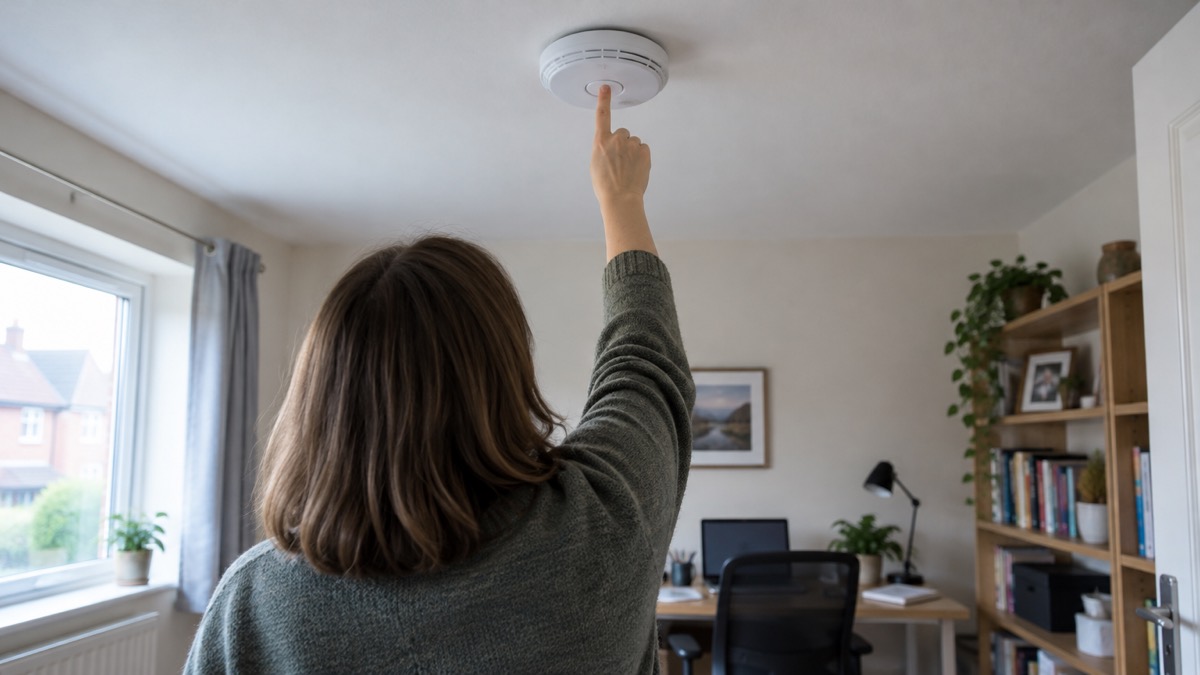
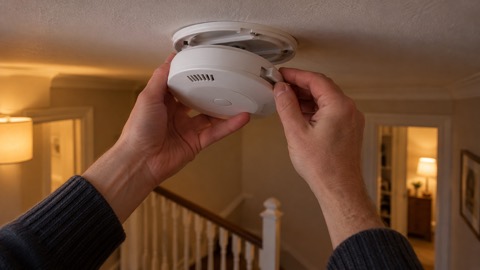
Test the alarm every month2. Press and hold the test button for 5 seconds and the alarm will sound2. When the test button is pressed the alarm will flash once every 8 seconds for 8 minutes2. If you have linked alarms, testing one should set the others off within 10 seconds2.
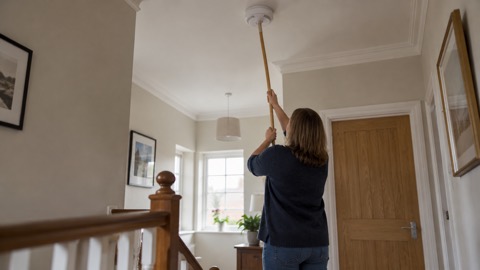
Vacuum the alarm every 3 months2. Dust and insects in the sensing chamber are a common cause of false alarms, and the maker's cleaning instruction is a vacuum rather than a cloth. Do not use cleaners or solvents, do not paint the alarm, and do not use any test method other than the one in the manual5.
Replace the alarm every 10 years2. The sensor degrades with age even if the alarm still sounds when tested, which is why the maker sets a replacement date rather than leaving it to the battery. For the wider question of when alarms of different types reach the end of their life, see When to Replace a Smoke, Heat or CO Alarm.
The battery should last approximately one year under normal use2. FireAngel recommends Duracell MN1604, Gold Peak GP1604S and GP1604A, and Raymax 6F22 and 6LR61, and warns that a battery other than those recommended may have a detrimental effect on alarm performance2. Once the batteries are removed the low battery chirp will stop5.
Children, sleeping and the limits of any alarm
An alarm is only part of a plan. Government fire safety guidance warns that some children may not be woken by smoke alarms10, and the same warning appears in official preparedness advice12. FireAngel's own manual says experience has shown that children may not be woken by fire alarm tones5.
The practical consequences are set out in the same manual. Families should have a rehearsed fire escape plan, sleeping children must be woken and taken to safety, and the fire and rescue service should always be called without delay5. Do not rely on the sound alone to rouse a child; make waking them part of the plan.
"Please be aware that some children may not be woken by smoke alarms."
A rehearsed plan is the answer, and How to Make a Fire Escape Plan walks through one. Households with a deaf or hard of hearing person need a different solution again, covered in Smoke and CO Alarms for Deaf and Hard of Hearing People.
Warranty, support and disposal
The SW1 carries a 5 year warranty1. FireAngel's conditions require proof and date of purchase, the warranty is not transferable, a replacement lasts for the remainder of the original period, and it does not cover accident, misuse, disassembly, abuse or lack of reasonable care2. The push-fit manual adds that it does not cover applications not in accordance with the user manual, or events outside FireAngel's control such as fire and severe weather5.
Support is UK based. FireAngel says its customer support specialists are based in the UK and can help with product advice, installation queries and troubleshooting by phone, email or live chat13. The current manual gives Technical Support on 0800 141 2561, the website fireangel.co.uk/support and the email technicalsupport@fireangel.co.uk2. Some FireAngel manuals and support pages give 0330 094 5830 for general customer support14, and fire and rescue customers are directed to 0800 141 256115. Staffordshire Fire and Rescue Service also points residents with issues on current smoke alarms to 0800 141 256116, and Greater Manchester Fire and Rescue Service gives the same freephone number for FireAngel alarms it fitted that are still under guarantee17.
At the end of its life, dispose of the alarm within the waste electronic and electrical equipment (WEEE) recycling scheme, remove the batteries before disposal, do not attempt to open it and do not burn it2. Your local household waste recycling centre takes small electrical items.
Sources (17)
- SW1-R Data Sheet, FireAngel, 2024
- SW1-R User Manual, FireAngel, 2024
- SW1-R Optical Smoke Alarm, FireAngel, 2026
- Smoke Alarm Guide, FireAngel, 2026
- SW1-PF-T User Manual, FireAngel, 2019
- Installing Your FireAngel Mains Powered Heat Alarm, FireAngel, 2024
- Electrical Safety at Home, Scottish Fire and Rescue Service, 2025
- SW10-EUT User Manual, FireAngel, 2026
- CW1-PF-T User Manual, FireAngel, 2019
- Fire Safety in the Home, GOV.UK, 2022
- Fire Safety for Parents and Child Carers, GOV.UK, 2022
- Protecting Your Family: Fire, Essex Prepared
- Carbon Monoxide Safety, FireAngel, 2026
- FireAngel Product FAQs, FireAngel, 2026
- FS2126-T ST-632 Manual, FireAngel, 2021
- Home Fire Safety Visits, Staffordshire Fire and Rescue Service, 2026
- Problem With Your Smoke or Heat Alarm, Greater Manchester Fire and Rescue Service, 2026
 FireAngel FP2620W2-R Alarm
 FireAngel ST-632 Smoke Alarm
 FireAngel ST-750 Smoke Alarm
 FireAngel SW10 Smoke Alarm
 FireAngel SB1 Smoke Alarm
 FireAngel SM-SN-1 Smoke Alarm
 FireAngel FA6611 Smoke Alarm
 FireAngel FA6615 Smoke Alarm
 FireAngel FA8620BW Alarm
 Kidde 2030-DSR Smoke Alarm
 Kidde 2030-DCR CO Alarm
 Kidde 10Y29 Smoke Alarm