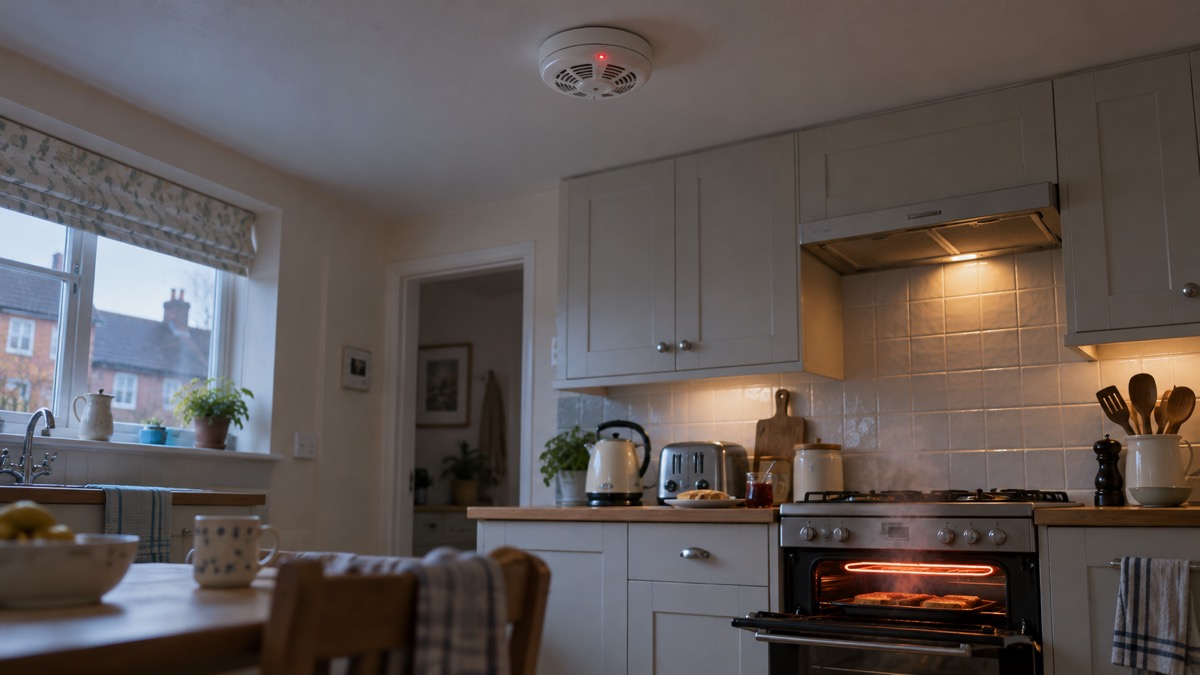
The FireAngel HW10 is a mains powered heat alarm for the kitchen, garage and loft: the rooms where a smoke alarm tends to cry wolf. It does not look for smoke. It sounds when the air around it reaches between 54°C and 70°C, which is why cooking fumes and dust do not set it off1. It runs from the mains on a 24 hour circuit that cannot be switched off, with a replaceable 9V lithium battery as back-up, and it can be linked to up to 11 other FireAngel mains alarms so that one alarm sets off the whole network1.
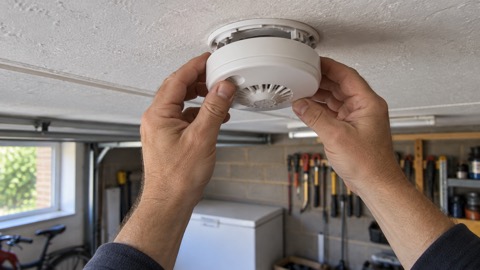
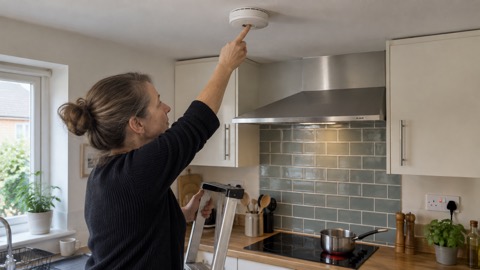
If you are fitting one, the decisions that matter are where it goes and who wires it. The maker's manual says wiring should be installed by a qualified electrician in accordance with BS 7671 or local building standards, and that the alarm should sit on the ceiling, at least 300mm from light fittings and walls, no more than 5.3m from the farthest wall and no more than 5.3m from a door to any room where a fire might start1. It must not be installed on a wall1.
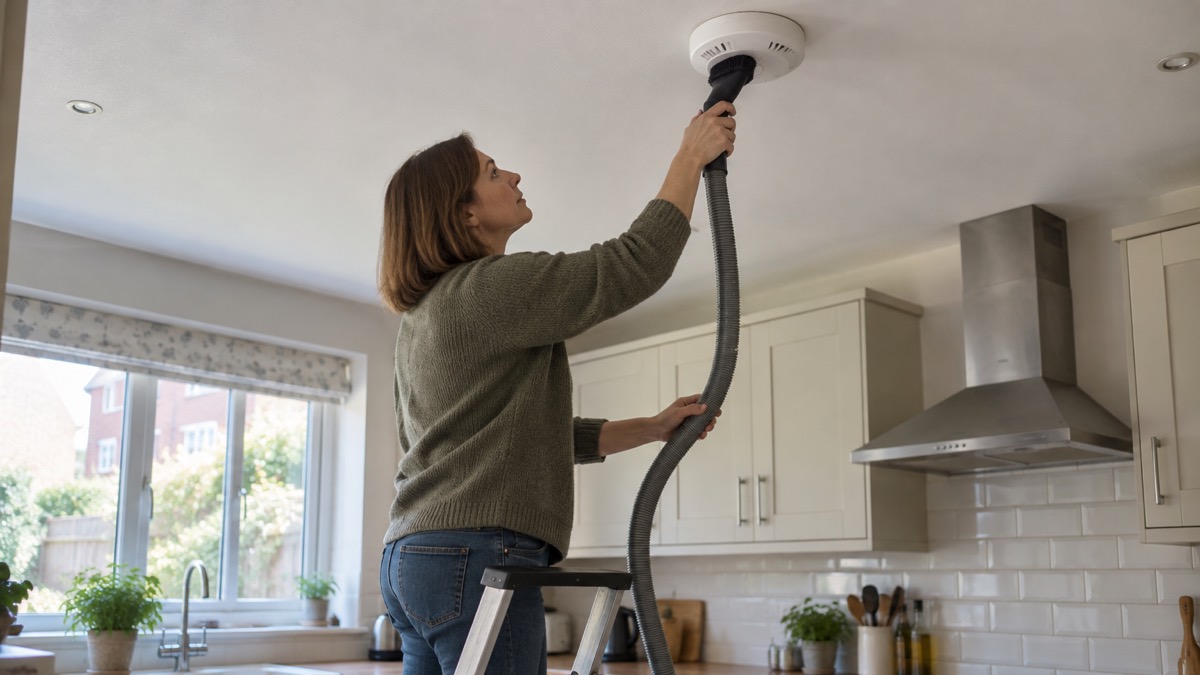
Once it is up, the routine is simple: test it every month, vacuum it every 3 months, and replace it every 10 years1. The datasheet gives a 5 year warranty2. FireAngel technical support is on 0330 094 5830, by email at technicalsupport@fireangeltech.com, or online at www.fireangeltech.com/support1.
What the FireAngel HW10 is, and the rooms it suits
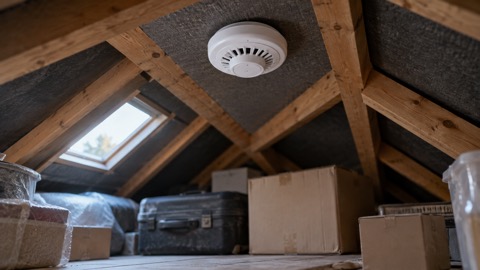
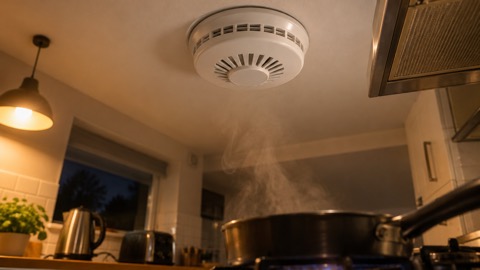
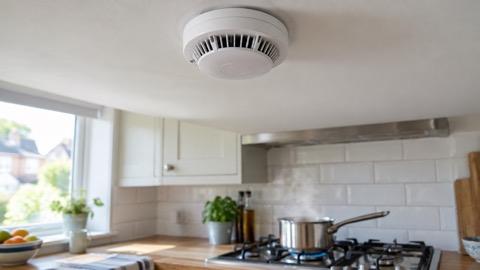
A heat alarm is a different instrument from a smoke alarm, and the difference is the point of owning one. FireAngel describes heat alarms as specifically designed for areas with fumes and high humidity, such as kitchens where cooking fumes would otherwise trigger a smoke alarm3. The maker's guidance for its mains heat alarms lists kitchens, utility rooms, boiler rooms, attics and garages as suitable rooms4. Its product pages add that heat alarms are ideal for kitchens, garages or unconverted lofts because fumes and dust there make false alarms more likely5.
The HW10 itself is a 230V mains powered heat alarm with a thermistor sensor, a large central test button, a separate silence button, LED indicators for power and for fault or alarm, and a low battery warning2. It measures 126mm across and 49mm deep2. FireAngel has sold alarms in the UK since 1998 and describes its range as independently certified with the BSI Kitemark6.
What it cannot do matters as much as what it can. A heat alarm does not detect smoke, so it will not give early warning of a slow, smouldering fire the way a smoke alarm will. The maker's manual is explicit that for the best protection, heat alarms should always be installed as part of a complete fire protection system that includes smoke alarms1. In practice that means smoke alarms in hallways, landings and living rooms, and a heat alarm where smoke detection would keep going off. Our guide to heat alarms sets out the wider picture, and Heat Alarm or Smoke Alarm: Which Goes Where compares the two room by room.
Specifications: Class A2 detection between 54°C and 70°C
The HW10 carries Class A2 heat detection, which the datasheet gives as a range of 54°C to 70°C2. The manual puts it in plain terms: the alarm will sound a warning when the ambient temperature in a room is between 54°C and 70°C1. It is certified to BS 5446-2: 2003, licence number KM6942921.
| Specification | FireAngel HW10 |
|---|---|
| Type | 230V mains powered heat alarm2 |
| Detection | Class A2 heat detection, 54°C to 70°C2 |
| Sensor | Thermistor2 |
| Standard | BS 5446-2: 2003, licence KM6942921 |
| Sound level | 85dB at 3 metres2 |
| Back-up battery | Replaceable 9V PP3 lithium2 |
| Size | 126mm diameter x 49mm depth2 |
| Mounting | Ceiling only2 |
| Operating humidity | 10% to 85% relative2 |
| Storage temperature | 5°C to 38°C2 |
| Storage humidity | 10% to 85% relative2 |
| Warranty | 5 years2 |
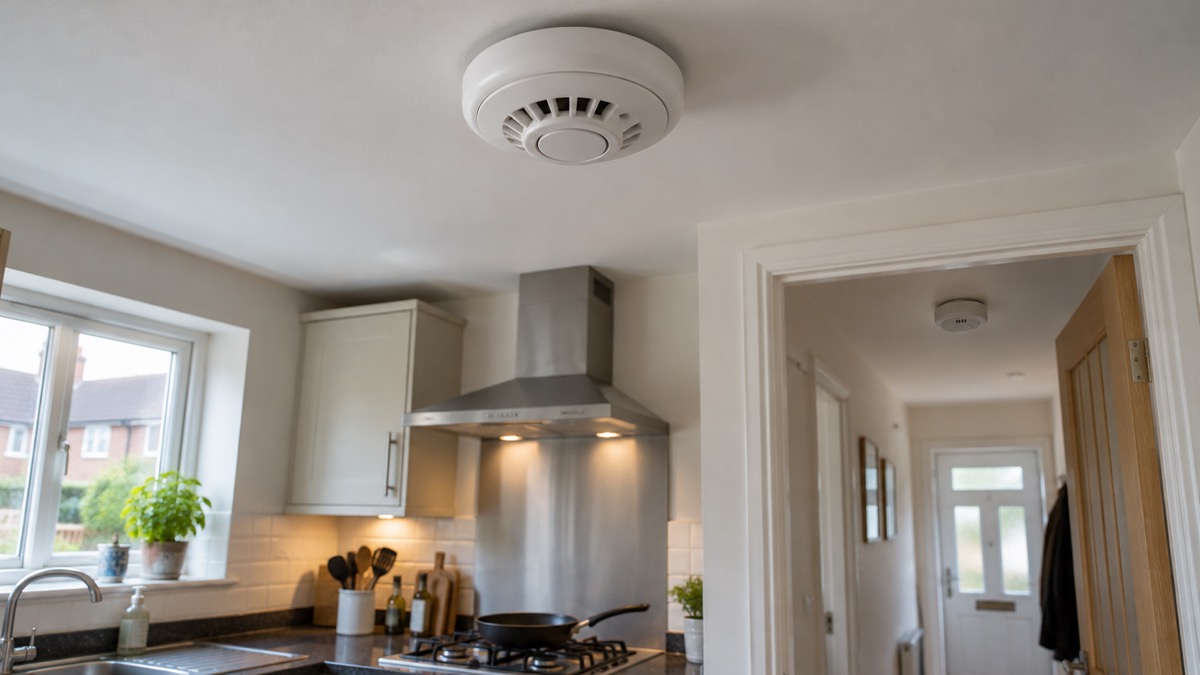
Two of those figures decide how the alarm behaves in a real fire. The 54°C to 70°C band means it waits for a genuine build-up of heat rather than reacting to steam or a hot pan, which is what keeps it quiet during cooking. The 85dB at 3 metres sound level is the same order of loudness as a smoke alarm, so it will wake most people in an adjacent room, though closed doors and distance reduce it. The device has no protection against splashing water and must not be exposed to dripping or splashing, so it is not a bathroom fitting1.
The datasheet also lists a safety clip feature that prevents the alarm being installed without a battery fitted2. That is a small detail with a practical consequence: if the alarm will not seat on its base, the battery is probably missing or wrongly seated, not the base at fault.
Wiring and power: a 24-hour circuit fitted by a qualified electrician
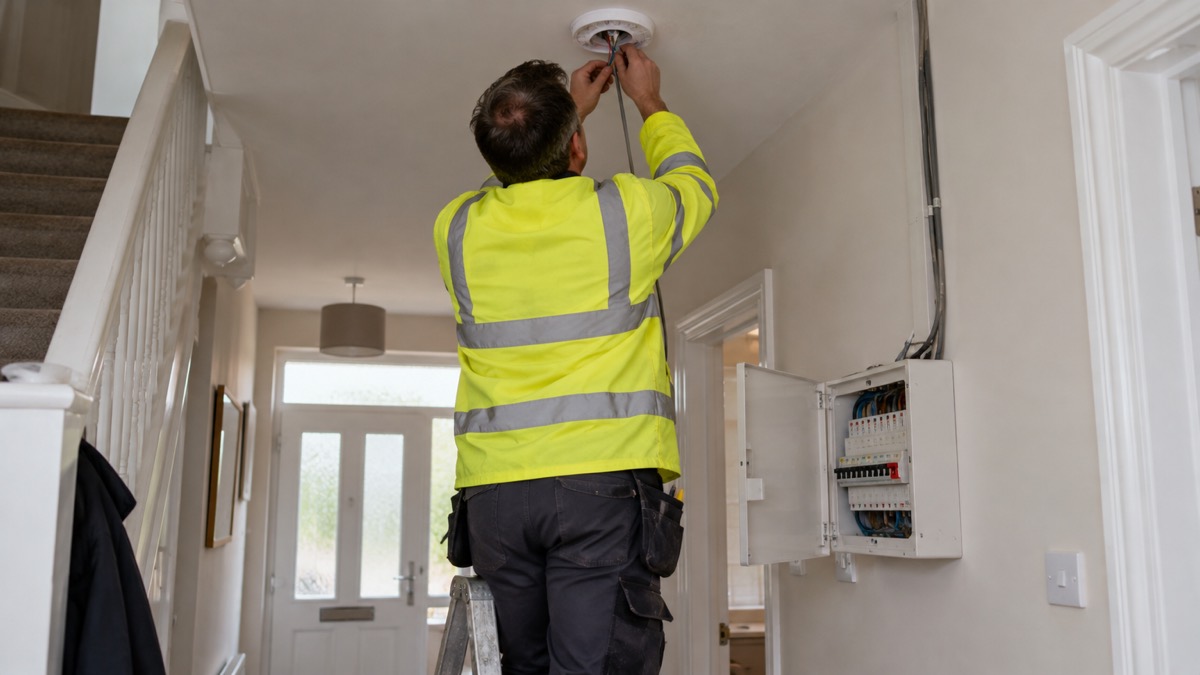
The HW10 is not a DIY fitting. The maker's manual says wiring should be installed by a qualified electrician in accordance with either BS 7671 or local building standards1. FireAngel's own installation guidance repeats that its mains powered alarms are designed to be installed by a qualified electrician in accordance with BS76714. If you are having one fitted, that is the arrangement to expect, and it is worth confirming the electrician will issue the usual certificate for the circuit.
The circuit itself has a specific requirement. The manual states that the circuit used to power the alarm must be a 24 hour voltage circuit that cannot be turned off by a switch1. In other words, it is not wired to a lighting circuit you can kill at the wall, so the alarm keeps its mains supply even when the room is dark. The manual also says to ensure a permanent connection is made in a suitable junction box, which is not provided1.
The wiring colours are standard: brown for live, blue for neutral, and black or grey for the interlink, with the earth terminated in a spare connector and no connection made to the mains earth terminal1. The interconnect wire must be at least 0.75mm2 and must be treated as live, insulated and sheathed1. Keep any wiring at least 1000mm from fluorescent lighting, and site the alarm itself at least 1500mm from fluorescent fittings and wiring1. The manual also advises against using circuits that include fluorescent lamps or dimmers1.
Interconnecting up to 12 FireAngel alarms
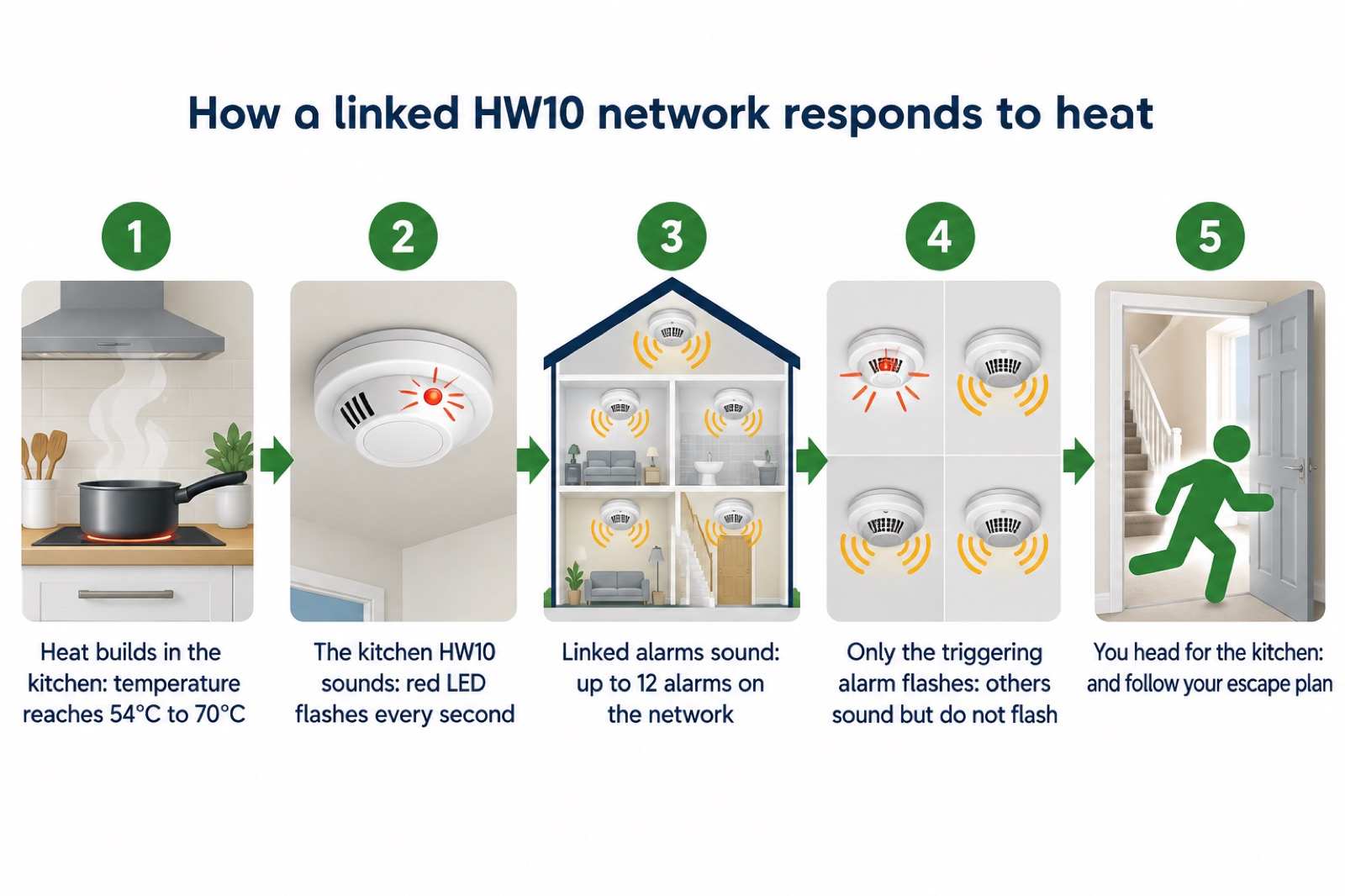
One heat alarm in a kitchen warns the kitchen. A network warns the house. The HW10 can be interconnected with up to 11 other FireAngel mains smoke (SW1 or SW10), heat (HW1 or HW10) or carbon monoxide (CW1) alarms through the "I" connector, giving up to 12 alarms on a single network1. The maker's manuals for the other alarms in that family give the same limit, and warn not to connect more than 12 devices7.
When one alarm senses fire, they all sound2. There is a useful detail in how they behave: only the alarm that senses the fire will sound and flash its LED, while the other connected alarms will sound a warning but will not flash their LED1. That tells you which room to head for, or which room to avoid.
Testing a network takes a little patience. The manual says to test each alarm and ensure every connected alarm sounds within 10 seconds1. If they do not all sound immediately, it may take a few seconds for hardwired interconnected alarms to respond, so keep the test button pressed until every unit emits a sound1. When you press test, the alarm flashes once every 8 seconds for 8 minutes1.
If you want alarms linked without running cable between them, FireAngel's Spec+ range uses Bluetooth to interconnect up to 50 alarms wirelessly, and the maker says this prevents interference or cross-connection with devices outside the network10. That is a different system from the HW10's wired interlink, and the two should not be confused. Our guide to interlinked alarms explains how linking works, and Wireless or Wired Interlinked Alarms compares the two approaches.
Testing, silencing and looking after it
The HW10 needs very little, but it needs it regularly. The manual says to test the alarm every month and vacuum it every 3 months1. To test, press and hold the test button for 5 seconds and the alarm will sound1. The red LED flashes once every 8 seconds for 8 minutes when the test button is pressed1.
If the alarm goes off and you know there is no fire, the silence button buys you time. Pressing it silences the alarm for 10 minutes, after which it will automatically sound 2 chirps and return to full sensitivity1. While it is silenced, the red LED flashes once every 8 seconds to show it is in silence mode1. Do not treat silence as a fix: if it keeps going off, the cause needs dealing with.
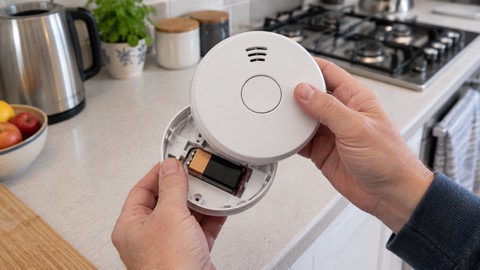
The battery is a replaceable non-rechargeable 9V lithium back-up, with an Energizer L522 recommended by the maker1. Under normal use the battery should last the lifetime of the alarm1. When it runs low, the alarm chirps and the LED flashes every 32 seconds1. If the alarm chirps every 32 seconds but the red LED does not flash, the manual says that indicates a fault, and you should contact technical support1.
When it will not sound, or will not stop
Two faults account for most calls about a heat alarm: it stays silent when tested, or it goes off when there is nothing to warn about.
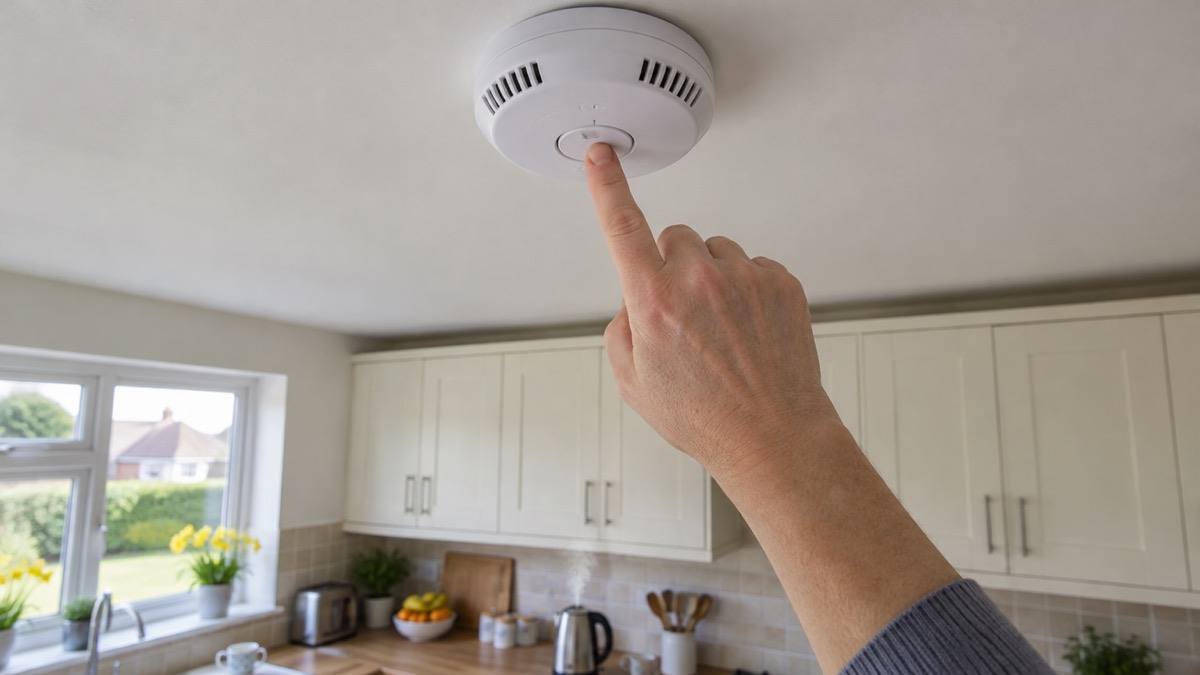
If it does not sound on test, the manual's checklist is short. Check that the alarm is connected to the power supply and that the battery is correctly installed, allow a few seconds to settle after a first installation, and push and hold the centre of the test button firmly for 5 seconds1. If the green LED does not light, check the same two things: the mains connection and the battery1. FireAngel's general guidance for its alarms adds that if an alarm does not sound or is beeping when it is not being tested, the battery could be running low or the alarm could be coming to the end of its life and need replacing11.
If it activates when there is no fire, the manual says to check the location of the heat alarm and clean it1. Frequent unwanted alarms usually mean the alarm is too close to a heat source, such as a cooker hood or a boiler flue, or that dust has built up on the sensor. Repositioning and cleaning are the first steps; if the problem persists, technical support can advise.
"If you experience frequent unwanted alarms: Check the location of your heat alarm. Clean the heat alarm."
For a HW10 bought and fitted yourself, use FireAngel technical support on 0330 094 58301. FireAngel states that its customer support specialists are based in the UK and can help with product advice, installation queries and troubleshooting, by phone, email or live chat12.
Support, warranty and the manual in other formats
FireAngel's technical support is reachable on 0330 094 5830, by email at technicalsupport@fireangeltech.com, and online at www.fireangeltech.com/support1. The maker's manuals give the postal address as Vanguard Centre, Sir William Lyons Road, Coventry CV4 7EZ13. FireAngel says its customer support specialists are based in the UK and can help with product advice, installation queries and troubleshooting by phone, email or live chat14. Its product FAQ page also directs people to the same number15.
The HW10 datasheet states a warranty of 5 years2. That is not the same as the alarm's life: the manual says to replace the alarm every 10 years1. Keep the installation date and your proof of purchase, because a warranty claim will normally need both. FireAngel states that its customer support specialists are based in the UK and can help with product advice, installation queries and troubleshooting, by phone, email or live chat16.
If you need the instructions in another form, FireAngel states that its user manuals are also available in large text and other formats, and asks people to email technicalsupport@fireangeltech.com or call 0330 094 58301. The same offer appears in the manuals for its other alarms, so it is a standing arrangement rather than a one-off8.
Where it fits in a household alarm plan
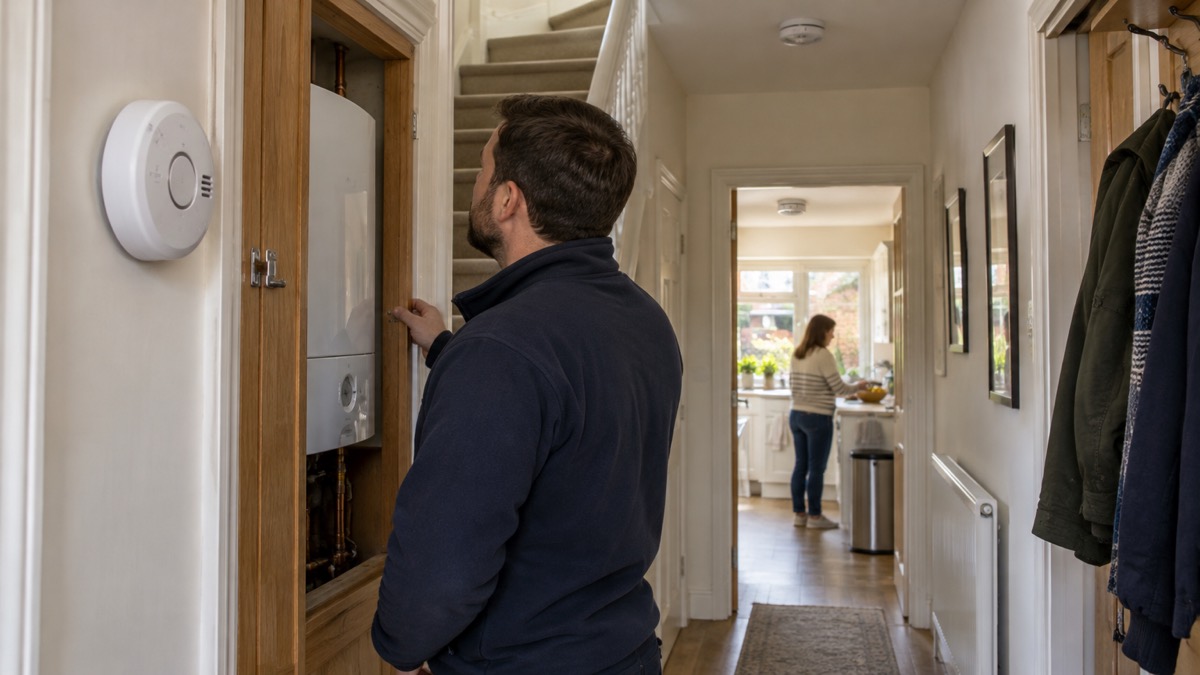
The HW10 answers a specific problem: a kitchen, garage or loft where a smoke alarm would keep going off. It does not replace smoke alarms, and the maker says so plainly1. A sensible arrangement is smoke alarms on every level and in the hallway and landing, a heat alarm in the kitchen and garage, and carbon monoxide alarms wherever there is a fuel-burning appliance. FireAngel states that its customer support specialists are based in the UK and can help with product advice, installation queries and troubleshooting, by phone, email or live chat19.
If you are starting from scratch, our guide to smoke alarms explains the types, and How Many Smoke Alarms Does a House or Flat Need? works through the count. For the rules on grades and standards, see Alarm Standards: BS 5839-6, BS EN 50291 and System Grades. If you have a fuel-burning appliance, our guide to carbon monoxide alarms covers what to fit and where.
The HW10 is one of a family. FireAngel's HW1 is a battery powered heat alarm for the same kinds of room, and the SW1 and SW10 are the mains smoke alarms it is designed to link with. The CW1 is the carbon monoxide alarm that completes the network. All of them are made by FireAngel.
Sources (19)
- FireAngel HW10-EUT User Manual, FireAngel, 2026
- FireAngel HW10 Datasheet, FireAngel, 2024-10
- FireAngel HW10-EUT Product Page, FireAngel, 2026-08-21
- Installing Your FireAngel Mains Powered Heat Alarm, FireAngel, 2024-10-17
- FireAngel FS1226-T Kitchen Heat Alarm, FireAngel, 2026-08-20
- FireAngel Smoke Alarm Guide, FireAngel, 2026-07-15
- FireAngel SW10-EUT User Manual, FireAngel, 2026
- FireAngel CW1 User Manual, FireAngel, 2026
- FireAngel SW1 User Manual, FireAngel, 2026
- FireAngel Spec+ Heat Alarm, FireAngel, 2026-09-28
- Maintaining and Testing Your FireAngel Smoke Alarm, FireAngel, 2024-08-27
- Problem With Your Smoke or Heat Alarm, Manchester Fire and Rescue Service, 2026-10-29
- FireAngel FP1640W2-R Manual, FireAngel, 2019-05
- FireAngel Carbon Monoxide Safety, FireAngel, 2026-07-31
- FireAngel Product FAQs, FireAngel, 2026-10-29
- FireAngel FA3313, FA3322, FA3328 and FA3820 Manual, FireAngel, 2024-09
- FireAngel FA8080BW WiFi Gateway Manual, FireAngel, 2026
- FireAngel FA7312 Temperature and Humidity Manual, FireAngel, 2025-08
- FireAngel HW10-EUT Product Page (2), FireAngel, 2026-08-21
 FireAngel FA6720-R Heat Alarm
 FireAngel HW1 Heat Alarm
 FireAngel HM-SN-1 Heat Alarm
 Kidde Firex KF30 Heat Alarm
 Firehawk FHH10 Heat Alarm
 Aico Ei144e Heat Alarm
 FireAngel FA8720BW Heat Alarm