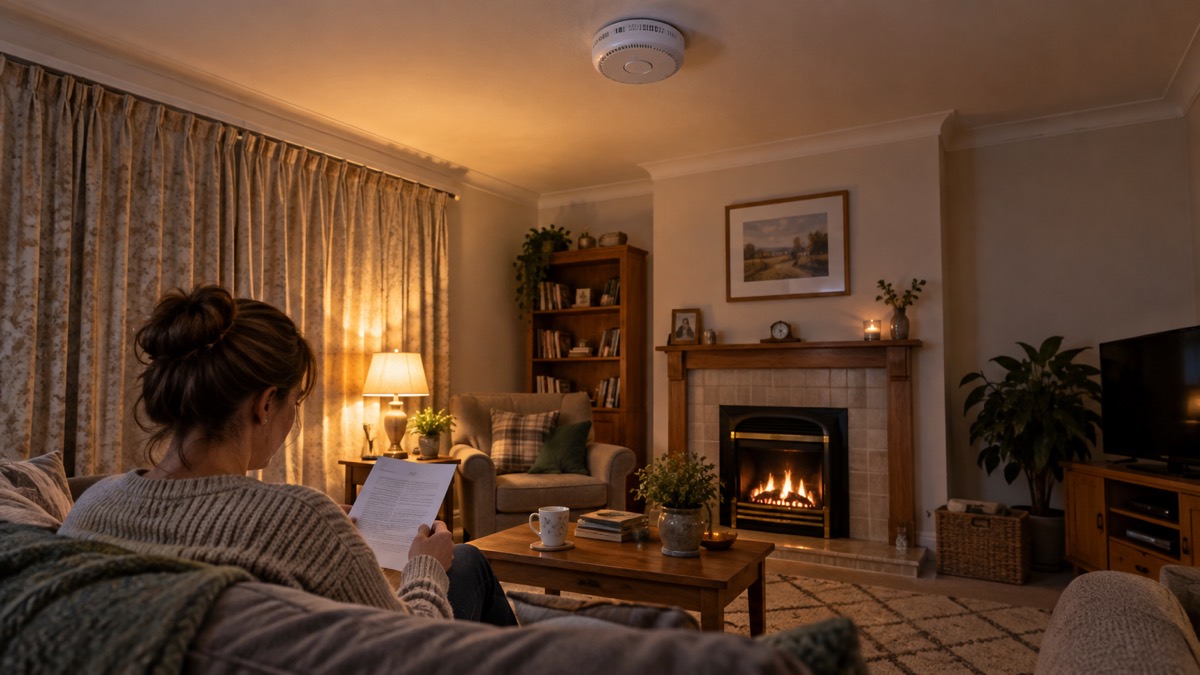
The FireAngel CW1-PF is a mains powered carbon monoxide alarm with a replaceable 9V battery back-up, made for UK homes by a company that is still trading and still supporting its products1. It uses an electrochemical sensor, sounds at 85dB at 3 metres, and has a product life of 10 years2. If it detects carbon monoxide it sounds four quick beeps followed by 5 seconds of silence, repeated until the sensor is clear2.
What you do when it sounds does not depend on the model. Get everyone out into fresh air, do not switch anything on or off, and call the gas emergency number. The alarm is a warning device, not a fix: it tells you CO is present so you can leave, and the maker's own manual tells you to test it every month and vacuum it every 3 months so it stays ready to warn you4.
This page sets out what the CW1-PF is, what its specifications mean in practice, where to fit it, what its chirps and lights tell you, and how to test, clean, dispose of and get support for it. It is one alarm in a wider picture: for the general choice, see Carbon Monoxide Alarms: What They Do and How to Choose.
FireAngel is still trading and UK support continues
FireAngel is an established UK brand, trading since 1998 and based in Coventry, and its customer support specialists are based in the UK5. They can help with product advice, installation queries and troubleshooting by phone, email or live chat5. Nothing in the record shows the company has failed, so an owner can expect spares advice, technical help and warranty service to continue.
The contact routes are consistent across the maker's manuals and support pages. Technical support is on 0330 094 5830, by email at technicalsupport@fireangeltech.com, and online at www.fireangeltech.com/support6. Fire and rescue customers have a separate freephone number, 0800 141 25619. The maker states that its customer support specialists are based in the UK and can help with product advice, installation queries and troubleshooting, by phone, email or live chat11.
FireAngel's range includes alarms powered by either a replaceable battery or a sealed for life power pack, and on some models there is the ability to run diagnostic reports to prove if an alarm was activated, at what level and when12. The CW1-PF is the simpler end of that range: a mains alarm with a battery back-up rather than a connected or app-linked device. If you want the connected option, the FireAngel FP1820W2-R is the smart CO alarm in the same family13.
What the CW1-PF is and who it suits
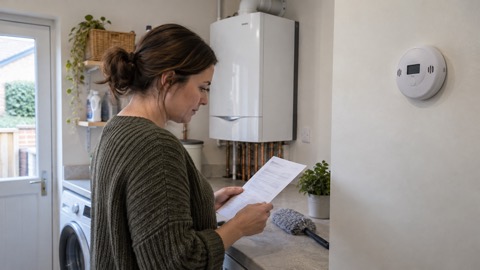
The CW1-PF-T is a mains powered carbon monoxide alarm with a replaceable 9V battery back-up1. The manual describes it as a 220 to 240V AC 50Hz mains powered CO alarm with 9V battery back-up2. It is designed for the rooms where people spend time and where a fuel-burning appliance may be: the landing, hallway, bedroom, living room, dining room and kitchen2.
That combination of mains power and a battery back-up is what makes it suited to a home that wants a permanently wired alarm without losing protection in a power cut. When it is running from the mains the green LED stays on constantly; when it is running on the battery the green LED flashes once every 33 seconds2. That single difference tells you at a glance whether the back-up is doing its job.
It is not a smoke alarm and it will not detect a gas leak. It detects carbon monoxide, the colourless, odourless gas produced by faulty or poorly ventilated fuel-burning appliances14. If you smell gas, that is a different emergency with a different response: see What to Do If You Smell Gas. For the difference between alarm types, see Can a Carbon Monoxide Alarm Detect a Gas Leak?.
The CW1-PF is a sensible fit where there is a wired ceiling position near a boiler, fire or cooker and you want a back-up battery rather than a sealed unit. If you are choosing between mains and battery alarms generally, Battery or Mains Smoke Alarms sets out the trade-offs, and Sealed 10-Year or Replaceable Battery Alarms covers the battery question.
CW1-PF specifications
The figures below come from the maker's manual and datasheet. Where the two documents give the same figure, it is stated once.
| Specification | Figure | Source |
|---|---|---|
| Sensor type | Electrochemical | 2 |
| Alarm sound level | 85dB at 3 metres | 2 |
| Power supply | 220 to 240V AC 50Hz with 9V battery back-up | 2 |
| Battery type | DC 9V (Raymax 6LR61, Duracell MN1604, Gold Peak 1604A or 1604S) | 2 |
| Battery life | 1 year | 2 |
| Product life | 10 years | 2 |
| Dimensions | 140mm diameter, 55mm thick | 2 |
| Weight | 250g net | 2 |
| Power consumption | Under 5W | 2 |
| Product standard | EN 50291-1:2018 | 2 |
| Warranty | 5 years | 2 |
The 85dB figure is the volume at 3 metres, and the alarm ramps up: it starts at a lower volume for around 10 seconds, then increases to the normal 85dB2. The 10 year product life is the point at which the whole unit is replaced, not just the battery2.
The manual also gives the response behaviour at low levels: at 30ppm the alarm will not sound before 120 minutes2. That is deliberate, to avoid nuisance alarms from trace levels, but it means the alarm is not an instant read-out. If you want to see low level readings, that is a feature of the digital models in the range rather than the CW1-PF12.
When the alarm sounds: four quick beeps, then get everyone out
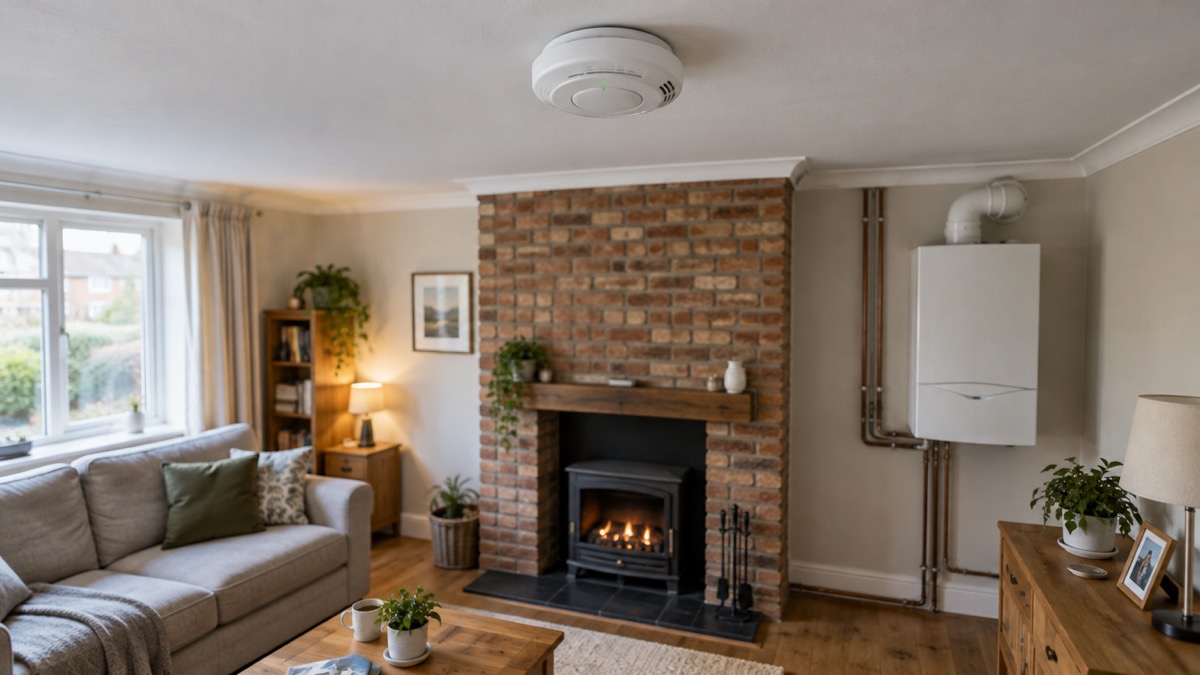
The CW1-PF sounds four quick beeps followed by 5 seconds of silence, repeated until the sensor is clear2. FireAngel's support guidance describes the same pattern across its CO alarms: four loud beeps and a break, repeated until the sensor is clear of carbon monoxide gas6. That four-beep pattern is the CO signal; three beeps is the smoke or fire signal on FireAngel's connected alarms16.
What to do is not in doubt. Get everyone out of the property into fresh air, and do not stop to open windows, switch appliances off or look for the source. Call the gas emergency number from outside. Do not re-enter until you have been told it is safe. The full sequence is set out in What to Do If Your CO Alarm Sounds or You Suspect Carbon Monoxide.
The alarm can take up to 10 minutes to clear once the CO has gone, depending on the level detected2. Do not wait for silence before acting, and do not silence it and go back to bed. If it sounds again after you return, treat it as a real leak and call for help again.
Where to fit it: 1 to 3 metres from the appliance
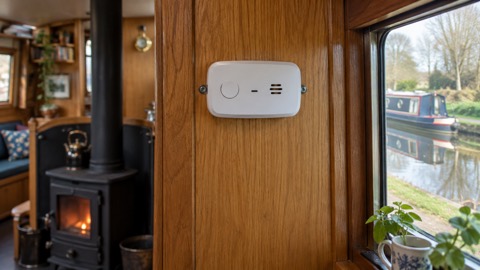
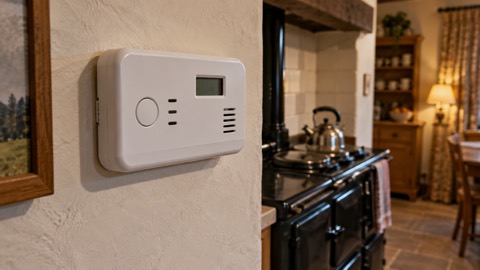
If the alarm is in the same room as a fuel-burning appliance, the maker says it should ideally be located 1 to 3 metres from the potential CO source2. It should be positioned at no more than 600mm vertically below the highest point in the room, which in practice means on the ceiling or high on the wall2. Keep it at least 300mm from light fittings and walls, and at least 1500mm from fluorescent lighting and its wiring2.
The manual recommends fitting it in a room where the temperature is between -10°C and 40°C2. It also points to EN 50292-2013 for further siting guidance2. For the general rules on where CO alarms go, including bedrooms and hallways, see Where to Put a Carbon Monoxide Alarm.
- Same room as the appliance: 1 to 3 metres from the source2
- Height: no more than 600mm below the highest point in the room2
- Clearance: at least 300mm from light fittings and walls2
- Fluorescent lighting: at least 1500mm away2
- Temperature: fit where it stays between -10°C and 40°C2
The appliance itself matters too. A Gas Safe registered engineer should carry out installation and maintenance of gas fires4. A blocked or poorly maintained flue is one of the ways CO gets into a home, which is why the alarm and the annual service go together17.
Mains installation must be done by a qualified electrician
The CW1-PF is a mains device, and the maker's manual is explicit: wiring should be installed by a qualified electrician in accordance with BS 76712. FireAngel's guidance for its mains powered alarms says the same: they are designed to be installed quickly and simply by a qualified electrician, in accordance with BS767118.
The manual sets out how the mains connection should be made: a permanent connection to the house wiring in a suitable junction box, with the supply taken either from an independent circuit at the main circuit board or from a separately electrically protected, regularly used local lighting circuit2. That is electrician's work, not a DIY job, and getting it wrong is a fire and shock risk.
Once connected, the alarm runs a start-up sequence: the three colour LEDs light up briefly and the device beeps, then the green LED flashes constantly for 40 seconds2. After that, a steady green LED means mains power, and a green LED flashing once every 33 seconds means it is running on the battery2.
Chirps and LED signals: low battery, fault and end of life
The CW1-PF uses chirps and amber LED flashes to tell you something needs attention. The pattern tells you which.
| Signal | What it means | What to do |
|---|---|---|
| Chirp once, amber LED flashes once every 33 seconds | Low battery | Replace the 9V battery2 |
| Chirp twice, amber LED flashes twice every 38 seconds | Fault | Contact FireAngel support2 |
| Chirp three times, amber LED flashes every 33 seconds | End of life | Replace the alarm, it has reached its 10 year life2 |
The low battery warning is the one most owners will meet first, because the maker gives a battery life of one year2. The end of life signal is the one that matters most in the long run: the alarm chirps three times and the amber LED flashes every 33 seconds when the device reaches the end of its 10 year life, and at that point the whole unit is replaced2. For the general question of when alarms need replacing, see When to Replace a Smoke, Heat or CO Alarm, and for beeping specifically, Why Is My Carbon Monoxide Alarm Beeping?.
Testing, cleaning and the 5-year warranty
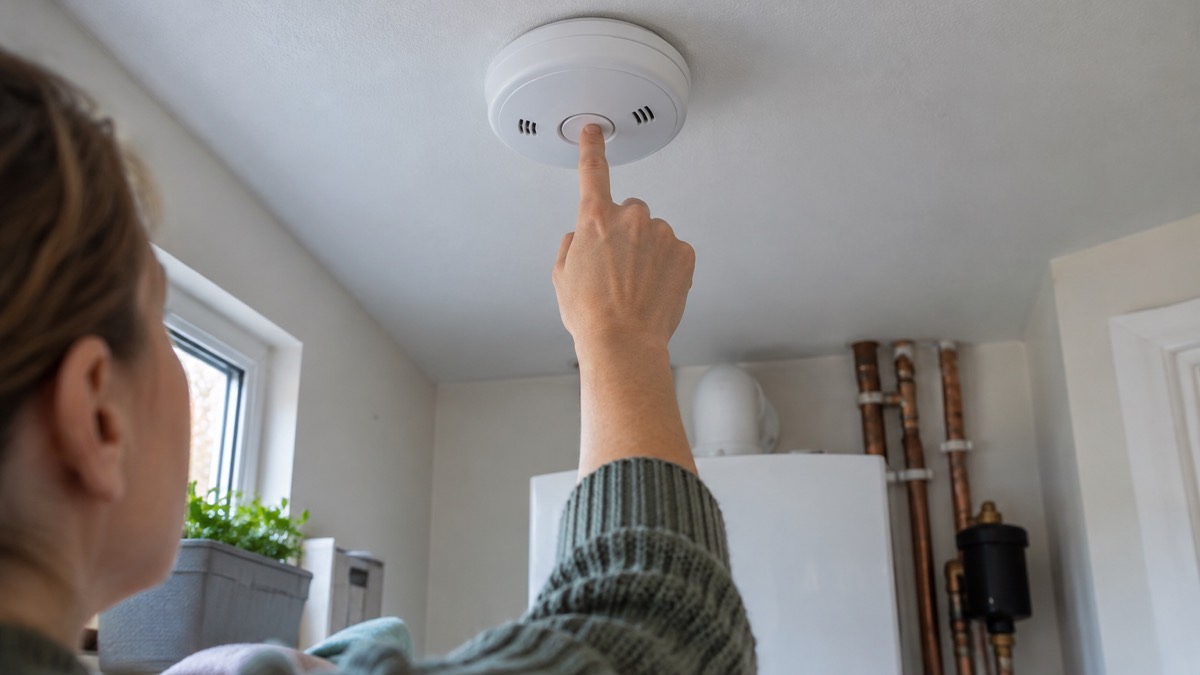
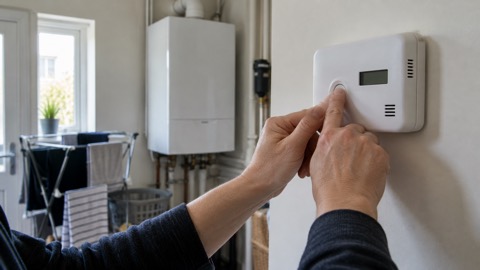
The maker's maintenance instructions are simple and worth following. Test the alarm every month by pressing and holding the Test button for 10 seconds; the alarm will sound at the normal 85dB volume2. Vacuum the alarm every 3 months, and do not use cleaners or solvents on it2. Do not attempt to open it and do not burn it2.
The CW1-PF carries a 5 year warranty from the date of purchase, not including the replaceable battery2. The warranty applies to the original retail purchaser and is not transferable, and proof of purchase is required2. FireAngel says that to confirm your warranty you need your proof of purchase including the date purchased and the batch number printed on the alarm, and the warranty begins from the date purchased19. Keep the receipt and note the batch number when you fit it.
When the alarm reaches the end of its life, the maker says it is ideally suited for disposal within the waste electronic and electrical equipment (WEEE) recycling scheme, and that batteries should always be removed before disposal2. Take it to a household waste recycling centre or a retailer that accepts small electrical items. Do not put it in the general waste and do not burn it2.
Where to get help
For product advice, installation queries and troubleshooting, FireAngel's UK based support team is on 0330 094 5830, by email at technicalsupport@fireangeltech.com, and online at www.fireangeltech.com/support5. Fire and rescue customers have a separate freephone number, 0800 141 25619. The company's address is Vanguard Centre, Coventry CV4 7EZ8.
For the wider picture, the Home Emergencies section covers fire, carbon monoxide, gas leaks and burst pipes, and Carbon Monoxide Poisoning Symptoms sets out what to look for. If you are choosing an alarm for the first time, start with Do I Need a Carbon Monoxide Alarm? and Carbon Monoxide Alarms: What They Do and How to Choose.
Sources (19)
- CW1-PF-T Carbon Monoxide Alarm product page, FireAngel, 2026-08-20
- CW1-PF-T User Manual, FireAngel, 2019
- CW1-PF Datasheet, FireAngel, 2024-09
- Winter Safety, Devon and Somerset Fire and Rescue Service, 2020-11-09
- Carbon Monoxide Safety, FireAngel, 2026-07-31
- FireAngel FAQs, FireAngel, 2026-10-29
- Smoke Alarm Guide, FireAngel, 2026-07-15
- HW1-R Manual, FireAngel, 2024-09
- FS2126-T-ST-632 Manual, FireAngel, 2021-06
- SW1-PF-T User Manual, FireAngel, 2019
- Problem with your smoke or heat alarm, Manchester Fire and Rescue Service, 2026-10-29
- About CO Alarms, CO-Gas Safety, 2024-02-18
- FP1820W2-R Smart Carbon Monoxide Alarm, FireAngel, 2026-10-28
- Safe Home Heating, Warwickshire County Council, 2026-10-29
- Carbon Monoxide, Public Health Wales, 2025-12-08
- FP1740W2-R Pro Connected Heat Alarm, FireAngel, 2026-10-28
- Chimney Safety, Manchester Fire and Rescue Service, 2026-10-29
- Installing your FireAngel mains powered heat alarm, FireAngel, 2024-10-17
- FA7312-EUX4 Temp & Humidity Sensor | FireAngel, FireAngel
 FireAngel FA3313 CO Alarm
 FireAngel FA3322 CO Alarm
 FireAngel FA3820 CO Alarm
 FireAngel FA6812 CO Alarm
 FireAngel FA6813 CO Alarm
 FireAngel FA6829S CO Alarm
 FireAngel W2-CO-10X CO Alarm
 FireAngel FP1820W2-R CO Alarm
 Kidde K7DCO CO Alarm
 Kidde K5DCO CO Alarm
 Kidde K10LLDCO CO Alarm
 Kidde K10LLCO CO Alarm