
The Kidde K10LLCO is a standalone carbon monoxide alarm for the home: a sealed-battery unit that detects carbon monoxide only, sounds at 85dB, and is designed to run for its full 10-year life without a battery change1. It is Kitemarked to BS EN 50291-1: 2018 and carries CE and UKCA marks, so it meets the standard that official and independent guidance asks for in a domestic CO alarm1. It can sit freestanding on a shelf or be screwed to a wall at head height, and the screws come in the box1.
What it will not do is warn you of smoke or fire. Kidde's own support guidance is explicit that this is a carbon monoxide alarm only, and that a home also needs a dedicated smoke alarm or a combined smoke and CO unit4. If you are choosing between a CO-only alarm and a combined unit, the decision turns on whether you already have working smoke alarms where they are needed.
The alarm is built around a sealed lithium battery that lasts the full lifespan of the unit, so there is nothing to recharge and nothing to swap out. When the alarm reaches the end of its life it tells you, and the whole unit is replaced rather than refilled1. That is the single most important thing to understand about owning one: it is a ten-year sealed instrument, not a battery holder you service.
What the Kidde K10LLCO does, and what it does not
This is a domestic carbon monoxide alarm. It samples the air, and when carbon monoxide reaches the level it is designed to respond to, it sounds an 85dB alarm and lights its alarm indicator1. It is a standalone unit, meaning it is not wired into a system and does not interconnect with other alarms in the house1. It works on its own, in the room where it is fitted.
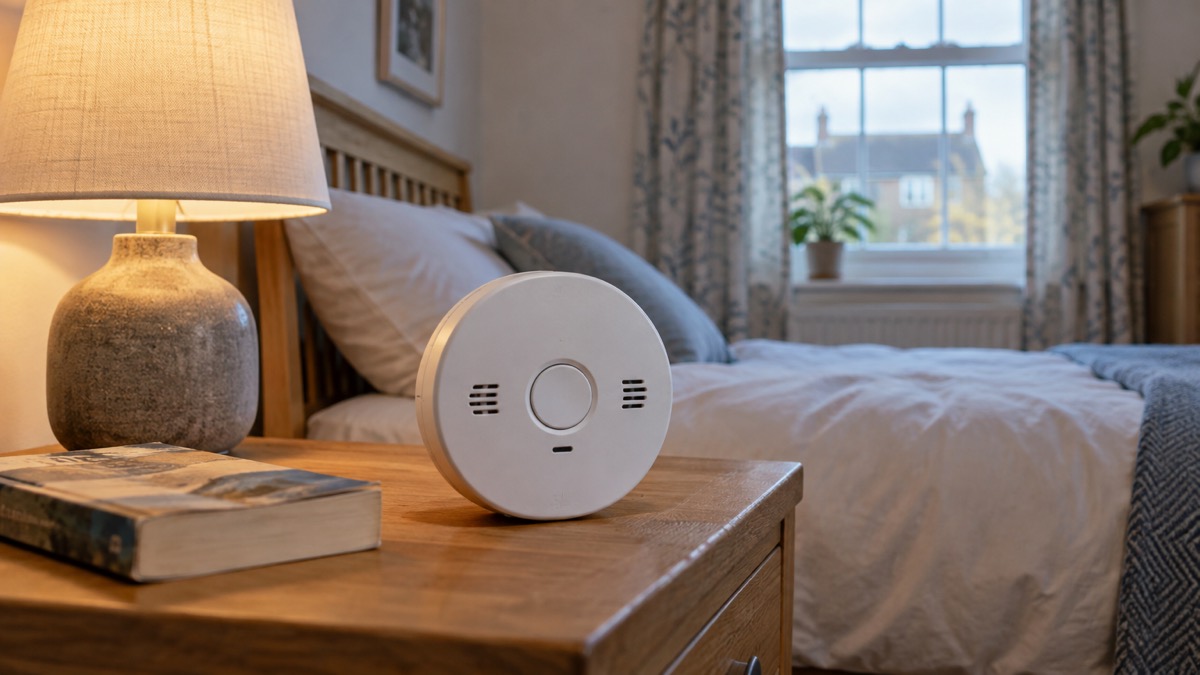
That standalone design suits a household that wants a CO alarm in one or two key places without rewiring. It also means the alarm protects the air around it, not the whole house: a unit in a hallway will not necessarily pick up carbon monoxide building in a closed bedroom, which is why official guidance suggests you may wish to keep a CO alarm in the bedroom so it would wake you while you sleep6.
What it does not do is detect smoke or fire. Kidde's support guidance states plainly that the alarm detects carbon monoxide only and will not alert you to smoke or fire, and points to a dedicated smoke alarm or a combined smoke and CO alarm for complete home protection4. If your smoke alarms are already in place and working, a CO-only unit like this fills the gap they leave. If they are not, deal with smoke detection first: our guide to smoke alarms and how to choose one sets out the options, and combined or separate alarms covers the trade-offs of a unit that does both.
One point of caution about buying any CO alarm. Testing has found that cheap and unbranded alarms sold online cannot always be relied on to detect carbon monoxide and sound the alarm, with every unbranded alarm tested failing to detect the gas7. Buy a badged, certified product from a recognised retailer, and check the standard marking on the box.
Specifications
The figures below are the distributor's listing for this model. Where a maker's or retailer's figure differs, the maker's figure is the one to rely on; here the listing is the specification source.
| Specification | Kidde K10LLCO |
|---|---|
| Sensor type | Electrochemical1 |
| Alarm sound level | 85dB1 |
| CO alarm level | From 50ppm1 |
| Battery | Sealed lithium, 10-year longlife1 |
| Battery replacements needed | None for the full alarm lifespan1 |
| Lifespan | 10 years1 |
| Warranty | 10 years8 |
| Power type | Battery powered1 |
| Connection | Standalone1 |
| Display | LED indicators (Power / Fault / Alarm)1 |
| Alarm memory | Red LED indicates a previous CO event1 |
| Mounting | Wall mounting or freestanding1 |
| Installation position | Mount at head height1 |
| Fixing | Screws, included1 |
| Dimensions | 72mm high, 119mm wide, 39mm deep1 |
| Weight | 132g1 |
| Material | Plastic1 |
| Operating temperature | -10°C to +40°C1 |
| Relative humidity | 0% to 90%1 |
| Environmental suitability | Home1 |
| Standard | BS EN 50291-1 (Domestic)1 |
| Marking | Kitemarked to BS EN 50291-1: 2018, CE and UKCA marked1 |
| End of life warning | Yes, when the alarm needs replacing1 |
| Local legislation | Scottish Legislation (2022), Welsh Legislation (2022), Northern Ireland Legislation (2024)1 |
The electrochemical sensor is the type most domestic CO alarms use, and it is the reason the unit has a finite life: the cell degrades over time, which is why the whole alarm is rated for 10 years rather than the battery alone1. The 85dB sound level is in the same range as a domestic smoke alarm, loud enough to wake most people in a nearby room.
When the alarm sounds: 50ppm and the response times
The listing gives the alarm level as from 50ppm of carbon monoxide1. That figure needs a word of explanation, because it does not mean the alarm shrieks the instant the air reaches 50 parts per million. Independent testing guidance sets out the response times alarms are expected to meet: at 50ppm, alarms should sound between 60 and 90 minutes, and at 100ppm, the alarms should sound between 10 and 40 minutes9. Those are the performance expectations the standard is built around, and they reflect a deliberate design choice: an alarm that went off at the faintest trace would be unusable, so it waits until the exposure is meaningful.
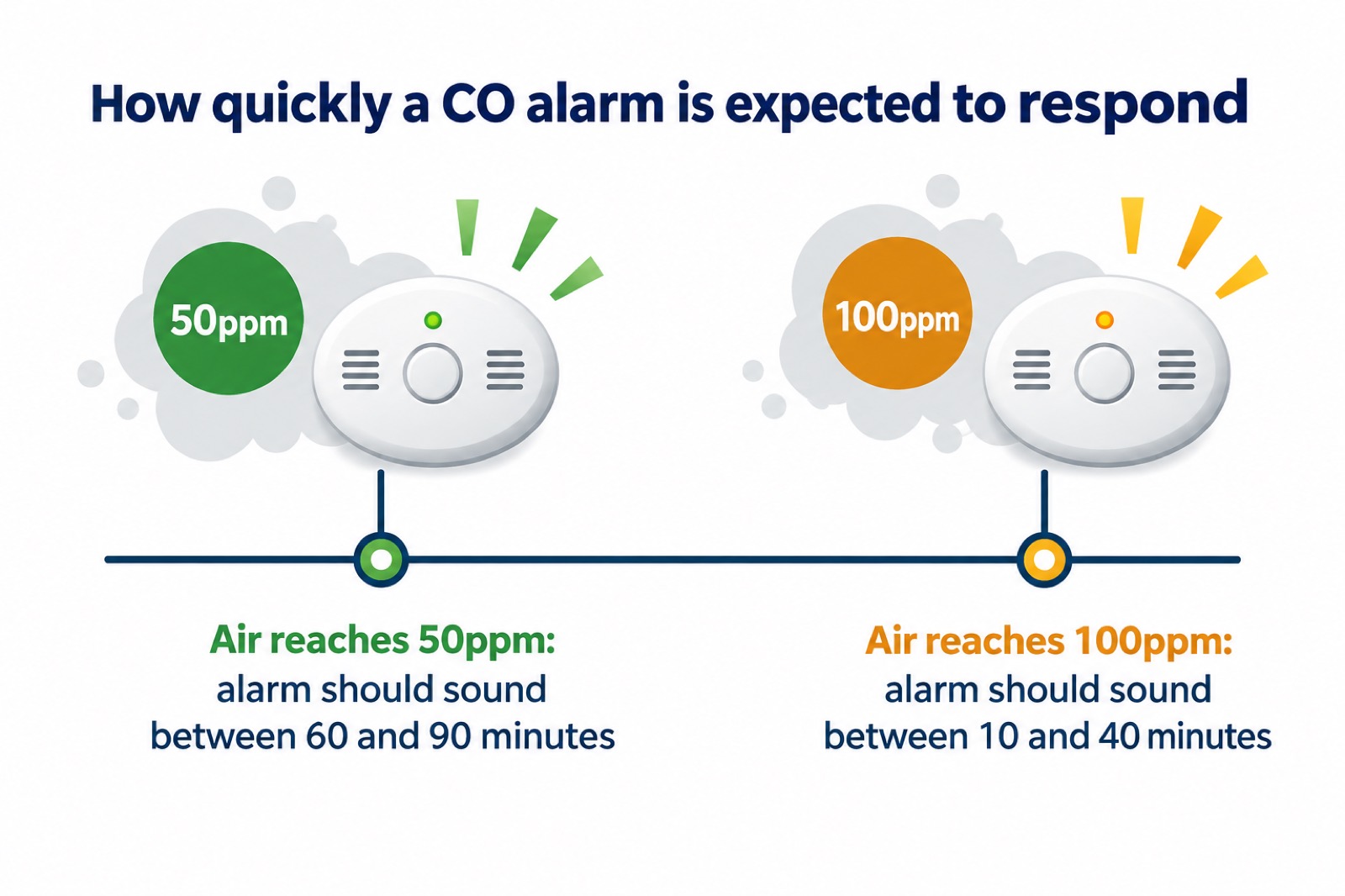
The practical consequence is that a CO alarm is a backstop, not an early warning system. As one safety body puts it, a carbon monoxide alarm will only sound at relatively high levels of CO11. It is there to catch a serious build-up, not to tell you a flue is slightly off. That is why the other defences matter: an annual service of fuel-burning appliances by a Gas Safe registered engineer, clear vents and flues, and never running a barbecue or generator indoors12.
If your alarm has sounded, or you suspect carbon monoxide for any reason, our guide to what to do if your CO alarm sounds or you suspect carbon monoxide walks through the steps in order, and carbon monoxide poisoning symptoms explains what to look for in yourself and others.
Reading the Power, Fault and Alarm lights
The unit has clear LED indicators showing its status across three states: Power, Fault and Alarm1. Independent guidance describes the same arrangement as LEDs to show when the alarm is working, faulty and sounding3. In everyday use, the power light tells you the unit is alive, the fault light tells you something is wrong with the alarm itself, and the alarm light tells you it has detected carbon monoxide.
The alarm memory feature is the one people ask about most. The listing describes a red LED alarm memory feature that indicates when a CO event has occurred1, and Kidde's support guidance explains that a red LED will flash to let you know there has been a previous CO alarm activation within the last 30 days4. This matters when you come back to a silent alarm after a day out: a flashing memory light tells you it went off while you were away, which is exactly the situation you must not ignore.
A chirp is a different signal. Independent guidance says chirping every 30 seconds is the sign that your alarm is ready to be replaced8, and the unit also provides an end of life warning when it needs replacing1. If your alarm is beeping and you are not sure which signal you are hearing, our page on why your carbon monoxide alarm is beeping separates the low battery, fault, end of life and alarm signals.
Test the unit every month5. Testing is how you find a fault before you need the alarm, and it takes seconds.
Where to fit it: head height on a wall, or freestanding
The installation position given for this model is to mount it at head height1. It can be wall-mounted or used freestanding1, and the fixing screws are included1. Head height puts the unit in the air you actually breathe and keeps it out of the way of furniture and vacuum cleaners.
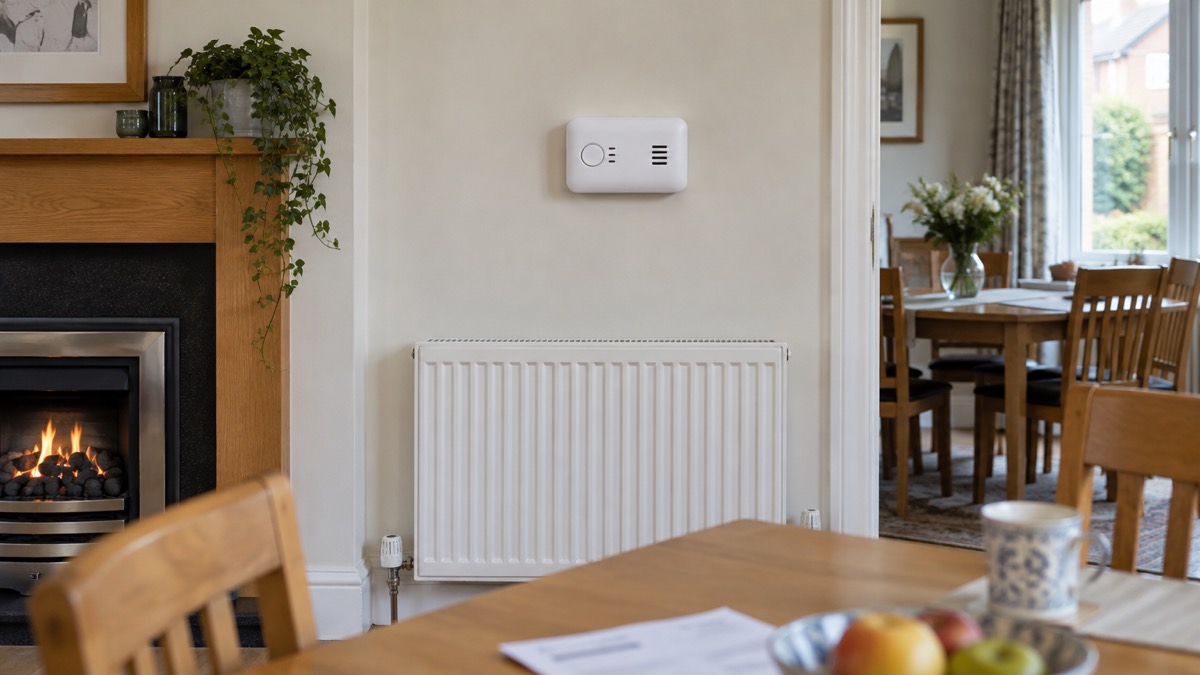
Where in the home matters as much as how high. Official guidance suggests you may wish to keep a CO alarm in the bedroom so it would wake you when sleeping6, and fitting an alarm that sounds a warning and testing it regularly is the core advice from safety organisations13. The rooms that most need one are those with a fuel-burning appliance: a boiler, a gas fire, a solid fuel stove or an open fire. Our page on where to put a carbon monoxide alarm works through room by room.
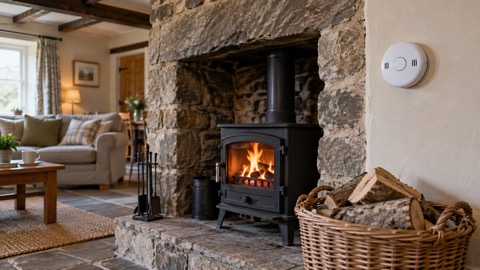
A few practical points on siting. Keep the unit away from the immediate vicinity of a cooker or a steamy bathroom, where cooking fumes and steam can trigger nuisance alarms, and do not box it in behind curtains. If you have a solid fuel stove or open fire, HETAS guidance asks for an audible alert for low battery or faults alongside the CO alarm itself, which this unit provides14. For a household with a wood burner, our guide to heating and cooking without mains power or gas covers stove safety more broadly.
Certified to BS EN 50291-1, and the rules in Scotland, Wales and Northern Ireland
The unit is Kitemarked to BS EN 50291-1: 2018 and CE and UKCA marked1. That standard is the one official and independent guidance names: buy an audible CO alarm marked BS EN 502912, and get an audible CO alarm certified to British Standard BS EN 50291-115. Scottish Government guidance states that CO detectors should comply with BS EN 5029116, and Scottish Borders Council's guidance says CO detectors must comply with BS EN 50291-1:2010+A1:201217. The listing's own standard entry is BS EN 50291-1 (Domestic)1.
The listing also records compliance with the devolved legislation: Scottish Legislation (2022), Welsh Legislation (2022) and Northern Ireland Legislation (2024)1. Those dates matter because the alarm rules differ across the UK. Scotland's rules on fire and smoke alarms, introduced in 2022, are the best known, and our guide to alarm standards, BS 5839-6 and BS EN 50291 explains how the CO standard fits alongside the smoke alarm standard. For Wales and Northern Ireland specifically, our page on Wales and Northern Ireland alarm rules and fire services sets out what each nation requires.
| Nation | What the listing records | What the guidance says |
|---|---|---|
| England | BS EN 50291-1 (Domestic)1 | Buy an audible alarm marked BS EN 502912 |
| Scotland | Scottish Legislation (2022)1 | CO detectors should comply with BS EN 5029116 |
| Wales | Welsh Legislation (2022)1 | Standard applies as for the UK1 |
| Northern Ireland | Northern Ireland Legislation (2024)1 | Standard applies as for the UK1 |
If you rent, the responsibility for fitting alarms sits with your landlord under the rules for your nation, and the standard to look for on the unit is the same wherever you live. If you are unsure whether your home has the alarms it should, our guide to whether you need a carbon monoxide alarm covers the situations that call for one.
The sealed 10-year battery: why you replace the alarm, not the battery
The K10LLCO has a sealed-in lithium battery that lasts for the full lifespan of the alarm, meaning no battery replacements1. The unit is rated for a 10-year lifespan1 and carries a 10-year warranty8. When the battery eventually dies, the alarm is replaced in its entirety rather than opened up and refilled.
That is now the mainstream approach for domestic alarms. Fire and rescue services point out that you can buy alarms with ten-year batteries, which provide peace of mind, but have to be replaced in their entirety when the battery eventually dies18, and Scottish Government guidance notes that alarms have long-life lithium batteries which can last up to 10 years19. Sealed battery alarms have a battery that will last as long as the alarm, so the battery will not need to be replaced2. For comparison, a battery-powered alarm without a sealed ten-year battery needs its battery replaced every year20.
The trade-off is straightforward. A sealed unit costs more up front than a cheap battery alarm, but you never buy batteries for it and you never have to remember to. Fire services describe ten-year sealed battery alarms as the best option for exactly this reason21, and others advise choosing alarms with a 10 year or long lasting sealed battery22. Our comparison of sealed 10-year or replaceable battery alarms sets the two approaches side by side.
When the end comes, the unit warns you: it provides an end of life warning when the alarm needs to be replaced1. Do not ignore it and do not try to keep it going. Our guide to when to replace a smoke, heat or CO alarm explains the timing, and the distributor's listing notes that the unit is covered by Valpak's WEEE Distributor Take-back Scheme for disposal1.
Looking after it: testing, cleaning and what shortens its life
The routine is short. Test the alarm every month5, and fit a carbon monoxide alarm that will sound a warning if there is carbon monoxide in the air and test it regularly13. Beyond that, keep the unit clear of dust and cobwebs, and do not paint over it or block its vents.
The operating range tells you where it can live: -10°C to +40°C and 0% to 90% relative humidity1. That covers an unheated hallway in a cold snap, which is worth knowing in a UK winter, but the listing describes the environmental suitability as home1, so treat a garage, shed or outbuilding as outside what it is sold for. If you have a fuel-burning appliance in a garage, the answer is to have it serviced and ventilated properly, not to rely on a domestic alarm in a space it was not designed for.
A few habits protect the alarm and the household:
- Have fuel-burning appliances serviced annually by a Gas Safe registered engineer, and keep vents and flues clear12.
- Never run a barbecue, camping stove or generator indoors or in a garage, even with the door open12.
- Test the alarm monthly and note the result5.
- Check the memory light after any period away, in case it sounded while you were out4.
- Replace the whole unit at end of life, when it warns you1.
If you want a wider routine, our fire safety checklist for your home and bedtime fire safety checks put the monthly test alongside the other checks worth doing.
Support, warranty and where to buy
Kidde guarantees its home range for 10 years and certifies it to EN50291-Part 123. The K10LLCO carries a 10-year warranty8. Kidde says its CO alarms can be found online and in leading independent stores as well as national retailers including Argos, Homebase, Asda, Amazon and Costco, and gives its website and phone number for product questions23. The distributor's listing records a customer rating of 4.7 out of 5 stars from 70 reviews1; that is a retailer's figure, not a safety claim.
If you are weighing this unit against others in the same range, our pages on the Kidde K10LLDCO, the Kidde K7DCO and the Kidde K5DCO set out what each does, and the Kidde K10SCO is the combined smoke and CO option. For the wider picture on CO alarms, start with carbon monoxide alarms: what they do and how to choose, and for the household view of fire and gas emergencies, see home emergencies.
The Kidde CO2 Klem Valve recall
On 12 February 2024, affected batches of the Kidde CO2 Klem Valve, made between 01/2022 and 05/2023, were recalled over the risk of detachment and CO2 discharge. Affected valves were withdrawn from the market, UK customers were sent a safety notice, and a retrofit safety guard was made available24. This is a carbon dioxide valve, not a carbon monoxide alarm, and it does not affect the K10LLCO. If you own a Klem valve, check its batch against the recall notice. Our guide to checking whether an electrical product has been recalled explains how to check any product you own.
Sources (24)
- Kidde K10LLCO product listing, Safelincs, 2026-10-29
- How to choose a carbon monoxide detector, Which?, 2026-07-14
- What to do when a carbon monoxide detector goes off, Which?, 2026-07-14
- Product FAQs, FireAngel, 2026-10-29
- Carbon monoxide alarms, Gas Safe Register
- How to install and test carbon monoxide detectors, Which?, 2026-07-14
- Unbranded carbon monoxide alarm review, Which?, 2026-07-14
- Carbon monoxide symptoms, Which?, 2026-07-14
- How we test carbon monoxide detectors, Which?, 2026-07-14
- Five ways to avoid a carbon monoxide build-up, Which?, 2026-07-14
- Insurers urge travellers to pack carbon monoxide alarms, CO-Gas Safety, 2025-09-22
- Home gas safety tips, Gas Safe Register
- Autumn safety, CAPT, 2026-10-08
- Carbon monoxide leaflet, HETAS, 2025-03-22
- Carbon monoxide: tenants, RoSPA, 2026-10-26
- Tolerable Standard guidance: satisfactory fire and carbon monoxide detection, Scottish Government, 2023-06
- Carbon monoxide detectors: governmental guidance, Scottish Borders Council, 2015-06-25
- Smoke alarms, Dorset and Wiltshire Fire and Rescue Service, 2026-02-17
- Fire and smoke alarms in Scottish homes: where and what to buy, Scottish Government, 2024-08-14
- Home safety quiz, Independent Age, 2026
- Fire alarms and carbon monoxide detectors, Lincolnshire County Council, 2026-10-29
- Detectors, Surrey County Council, 2026-10-28
- Carbon monoxide alarms, CO-Gas Safety, 2024-02-18
- Product safety report: Kidde CO2 Klem Valve, Office for Product Safety and Standards, 2024-02-12
 FireAngel FA3313 CO Alarm
 FireAngel FA3322 CO Alarm
 FireAngel FA3820 CO Alarm
 FireAngel FA6812 CO Alarm
 FireAngel FA6813 CO Alarm
 FireAngel FA6829S CO Alarm
 FireAngel CW1-PF CO Alarm
 FireAngel W2-CO-10X CO Alarm
 FireAngel FP1820W2-R CO Alarm
 Kidde K7DCO CO Alarm
 Kidde K5DCO CO Alarm
 Kidde K10LLDCO CO Alarm