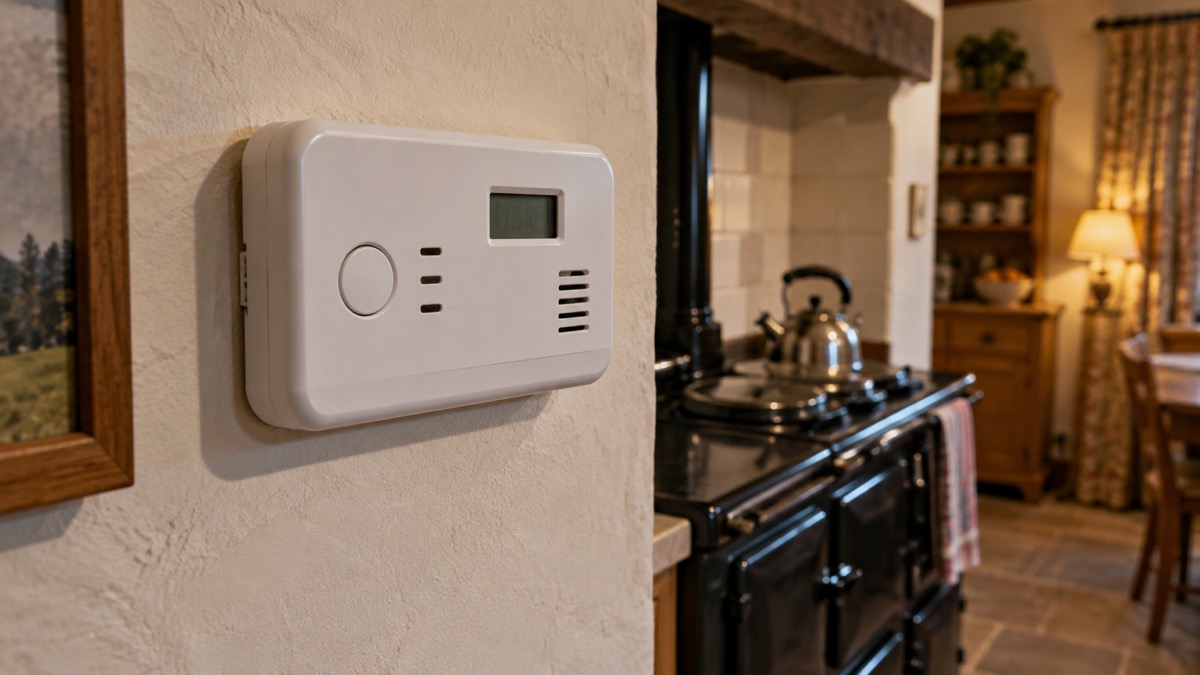
The Kidde K7DCO is a battery-powered carbon monoxide alarm with a digital display. It runs on two AA batteries, sounds an 85dB alarm from 50ppm of carbon monoxide, and shows CO levels on its screen from 11ppm, checking the air every 15 seconds1. It can be wall mounted with the screws supplied or stood free-standing, and it is listed as suitable for caravans, camping and boats as well as the home1.
If you are thinking of buying one, the things that decide it are the display, the replaceable AA batteries and the 10 year product life. If you already own one, the things that matter are testing it, changing the batteries when it chirps, and replacing it at the end of its life rather than waiting for it to fail1.
One point to clear up first: the Kidde CO2 Klem valve recall does not involve this alarm. It was a separate product, and owners of affected valves were sent a safety notice and offered a retrofit safety guard. Details are below.
What the K7DCO does and who it suits
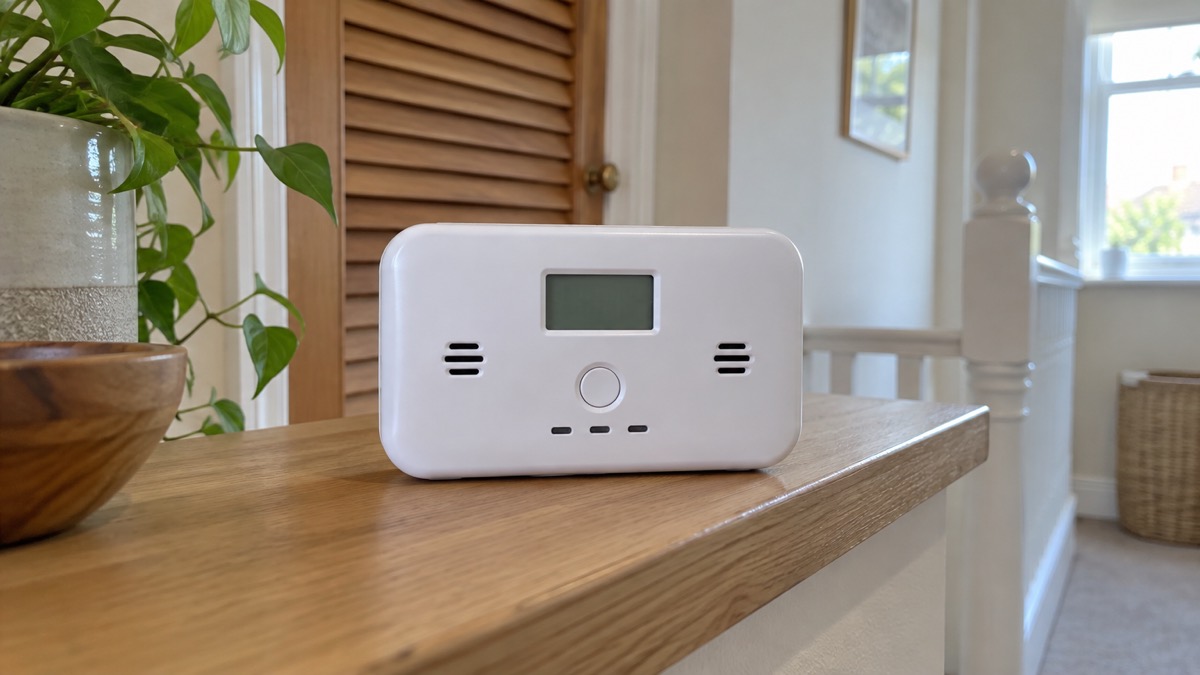
A carbon monoxide alarm is not a smoke alarm and does not replace one. It watches for carbon monoxide, a gas you cannot see, smell or taste, produced by fuel-burning appliances that are faulty, badly ventilated or blocked3. The K7DCO is a standalone unit: it is not wired into the mains and does not link to other alarms1.
What sets it apart from a basic alarm is the screen. Digital display models show real-time CO levels, letting you spot rising concentrations before the alarm triggers3. That matters because carbon monoxide builds up gradually. A number climbing on the display gives you time to act before the 85dB sounder goes off1.
It suits a household that wants to see what the air is doing, and that is happy to change two AA batteries when told to. It also suits a caravan, boat or tent, because it is battery powered and free-standing1. It does not suit anyone who wants a sealed unit they never touch: for that, Kidde makes models with sealed-in lithium batteries that last the full 10 year life2.
All certified CO alarms run regular self-tests of their battery, circuitry and sensor, and are designed to let you know when there is a problem4. The K7DCO adds an end of life warning signal that alerts you when the alarm needs replacing1.
Specifications
| Feature | Kidde K7DCO |
|---|---|
| Type | Carbon monoxide alarm, standalone1 |
| Sensor | Electro-chemical, 10 year lifespan1 |
| Display | Digital, shows CO from 11ppm1 |
| Detection level | From 11ppm1 |
| Alarm level | From 50ppm, 85dB1 |
| Sensitivity | 30ppm1 |
| Measurement interval | Every 15 seconds1 |
| Power | 2 x AA batteries, included1 |
| Low battery warning | Chirp and display message1 |
| End of life warning | The display shows the word "end" and the alarm bleeps periodically to say it has expired1 |
| Fixing | Screws included; wall mounted or free-standing1 |
| Size | 119mm wide, 72mm high, 39mm deep1 |
| Weight | 250g1 |
| Operating temperature | +4°C to +38°C1 |
| Relative humidity | 10% to 95%1 |
| Environmental suitability | Caravan, camping and boats1 |
| Certification | NCC approved for caravans and boats1 |
| Warranty and life | 10 years each1 |
The retailer lists a customer rating of 4.7 out of 5 stars from 75 reviews1. A second retailer listing gives 4.8 out of 5 stars from 86 reviews; the two listings disagree, so treat ratings as a snapshot rather than a fixed figure1.
Detection and alarm levels: readings from 11ppm, alarm from 50ppm
The K7DCO starts showing a number at 11ppm and sounds its alarm from 50ppm1. Those two thresholds do different jobs. The display is an early warning: it lets you see carbon monoxide arriving before the concentration is high enough to trigger the sounder3. The alarm is the point at which you must act.
How quickly an alarm should respond at 50ppm is set by the standard, not the maker. Independent testing guidance says that at 50ppm, alarms should sound between 60 and 90 minutes5. That is not a fault in the alarm: it is how certified alarms are designed, so that they do not shriek every time a little carbon monoxide appears from a cooker. It also means you should never wait for the alarm before acting on a rising display reading.
For context, Aico, another alarm maker, describes its alarms as detecting abnormal gas levels from 50ppm and progressively alerting as levels reach 100ppm and 300ppm7. The K7DCO's own listing gives the alarm level as 50ppm and its sensitivity as 30ppm1.
Independent testing also exposes alarms to a very high concentration of CO, 5,000ppm, to see whether they detect the gas and continue to work6. That is a test laboratory figure, not something a household should ever encounter.
Display, lights and the Test/Reset button
The K7DCO has a Test/Reset button and a digital display to allow simple verification of alarm operation1. Pressing it checks the alarm is working; the display then shows you what the sensor is reading.
Test it regularly. The maker's own instructions are to use the Test/Reset button and digital display to verify that the alarm operates1. If the alarm has been silent for a long time, that is not proof it is working.
The display is also how the alarm talks to you between alarms. When the batteries run low, a warning chirp and a digital display message indicate it1. Most modern carbon monoxide alarms have a low battery notification, which could be an audible beep or a flashing light on the device8. On the K7DCO you get both a sound and words on the screen.
If the unit reaches the end of its life, an audible warning signal tells you it needs replacing1. Do not ignore that one: it means the sensor has done its work.
Power: two AA batteries and the low battery warning
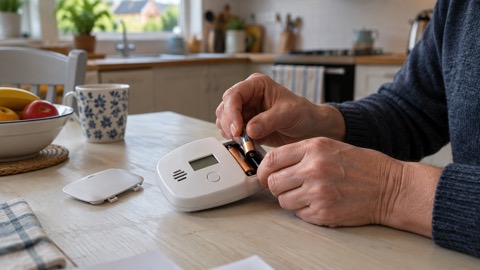
The K7DCO takes 2 x AA batteries, and they are included1. That is worth knowing because packaging on some units is marked as excluding batteries; check the box before you rely on it, and fit fresh AA cells if none are inside.
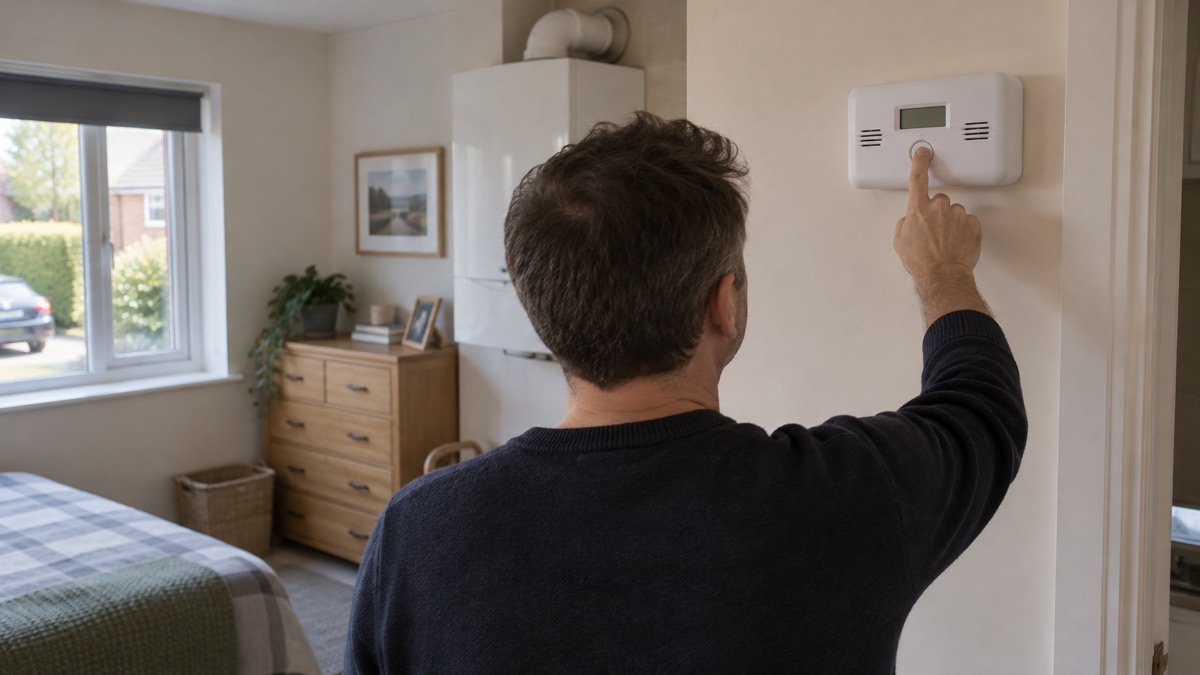
When the batteries run down, the alarm chirps and the display tells you1. Fire and rescue services give the same advice for smoke alarms: if it beeps every minute or so this could be a low battery warning, and you should replace the battery as soon as possible9. The same discipline applies here. A chirping CO alarm is a working alarm telling you it is about to stop working.
Change the batteries promptly, and do not wait for the chirp to become a silence. Keep a spare pair of AA batteries with your household emergency kit so a replacement is always to hand.
Button batteries are a separate hazard in the home. Child-resistant packaging with scissor-only opening makes it almost impossible for little fingers to open the packet and get into new button batteries11. There is no requirement to place a warning on the packaging highlighting the serious consequences for a small child of swallowing a lithium coin cell battery12, so store spare cells out of reach.
Fitting it on a wall or standing it free
The K7DCO can be wall mounted or used free-standing for flexible installation, and screws are included1. That gives you two ways to place it, and the right one depends on where you need it.
Wall mounting suits a permanent position near a fuel-burning appliance or in a bedroom. Free-standing suits a bedside table, a caravan shelf or a tent, where you want the alarm close to where people sleep and can move it as needed. Wherever it goes, the principle from official guidance on making safety equipment visible is sound: consider mounting it on a wall or in a cabinet so it is visible and easy to access by any person13.
Where to put a carbon monoxide alarm is covered in full on our page on where to put a carbon monoxide alarm. The short version: near sleeping areas and near the appliance, following the maker's instructions, and not in a dead corner where air does not circulate.
If you are replacing an older 7DCO, do not assume the new unit clips onto the old baseplate. The K7DCO is a standalone alarm1, and the product information does not confirm baseplate compatibility. Use the screws supplied, or stand it free, and check with Kidde if you want to reuse an existing fixing.
Use in caravans, boats and on camping trips
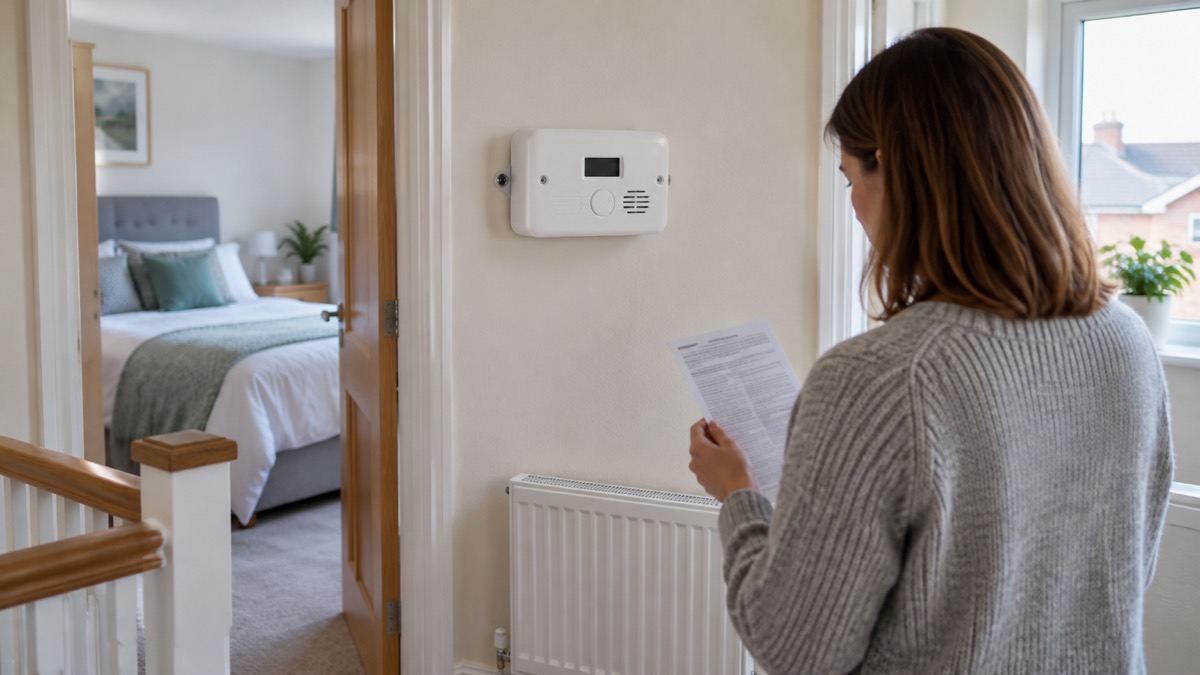
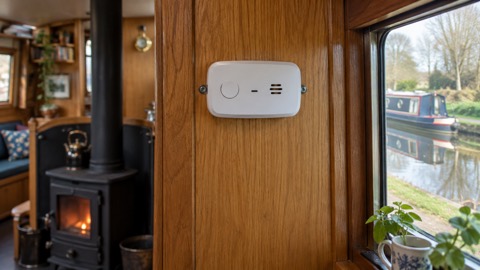
The K7DCO is listed as suitable for caravans, camping and boats, and as NCC approved for use in caravans and boats1. That makes it one of the few places a battery CO alarm earns its keep outside the house.
Caravans and mobile homes carry real risk. Fire and rescue guidance for caravans and mobile homes says to make sure the heaters work properly, and to take extra care when cooking with hot oil14. Butane is used mainly in cylinders for portable applications in mobile heaters in the home, and for leisure activities such as boats, caravans and barbecues15. Any of those can produce carbon monoxide if something goes wrong.
Keep cylinders outside your caravan16. If you use a camping stove or portable gas stove, you should use these outdoors17. A gas fired camping stove tucked away for power cuts can be useful, but only outdoors18.
The K7DCO's operating range matters here. It works from +4°C to +38°C and 10% to 95% humidity1. A cold caravan in early spring, or a damp boat cabin, may sit outside that range, and an alarm that is too cold may not work as intended. Bring it into the living space and let it settle before you rely on it.
Where it works: temperature and humidity limits
The K7DCO is rated for +4°C to +38°C and 10% to 95% relative humidity1. Those are ordinary indoor conditions, and they tell you where not to put it. An unheated garage in winter, a shed, a loft or an outbuilding can drop below +4°C, and a bathroom or a damp cellar can push humidity to the top of the range.
For comparison, Aico's Deaf and Hard of Hearing Module is rated for normal operating and storage at 15% to 95% relative humidity19. Different products have different limits, so always check the maker's figure for the unit you own rather than assuming.
If you move the alarm between house and caravan, let it adjust. A unit carried from a warm house into a cold caravan may read oddly until it settles. Keep it within its stated range and it will do what it says.
The Kidde CO2 Klem valve recall
The Kidde CO2 Klem valve was recalled over a risk of detachment and CO2 discharge. Affected batches, made between 01/2022 and 05/2023, were withdrawn from the market, UK customers were sent a safety notice, and a retrofit safety guard was made available.
This is not the K7DCO. The Klem valve is a CO2 product, not a carbon monoxide alarm, and the recall does not affect the alarm described on this page. If you own a Klem valve, follow the safety notice that came with it and fit the retrofit guard as instructed. If you are unsure whether a product you own is affected, check our guide to product recalls.
Support, warranty and recycling
The K7DCO is listed with a 10 year warranty and a 10 year product life, and its sensor has a 10 year lifespan1. Kidde's carbon monoxide alarms are described as fully certified by BSI to EN50291-Part 1 and guaranteed for 10 years2. The brand's wider range includes models with sealed-in lithium batteries that last the full 10 year life, hard-wired inter-connectable alarms, and a Lifesaver branded model guaranteed for 7 years2.
Kidde says its CO alarms can be found online and in leading independent stores as well as national retailers, and gives its website and a contact number for support2. Keep your receipt or order confirmation: a 10 year warranty is only useful if you can show when you bought it.
At the end of life, do not simply bin it. Some but not all types of alarms can be recycled at recycling centres; look on the alarm for information or check with the manufacturer20. The K7DCO is listed under Valpak's WEEE Distributor Take-back Scheme1, so ask the retailer about take-back when you replace it. CO alarms should be replaced before their expiry date21, and the K7DCO's own end of life warning will tell you when that point is near1.
Rules differ across the UK
Alarm rules are not identical in England, Scotland, Wales and Northern Ireland. The K7DCO is listed as meeting Welsh Legislation (2022)1, and Wales has its own rented housing rules: from 1 December, housing law is changing under Renting Homes Wales guidance8. If you rent out a property in Wales, check the current guidance rather than relying on a product listing.
In Scotland, statutory guidance for the provision of carbon monoxide alarms in private rented housing set expectations for landlords, with CO detection to be installed by 1 December 201522. In England, Awaab's Law will be extended to the Private Rented Sector, setting clear, legally enforceable timeframes within which landlords must make homes safe where they contain serious hazards23.
For the detail by nation, see our pages on Wales and Northern Ireland alarm rules and carbon monoxide alarms: what they do and how to choose. If you are a tenant with a concern about your home, most private sector rented housing issues are dealt with by the council's housing team24.
Sources (24)
- 10 Year Digital Carbon Monoxide Alarm - Kidde K7DCO, Safelincs, 2026-10-29
- Carbon monoxide alarms, CO-Gas Safety, 2024-02-18
- Carbon monoxide safety, FireAngel, 2026-07-31
- Top 5 carbon monoxide alarm tips for winter, Which?, 2020-12-18
- How to choose a carbon monoxide detector, Which?, 2026-07-14
- How to install and test carbon monoxide detectors, Which?, 2026-07-14
- Products FAQs, Aico, 2026
- Carbon monoxide alarms, Gas Safe Register, 2026-10-29
- Smoke alarms, Devon and Somerset Fire and Rescue Service, 2026-02-17
- E-bike conversion kits fire risks and safety advice, London Fire Brigade, 2026-10-25
- New button battery safety features, CAPT, 2026-10-21
- Recommendations on button batteries, CAPT, 2023-03-27
- First aid provisions, ProtectUK, 2026-06-01
- Caravans and mobile homes, Devon and Somerset Fire and Rescue Service, 2026
- What's the difference between propane and butane, Liquid Gas UK, 2026-10-25
- Caravan fire safety, Mid and West Wales Fire and Rescue Service, 2023
- Prepare for a power cut, Citizens Advice, 2023-11-14
- What to do in a power cut, Which?, 2026-06-04
- Ei170RF and Ei171RF instructions, Aico, 2021-06
- Installation of alarms, Scottish Government, 2024-08-14
- CO leaflet, HETAS, 2025
- Carbon monoxide detectors governmental guidance, Scottish Borders Council, 2015-06-25
- Cross government group 2024-2025, Health and Safety Executive, 2026-04
- Fire safety in rented accommodation, Cornwall Council, 2026-10-29
 FireAngel FA3313 CO Alarm
 FireAngel FA3322 CO Alarm
 FireAngel FA3820 CO Alarm
 FireAngel FA6812 CO Alarm
 FireAngel FA6813 CO Alarm
 FireAngel FA6829S CO Alarm
 FireAngel CW1-PF CO Alarm
 FireAngel W2-CO-10X CO Alarm
 FireAngel FP1820W2-R CO Alarm
 Kidde K5DCO CO Alarm
 Kidde K10LLDCO CO Alarm
 Kidde K10LLCO CO Alarm