Button batteries, the small coin cells that power key fobs, remote controls, hearing aids and many small torches, are one of the most dangerous things in an ordinary home. If a child swallows one and it sticks in their food pipe, it can burn through the tissue and cause life-altering injuries or death, and you might not know it has happened until it is too late1. The risk is not only from new cells: even used "flat" batteries still hold enough charge to be dangerous2.
The good news is that the fix is simple and takes a few minutes. Keep spare button batteries in a sealed container in a high cupboard, well out of children's reach, and do the same with flat ones until you can recycle them3. Check new packets for loose spares before a child finds them, and never put any battery in the household rubbish5.
This page sets out where button cells hide, how to store and dispose of them, how to keep your emergency torch and its spares safe, and what to do if you think a child has swallowed one.
Where button batteries hide, and why spares matter
Button cells are in more places than most people expect. Official NHS advice lists hearing aids, car keys, remote controls, weighing scales, musical greeting cards and some toys11. That means the risk is not confined to a torch drawer: it is in handbags, on bedside tables and in the kitchen.
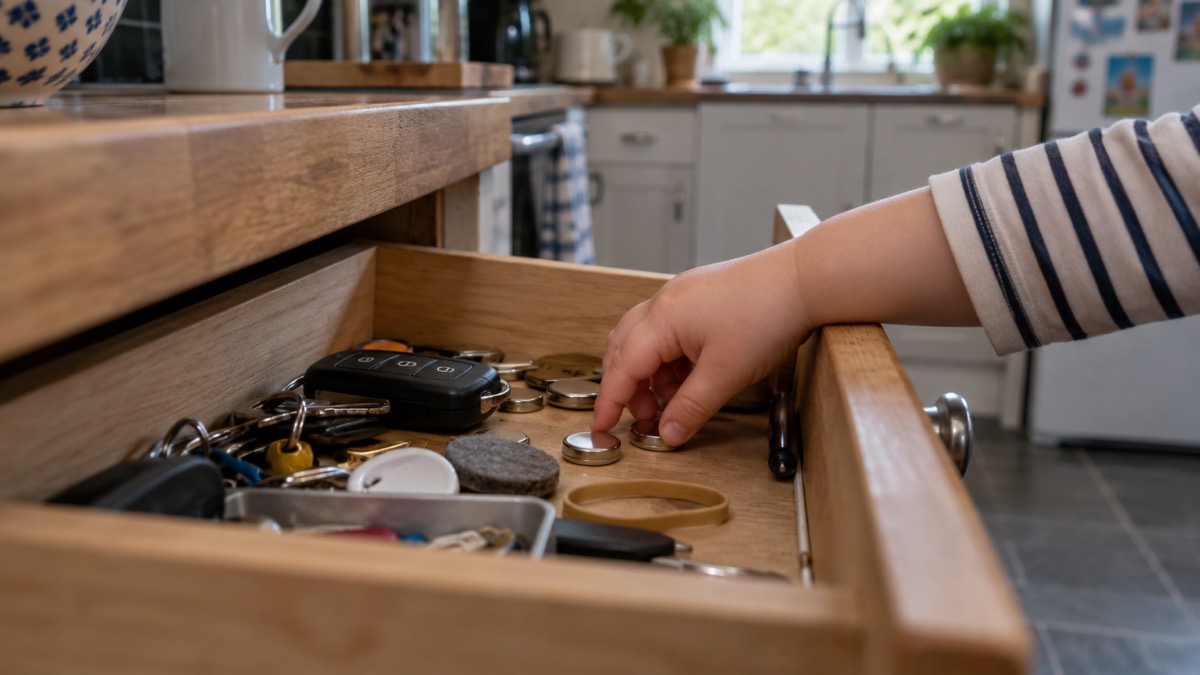
The most common route to a swallowing is a spare cell that has escaped its packaging. Small children often find spare button batteries in a drawer or used batteries that have not been disposed of yet12. They also find them on the floor after a packet spills open13. Some packets are worse than others: with cheaper packs, once you open them all the batteries come out, so spares end up stored in open containers or loose in a drawer8.
The harm is fast and severe. If a child swallows a button battery it can get stuck in their food pipe, burn through to the main artery and badly harm or even kill them, and this can happen very quickly4. Smaller button batteries can still cause harm, especially if they are new2. A case reported by a safety charity involved a 3-year-old boy who swallowed a "flat" button battery from some weighing scales while it was being replaced with a new one; it was removed within 3 to 4 hours but caused a nasty burn of his oesophagus12.
Store spares in a sealed container in a high cupboard
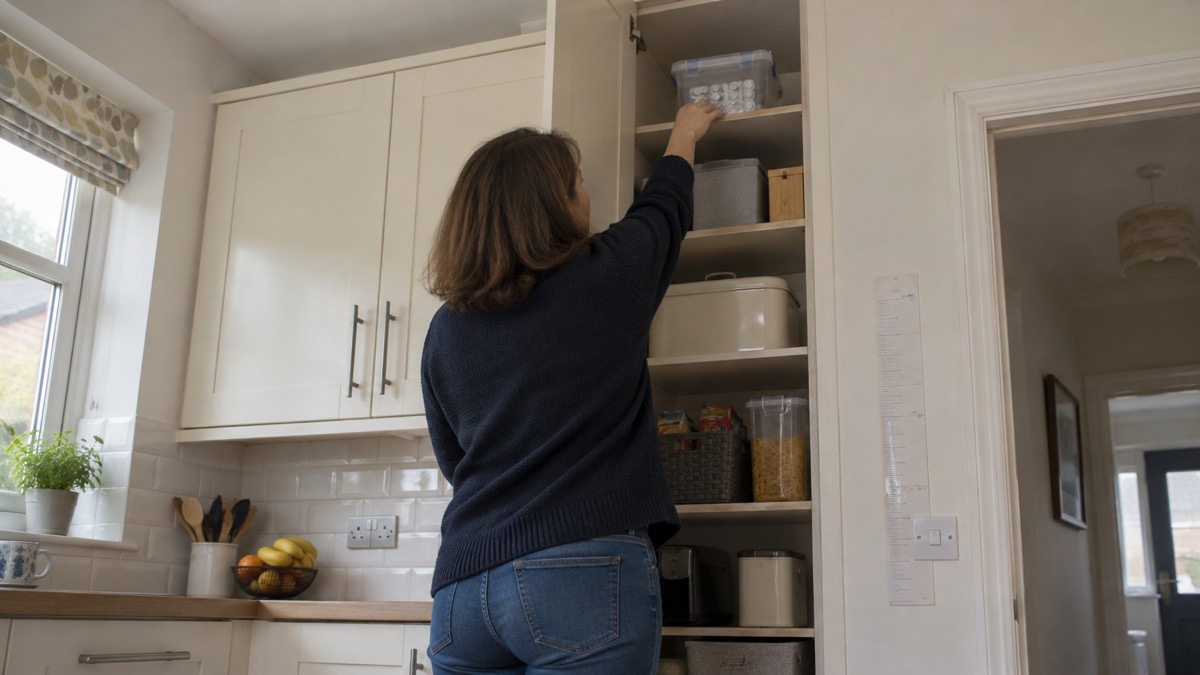
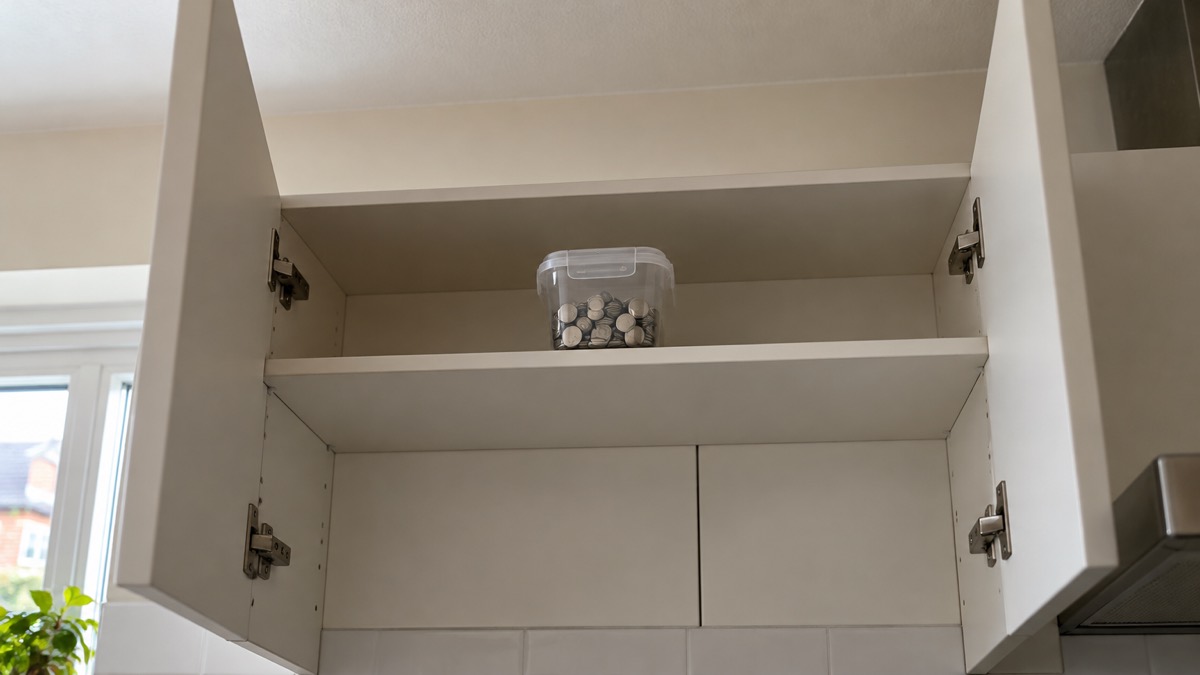
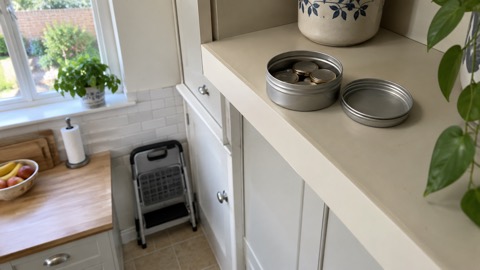
The core habit is straightforward. Check packaging for spare button batteries that could be easily swallowed, and store them, with any others you have in stock, in a sealed container in a high cupboard, well out of children's reach3. "Sealed" matters: a container a child can flip open is no better than a drawer. A screw-top jar or a clip-lock box that stays shut when dropped is the aim.
Keep the container where an adult can reach it but a child cannot, and treat it as a fixed home for every coin cell in the house, not just the ones bought for a torch. When you change a battery in a remote, a key fob or a toy, the new cell comes out of the container and the old one goes back into it, so nothing is left loose on a worktop.
Where spare batteries must never go
Loose cells in a drawer or on a surface are the single most common way a child gets hold of one12. The rule is simple: no button battery is ever left loose, even for a few minutes while you fetch a screwdriver.
- Not loose in a drawer. Never put loose batteries in your pocket, or leave them in purses, bags or even drawers in your home7.
- Not in a handbag or coat pocket. A spare in a bag travels into other homes and cars.
- Not in the household rubbish. Never place loose batteries or electrical items, including those containing batteries, in general waste bins6. Batteries of all kinds, whether loose or hidden in electricals, should never be binned, always recycled8.
There is a second reason to keep cells out of drawers and surfaces: fire. Batteries can be damaged or crushed during waste collection and processing, which can start fires in bin lorries and waste centres14. Fire and rescue services across the UK have warned about the number of battery fires in bin lorries and waste sites15.
Check new packaging before a child does
When a new pack of coin cells comes into the house, open it over a tray or a table, not over the floor, and count what is inside. Some packs hold spares in a separate compartment or a blister that splits; others release every cell at once8. Tip the whole pack into your sealed container in one go, then check the packaging and the floor for anything that escaped.
Do the same when you change a battery in a device. The old cell is as dangerous as a new one, so it goes straight into the container rather than onto the side. If a packet spills, get down to floor level and check under furniture and along skirting boards before a child does.
Used and flat batteries: keep them out of reach until you dispose of them
A flat battery is not a safe battery. Even used "flat" batteries still hold enough charge to be dangerous2. Modern products are power-hungry, so a battery too flat for the device still holds a harmful charge5. A used button battery can burn through a young child's food pipe if it is swallowed and it gets stuck5.
Official NHS advice is to store spare and "flat" batteries well out of reach too4. Electrical Safety First says even used batteries that have run out of charge remain a risk, so keep them away from children and dispose of them safely17. The charity behind much of the UK's button battery safety work recommends keeping used "flat" batteries well out of children's reach, high up in a sealed container, and recycling them as soon as you can3.
In practice, that means a second sealed container, or a compartment in the same one, for dead cells, kept high up and emptied often. Do not let flat cells accumulate in a drawer "to deal with later": the longer they sit within reach, the greater the chance a child finds one.
Dispose of dead batteries straightaway
When a battery has died, dispose of it safely straight away; do not store them up to dispose of in one go18. Batteries should go into special disposal containers in your local area, not the household rubbish, and many supermarkets have battery disposal bins; check your council's website for your nearest one18.
There are several easy routes, and any of them is better than the bin:
- Supermarket collection points. Many supermarkets have battery disposal bins18. A practical routine is to put used batteries in a box kept up high, take the box when you pick up your shopping bags, and pop them in the battery recycling bin at the supermarket5.
- Designated recycling points and retailers. Take unwanted batteries to a designated battery recycling point, a household waste recycling centre or a participating retailer14.
- Kerbside where offered. Some councils collect batteries: use designated battery and vape recycling points, often in supermarkets, or place them in a small, clear tied bag and leave it on top of your recycling boxes for kerbside collection19.
- A dedicated bag by the door. Set aside a bag just for batteries, and each time you remove a battery from a gadget, put it in the bag ready to take to a recycling point, or to be collected if your local council provides this service20.
Torches in your emergency kit: storing their spare batteries safely
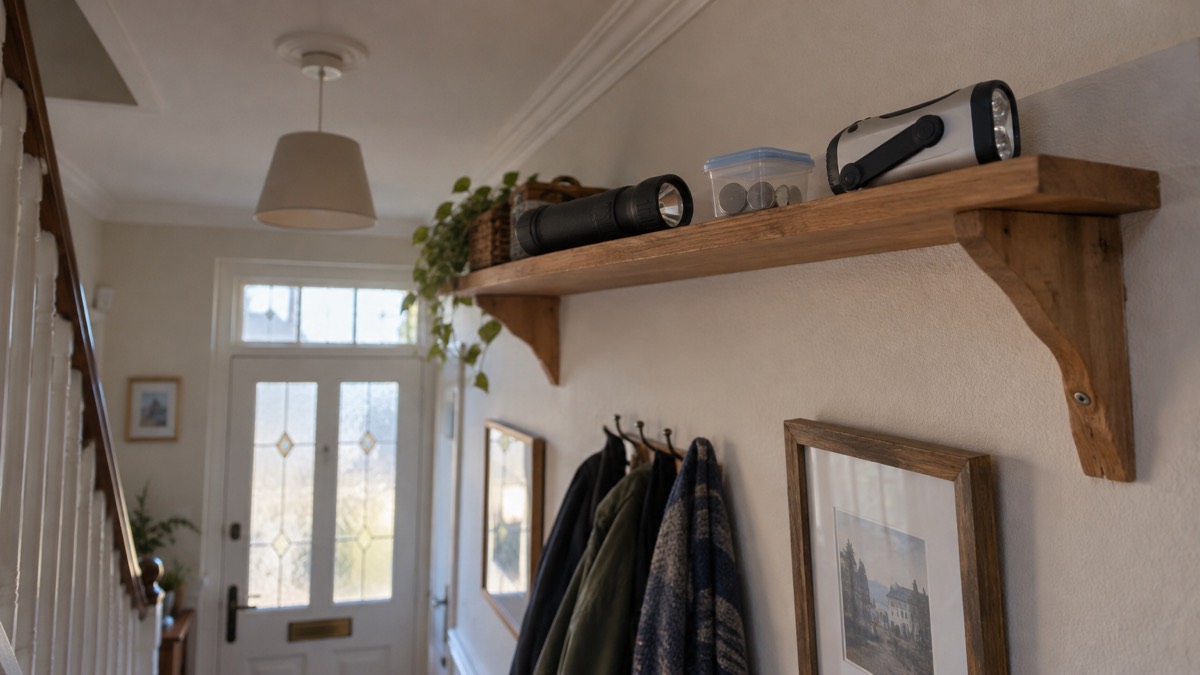
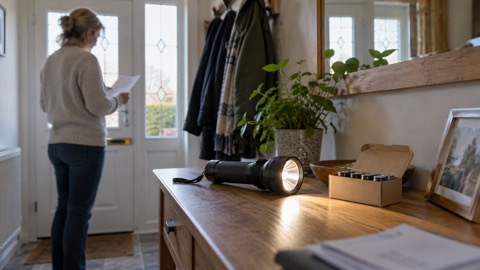
A torch is one of the basics of a home emergency kit. Official guidance for power cuts says to keep a battery or wind-up torch and spare batteries at home, and that torches are safer than candles9. The same advice appears in the UK Government's "Prepare" campaign21, in Scotland's "Ready Scotland" emergency kit list22, and in Wales, where winter-ready guidance says to store a battery or wind-up torch somewhere you can access easily so you can check the fuse box and make your way around the house safely23.
If your torch takes coin cells, its spares need the same treatment as any other button battery: sealed container, high cupboard, out of reach. If it takes AA or AAA cells, the swallowing risk is lower but not zero, and the same storage habit works. For a fuller look at cell types, see Torch Batteries: AA, AAA, 18650 and Built-In Packs.
| Torch type | Spare cells to store | What to watch |
|---|---|---|
| Battery torch, coin cell | Button cells in a sealed container, high up3 | Swallowing risk from loose or flat cells4 |
| Battery torch, AA or AAA | Spare cells in a sealed container, high up3 | Keep out of children's reach; recycle dead cells18 |
| Wind-up torch | None needed9 | No battery swallowing risk from the torch itself |
Whichever you choose, keep the torch with spare batteries in an accessible location24, and make sure everyone in your home knows where these are kept, so the nearest person can retrieve them and then safely help others10. Keep the torch itself out of children's reach, and store its spare cells separately in the sealed container. For more on choosing between the two, see Rechargeable or Battery Torches for Emergencies and Torches: Types and How to Choose One for Home.
If you think a child has swallowed a button battery
Act immediately. If your child swallows a button battery or magnet, or you think they may have swallowed one, call 999 or take them to A&E straight away7. Tell the doctor you think your child has swallowed a button battery4. Do not make them sick8.
Symptoms may not be obvious, or can seem like a tummy bug or cough, and young children may not be able to say they swallowed something5. That is why the response is the same whether or not you are sure: a swallowed button battery can badly hurt or kill a small child25.
"If your child swallows a button battery, it can get stuck in their food pipe. It can burn through to the main artery and badly harm or even kill them. This can happen very quickly."
Sources (25)
- Autumn safety, CAPT, 2026-10-08
- 2024 CAPT button battery factsheet, City of London Corporation, 2024
- Be aware of button battery risks this Christmas, CAPT, 2023-03-27
- Button battery safety notice, Wrightington, Wigan and Leigh Teaching Hospitals NHS Foundation Trust, 2026-10-25
- Are your used batteries really flat?, CAPT, 2026-04-15
- Lithium-ion batteries, National Fire Chiefs Council, 2026-10-09
- What to do if your child has an accident, NHS, 2025-12-18
- All I want this Christmas is for my child to be safe from button batteries, CAPT, 2023-03-27
- Be informed about hazards: power cuts, UK Government Prepare campaign, 2026-10-21
- 12 tips to prepare for a power cut, Horsted Keynes Parish Council, 2026
- Swallowed something, Alder Hey Children's NHS Foundation Trust, 2025-09-25
- Store button batteries safely, CAPT, 2025-08-04
- Check for loose button batteries, CAPT, 2024-11-11
- Residents urged to think before binning batteries, Devon and Somerset Fire and Rescue Service, 2026-07-23
- Over 1,200 battery fires in bin lorries and waste sites across the UK in last year, National Fire Chiefs Council, 2024-05-10
- 2024 CAPT button battery factsheet, CAPT, 2024
- New parents, Electrical Safety First, 2026-10-25
- Button batteries: using them safely, Great Ormond Street Hospital, 2018-10-01
- Recycle your electricals campaign, North Yorkshire Fire and Rescue Service, 2024-05-01
- E-bikes and e-scooters, South Wales Fire and Rescue Service, 2026-07-29
- Be informed about hazards: power cuts, UK Government Be Ready campaign, 2026-10-21
- Emergency kit, Ready Scotland, 2026-10-22
- Winter ready, Isle of Anglesey County Council, 2026-10-25
- Be prepared, Northern Powergrid, 2026-10-26
- Button battery safety, CAPT, 2025-11-17
 Spare Batteries for Lights
 Candle Safety Checklist
 Lighting Checks Before Winter
 Can Jar Candles Shatter
 Battery Tea Lights in a Pumpkin
 Keeping Pets Away from Candles
 Finding Torches in the Dark
 Red Light Mode on a Head Torch
 SOS and Strobe Modes
 IPX Ratings for Torches
 Torch Battery Runtime
 Camping Lantern Run Time
 Using a Torch While Charging
 Looking Into a Bright Torch
 Flat Button Battery Dangers