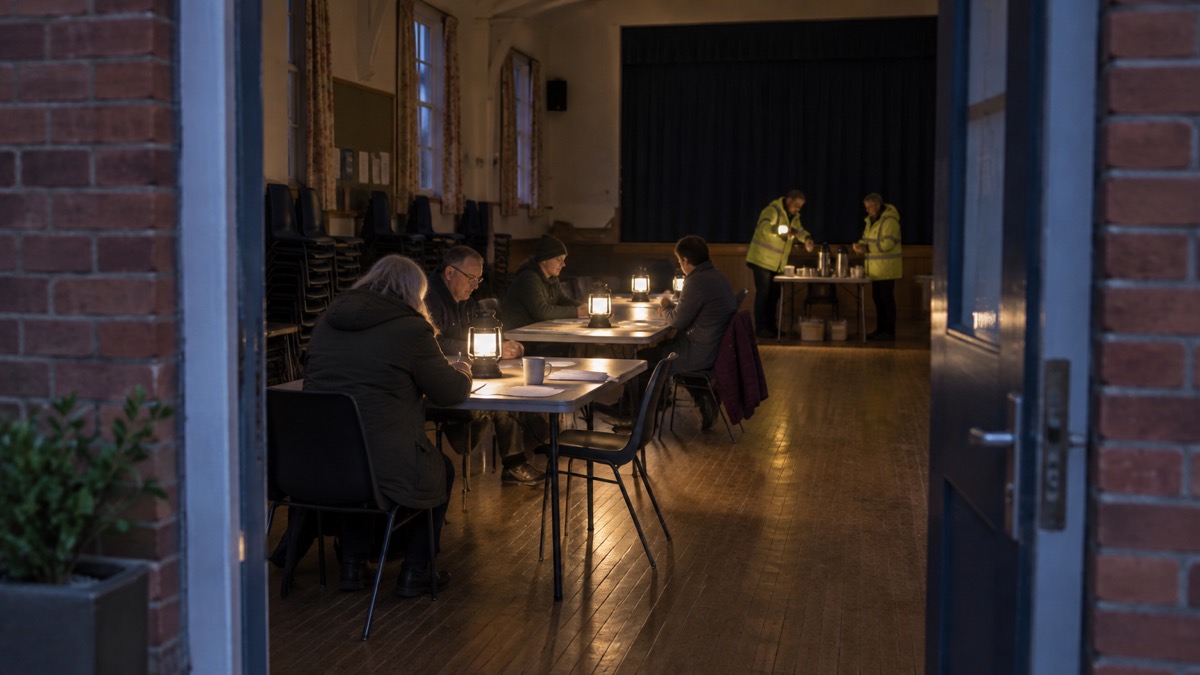
A camping lantern will run for anything from a couple of hours to several days in a power cut, and the difference is almost entirely down to two things: the battery inside it and the brightness setting you choose. On its highest setting, the Coleman 360 Sound and Light Lantern gives up to seven hours of light1. On its lowest, the Black Diamond Orbiter 450 runs for 120 hours, against 2 hours on high2. The same lantern can be a two hour light or a five day light depending on which button you press.
That is the single most useful thing to know before an outage. Most power cuts do not last very long3, so a lantern on a bright setting will usually see you through an evening. But if the power stays off, or you are lighting a room for several nights, the setting you choose on the first evening decides whether the lantern is still working on the third.
This page sets out what run times actually mean, how to make one lantern last, why a battery lantern is the safer choice over candles, and how to charge and store it so it works when you reach for it.
What a lantern's run time figure actually tells you
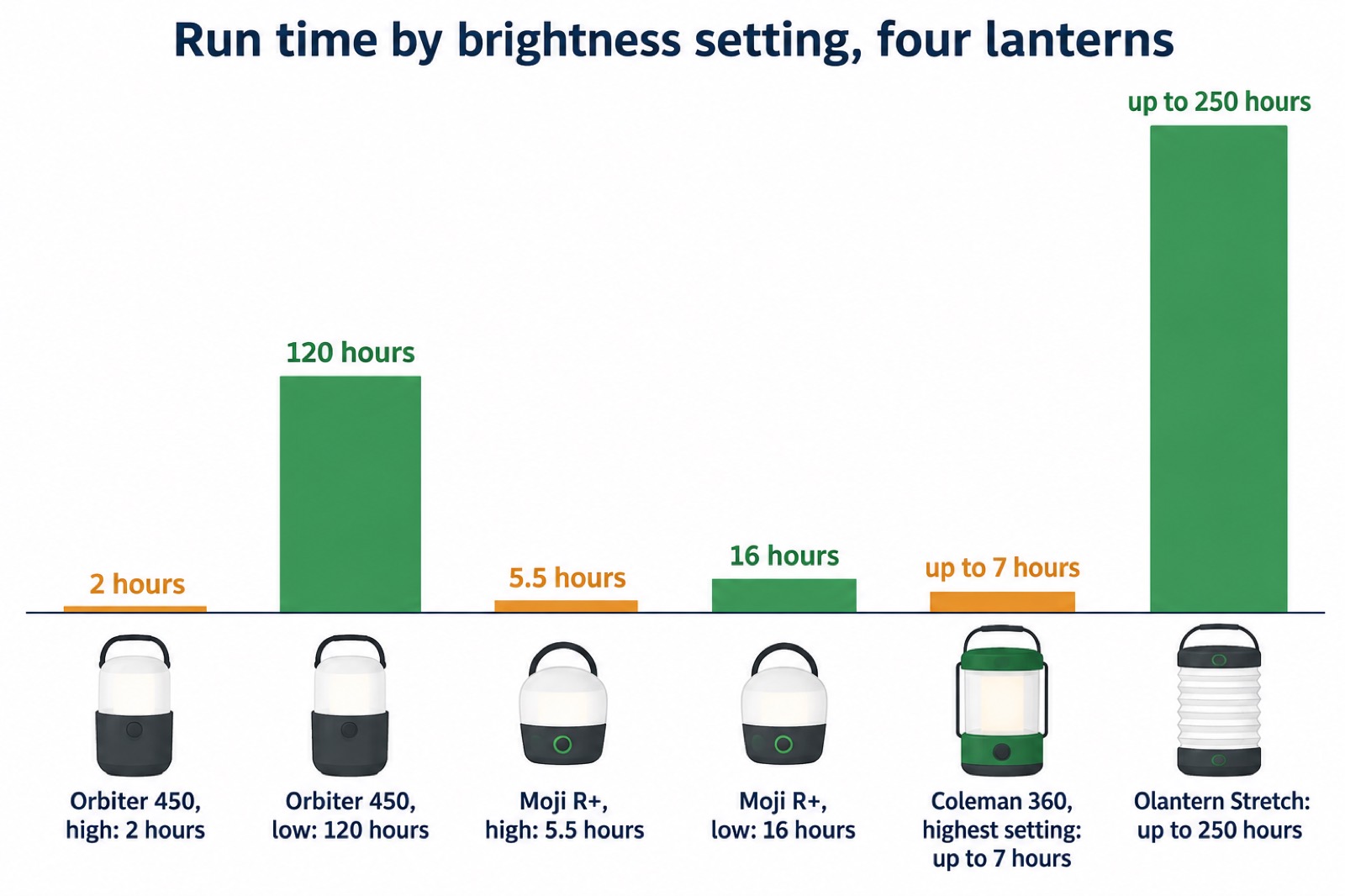
A run time is not one number. It is a range, and the maker usually quotes the best end of it. The Vango Lunar 250 is listed at 4 hours on low and 2 hours on high, depending on battery quality5. The Jackery Camping Lantern is quoted at 3.5 to 8 hours8. The Coleman 360 Sound and Light Lantern gives up to seven hours at its highest setting1. Read side by side, these are lanterns for an evening, not for a week.
Then there is a second group built for long, dim light. The Olight Olantern Stretch gives up to 250 hours of lighting time4. The Black Diamond Orbiter 450 gives 2 hours on high and 120 hours on low2. The MPOWERD Luci Original lasts up to 24 hours9. The Olight Olantern Classic 2 Pro is quoted at up to 7.5 days10. These are the lanterns that suit a long outage, because they can be turned right down and left on.
The pattern is consistent across makers: high brightness burns through the battery quickly, low brightness stretches it. If you want to understand the trade between brightness, beam and time, our guide to lumens, beam distance and run time explains it.
Making one lantern last through a long power cut
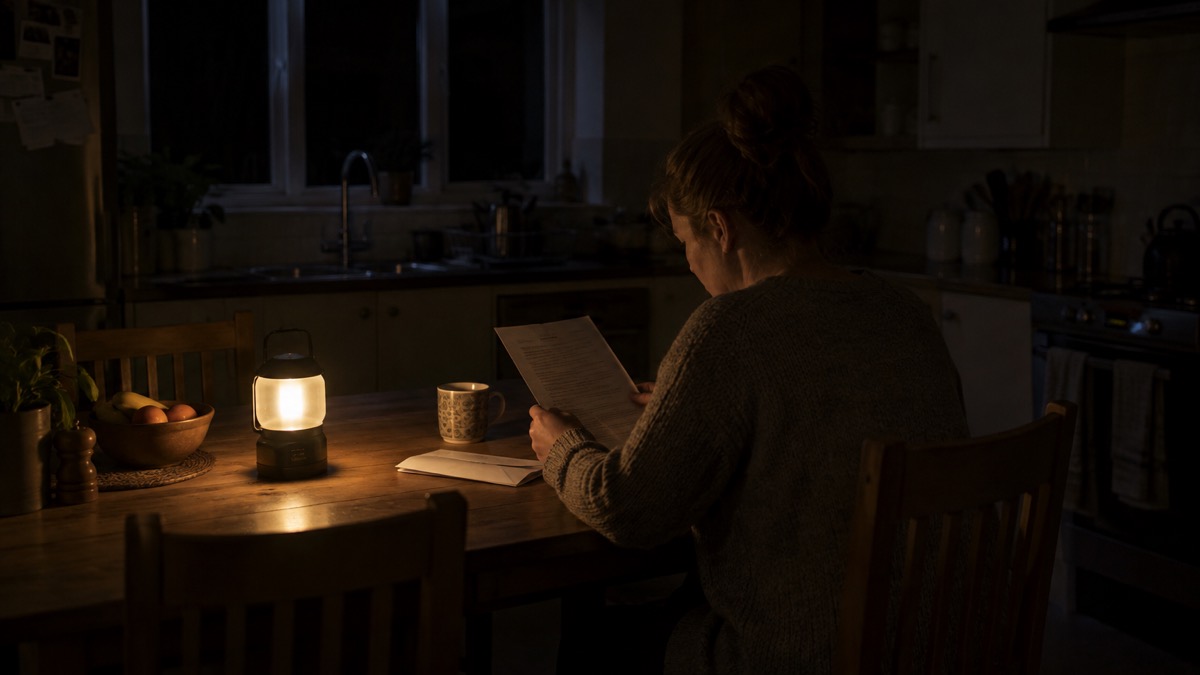
The first decision is where the light goes. A lantern on a table lights a room; a lantern carried from room to room wastes light and battery. Set it once, on its lowest usable setting, and leave it. The Orbiter 450's 120 hours on low2 and the Olantern Stretch's 250 hours4 are only reachable if you resist turning them up.
The second is to have more than one light. A small torch for finding things and checking the fuse box, and a lantern for the room you sit in, means the lantern is not carried about and knocked on and off. Our page on battery and rechargeable lanterns sets out the types side by side, and lantern or torch explains which lights a room better.
The third is to know your own kit before the night you need it. Run each lantern for an evening at home, note which setting you actually use, and work out from the maker's figure roughly how many nights that gives you. Keep a note of it with the lantern.
A simple way to think about it is a timeline of what each setting buys you:
A lantern instead of candles: the fire risk
Fire and rescue services are consistent on this point. Candles can be used but they present a fire hazard, so it is best to stick with torches12. The government's own power cut advice says to keep a battery or wind-up torch and spare batteries at home, because torches are safer than candles7. The National Grid's advice is to keep a lantern or torch somewhere easy to find, check the batteries work and keep a spare set13. The message is the same from every direction: light your home with a battery light, not a flame.
The risk is not theoretical. Around 30% of fires started by candles and attended by fire and rescue services result in death or injury6. Merseyside Fire and Rescue Service goes further and says it is safest to avoid using candles at all and choose safer alternatives such as battery-powered lights14.
"Candles can be used but they present a fire hazard, so it's best to stick with torches."
If you do keep candles for a power cut, treat them as a last resort and never leave one burning in a room you have left. Our candle fire safety page covers the rules in full, and LED candles or real candles compares the two.
Safe charging and storage of rechargeable lanterns
A rechargeable lantern is only as good as its charge on the night. Charge it before winter, and again if it has sat unused for months. The Olight Olantern Classic 2 Pro takes 4 hours to charge fully through USB-C with a high-powered adapter10, so a flat lantern is an afternoon's job, not a five minute one.
For long-term storage, follow the maker's instructions. Petzl also notes that after 12 months in these conditions without use, the rechargeable battery will be discharged18.
The Scottish Fire and Rescue Service advises that if a lithium-ion battery will not be used for an extended period, you should follow the manufacturer's instructions for proper storage and maintenance19. That is the rule to hold on to: the maker knows its own battery, and its manual is the instruction to follow.
Spare batteries and power for a lantern
For a battery lantern, the spare set is the whole plan. The National Grid's advice is to check the batteries work and always make sure you have a spare set13. The government's power cut guidance says the same: keep a battery or wind-up torch and spare batteries at home7. Store them with the lantern, not in a drawer you would have to find in the dark.
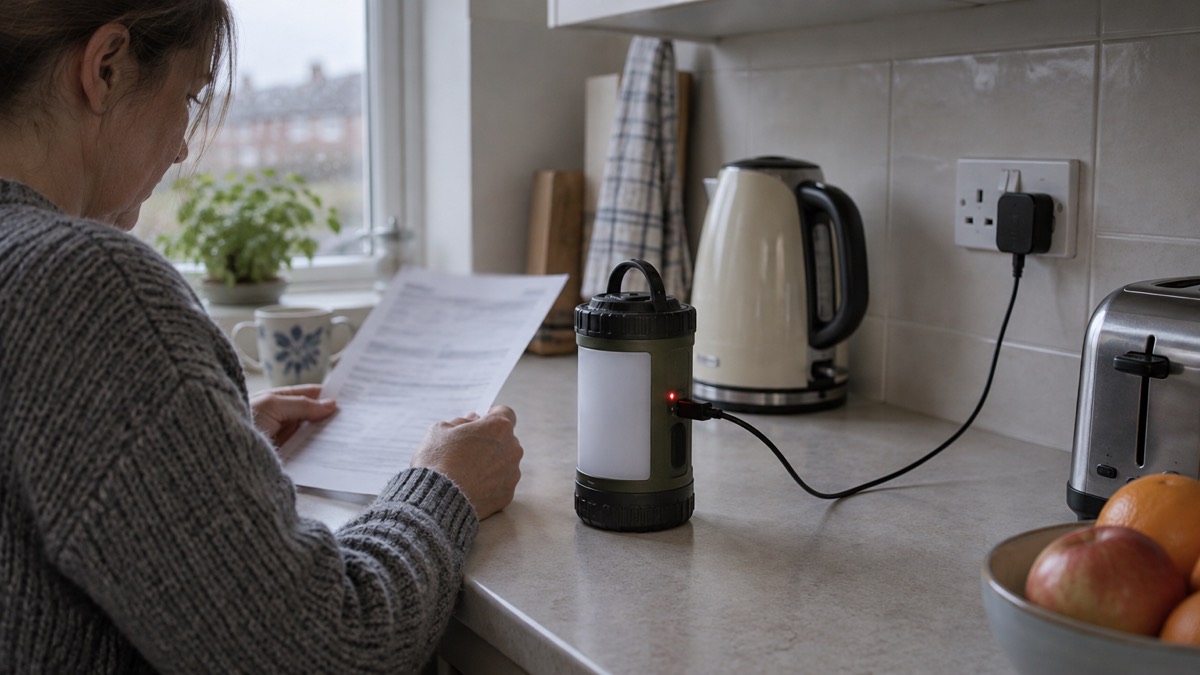
For a rechargeable lantern, the spare power is a charged power bank or a charged spare battery. A power bank will charge a USB lantern, though more slowly than mains. The Caravan and Motorhome Club's guidance on leisure batteries gives a sense of scale: a 60 Ah battery will power two lights for nine days before complete discharge20. That is a caravan example, not a household one, but it shows how much light a modest battery holds.
| What you have | What it suits | What to check |
|---|---|---|
| Battery lantern with spare cells | A lantern stored for years and used rarely | Spare set kept with the lantern13 |
| Rechargeable lantern | Regular use, and a long outage if you can recharge | Charge time, such as 4 hours via USB-C10 |
| Power bank | Topping up a USB lantern during an outage | Charge it in advance, keep it dry |
| Wind-up or solar light | No batteries and no mains at all | Our guide to solar and wind-up lamps |
Whichever you choose, keep the light where you can find it. Our power cut checklist and spare batteries to keep pages turn this into a list you can work through before winter.
Where to get help and what to do first
If the power goes, check whether your neighbours have lost power too, then report the cut to your network operator. Keep a lantern or torch to hand while you do it, and do not rely on a phone torch for long, because it drains the phone you may need. The government's advice on phone and broadband outages is to keep a charged phone and a way to charge it21.
If anyone in the household depends on electrical equipment for health reasons, or is older or disabled, ask their energy supplier about the Priority Services Register. For vulnerable customers with an analogue landline, the government says the communication provider must supply a free back-up battery unit, so the landline works for at least an hour during a power cut, and many batteries now last much longer21. Our page on lights for older and disabled people covers this in more detail.
For the wider picture, our guides to lighting during a power cut and to power cuts set out what to do before, during and after. And if you are choosing a lantern for the first time, start with emergency lighting at home.
Sources (21)
- Coleman 360 Sound and Light Lantern, Coleman UK, 2026-10-26
- Black Diamond Orbiter 450 Lantern, Black Diamond Equipment, 2026-10-25
- Generators, Wiltshire and Swindon Prepared, 2026-10-25
- Olight Olantern Stretch, Olight UK, 2026-10-26
- Vango Lunar 250 Lantern, Vango, 2026-10-25
- Candles, Merseyside Fire and Rescue Service, 2026-10-26
- Power Cuts, Prepare (UK Government), 2026-10-21
- Jackery Camping Lantern, Jackery, 2026-10-25
- MPOWERD Luci Original 3-Pack, BioLite Energy, 2026-10-25
- Olight Olantern Classic 2 Pro Rechargeable Lantern, Olight UK, 2026-10-26
- Black Diamond Moji R+ Rechargeable Lantern, Black Diamond Equipment, 2026-10-25
- How to Prepare for the Loss of Electricity, Wiltshire and Swindon Prepared, 2026-10-25
- Being Prepared for a Power Cut, National Grid, 2026
- Top Ways to Reduce Your Risk of Having a Fire at Home, Devon and Somerset Fire and Rescue Service, 2026
- Wildfire Prevention Advice, National Fire Chiefs Council, 2026-03-18
- Other Safety, Northern Ireland Fire and Rescue Service, 2026-10-22
- Fireworks, Devon and Somerset Fire and Rescue Service, 2026
- Petzl Rechargeable Lamp Manual, Petzl, 2019-05-21
- Lithium-Ion Batteries, Scottish Fire and Rescue Service, 2024-12
- Batteries: Technical Advice, Caravan and Motorhome Club, 2026-10-25
- Phone and Broadband Outages, Prepare (UK Government), 2026-10-12
 Spare Batteries for Lights
 Candle Safety Checklist
 Lighting Checks Before Winter
 Can Jar Candles Shatter
 Battery Tea Lights in a Pumpkin
 Keeping Pets Away from Candles
 Finding Torches in the Dark
 Red Light Mode on a Head Torch
 SOS and Strobe Modes
 IPX Ratings for Torches
 Torch Battery Runtime
 Using a Torch While Charging
 Looking Into a Bright Torch
 Storing Spare Coin Cells
 Flat Button Battery Dangers