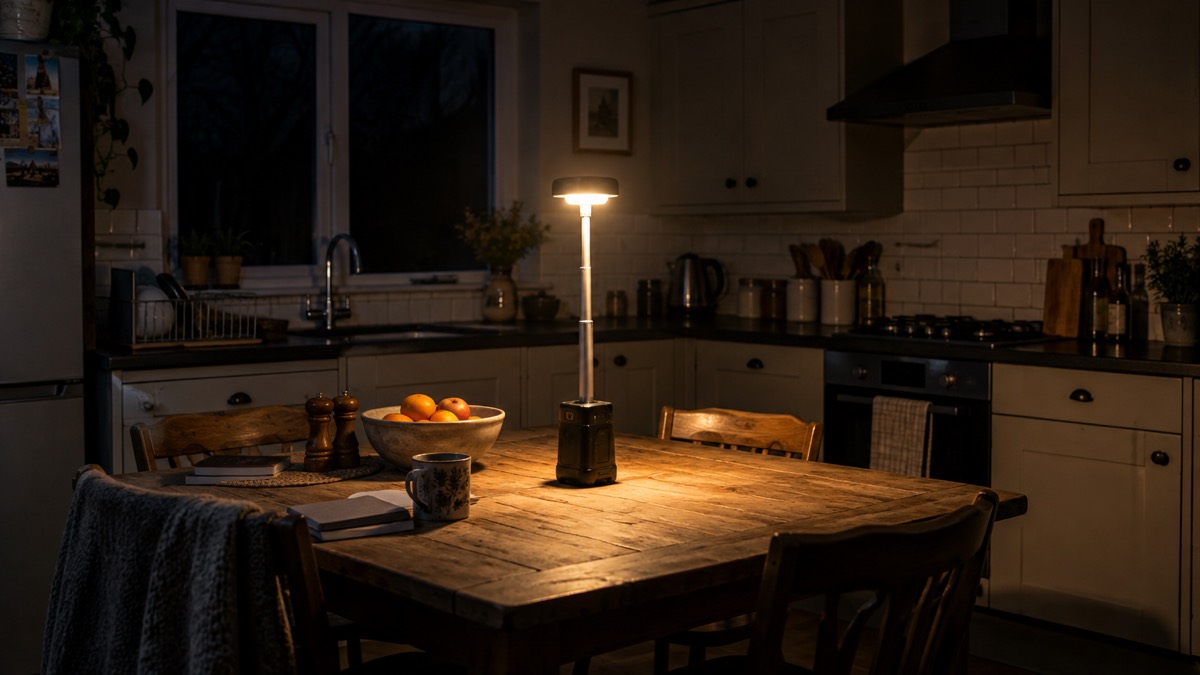
The Olantern Stretch is a rechargeable lantern with a height-adjustable light head, made by Olight. It gives up to 500 lumens of white light or 130 lumens of warm light, and the maker states it runs for up to 250 hours from a 16000mAh battery1. For a household preparing for power cuts, that combination is the point: a light you can stand low on a table for a soft glow, or raise to light a whole room, without hunting for disposable batteries.
The maker's product page now marks the Olantern Stretch as discontinued1. That does not stop an existing one being useful, but it changes what you should do about it. If you already own one, keep it charged and checked, and treat it as one light among several rather than your only plan. If you are thinking of buying one, know that new stock is unlikely and that support for a discontinued model may be limited.
This page covers what the lantern does, how its controls work, how to charge and store it safely, and how it fits a household emergency plan. It does not cover prices, and it does not set the lantern against other products.
What the Olantern Stretch is, and why the maker has stopped it
The Olantern Stretch is a lantern built around a light head that slides up and down on its body. The maker calls it the industry's first lantern with a height-adjustable light head for a customisable lighting range1. That single feature is what separates it from a fixed lantern: pulled down, it sits close to a surface and throws a compact pool of ambient light; raised, it stands taller and spreads light further across a room.
It belongs to the Olantern Series, which the maker describes it as a creative and versatile addition to1. The original Olantern in that family is a rechargeable LED camping lantern with replaceable white light and flaming LED modules, an even 360-degree light distribution, a stable base and a hanging hook for different placement options4. The Stretch keeps the family idea of a lantern you can put down or hang up, and adds the adjustable head and a larger battery.
The maker's product page carries the word Discontinued against the model1. There is no date given for when it stopped, and no reason is stated. What that means for a household is practical rather than sentimental: the design is fixed, so any spares or accessories you might want later will get harder to find, and the sensible response is to make sure the lantern is not your only light.
If you are weighing up what kind of light suits a room in an outage, our guide to battery and rechargeable lanterns for lighting a room sets out the options, and lantern or torch: which lights a room better explains the trade-off between the two.
Light output and run time: what the numbers mean at home
The headline figures are straightforward. The white light reaches up to 500 lumens and the warm light gives 130 lumens1. The battery is rated at 16000mAh and the maker states up to 250 hours of lighting time1. Those are the maker's own figures, and they are the ones to plan around.
What the numbers do not tell you is how the two settings feel in a room. White light at full output is bright enough to work by, read by or light a hallway while you check the fuse box. Warm light at 130 lumens is the setting for the evening: low enough not to glare, warm enough not to feel clinical. The brightness knob is stepless, so you are not limited to fixed steps1; you can dial the white light down to something closer to a night light.
| Specification | Figure | What it means for a household |
|---|---|---|
| White light output | Up to 500 lumens1 | Bright enough to light a room or a task area |
| Warm light output | 130 lumens1 | A softer evening light, suited to a bedside or a living room |
| Battery capacity | 16000mAh1 | A large built-in pack, charged from the mains rather than replaced |
| Run time | Up to 250 hours1 | Long enough to cover a multi-day outage on lower settings |
| Brightness control | Stepless knob1 | Any level between the lowest and highest setting |
| Light selection | Toggle switch1 | One flick between white and warm |
Run time depends heavily on the setting you use. The maker's up to 250 hours is a maximum, reached at low output; running the white light at full brightness will use the battery far faster. If you want to understand how output and duration trade against each other across lanterns generally, lumens, beam distance and run time explained covers the principles, and how long does a camping lantern run in a power cut looks at the question for a household specifically.
Compact ambient light or taller area light
The height-adjustable head is the feature to understand, because it decides how you use the lantern in an emergency. There are two ways to run it, and they suit different moments.
- Low and compact: with the head down, the lantern works as an ambient light. It sits close to a table, a bedside or a kitchen worktop and gives a contained pool of light without filling the room. This is the setting for the evening, for reading, or for keeping a hallway dimly lit overnight.
- Tall and open: with the head raised, the light spreads further. This is the setting for a room where several people are sitting, for a kitchen while you cook without power, or for a landing that needs to be safe to cross.
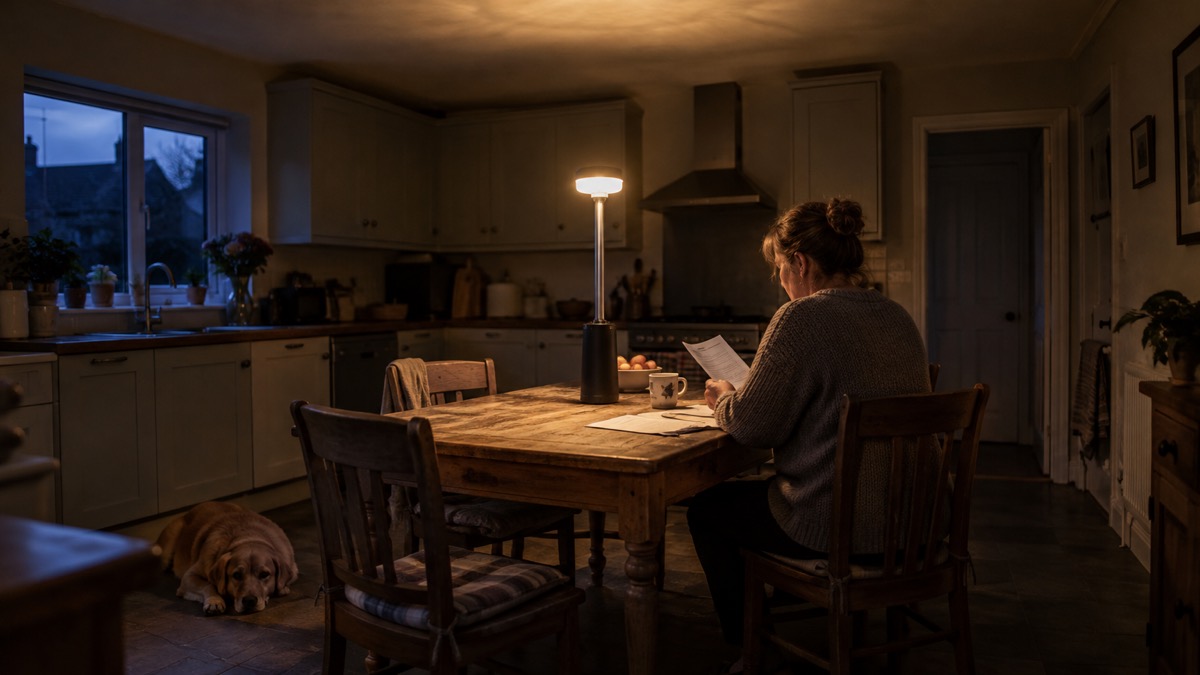
The maker's earlier Olantern used a high-performance LED combined with a transparent cover to give an even, steady 360-degree light distribution4, and the family approach carries through. One point worth knowing from the maker's own comparison of the range is that the original Olantern's bright white light, especially on its highest setting, is not diffused, so keeping it at eye level could be an issue5. The practical lesson applies to any bright lantern: do not park it at head height on full white output. Put it lower, or turn it down, or switch to the warm setting.
Using the toggle switch and brightness knob
The controls are deliberately simple, which matters when you are using them in the dark. The maker's instructions are to switch between the two light sources with a flick of the toggle switch, and to use the knob for stepless lighting control1.
- Find the toggle switch and choose between the two light sources, white and warm1.
- Turn the knob to set the brightness. Because the control is stepless, you can start low and raise it until the room is comfortable1.
- Place it on a stable surface, away from the edge of a table and away from anything that could fall onto it.
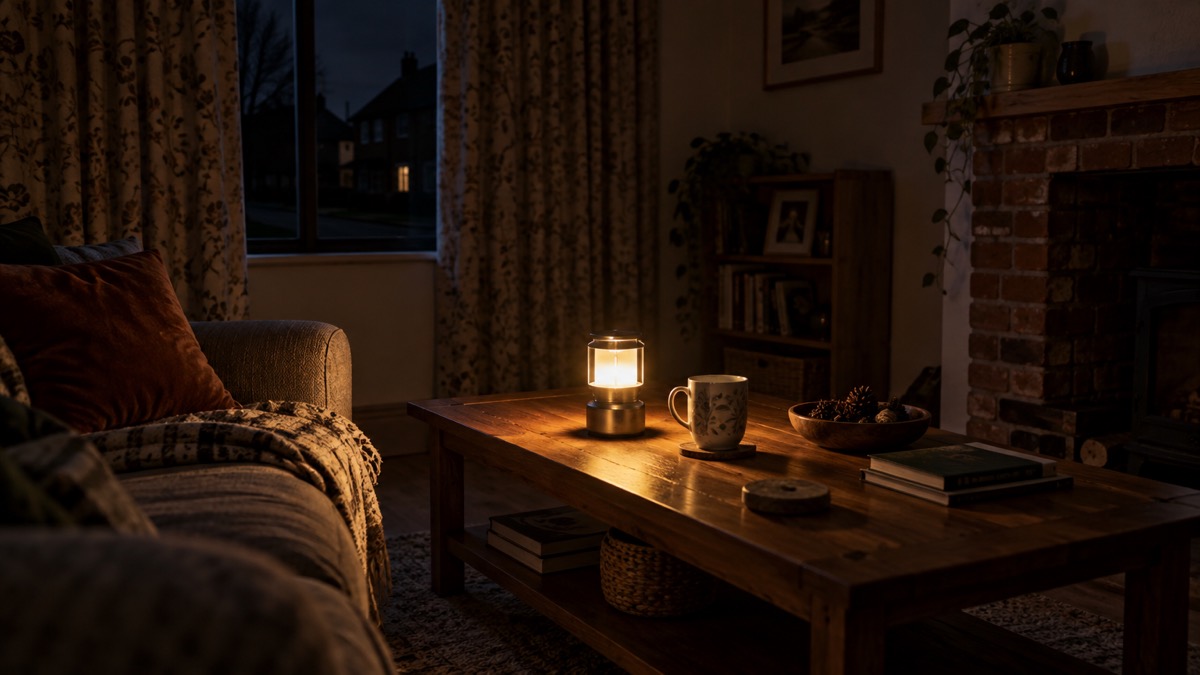
The earlier Olantern in the family had a feature worth knowing if you have one of those as well: the maker says you can swap out the bulb with the included flicker bulb for a soft yellow flickering light that mimics a candle5. That is a feature of the original, not something the Stretch page describes, so check your own model before assuming it.
Charging with Quick Charge, and keeping it ready
The Olantern Stretch is charged from the mains through its built-in battery rather than by swapping cells. The maker states that the Quick Charge protocol allows for fast recharging and discharging6. Charge it fully before winter, then top it up every few months so it is not sitting flat when a storm takes the power out.
A few habits keep a rechargeable lantern dependable:
- Charge before the season turns. Autumn is the time to check every battery light in the house, not the night the wind gets up.
- Top up rather than drain. A pack left flat for months is a pack you cannot rely on.
- Keep the cable with the lantern. A light you cannot recharge is a light with a fixed lifespan.
- Store it where you can find it in the dark, not in a cupboard behind other things.
Our guide to charging and storing rechargeable torches safely covers the general principles, and can the wrong USB charger damage a torch battery answers the question people ask when they reach for whatever charger is nearest.
Using it in a power cut
A power cut is the emergency this lantern is built for. The fire service's advice is to use battery-operated lights or torches as an alternative light source during a power cut2, and a charged lantern is exactly that. It gives you room lighting without a flame, which is the safest option in a house where people are moving around in the dark.
The order to do things in matters:
- Switch off appliances that could come back on unexpectedly, such as hair straighteners and irons7. The fire service also advises switching off electrical equipment such as hair straighteners, blow dryers and mobile phone chargers when not in use6.
- Set up your light. Put the lantern where it lights the room you are using, with the head raised if several people are in it.
- Keep a torch handy as well, for stairs, cupboards and the fuse box8.
- Have blankets and warm clothing to hand if the outage is in cold weather9.
- Report the cut by calling 1053.
If someone in the household depends on powered medical or assistive equipment, plan beyond lighting. Official guidance notes that some equipment may stop working during a power cut, for example ventilators, oxygen concentrators, electric wheelchairs, hoists, communication devices and feeding pumps10. Our guide to lights for older and disabled people in a power cut covers what to arrange in advance.
Bedside lighting and evening use
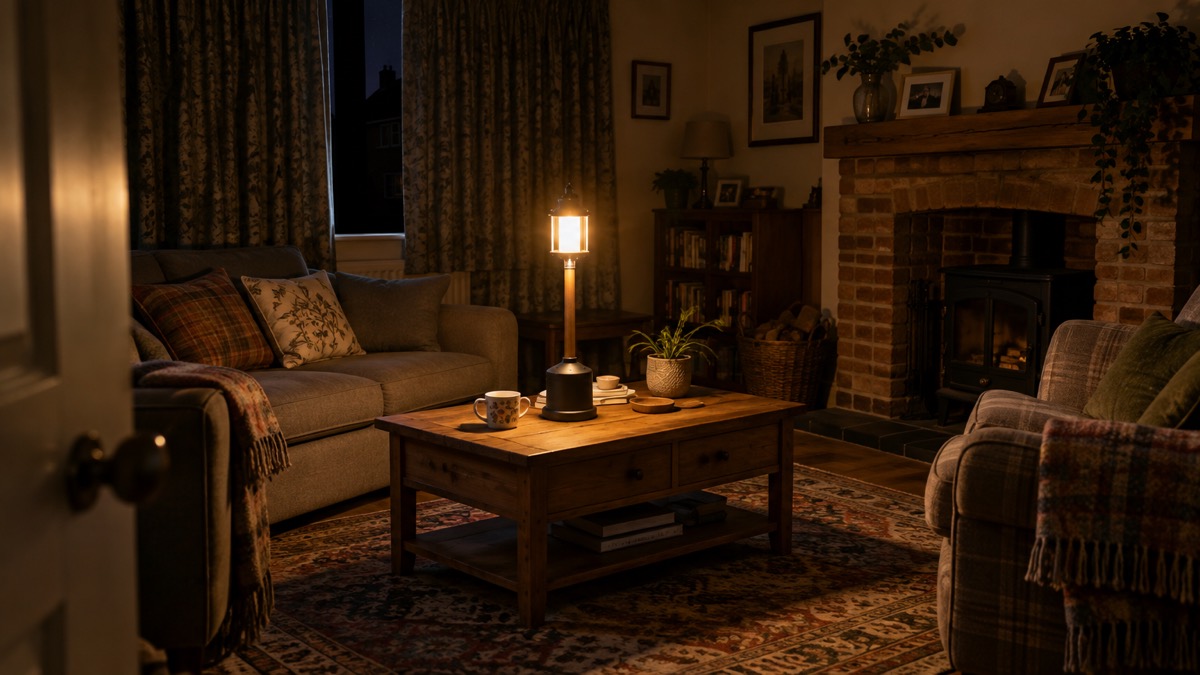
The maker lists bed lighting among the lantern's intended uses1. The lantern has two light sources, white and warm, switched with the toggle switch, and a knob for stepless brightness control1.
For a bedside, keep the head down so the light stays contained, and put the lantern on a firm bedside table rather than on the bed itself. Charge it during the day. If the power fails overnight, you want to be able to reach for a light that is already full, not one that died at midnight.
Households with children should think about where the lantern lives. A rechargeable lantern is a far safer night light than a candle, and our guide to torches, candles and children: keeping them safe sets out the wider points.
Taking it on road trips
The maker lists road trips among the lantern's intended uses1, and a rechargeable lantern earns its place in a winter car kit. Official winter driving advice is to take a shovel, ice scraper, torch, wellington boots and warm clothing where possible, and to pack food and a hot drink on long journeys11. For longer journeys, take blankets, a snack and a flask of warm drink in case you break down and need to wait for assistance, as recovery companies can be extremely busy at this time of year12. Blankets in the car are useful for an impromptu picnic or for sitting and waiting for recovery if the car breaks down13.
Before you set off, check the forecast and road conditions14, let someone know where you are going and how long the journey should take15, and allow extra time16. In high winds, listen out for travel updates on your car radio17, and use main roads18. Drivers of high-sided vehicles, caravans and motorbikes should take extra care in high wind because of the increased risk of vehicles being blown over12.
A few points specific to carrying a lantern:
- Charge it before you leave, and keep the charging cable in the car.
- Store it where you can reach it without unpacking the boot, so it is useful if you are waiting in the vehicle.
- Remember that a journey can start or end on an untreated section of road19, so a light is worth having even when the main routes are clear.
Our guide to storms, snow and ice covers the wider household preparations for winter travel.
The Vintage Copper colour and the holster
The Olantern Stretch is listed in a Vintage Copper colour variant1. The colour is a finish choice; it does not change the light output, the battery or the controls. If you are buying secondhand, check that the listing states the colour and that the holster is included.
The maker describes the holster as a versatile holster with larger capacity and longer runtime1. In household terms, it is the part that carries the lantern and adds to how long it can run, so keep the two together. A lantern separated from its holster still works, but you lose the extra capacity the maker built into the design.
The maker notes that the original Olantern has become a staple in both outdoor gear and in-home emergency supply kits5, and that aftermarket distributors are available should you want an original5. That is a reminder that the secondhand market is where discontinued models live, and that buying used means checking what is in the box.
Support, spares and what to do now it is discontinued
The maker's product page marks the Olantern Stretch as discontinued1. No replacement date or successor is given there. For a household, the practical steps are these:
- Contact Olight directly through its UK site for faults, spares or warranty questions on a discontinued model, and keep your proof of purchase if you have it.
- Check the lantern over each autumn: charge it, run it through both light settings, and turn the knob through its range.
- Do not rely on one light. A household plan should have a torch for each person and a second room light, so a single failure does not leave you in the dark.
- Check for recalls before you rely on any rechargeable light or its charger. Our guide to recalled and unsafe torches and chargers explains how to check and report.
If you are building out the lighting side of a household plan, start with our section on emergency lighting at home, then look at lighting your home safely when the power goes off and the power cut checklist. For the wider picture, power cuts: a household guide covers what to do before, during and after an outage.
Sources (19)
- Olantern Stretch height-adjustable lantern, Olight, 2026-10-26
- Power cuts at home, Scottish Fire and Rescue Service, 2026-10-25
- Who to call for storm damage, Dorset and Wiltshire Fire and Rescue Service, 2022-08-03
- To be an enthusiastic camper with Olantern, Olight, 2021-06-30
- Olantern Classic 2 vs Olantern Mini vs Olantern, Olight, 2022-07-14
- Student safety, Devon and Somerset Fire and Rescue Service, 2026
- Energy outages, NESO, 2026
- Get help and advice in an emergency, Lincolnshire County Council, 2026-10-29
- Staying safe in the snow, North Yorkshire Fire and Rescue Service, 2023-03-09
- Disabled people and carers, Ready Scotland, 2026-10-25
- Winter driving, Derbyshire County Council, 2026-10-29
- Driving in adverse weather, Cheshire Fire and Rescue Service, 2026-03-11
- Out and about, Wiltshire and Swindon Prepared, 2026-10-25
- Adverse driving conditions, South Wales Fire and Rescue Service, 2026-08-28
- Winter driving, Mid and West Wales Fire and Rescue Service, 2026-10-29
- Weather safety, Oxford Health NHS Foundation Trust, 2026-09-18
- Keeping safe during high winds and heavy rain, North Yorkshire Fire and Rescue Service, 2024-01-22
- Strong winds weather warning information and advice, nidirect, 2023-11-13
- Prepare winter driving conditions, nidirect, 2025-11-18

 NEBO Galileo Tempest 350
 NEBO Newton 500 Torch
 NEBO Davinci 800L
 NEBO Luxtreme SL25R
 NEBO Master Series SL25
 NEBO 8K Flood Light
 NEBO 5K Floodlight
 NEBO Torchy 2K Torch
 NEBO Torchy 600 Flex
 NEBO Tac Slyde Torch
 NEBO Slyde King 4K
 NEBO Mycro 900+ Headlamp