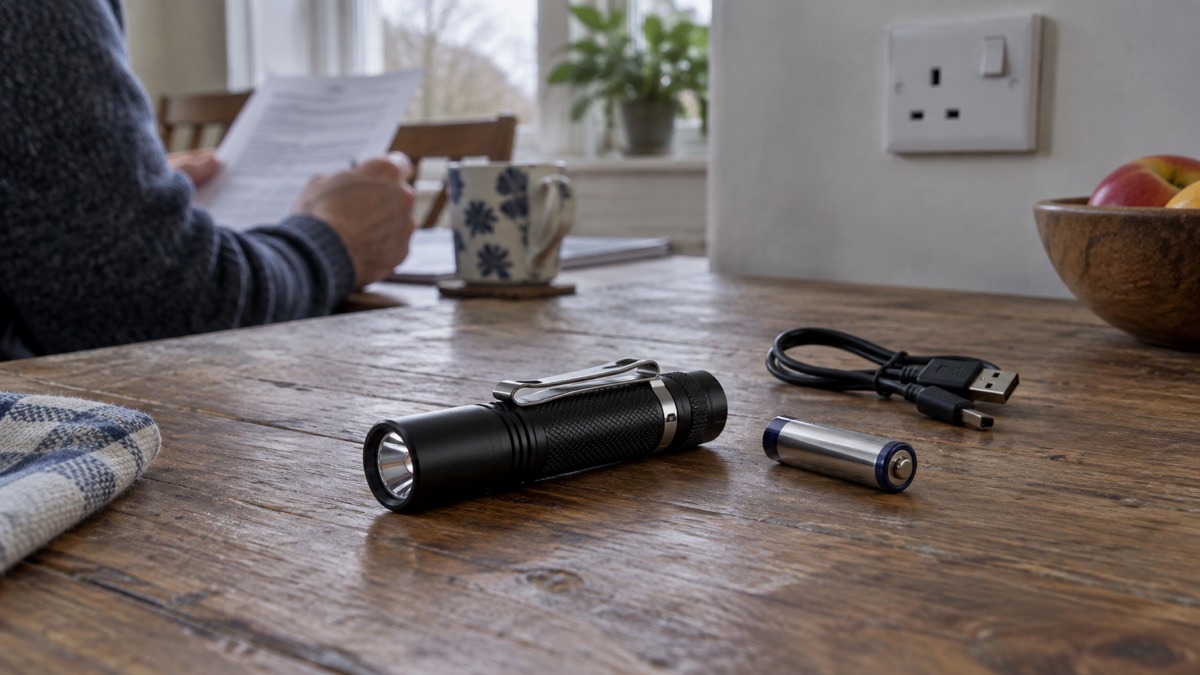
The NEBO Torchy 600 Flex is a pocket-sized rechargeable torch with a magnetic base, a steel pocket clip and a 6x zoom, and it will run on either the 14500 lithium-ion cell supplied with it or a single AA battery you add yourself1. On a single AA it drops to 100 lumens on High for 3.5 hours and 60 lumens on Low for 8.5 hours, but the AA is not included2.
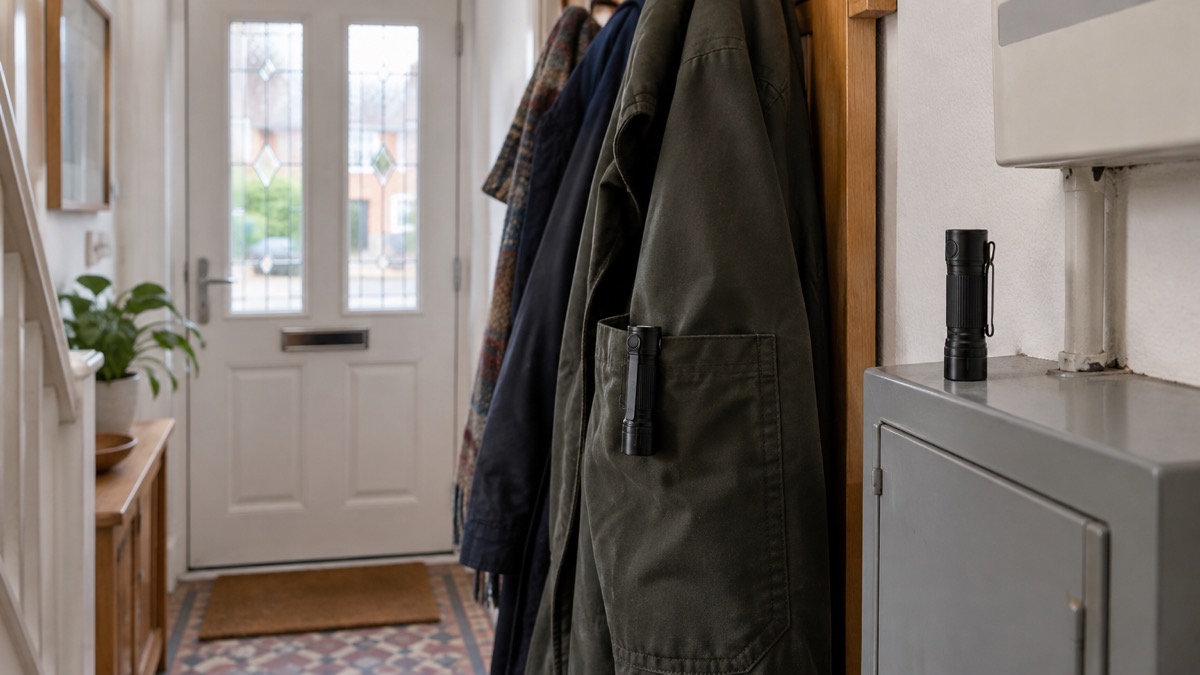
For a household, that makes it a torch to keep charged and clipped by the door or in a kit bag, with a spare AA in the drawer as the fallback when the rechargeable cell is flat and there is no power to charge it. The maker states that the torch runs on either a 14500 lithium-ion rechargeable battery, which is included, or a standard AA battery1.
This page sets out what each mode does, how far the beam reaches, how to charge it and read the battery indicator, how to use the zoom and strobe, and how to look after it so it works when you need it. It is a description of one product from its maker's own instructions and specifications, not a comparison with anything else.
What the Torchy 600 Flex is and what it suits
The maker describes the Torchy 600 Flex as a pocket-sized, rechargeable torch with a 600 lumen beam, a magnetic base and a steel pocket clip1. The body is anodised aircraft-grade aluminium, described as water and impact resistant, with a convex lens and a dual-direction steel clip2. The clip is low profile and designed for one-handed operation, so it fastens to a pocket, belt or bag for instant access1.
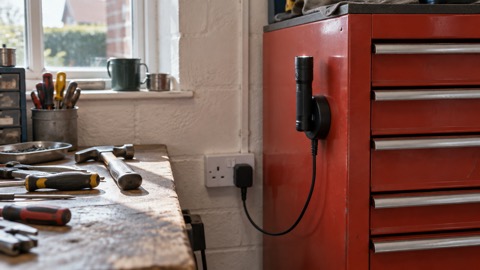
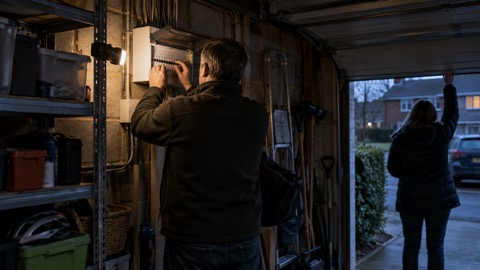
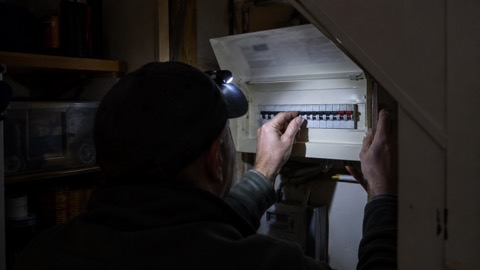
The magnetic base is the feature that changes how you use it. The maker states that it lets the light attach securely to any metal surface, freeing up your hands1. In a power cut that means you can stick it to a fuse box, a boiler casing or the underside of a shelf and work with both hands rather than holding a torch in your teeth. It is not a substitute for a head torch if you need light that follows you around, but for a job in one place it does the same work.
NEBO also makes a point of the exterior on its torches and head torches generally: a rubberised body acts as shock-absorbing armour against accidental drops and bumps, with a textured surface for grip in oily or wet conditions3. That is maker guidance for the range rather than a specification of this model, but it explains why the torch is built to be carried loose in a pocket rather than kept in a box.
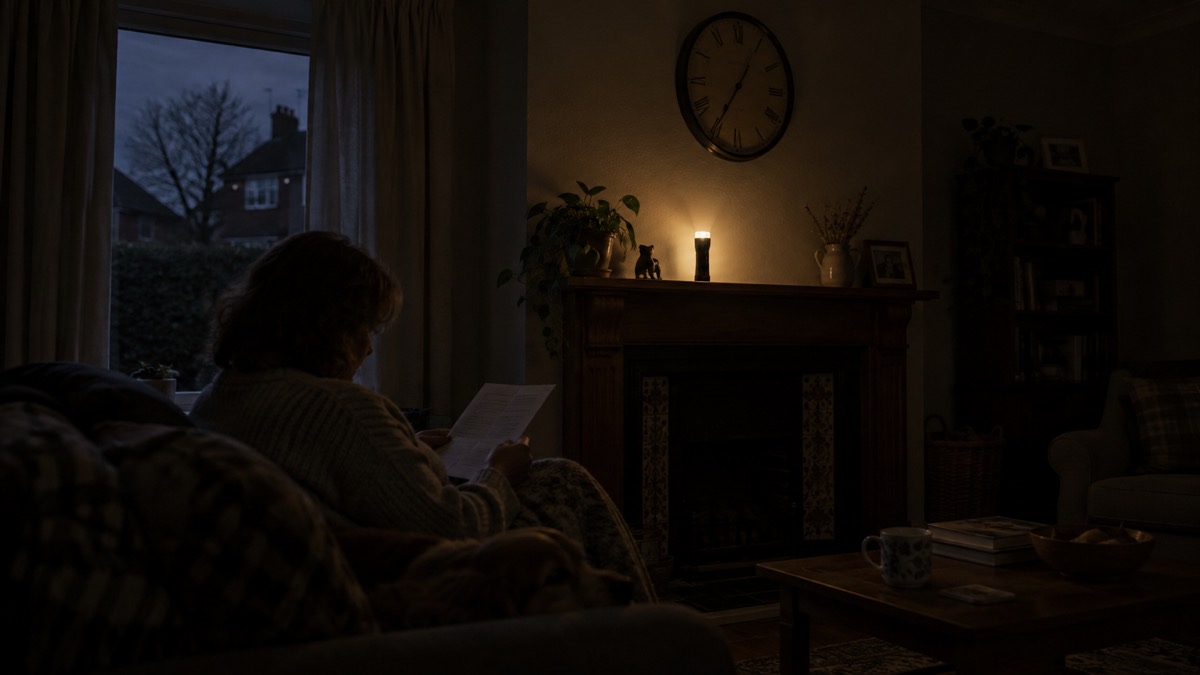
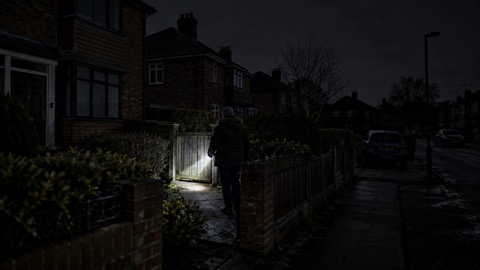
As a household torch it suits three jobs: a light to keep by the front door for the walk to the meter cupboard, a light to stick to metal while you deal with a trip switch, and a light small enough to go in a bag or glovebox. If you want a light that fills a room during an evening power cut, a lantern does that better; our guide to torches and how to choose one for home sets out the difference.
Two power options: the rechargeable cell or a single AA
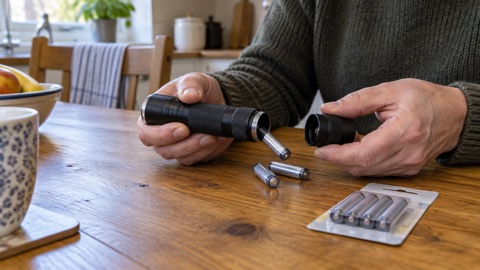
The torch uses what the maker calls Flex-Power technology: it runs on either a 14500 lithium-ion rechargeable battery, which is included, or a standard AA battery, which is not1. The maker's own framing is that you use the rechargeable cell for everyday operation and a standard alkaline AA when you are in a pinch1. That is a sensible way to think about it for a household: the rechargeable cell is the working battery, and the AA is the insurance.
The two cells do not give the same torch. The 14500 cell unlocks the full range of modes and outputs, while the AA gives a reduced High and Low only2. The table below sets the maker's figures side by side.
| Mode | Battery | Output | Run time | Beam distance |
|---|---|---|---|---|
| Turbo | 14500 | 600 lumens | 40 seconds, then reverts | 185 m |
| Strobe | 14500 | not stated | 2 hours | 160 m |
All figures are the maker's1. Note that the AA figures are not a dimmer version of the same torch so much as a different balance: less light, but far longer.
Run time: what you get from each battery
Run time is the figure that decides whether a torch is useful in a long power cut, and the Torchy 600 Flex has two quite different answers depending on which battery is in it.
The pattern is the one you would expect from any torch: the brighter the mode, the shorter the run. What matters for planning is that the brightest setting is not the one to leave on. Turbo is a burst for spotting something at distance, not a working light, and the maker's own instruction is that it runs for 40 seconds and then reverts to the previous mode1.
If you want to understand how lumens, beam distance and run time relate to each other across torches generally, our explainer on lumens, beam distance and run time sets out what the numbers mean and what they do not tell you. The short version is that a beam distance of 185 metres does not mean the torch lights a room 185 metres wide; it means the light throws that far in a narrow beam.
Turbo lasts 40 seconds, then drops back
Turbo is the headline mode: 600 lumens and a beam that reaches 185 metres1. It is also the shortest. The maker's instruction is that Turbo Mode will run for 40 seconds and then revert to the previous mode1. To activate it, from ON press and hold the power button for 2 seconds and release1.
That behaviour is deliberate, and it is common to small torches that push a high output from a small cell: the burst gives you a moment of maximum light to identify something at distance, and then the torch steps back to a mode it can sustain. For a household the practical consequence is simple. Do not plan to use Turbo as your working light. Use it to check what is at the end of the garden, to see whether the street light is out along the road, or to find the stopcock in a dark corner, then let it drop back.
The same logic applies to the beam distance figures. The maker gives 185 metres on Turbo, 141 metres on High and 88 metres on Low on the rechargeable cell, and 68 metres on High and 54 metres on Low on an AA1. Those are throw figures for a focused beam. With the zoom widened, the light covers more area at a shorter distance, which is what you want indoors.
Using the modes, strobe and the 6x zoom
The torch has a 6x adjustable zoom: twist the head to narrow or widen the light beam1. Narrow gives you the throw figures above; wide gives you a pool of light for close work, which is the setting to use when you are reading a meter, changing a fuse or looking in a cupboard. The maker's manual also describes sliding the lens housing or twisting the lens sleeve, so the mechanism is a twist of the head1.
The mode cycle is HIGH > LOW > OFF, with the power button pressed and released to turn the torch on and off and to cycle through modes1. Strobe is activated by a double tap1. Turbo, as above, is a press and hold for 2 seconds from ON1. On an AA battery the torch gives High and Low only2.
There is one quirk worth knowing before you use it in the dark. When the light has been ON for 8 seconds or longer, the next button press will turn the unit off1. In other words, if you turn the torch on and leave it for a while, the next press switches it off rather than moving to the next mode. To change mode, press within the first 8 seconds. Once you know the rule it stops feeling like a fault, and it means a single press always gets you to darkness when you want it.
Strobe is a signalling mode rather than a working light. Our page on SOS and strobe modes explains when a flashing light helps and when it just disorients you. For ordinary household use, the mode you will use most is Low, with High for checking something at a distance and the zoom wound in.
Charging and reading the battery indicator
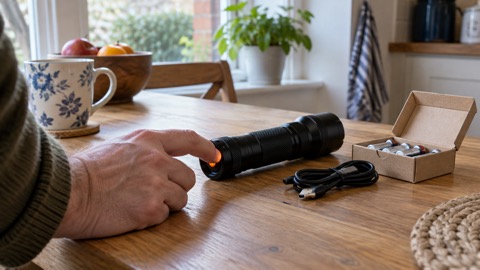
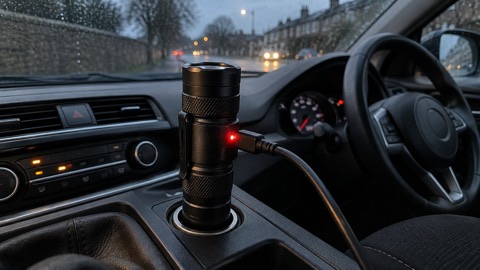
To charge the torch, slide the top of the unit up and insert the included charging cable1. The maker supplies a USB-A to USB-C cable2. The power button doubles as the battery indicator: steady red means charging, steady blue means fully charged1.
The same button tells you how much charge is left when the torch is in use. Flashing red means the battery is below 25 per cent, and steady red means it is below 10 per cent1. Treat the flashing red as the point to charge it or to swap in an AA, rather than waiting for the light to fade.
The battery is lithium-ion1. Charge it before you need it, and check it at the start of winter rather than during the first power cut. Our guide to charging and storing rechargeable torches safely covers the general points about where to charge, what charger to use and how to store a torch so it is ready. If you are unsure whether a particular USB charger is suitable, our page on whether the wrong USB charger can damage a torch battery sets out what to check.
Built for wet and rough use: IPX7 and aluminium
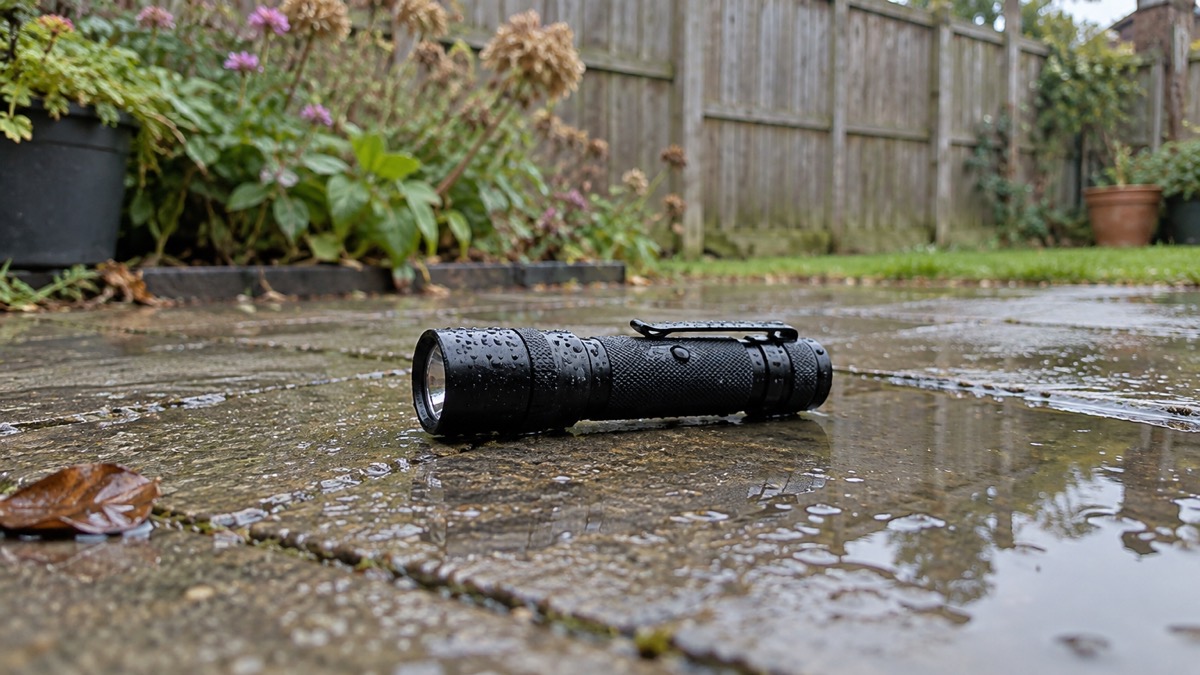
The Torchy 600 Flex carries an IPX7 rating. The maker states that this ensures the device can survive accidental submersion in up to 1 metre of fresh water for 30 minutes1. The rating does not cover high-pressure water jets or saltwater exposure1. In household terms, that means a dropped torch in a puddle, a sink or a water butt is likely to survive; a torch left on a windowsill in sea spray or hosed down is not covered.
The body is anodised aircraft-grade aluminium, described by the maker as water and impact resistant2. NEBO's general guidance for its torches and head torches describes a rubberised exterior that acts as shock-absorbing armour against accidental drops and bumps, with a textured surface for grip in oily or wet conditions3. That is the kind of construction that suits a torch kept in a kitchen drawer or a toolbox rather than a display cabinet.
If you want to understand what IP ratings mean across torches and lanterns, our page on what IPX ratings mean explains the scale. The short version is that the first digit covers solids and the second covers water, and IPX7 is a water rating only, with the X standing in for an unstated dust figure.
Keeping a spare AA in your emergency kit
A torch is only useful if it works when the power goes, and that means batteries. Official emergency kit guidance for Scotland lists a torch and spare batteries among the things a household should have ready5. The Met Office winter checklist says the same: torch and spare batteries6. Independent guidance on emergency kit says it is good to have spare batteries so you can keep a torch or radio running, or replace the batteries in an item7. NIE Networks advises keeping a torch and spare batteries in an easily accessible place8, and Northern Powergrid lists torches and spare batteries among grab bag contents9.
For this torch, the spare that matters is a single AA. Keep one with the torch, and keep it somewhere you can find in the dark. Our checklist on spare batteries to keep for your lights sets out what to hold for a household.
If you are deciding between a rechargeable torch and one that runs on disposable batteries, our comparison of rechargeable or battery torches for emergencies sets out the trade-offs. The Torchy 600 Flex sits in both camps, which is its main practical advantage for a household.
Where it fits in a household lighting plan
A pocket torch is one part of a lighting plan, not the whole of it. The Torchy 600 Flex is small, bright in short bursts, waterproof and able to stick to metal, which makes it the light you carry and the light you use for a job. It is not the light that fills a room for an evening. For that you want a lantern, and our guide to battery and rechargeable lanterns explains what to look for.
A sensible arrangement for most households is a torch by the door, a lantern for the main room, and a head torch for anything that needs both hands and movement. Our page on torch or head torch for a power cut sets out which suits which job. The Torchy 600 Flex covers the torch role well, and its magnetic base covers some of the hands-free jobs a head torch would otherwise do.
Keep it where you can find it in the dark. Our page on where to keep torches so you can find them in the dark has suggestions, and the power cut checklist lists what to have ready before the lights go out. If you are building a kit from scratch, the emergency lighting section covers torches, lanterns and candles together.
Support, spares and the rest of the NEBO range
The Torchy 600 Flex is made by NEBO, and the maker's product page and manual are the place to check specifications and instructions if anything on this page needs confirming1. The torch is also sold as part of a triple light kit alongside the Mycro 250 and the Galileo Tempest 35010, so if you already own that kit you have this torch in it.
The maker's manual is the authority on how the torch behaves, including the 8 second rule, the Turbo timing and the charging indicators1. If your torch does something different from what is described here, check the manual that came with it, since makers can change specifications between production runs.
For the rest of the range, our pages on the NEBO Galileo Tempest 350 and the other NEBO lights cover the lanterns and larger torches. If you are comparing this torch with another NEBO model, the specifications tables on those pages give the maker's figures for each.
Sources (10)
- Torchy 600 Flex product page, NEBO Tools UK, 2026-10-25
- Triple Light Kit product page, NEBO Tools UK, 2026-10-25
- Lighting technology, NEBO Tools UK, 2026-10-25
- Can I recharge any battery?, Duracell UK, 2026-10-26
- Emergency kit, Ready Scotland, 2026-10-22
- WeatherReady winter checklist, Met Office, 2026
- Emergency kit packing list, Which?, 2026-09-30
- Get storm ready, NIE Networks, 2025-12-03
- Are you ready for big coat weather, Northern Powergrid, 2024-11-08
- Galileo Tempest 350, NEBO Tools UK, 2026-10-25

 NEBO Newton 500 Torch
 NEBO Davinci 800L
 NEBO Torchy 2K Torch
 NEBO Tac Slyde Torch
 NEBO Slyde King 4K
 NEBO Mycro 900+ Headlamp
 NEBO Edge 800
 NEBO Transport 400
 Fenix E04R Keyring Torch
 Fenix E05R Keychain Torch
 Fenix E06R Pro Pocket Torch
 Fenix E09R Torch