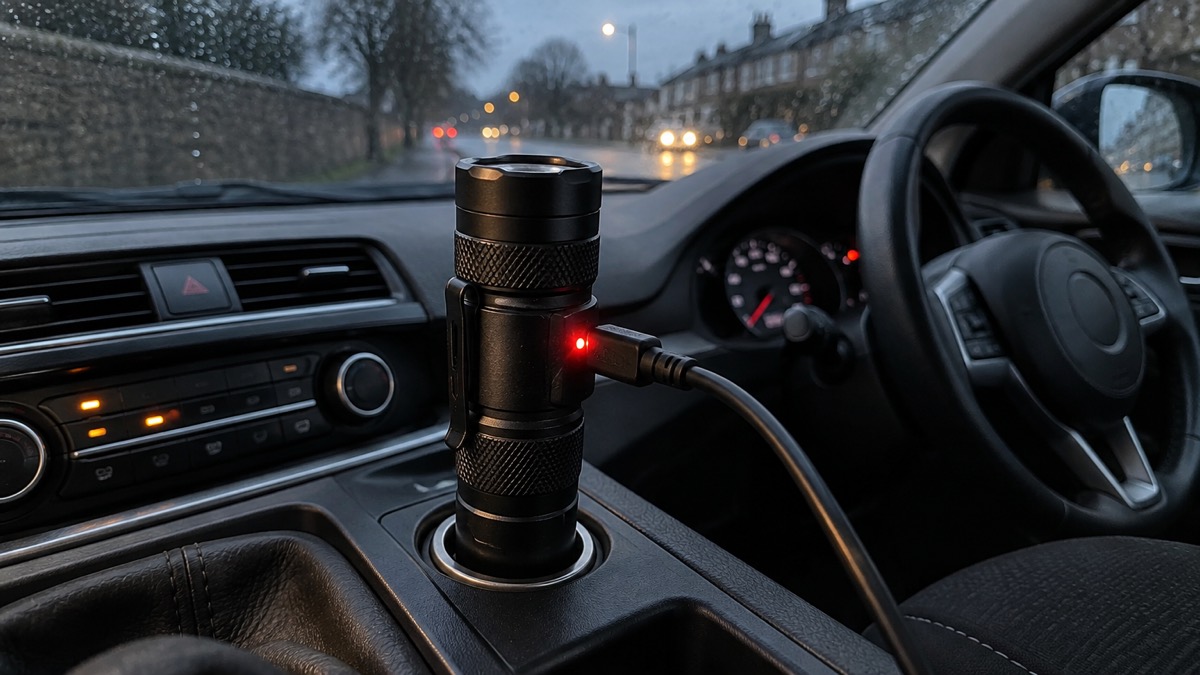
The NEBO Transport 400 is a rechargeable torch made to live in a vehicle. It is a 2-in-1 car charger and torch: it charges from a standard automotive 12/24V accessory port or a USB-C cable, and it can pass power out again to a phone through its USB-A car charger output1. The maker rates it at 400 lumens on Turbo, with a beam distance of 85 metres on that setting1.
For a household, that makes it a car torch rather than a kitchen-drawer torch. It sits in the socket, tops itself up on the move, and gives you a bright beam and a way to top up a phone if you are stuck at the roadside or the power is off when you get home. It also carries a tungsten glass breaker and an IP67 rating, so it is built around the kind of emergency a car produces1.
This page sets out what the maker says it can do, how to reach each mode, how to charge it and charge from it, and how to use and store it without turning a useful tool into a fire risk. Where the maker's own product page gives two different figures for the same thing, both are given below and the disagreement is flagged.
What the Transport 400 is, and what it suits
The maker describes the Transport 400 as a 2-in-1 car charger and rechargeable torch, both USB-C and 12V DC rechargeable, with a car charger to power USB-A devices1. In practice that means one object does two jobs in a vehicle: it is the torch you reach for in the dark, and it is the thing that puts charge back into a phone that has run flat.
That combination suits a glovebox or door pocket. Breakdown and winter driving guidance is consistent that a torch belongs in the car: Devon and Somerset Fire and Rescue Service list a torch among the things you should have for winter driving, alongside an ice scraper, de-icer, warm clothes, a warning triangle, a high visibility jacket, a blanket, food and drink, a first-aid kit and a map2. The Scottish Government's emergency kit guidance likewise includes an ice scraper for the car3. A torch that charges from the socket you already have is one less thing to remember to top up at home, and the maker states that its Smart Power Control adjusts light output automatically based on the remaining battery charge1.
It is not a lantern and it is not a room light. It is a handheld spot beam with a red mode, sized to be carried. If you want something that lights a whole room during a power cut, that is a different job, and the section on lanterns and torches sets out the difference. What the Transport 400 does well is throw a bright, narrow beam a long way, which is what you want when you are looking under a bonnet, changing a wheel at the roadside or finding your way along an unlit path to the car.
The maker lists it as in stock and ready to ship in the UK1. It is one of a range of lights from NEBO, and the brand page lists the others if you are comparing what the range offers.
Brightness, beam and the six light modes
The headline figures are 400 lumens and an 85 metre beam, both on Turbo1. Lumens measure how much light comes out; beam distance measures how far it carries. A torch rated at 85 metres will light up objects well beyond the length of a driveway, which is more than most roadside and power-cut jobs need, and that is the point of having a Turbo setting you only use in short bursts.
The maker lists six light modes: Turbo, High, Medium, Low, Red and Red Strobe1. The white modes cycle in the order OFF, then HIGH, then MEDIUM, then LOW, using the side-positioned button1. Red and Red Strobe are reached separately, which matters in the dark when you do not want to cycle through a bright white beam to find a dim red one.
| Mode | How you reach it | What it is for |
|---|---|---|
| High, Medium, Low | Press the side button to cycle OFF > HIGH > MEDIUM > LOW1 | Everyday lighting, close work, saving battery |
| Turbo (400 lumens, 85m) | With the light on in any spot mode, long press the power button for two seconds1 | A short burst of maximum reach |
| Red | With the light off, press and hold the power button for 3 seconds for Direct-to-Red1 | Low-level light that preserves night vision |
| Red Strobe | With red mode on, press again1 | Being seen, rather than seeing |
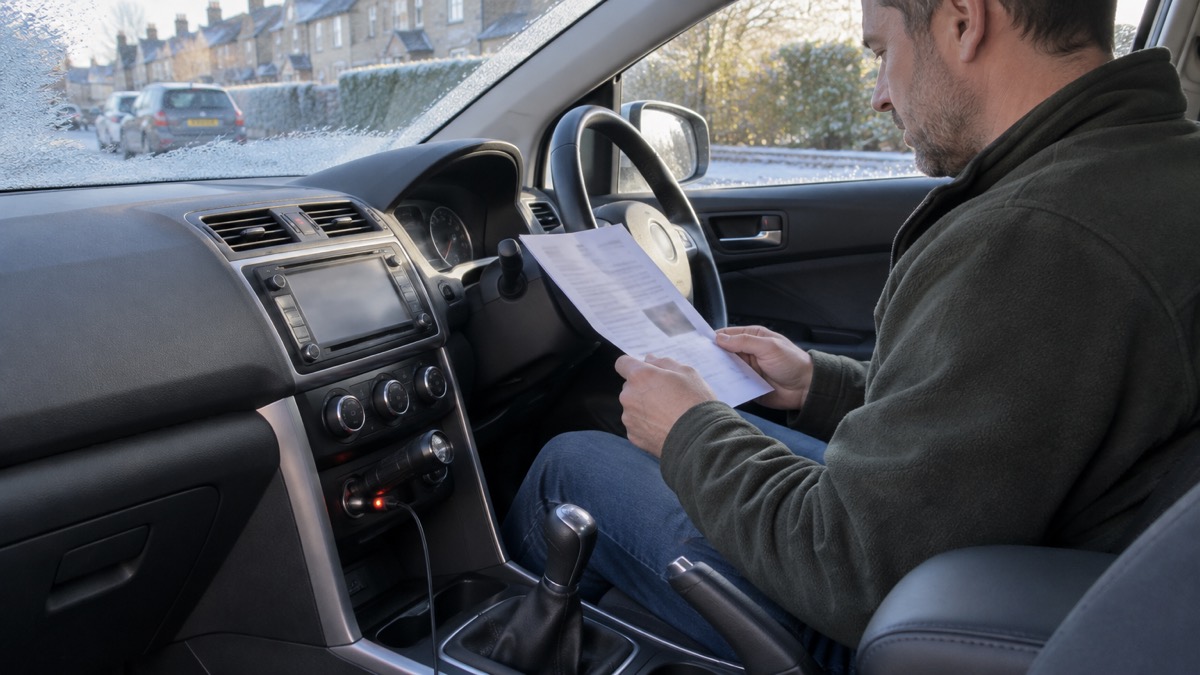
Two things about these figures need saying plainly. First, Turbo is time-limited: the maker states that with the light on in any spot mode, a long press of the power button for two seconds activates Turbo for 30 seconds, after which the torch automatically returns to the previous light mode1. Plan around that. If you need sustained light, use High or Medium, not Turbo.
Second, the maker's own product page gives more than one figure for brightness, beam distance and run time. Alongside the 400 lumen and 85 metre figures it also lists 250 lumens, and alongside a 16 hour figure for the red modes it lists 30 seconds for Turbo mode1. These are not reconciled on the page. Treat the 400 lumen Turbo figure and the 30 second Turbo limit as the ones to plan around, and expect real-world run time to depend on which mode you use. The general explanation of how lumens, beam distance and run time relate is set out in lumens, beam distance and run time.
Charging it from the car socket or USB-C
There are two ways to put charge into the Transport 400. The maker states it can be charged in a standard automotive 12/24V accessory port or using a USB-C charging cable, and that the cable is not included1. The 12/24V figure matters: it means the torch is designed for both the 12V socket in a car and the 24V socket found in some vans and lorries, so it is not limited to a standard car.
The charging indicator sits near the charging port. The maker states that when the product is plugged in and charging the indicator will be solid red, and that it shows solid green when charging is complete1. That is your only signal, so check it: red means leave it connected, green means it is full.
A few practical points follow from those facts:
- Keep a USB-C cable with it. The cable is not in the box, so a torch charged only by cable is a torch you cannot charge until you find one1.
- Use a reputable charger. Electrical Safety First advises that most mobile phones and tablets charge via a USB-type cable and a compatible USB charger, and that you should only use a compatible USB charger from a reputable source, as there are many substandard and dangerous chargers available4. The same caution applies to any USB charger you use with the torch.
- Charge on a hard surface at home. Electrical Safety First's living room guidance is to charge devices on a hard surface such as a table or desk5. Do not charge it on a bed, sofa or pile of coats.
- Do not leave charging unattended where you can avoid it. Fire and rescue services run campaigns specifically to encourage safe charging and storage of lithium-ion batteries, to raise awareness of the fire risks and to reduce fires and injuries caused by them6.
Charging a phone from it
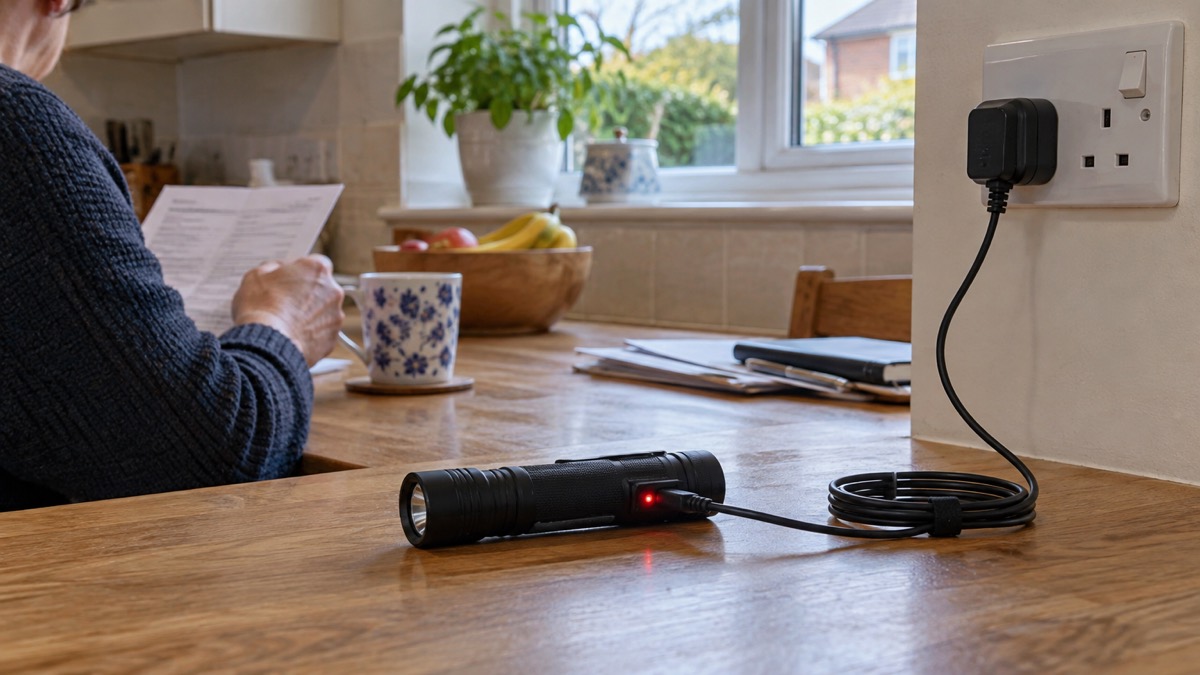
The Transport 400 has one USB-A car charger output and one USB-C output1. The maker describes it as having a car charger to power USB-A devices1. That is the function that earns it a place in a vehicle emergency kit: a phone with a flat battery is a phone you cannot use to call for help.
Use it the way you would use any power bank. Plug the phone into the USB-A output with a suitable cable and let it charge. The torch's own battery is small, so treat this as an emergency top-up rather than a full recharge of a modern smartphone, and keep the torch itself charged so it has something to give.
There is a second, less obvious use. Ofgem's advice, published by Electricity North West, notes that you may be able to charge your phone using wireless power sharing with another phone, and that many modern Android phones and some other brands can act as a power source for another device7. If you have two phones, one can top up the other. Which? makes the related point that hotspotting can quickly drain your phone's battery, so use it sparingly if you do not have a portable charger8. The Transport 400 is that portable charger, in a small way.
If you are building a power-cut kit rather than a car kit, a dedicated power bank holds far more. The NEBO 5K Powerbank is one option in the same range, and the backup power section explains what different sizes can and cannot do.
Built for a car emergency: glass breaker, IP67 and aluminium body
Three features mark this out as a vehicle torch rather than a general-purpose one.
The first is the tungsten glass breaker. The maker states that to shatter a tempered glass window you place the end of the Transport against a bottom corner of the window and press firmly, and that the breaker has a protective shield that automatically retracts when pressed against a hard surface1. That is the maker's own instruction for its own product. It is a tool for getting out of a vehicle in an emergency, not something to test on a window you value.
The second is the IP67 rating. The maker describes it as ensuring complete dust-tightness and water resistance up to 1 metre depth for 30 minutes1. That covers rain, splashes, dropping it in a puddle and a brief accidental dunking. It does not make it a diving torch, and the rating is the maker's figure, not an independent test result. The general meaning of these ratings is explained in what IP ratings mean for torches.
The third is the body. The maker lists anodized aircraft-grade aluminium and impact resistance among its features, along with a magnetic pocket clip and a side-positioned button for power and mode selection1. The magnet lets you stick the torch to a metal surface so it lights the job while both hands are free, which is exactly what you want when changing a wheel.
| Feature | What the maker states | What it means for you |
|---|---|---|
| Glass breaker | Tungsten, with a protective shield that retracts when pressed against a hard surface1 | A way out of a vehicle window in an emergency |
| Water and dust | IP67: dust-tight, water resistant to 1 metre for 30 minutes1 | Safe in rain and splashes, not for diving |
| Body | Anodized aircraft-grade aluminium, impact-resistant1 | Survives being knocked about in a car |
| Clip | Magnetic pocket clip1 | Sticks to metal so both hands are free |
| Controls | Side-positioned button for power and mode1 | Easy to find by feel in the dark |
Using it safely
The maker's own safety instructions for the Transport 400 are short and worth following exactly. The maker states: only use the device for its intended purpose; do not shine the light directly in someone's eyes; if the beam shines directly in your eye, look away immediately; do not use any magnifying instruments that could concentrate the light beam; keep it away from heat, hot surfaces, sparks and open flames; and do not incinerate it1.
"Do not shine the light directly in someone's eyes."
That is not a fussy warning. A 400 lumen beam at close range is painful and can leave a person dazzled and unable to see, which is dangerous if they are driving, cycling or walking near traffic. Point it at the ground or at the job, not at faces.
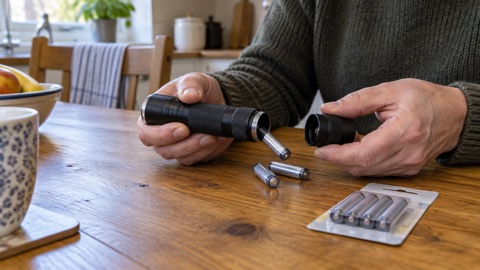
The battery is the other thing to manage. The maker lists a Li-ion 16340 rechargeable battery with a capacity of 700mAh and a total voltage of 3.7V1. Lithium-ion cells are safe when used and charged correctly, and fire and rescue services across the UK run campaigns to encourage safe charging and storage because fires do happen when they are not6. The Health and Safety Executive's advice on electrical equipment is to make sure people know how to use it safely, and to stop using equipment immediately if it appears to be faulty and have it checked by a competent person9. Apply that to a torch: if the body is damaged, the charging port is loose or the indicator behaves oddly, stop using it and get it checked.
Store it where you will find it. A torch in a glovebox is useful; a torch in a bag under a seat is not. Keep it in the accessory socket or in the door pocket, and check the indicator now and then so it is charged when you need it. If you want a wider check of what your lights need before winter, the lighting checks before winter checklist covers the rest of the house.
Where it fits in a household's lighting
The Transport 400 is a car torch. It is at its best in the vehicle: charging from the socket, throwing a long beam down an unlit road, breaking a window if it has to, and topping up a phone. It is not the light you want for a power cut at home, where a lantern that fills a room or a head torch that leaves your hands free does the job better. The torches section explains what to look for in a general-purpose torch, and the power cut lighting guide covers lighting a home when the mains goes off.
If you are building a car kit around it, the fire and rescue service list is a good starting point: an ice scraper, de-icer, warm clothes, a warning triangle, a high visibility jacket, a torch, a blanket, food and drink, a first-aid kit and a map2. The Transport 400 covers the torch. That is the scenario the glass breaker and the torch are for, and the maker's own instruction is to use the device only for its intended purpose and never to shine the light directly in someone's eyes1.
For charging and storage of rechargeable lights generally, the charging and storing guide sets out the safe routine. For the wider question of what to keep ready for a power cut, the power cut checklist lists the lights and spares a household should have.
Sources (9)
- NEBO Transport 400 Rechargeable, NEBO Tools, 2026-10-25
- Driving in snow and icy conditions, Devon and Somerset Fire and Rescue Service, 2026-01-02
- Emergency kit, Scottish Government, 2026-10-22
- Mobile phones and tablets, Electrical Safety First, 2026-10-25
- Living room electrical safety, Electrical Safety First, 2026-10-25
- Charge Safely, Sleep Soundly campaign, Devon and Somerset Fire and Rescue Service, 2025-03-18
- Tips to help you during a power cut, Electricity North West, 2026-10-25
- What to do in a power cut, Which?, 2026-06-04
- Electricity and electrical equipment, Health and Safety Executive, 2026

 NEBO Newton 500 Torch
 NEBO Davinci 800L
 NEBO Torchy 2K Torch
 NEBO Torchy 600 Flex
 NEBO Tac Slyde Torch
 NEBO Slyde King 4K
 NEBO Mycro 900+ Headlamp
 NEBO Edge 800
 Fenix E04R Keyring Torch
 Fenix E05R Keychain Torch
 Fenix E06R Pro Pocket Torch
 Fenix E09R Torch