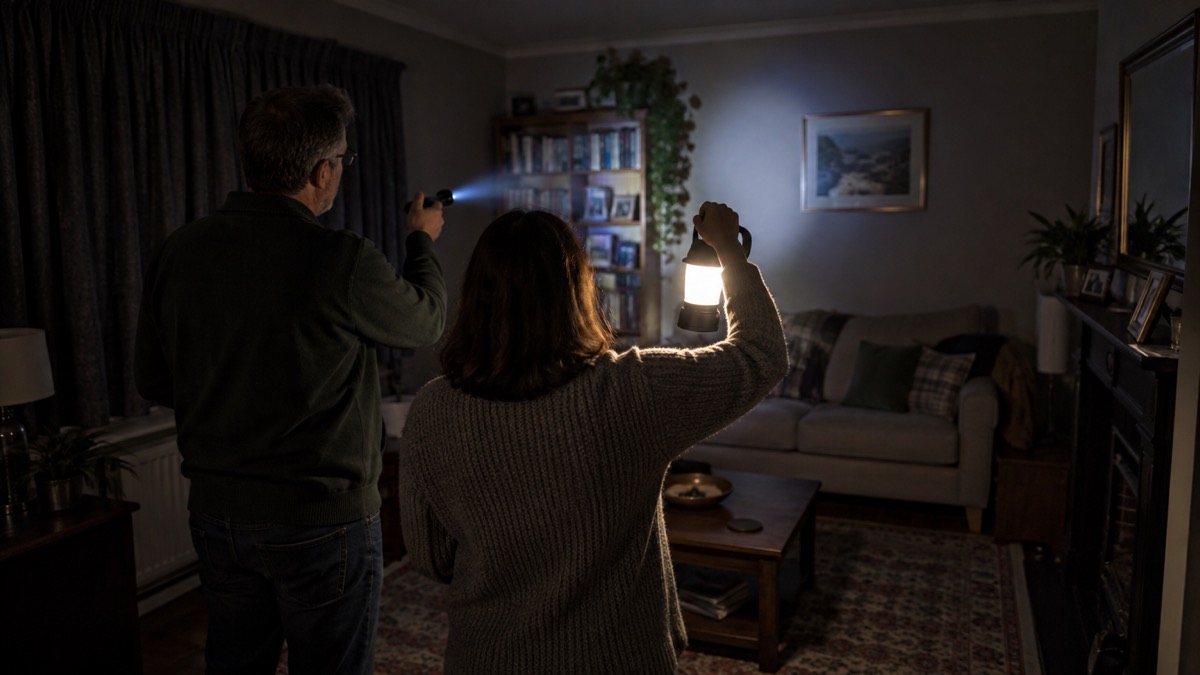
If the power goes off tonight, the light you reach for matters more than you might think. A torch throws a beam where you point it, which is what you want for checking the fuse box, finding the stopcock or moving down a dark hallway. A lantern spreads light around a room, so you can sit and read or eat without holding anything. Most well-prepared households keep both, plus a spare set of batteries for each.
The one thing the official advice is unanimous on is what not to use. National Grid says candles and paraffin lights can be dangerous, so it does not recommend using them during a power cut1. Other power cut guidance says not to use candles or paraffin heaters, and to keep wind-up, battery or solar powered torches ready instead2. A battery or wind-up torch, or a battery operated candle, gives you light without a flame in a room where the electricity has just failed.
This page sets out what to keep, where to keep it, how to store the batteries, and how to check a torch charger against a known recall. It is about choosing and using the light, not about buying a particular model.
Use a torch or lantern, never a candle, in a power cut
Every official source that mentions lighting in a power cut says the same thing: use a torch. The government's power cut preparation advice says to use a battery or wind-up operated torch or lantern instead of a candle, keep spare batteries and keep it in an easily accessible location3. Fire and rescue services across the UK repeat it. Suffolk Fire and Rescue Service advises using battery operated lights or torches as an alternative light source in a power failure8. National Grid says candles and paraffin lights can be dangerous, so it does not recommend using them during a power cut1.
The network operators, who deal with power cuts every day, are just as direct. National Grid says candles and paraffin lights can be dangerous and does not recommend using them during a power cut1. Its easy-read leaflet lists not using candles or paraffin heaters among its preparations9. Scottish and Southern Electricity Networks says to keep warm and use safe lighting such as torches rather than candles10. Northern Powergrid says to avoid candles because they can pose a fire risk, and that a battery-powered or wind-up torch is the safest option4.
"Candles and paraffin lights can be dangerous, so we don't recommend using them during a power cut."
If you want the flame look without the risk, battery operated candles are the answer. Cumbria Fire and Rescue Service describes them as heatless and flameless, using a small bulb to emit light instead of a lit flame11. Northern Ireland Fire and Rescue Service suggests having a torch or battery operated candles ready for a power cut12. For more on the alternatives, see LED Candles or Real Candles: Which Is Safer? and Candle Fire Safety at Home.
Torch or lantern: what each one does best
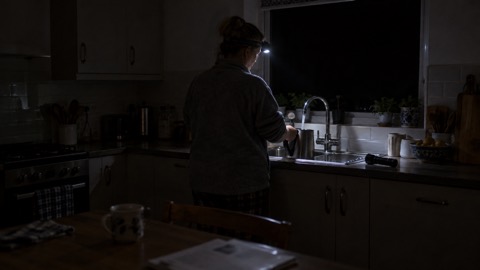
The choice comes down to what you are lighting. A torch is directional: it puts a bright spot where you aim it, which suits checking the consumer unit, reading a meter, or finding your way along a corridor. A lantern is diffuse: it lights a space so several people can sit in it, which suits a kitchen table, a living room or a child's bedroom during an evening without power.
| What you need it for | Better choice | Why |
|---|---|---|
| Checking the fuse box or meter | Torch | A aimed beam reaches into corners and cupboards13 |
| Moving around the house safely | Torch | Keeps your path lit without lighting the whole room13 |
| Sitting, eating or reading in one room | Lantern | Spreads light around rather than into one spot3 |
| Keeping hands free for care tasks | Head torch or chargeable lamp | Leaves both hands free14 |
| A light that never needs batteries | Wind-up torch or lantern | Requires no batteries at all5 |
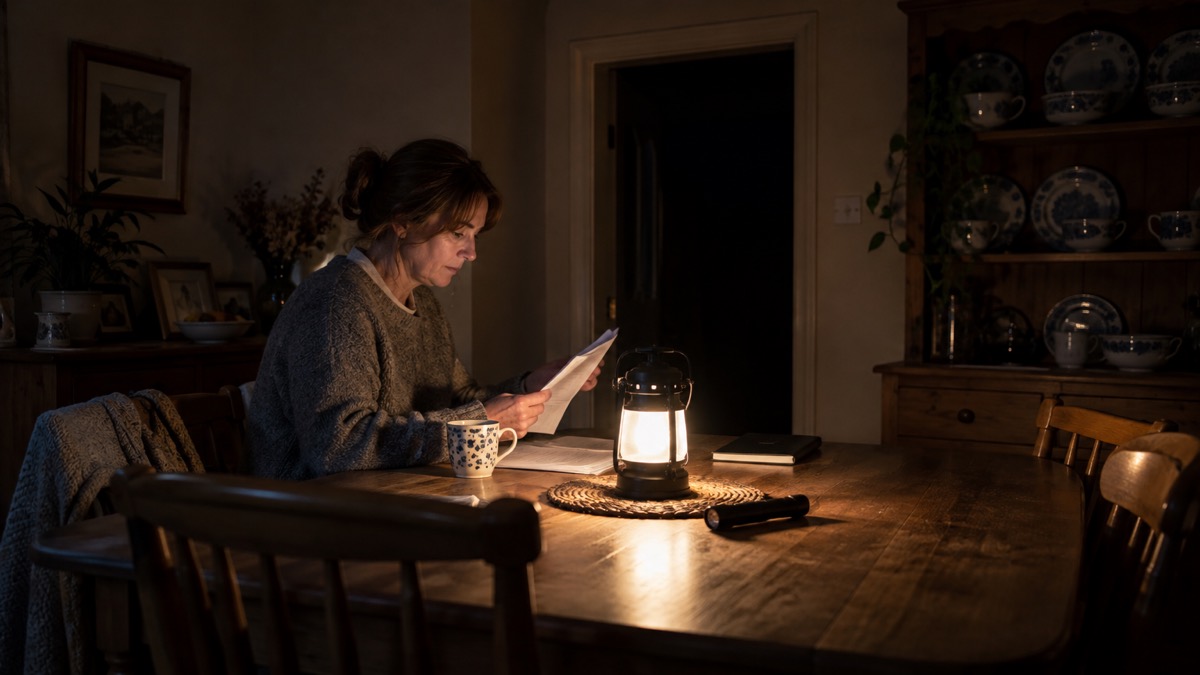
The Anglesey winter-ready advice puts it simply: store a battery or wind-up torch somewhere you can access easily, so you can use it to check the fuse box and move around the house safely13. That is the torch's job. The lantern's job is the room you sit in afterwards.
For households where someone needs care through the night, the NHS advice for families of technology-dependent children notes that chargeable lamps and head torches are useful because they leave your hands free for care such as suction, and suggests getting them in advance because there may be a shortage in the shops if an outage is announced14. More on this in Lights for Older and Disabled People in a Power Cut.
Keep spare batteries with every light
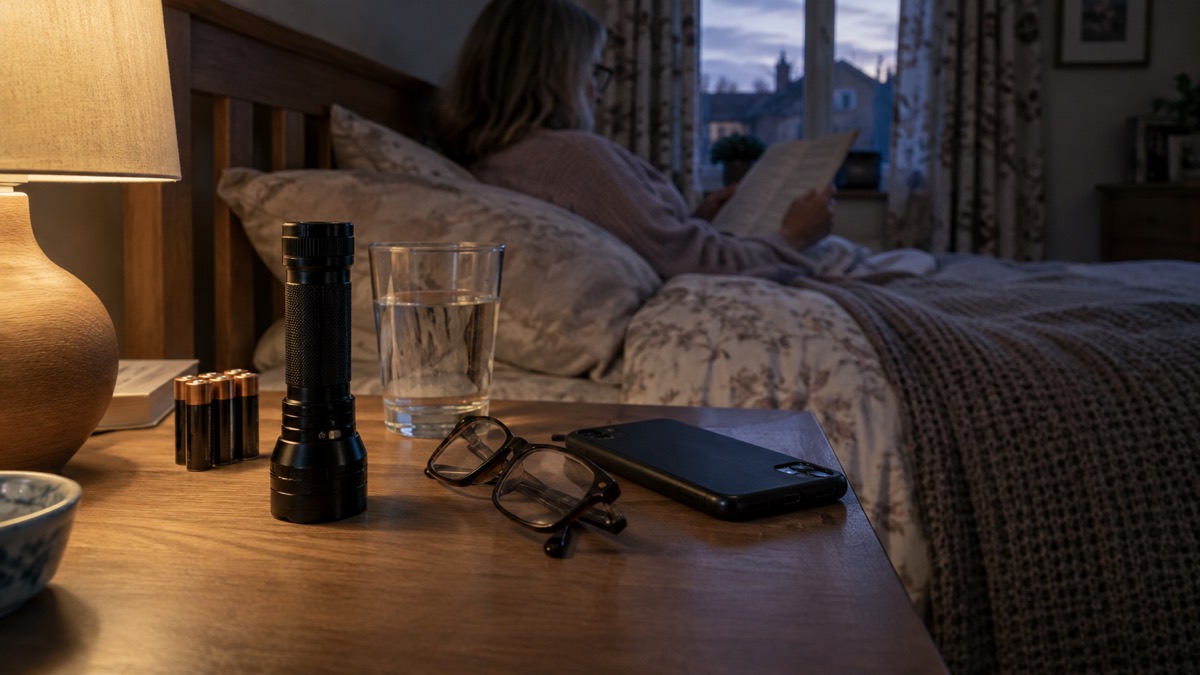
A torch without working batteries is a paperweight. The consistent advice is to keep the spare set with the light, not somewhere else in the house. National Grid says to keep a lantern or torch somewhere easy to find, check the batteries are working, and always make sure you have a spare set1. The Met Office winter checklist lists a torch and spare batteries together15. North Yorkshire Fire and Rescue Service says to keep a torch and spare batteries at home16.
The Horsted Keynes parish council's power cut tips add a point that matters in a household with more than one person: keep torches and spare batteries to hand in case the power cut happens when it is dark outside, and make sure everyone in the home knows where they are kept6. A light only one person can find is no use if that person is out.
- Keep the spare set with the torch, in the same drawer, box or hook1.
- Check the batteries work before winter and again at the start of any storm season1.
- Tell everyone in the household where the torches and batteries live6.
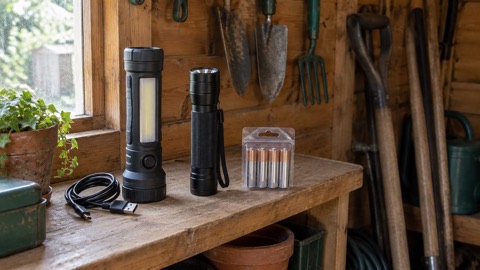
- Consider a separate battery charger so you can top up rechargeables without relying on the mains17.
- Store the power cut helpline number, 105, on your phone so you can report a cut once you have light18.
For a fuller list of sizes and types, see Spare Batteries to Keep for Your Lights and Torch Batteries: AA, AAA, 18650 and Built-In Packs.
A wind-up light needs no batteries at all
The strongest argument for a wind-up light is that it removes the one thing most likely to fail: the battery. Wiltshire and Swindon Prepared says wind-up torches or lanterns are available which require no batteries at all5. That makes them a sensible backstop for a household that does not want to think about battery rotation, or for a light kept in a car or a shed where batteries might corrode.
The Met Office's winter car kit advice makes the same case for the vehicle: a large torch with spare batteries, or a wind-up torch which does not require battery power, is essential for your vehicle, because a phone light will not really give you visibility if you are stuck by the side of a country road in winter19. That is a useful test of any emergency light: would it work if the batteries in it were flat and you had none to replace them?
Wind-up lights are not the only option. The Met Office's summer preparedness advice suggests knowing where you can find a torch and considering a separate battery charger17. The Scottish Government's emergency kit guidance lists a battery operated or wind-up radio, and the same logic applies to lights: either a battery light with spares, or a wind-up one that needs nothing20. Carmarthenshire Council's household emergency kit lists a battery torch with spare batteries, or a wind-up torch21.
| Type | Needs batteries | Suits | Watch out for |
|---|---|---|---|
| Battery torch | Yes, plus spares | Everyday use, checking the fuse box, moving around13 | Flat batteries if spares are not kept with it1 |
| Wind-up torch or lantern | No | A backstop light, a car kit, a shed5 | Needs winding to keep going |
| Rechargeable torch | Charging, not disposable batteries | Regular use, topping up before a storm17 | Needs mains power to recharge |
| Battery operated candle | Yes | A flame-free glow in a room11 | Light output is low compared with a torch |
For more on the battery-free options, see Solar and Wind-Up Lamps That Need No Batteries.
Where to keep a torch so you can find it in the dark
The advice is consistent: accessible, known to everyone, and in more than one place. Northern Powergrid says to keep a torch with spare batteries in an accessible location3. Other power cut guidance says to keep a torch handy in case you are without power during the night8. The Anglesey guidance explains why: so you can use the torch to check the fuse box and move around the house safely13.
In practice, that means a light by the bed, because a power cut at night is when you most need one, and a light near the door or the meter cupboard, because that is where you will go to investigate. A third in the kitchen helps if you are cooking when the power goes. The point is not the number but that each one is where a hand will reach for it without thinking.
- By the bed: so you are not searching in the dark if the power goes at night13.
- Near the meter or fuse box: so you can check the trip switch safely13.
- In the kitchen: so you can finish what you were doing.
- In the car: a large torch or wind-up torch for winter breakdowns19.
If the power goes off, Northern Powergrid's advice is to check whether neighbours or street lights still have power, then check your trip switch, which should be in the UP position, then call 105 or report it online22. Do that with a torch in your hand, not a flame.
Checking a torch charger against a recall
Rechargeable torches and their chargers are electrical products, and occasionally one is found to be unsafe. In June 2022, Electrical Safety First published a recall for an "18650 Lithium Battery Charger for LED Torch Rechargeable Flashlight with UK Plug", model number 2240514758657. The recall notice describes it as a black one-slot battery charger with a supply cord and a three-pin plug.
The safety warning is electric shock and fire7. When tested, the construction of the product was found to be unsafe. The notice says the creepage and clearance distances are insufficient, that the product failed a 3kV dielectric strength test between phase connectors and earth, and that the fuse fitted in the plug contained no silica and is considered counterfeit7. It also says the product is not supplied with an approved supply cord, that the plug does not meet the dimensional requirements of BS1363, and that the product is not compliant with the marking requirements of the relevant standard, with no instructions provided7.
The legal basis is set out plainly: the product does not meet the requirements of the Electrical Equipment (Safety) Regulations 2016 or the Plugs and Sockets Safety Regulations 19947.
To check your own equipment, look up the product on the Electrical Safety First product recall pages and compare the model number exactly. If it matches, follow the recall notice's instructions rather than continuing to use it. For more on spotting unsafe equipment, see Recalled and Unsafe Torches and Chargers: Checking and Reporting and Charging and Storing Rechargeable Torches Safely.
Getting the light you need before the next cut
The pattern across all the official advice is simple. Keep a torch, keep spare batteries with it, keep it where you can find it, and tell everyone in the house where it is. Add a lantern if you want to light a room rather than a spot, and a wind-up light if you want a backstop that needs no batteries at all. Never rely on a candle.
The wider emergency kit advice from the Scottish Government and Carmarthenshire Council puts a torch alongside bottled water and a wind-up radio, which is a fair picture of what a household actually needs when the power goes21. The National Risk Register makes the same point: keep basic supplies at home such as bottled water, a torch and batteries, which is safer than candles, and a wind-up radio to get updates during a power cut23.
If you are building the rest of your kit, start with Torches: Types and How to Choose One for Home and Battery and Rechargeable Lanterns for Lighting a Room. For the full picture of lighting through an outage, see Lighting Your Home Safely When the Power Goes Off and the Emergency Lighting at Home section.
Sources (24)
- Being prepared, National Grid, 2026
- nged-power-cut-leaflet.pdf, National Grid Electricity Distribution plc
- Tips to prepare for a power cut, Electricity North West, 2026
- What to do in a power cut, Northern Powergrid, 2026
- How to prepare for the loss of electricity, Wiltshire and Swindon Prepared, 2026
- 12 tips to prepare for a power cut, Horsted Keynes Parish Council, 2026
- 18650 lithium battery charger for LED torch recall, Electrical Safety First, June 2022
- Power cuts, Scottish Fire and Rescue Service, 2025
- Preparing for a power cut (easy read), National Grid, 2026
- Repeat power cuts, Scottish and Southern Electricity Networks, 2026
- Candle safety, Cumbria Fire and Rescue Service, 2026
- Storm Éowyn safety response, Northern Ireland Fire and Rescue Service, 2025
- Winter ready, Isle of Anglesey County Council, 2026
- Parental letter re power shortages, NHS North West Children's Operational Delivery Network, 2022
- WeatherReady winter poster, Met Office, 2026
- Staying safe in the snow, North Yorkshire Fire and Rescue Service, 2023
- 10 things you should do now to prepare for summer, Met Office, 2026
- Top tips to be weather ready, Met Office, 2026
- Winter car kit, Met Office, 2026
- Emergency kit, Ready Scotland, 2026
- Get prepared, Carmarthenshire Council, 2026
- Be prepared, Northern Powergrid, 2026
- National Risk Register, City of York Council, 2023
- National Risk Register, Cabinet Office, 2020
 LED Candles vs Real Candles
 Torch or Head Torch
 Rechargeable or Battery Torches