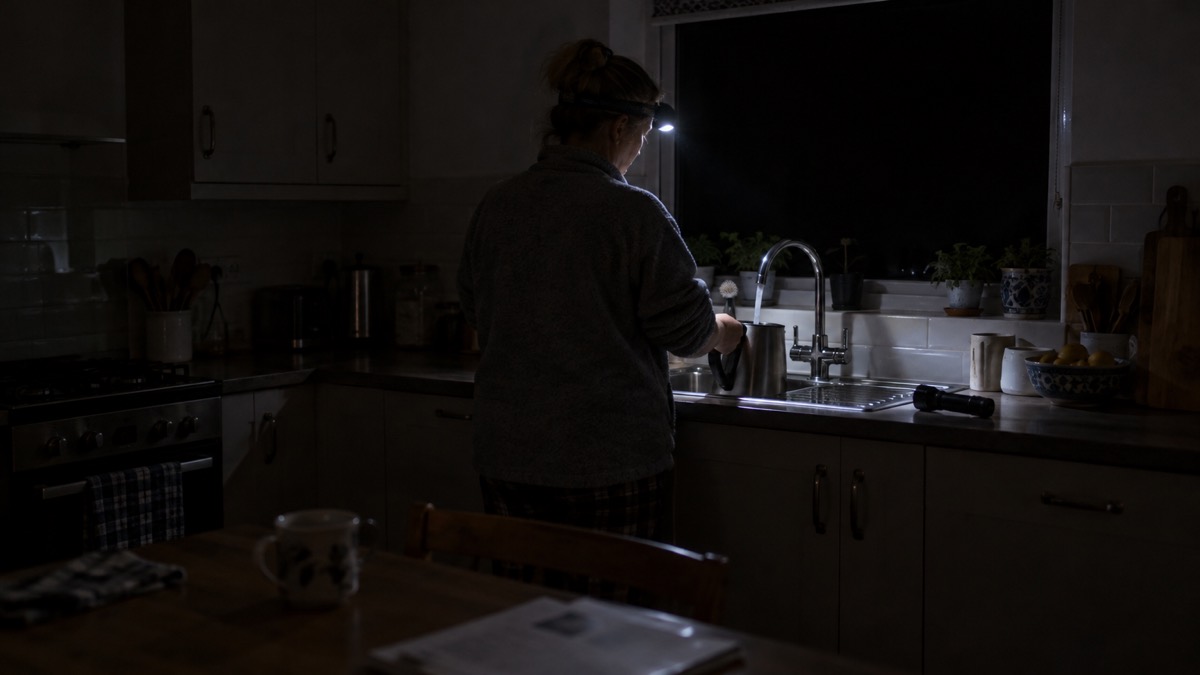
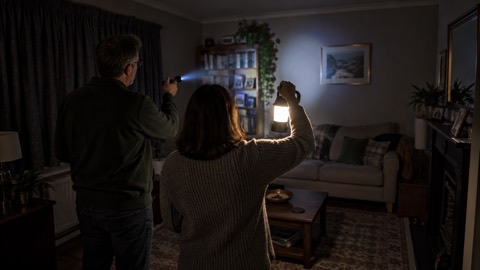
If the power goes off tonight, the light you reach for first should be a torch, not a candle. Government and fire and rescue service guidance is consistent on this: keep a battery or wind-up torch and spare batteries at home, because torches are safer than candles1. A head torch is the better choice when you need both hands free, for checking the fuse box, moving around the house or helping someone. A handheld torch is the better choice for lighting a room, signalling or handing to a child. Most well-prepared households keep both.
The practical answer is to have a torch you can find in the dark, a head torch for hands-free work, and spare batteries stored with them. Keep them somewhere you can reach easily so you can check the fuse box and make your way around the house safely2. Make sure everyone in your home knows where they are kept3.
This page sets out what official advice says about choosing between a torch and a head torch, how to store and check them, how to look after the batteries, and where to get help when the lights go out.
Keep a torch where you can reach it in the dark
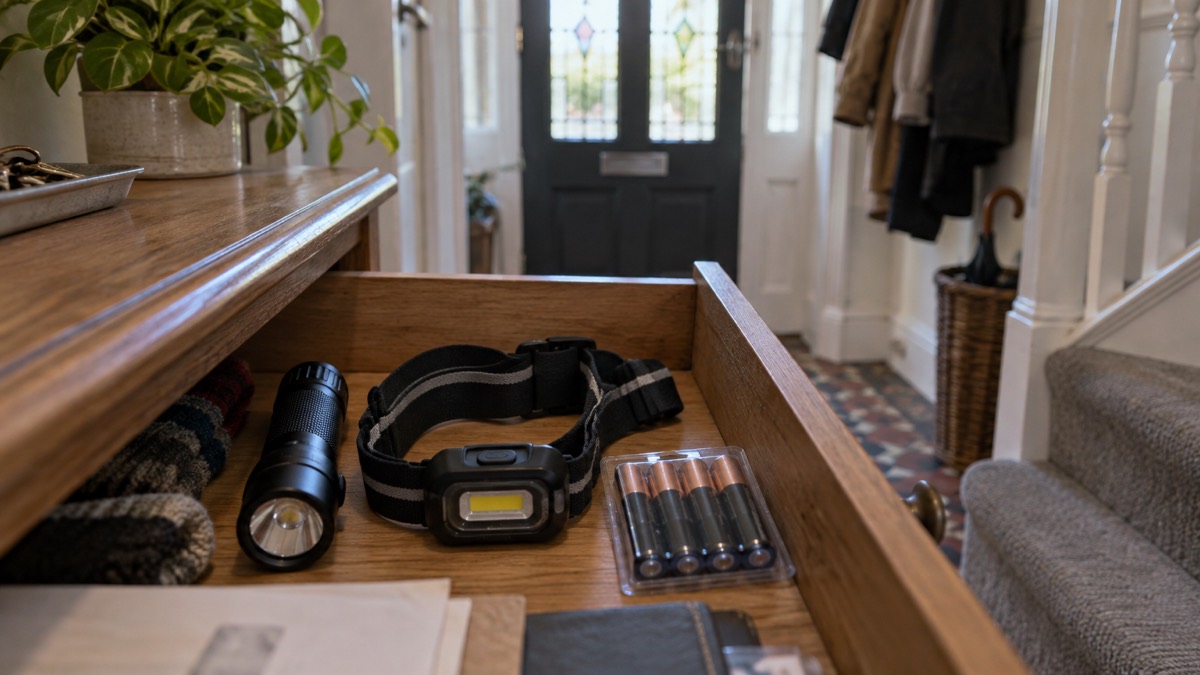
The single most useful thing you can do is decide now where your torches live and make sure everyone knows. Government guidance says to keep a torch handy7, and fire services add that torches and batteries should be kept in an easy to find place8. A torch buried at the back of a cupboard is no use when the power fails at night.
Store a battery or wind-up torch somewhere you can access easily, so you can use it to check the fuse box and make your way around the house safely2. Keep some torches and spare batteries to hand in case the power cut happens when it is dark outside, and make sure everyone in your home knows where they are kept3. Know where your torch is located and how you could easily put your hands on it4.
A few practical rules follow from that:
- Keep one torch by each bed, so you are not searching in the dark.
- Keep one near the front door or in a hallway drawer.
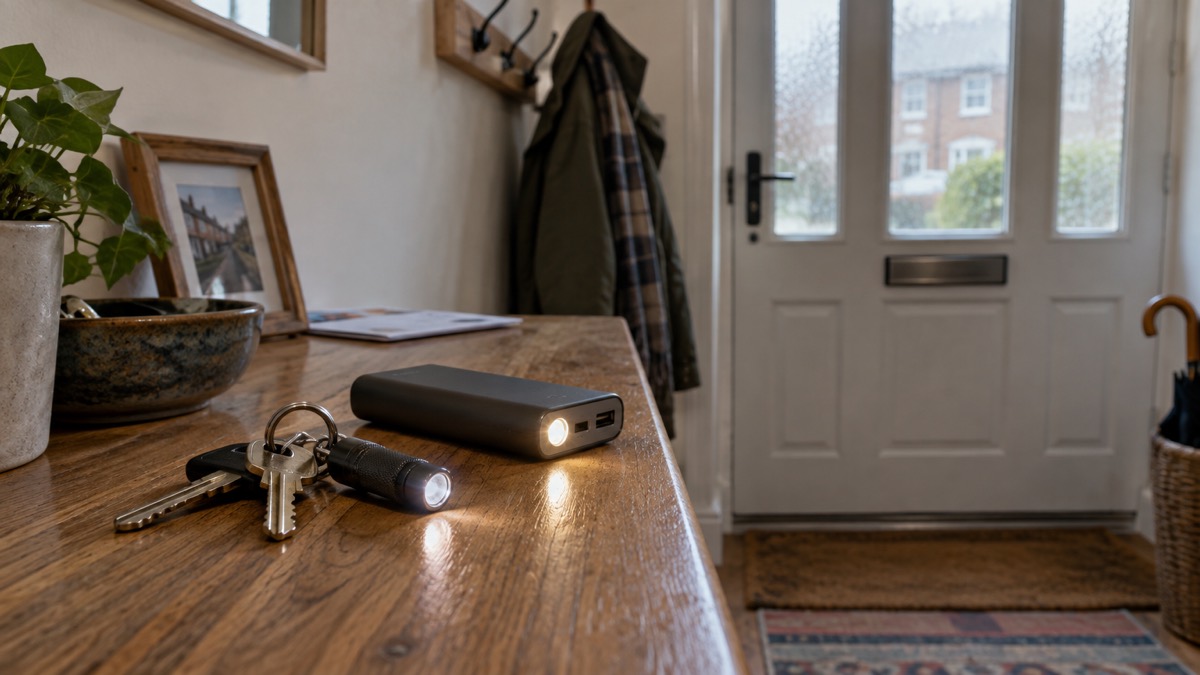
- Keep a small torch on your keys, so you always have a light with you.
- Tell children where the torches are and how to switch them on.
Battery-powered or wind-up: the safest light sources
Official advice is clear that torches and battery-powered lights are the safest way to light your home in a power cut. Keep a battery or wind-up torch and spare batteries at home, because torches are safer than candles1. Fire and rescue services advise using a standing electric torch or battery-powered lights in a power cut, because candles are a fire risk10.
The National Fire Chiefs Council lists LED candles and lights, and battery or wind-up torches, as safer products to light your home, and says it is much safer to use an LED candle or torch to light your way11. Suffolk Fire and Rescue Service advises using battery operated lights or torches as an alternative light source in the event of a power failure12.
So the choice is not really between a torch and a head torch for safety. Both are safe. The choice is about what each does best:
| Light source | What it does best | Who it suits |
|---|---|---|
| Handheld torch | Lighting a room, checking the fuse box, signalling | Every household; the default first light |
| Head torch | Hands-free work: repairs, first aid, moving around | Anyone who needs both hands free |
| Wind-up torch | No batteries to run down; works after long storage | Households that rarely check kit |
| Battery-powered lantern | Lighting a whole room from one spot | Families, older people, anyone wanting steady room light |
For more on how these compare, see Torches: Types and How to Choose One for Home and Head Torches for Power Cuts and Jobs in the Dark. If you want a light that fills a room rather than a beam, Battery and Rechargeable Lanterns for Lighting a Room sets out the options.
Candles versus torches: why official advice says torches
Every official source that addresses the question comes down on the same side. Candles can be used but they present a fire hazard, so it is best to stick with torches4. If your electricity goes off, preferably use a torch, oil or gas lamp as a source of light rather than candles13. Using LED candles, torches or battery lights are a brighter and safer alternative14.
The risk is not theoretical. Firefighters can be called to fires started by candles or portable heaters during a power cut8. That is why the advice is repeated across the UK: Northern Ireland guidance says to keep a supply of candles13, but the same guidance also says to prefer a torch, oil or gas lamp rather than candles13. If you do keep candles, treat them as a last resort and follow the safety rules on our Candle Fire Safety at Home page.
Spare batteries: keep them with the torch
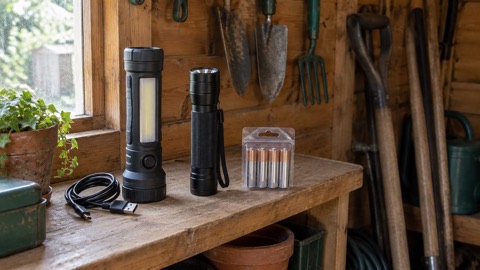
A torch without working batteries is a paperweight. Official guidance says to make sure you have spare batteries if the torch is battery operated4, and to use torches and make sure that you have spare batteries15. Keep a torch and spare batteries at home16, and include a battery-operated torch and spare batteries, or a wind-up torch, in your emergency kit17.
The Met Office winter checklist lists a torch and spare batteries as a single item18. That is the right way to think about it: the batteries are part of the torch, not a separate purchase to remember later.
- Store spare batteries in the same place as the torch, not in a kitchen drawer.
- Keep the size the torch needs: check before you buy.
- For rechargeable torches, keep the charger with the torch.
- Replace batteries before they leak, not after.
Our Spare Batteries to Keep for Your Lights checklist sets out what to keep for each type of torch, and Torch Batteries: AA, AAA, 18650 and Built-In Packs explains the differences.
Small backup lights: keyring torches and power banks with a torch
A single torch is a single point of failure. Official advice is to prepare battery candles, torches and batteries, and a mobile phone power pack in advance19. The essentials that could help you cope with a power cut are battery candles, torches and batteries, and a mobile phone power pack19.
Small backup lights earn their place because they are always with you:
- Keyring torches live on your keys, so you have a light even if the main torch is misplaced.
- Power banks with a built-in torch do two jobs: they recharge your phone and give you a light.
- Battery-powered lights can be left in a hallway or bathroom so there is always a light within reach.
For a phone torch, treat it as a backup only. It drains the battery quickly and leaves you without a phone for calls and information. The official advice to keep a mobile phone power pack alongside your torches19 is the practical answer: keep the phone charged, and keep a power bank to top it up.
Battery leaks and corrosion in a stored torch
A torch that has sat in a drawer for a year may not work when you need it. Batteries can leak and corrode the contacts, and a torch stored with batteries inside is at risk. The fire services warn that batteries can present a fire risk when over-charged, short-circuited, submerged in water or if they are damaged20. Water entering the battery or electrical components can cause short circuits, corrosion and battery failure21.
Lithium-ion batteries, the kind in many rechargeable torches, can overheat, catch fire or explode if improperly charged, handled, stored or disposed of22. A damaged battery can overheat and catch fire without warning and should be replaced, not used or charged23. Fires can result from overcharging batteries, charging devices on flammable surfaces such as on a bed or under a pillow, using batteries that are not recommended by the manufacturer, or exposing them to hot temperatures or water21.
To keep a stored torch ready:
- Check it every few months: switch it on and look at the beam.
- Look at the battery contacts for white or green crust, which means a leak.
- Remove batteries from torches you will not use for a long time.
- Store the torch somewhere dry, away from heat and water.
- Replace damaged batteries rather than charging them.
For rechargeable torches, our Charging and Storing Rechargeable Torches Safely page covers charging practice in more detail, and Can the Wrong USB Charger Damage a Torch Battery? explains why the charger matters.
Torches for children
A power cut can be frightening for children, and giving them their own torch helps. Fire services recommend providing children with a torch or glow stick as part of their costume at Halloween25, and ensuring children are visible by carrying glow sticks or torches25. The same principle applies at home: a child with their own light is calmer and easier to keep safe.
- Give each child a torch they can switch on themselves.
- Show them where it lives and how to change the batteries.
- Keep button and coin cell batteries well away from young children.
- Use a torch rather than a candle in a child's room.
Our Torches, Candles and Children: Keeping Them Safe page covers this in more detail, and Storing Spare Coin Cell Batteries Safely with Children explains the particular danger of small batteries.
Where to get help during a power cut
If your electricity is cut off because of an unplanned power cut, report it directly to your local network operator using their website, or call 105 for free5. Think about having the power cut helpline number, 105, somewhere accessible9. In Northern Ireland, contact NIE Networks on 03457 643 6436.
Check on relatives or neighbours who might need help during a power cut26. Community emergency hubs can help identify and assist vulnerable people, share out torches and lights to the most vulnerable, and liaise with the power company7. If someone in your household depends on powered medical equipment, contact their supplier or doctor without delay.
For more on preparing for a cut, see Power Cuts: A Household Guide and Lighting Your Home Safely When the Power Goes Off. Our Torches, Lanterns and Candles: Power Cut Checklist gives you a printable list to work through before the next cut.
Sources (26)
- Power cuts, GOV.UK, 2026
- Winter ready, Isle of Anglesey County Council, 2026
- 12 tips to prepare for a power cut, Horsted Keynes Parish Council, 2026
- How to prepare for the loss of electricity, Wiltshire and Swindon Prepared, 2026
- Check if you can get payment for a power cut, Ofgem, 2026
- Strong winds weather warning: information and advice, nidirect, 2026
- Emergency contact hub leaflet, Wiltshire and Swindon Prepared, 2025
- Power cuts, Scottish Fire and Rescue Service, 2026
- 10 things you should do now to prepare for summer, Met Office, 2026
- Safety in severe weather conditions, Devon and Somerset Fire and Rescue Service, 2026
- Cost of living toolkit, National Fire Chiefs Council, 2022
- Lighting factsheet, Suffolk Fire and Rescue Service, 2014
- Strong winds and heavy rain warning: information and advice, nidirect, 2026
- Stay fire safe leaflet, National Fire Chiefs Council, 2023
- Power, gas and water: what if they fail, Surrey County Council, 2026
- Staying safe in the snow, North Yorkshire Fire and Rescue Service, 2023
- Emergency kit, Ready Scotland, 2026
- WeatherReady_Poster_Winter2026_Englishpdf, Met Office
- Stay safe in a thunderstorm, Met Office, 2026
- Batteries and chargers, London Fire Brigade, 2026
- Heat, cold and rain: how weather conditions affect e-bikes and e-scooters, London Fire Brigade, 2026
- Lithium battery fire safety, Mid and West Wales Fire and Rescue Service, 2026
- E-bike and e-scooters, Scottish Fire and Rescue Service, 2026
- Recycle your batteries to prevent fires, Devon and Somerset Fire and Rescue Service, 2024
- Don't let flames play tricks on your treats this Halloween, Northern Ireland Fire and Rescue Service, 2025
- Community emergency planning guide: prepare, Ready Scotland, 2026
 LED Candles vs Real Candles
 Lantern vs Torch
 Rechargeable or Battery Torches