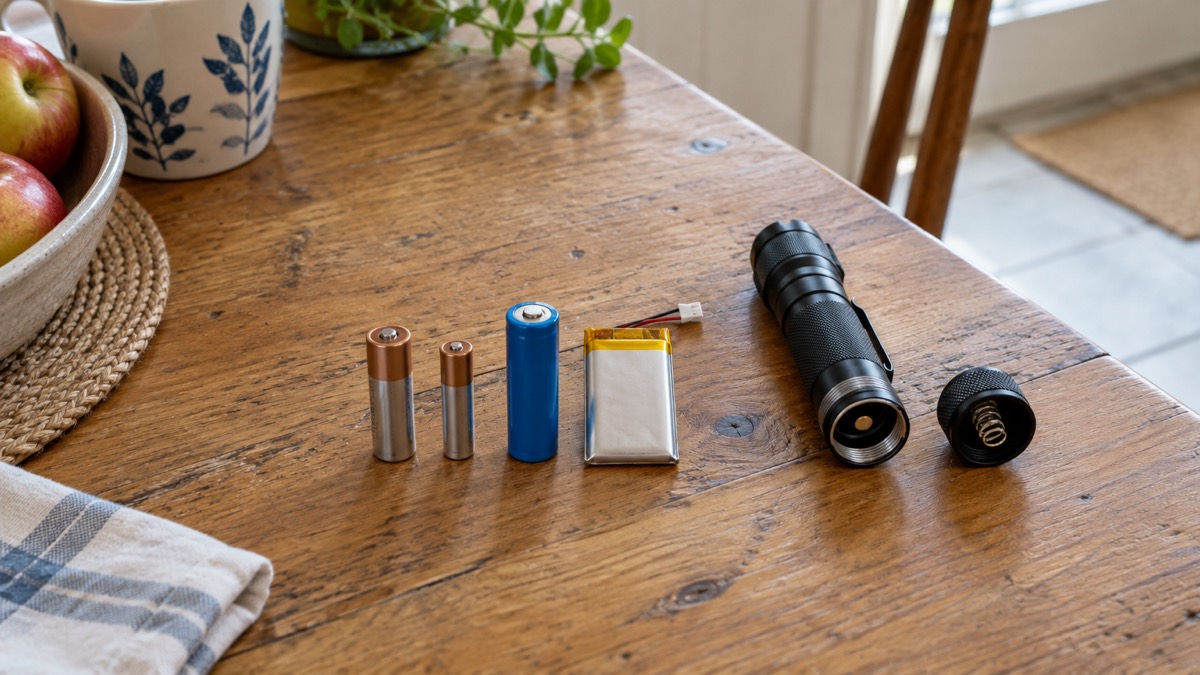
Most household torches run on one of four things: ordinary AA or AAA alkaline cells you buy anywhere, rechargeable AA or AAA cells, a removable lithium-ion cell such as an 18650 or 21700, or a lithium-ion pack built into the torch and charged by USB. Which one yours takes is written in the maker's instructions and usually printed inside the battery compartment, and it decides everything else: what spares to keep, how to charge, and how careful you need to be.
The government's power cut advice is simple on the main point: keep a battery or wind-up torch, and spare batteries, at home, because torches are safer than candles [S71]. Local resilience advice adds that you should make sure you have spare batteries if the torch is battery operated [S33]. If your torch has a built-in pack, your "spare battery" is a full charge, kept topped up and checked before winter.
This page explains each battery type, how to store and charge it safely, what to do if a cell leaks, swells or overheats, and how to dispose of batteries when they reach the end of their life. For choosing the torch itself, see Torches: Types and How to Choose One for Home, and for the wider picture see Emergency Lighting at Home.
How to tell which battery your torch takes
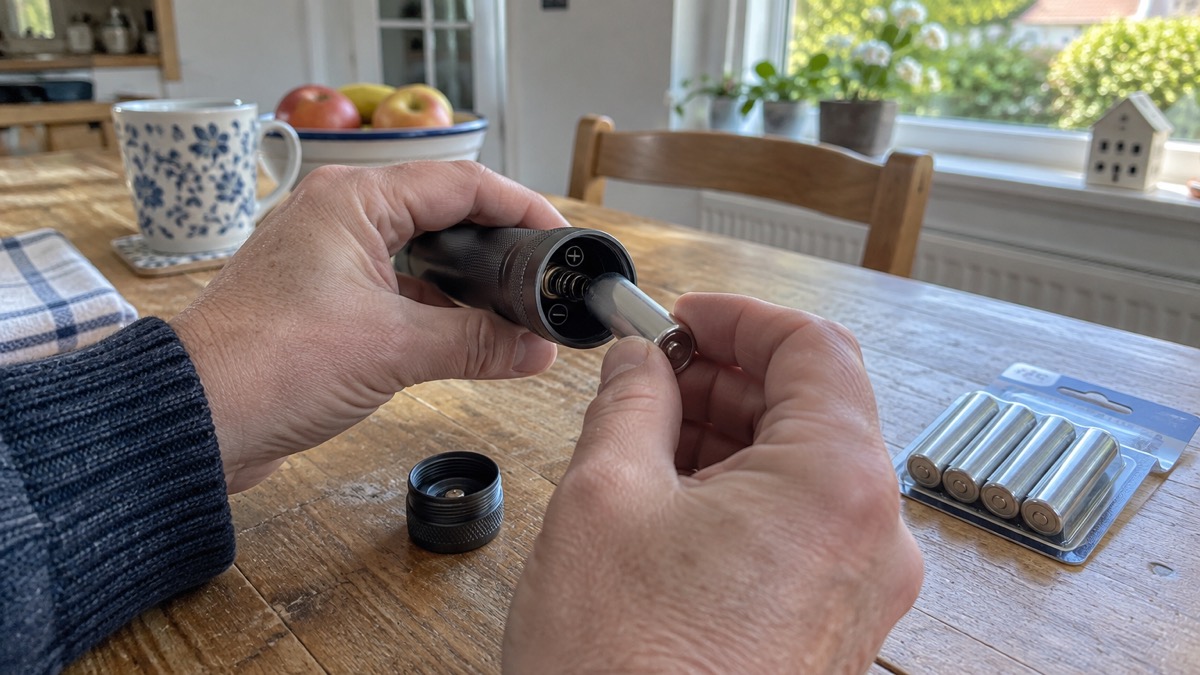
Start with the maker's instructions or the product page for your exact model. Makers state the battery type plainly. NEBO's Torchy 2K, for example, is listed as taking a 2200 mAh Li-ion 18650 rechargeable battery1. Ledlenser's P3 Core takes a single AAA alkaline 1.5V cell, included in the box, while the P7R Core in the same set takes a 21700 Li-ion cell of 4,800 mAh at 3.7V, also included and replaceable2. Two similar-looking torches from the same maker can therefore take completely different batteries, so always check the model, not the brand.
If you no longer have the instructions, open the compartment and read what is printed there, or read the label on the cells already inside. The names tell you the format: AA and AAA are the familiar cylinders, and 18650 and 21700 are larger lithium-ion cells named for their dimensions. A torch that charges by USB with no compartment at all has a built-in pack.
One point that catches people out: the two large lithium-ion formats are not interchangeable. Ledlenser states that the 18650 and 21700 cells are physically different sizes and cannot be swapped between torch formats3. If your torch uses a 21700 battery, Ledlenser directs you to its single-cell or dual-cell 21700 chargers; if it uses 18650 cells, you need the 18650 format instead3. Buying the wrong spare is a waste, and forcing a cell that does not fit is a risk, so confirm the format before ordering.
AA and AAA alkaline cells: what most household torches run on
The ordinary alkaline AA and AAA cell is still the default for small household torches, and it has real advantages for emergency use. You can buy it almost anywhere, it sits in a drawer for years without needing a charger, and you can carry spares without worrying about charging cables. Ledlenser's P3 Core, a pocket torch, ships with one AAA alkaline 1.5V battery in the box2.
The trade-off is that alkaline cells are single-use: when one runs flat it goes to recycling, not back into a torch. That makes spare batteries part of the deal. Every official emergency kit list includes them:
- The UK government's power cut guidance: keep a battery or wind-up torch, and spare batteries, at home; torches are safer than candles4
- Wiltshire and Swindon Local Resilience Forum: make sure you have spare batteries if the torch is battery operated5
- The Scottish Government's emergency kit advice: a battery-operated torch and spare batteries, or a wind-up torch6
- The Met Office's WeatherReady winter checklist: torch and spare batteries7
- The Met Office winter car kit: a large torch with spare batteries, or a wind-up torch which does not require battery power8
- Devon and Somerset Fire and Rescue Service's severe weather kit: a battery powered torch or battery powered candles9
One habit worth avoiding in a power cut: relying on your phone's torch. The government's power cut guidance notes you probably will not want to use the torch on your mobile phone, as this will drain its batteries more quickly10, and local resilience advice says to use it only in emergencies for short periods because it drains the battery heavily5. A torch with its own spare cells keeps your phone alive for calls and updates. For more on this, see Lighting Your Home Safely When the Power Goes Off.
Rechargeable AA and AAA cells and chargers
Rechargeable AA and AAA cells, usually NiMH chemistry, give you the same familiar format with the ability to refill from the mains, which suits a household that wants to top up its emergency lighting before a storm rather than buy fresh cells each time. The maker's compatibility note matters here. Ledlenser states the P3 Core is also compatible with AAA NiMH 1.2V rechargeable batteries, charged externally, and notes that the lower voltage may marginally affect maximum output2. That is the pattern to expect across brands: rechargeable cells work, but they run at 1.2V rather than the alkaline 1.5V, and the maker may say the light is very slightly less bright at full charge.
Because NiMH cells are charged externally, you need a separate charger, and the same charger-safety rules apply as for any battery charger: use a genuine charger from a trusted supplier, charge it where you can see it, and do not cover it while charging. The comparison between single-use and rechargeable torches, and what each means for a power cut, is set out in Rechargeable or Battery Torches for Emergencies, and the wider options for keeping devices alive are in Backup Power at Home.
A sensible arrangement for an emergency kit is a mix: a torch that takes alkaline cells as the fallback that will always work, plus rechargeable cells kept charged for regular use, plus a packet of spare alkalines in the kit box. That way a flat rechargeable cell never leaves you without light.
18650 and built-in lithium-ion packs: lightweight, energy dense, more volatile
The larger torches, and most torches charged by USB, use lithium-ion batteries. Mid and West Wales Fire and Rescue Service describes them plainly: they are lightweight, energy dense and long-lasting but can be more volatile than traditional batteries [S23]. The London Fire Brigade makes the same point in everyday terms: lithium batteries are the lightweight, rechargeable batteries that power our phones, laptops and cameras [S24]. These batteries are found in lots of household items, including mobile phones, laptops and vapes, as well as larger products like e-bikes, e-scooters and hoverboards [S55]. Torch batteries are one small corner of that picture, and the safety rules are the same.
| Battery type | What it is | Swappable? | What to keep as backup |
|---|---|---|---|
| AA / AAA alkaline | Single-use 1.5V cell, sold everywhere | Yes | Spare cells in the kit box4 |
| AA / AAA NiMH | Rechargeable 1.2V cell, charged externally | Yes | Charged cells plus a charger2 |
| 18650 | Removable lithium-ion cell, e.g. 2200 mAh in the NEBO Torchy 2K | Yes, in torches built for it | A charged spare cell1 |
| 21700 | Larger removable lithium-ion cell, e.g. 4,800 mAh in the Ledlenser P7R Core | Yes, in torches built for it | A charged spare cell2 |
| Built-in pack | Lithium-ion pack sealed in the torch, charged by USB | No | A full charge, checked regularly1 |
Two examples show how the formats work in practice. The NEBO Torchy 2K takes a 2200 mAh Li-ion 18650 rechargeable battery that can be removed: to charge it, you remove the battery and insert the USB-C cable into the charging port on the battery itself, with a red indicator meaning charging and green meaning fully charged1. The torch also tells you its own state: the power button illuminates orange above 25% charge and flashes continuously at one second intervals below 25%1. The Ledlenser P7R Core takes a 4,800 mAh 21700 Li-ion cell that is replaceable when it eventually degrades, and charges by a magnetic cable2. It also has an emergency light feature that automatically activates if mains power fails while the torch is charging, with no setup needed2, which is a genuine convenience in a power cut.
A built-in pack is the simplest to live with, nothing to lose or insert wrongly, but it has one limit worth knowing: when the pack eventually wears out, the torch is electrical waste unless the maker sells a replacement pack, as Ledlenser does for the P7R Core's cell2. A removable-cell torch can be revived with a new cell indefinitely.
Storing spare batteries so they are ready in a power cut
Storage has two jobs: keeping spares findable and charged, and keeping them safe. On the first, Electricity North West's advice for power cuts is to keep a battery-operated or wind-up torch somewhere easy to find [S40], and NIE Networks advises keeping a torch and spare batteries in an easily accessible place [S41]. Household power cut kit advice likewise pairs a torch with charged batteries or a wind-up dynamo torch, within easy reach [S37]. Keep the torch and its spares together, in the same place, so neither is useless without the other. Our page on where to keep torches so you can find them in the dark covers the placement in detail, and the spare batteries checklist lists what to hold.
On safety, the advice depends on the battery. For households with children, Alder Hey children's hospital advises keeping spare batteries in a locked cabinet or box11, a rule that matters most for button cells, which are dangerous if swallowed, but which is good practice for all small cells. For lithium-ion cells and packs, Mid and West Wales Fire and Rescue Service advises taping over the terminals with electrical tape to prevent short circuits and fire risk when they are not in use12. Scottish Fire and Rescue Service warns that where lithium-ion batteries fail they can explode or lead to a rapidly developing fire, and that the ferocity of a fire caused by one can be significant and prevent you escaping from your home13, so a little care in storage is proportionate, not fussy.
In winter, the London Fire Brigade's advice on lithium-ion batteries in cold weather is to avoid leaving your battery outside overnight, but if you are keeping it indoors, make sure it will not block your escape route if it starts a fire14. That applies to a spare e-bike battery more than a torch cell, but the principle is the same: charge and store batteries away from doors and hallways you would need to get out through.
Safe charging: the charger that came with the torch, never overnight or covered
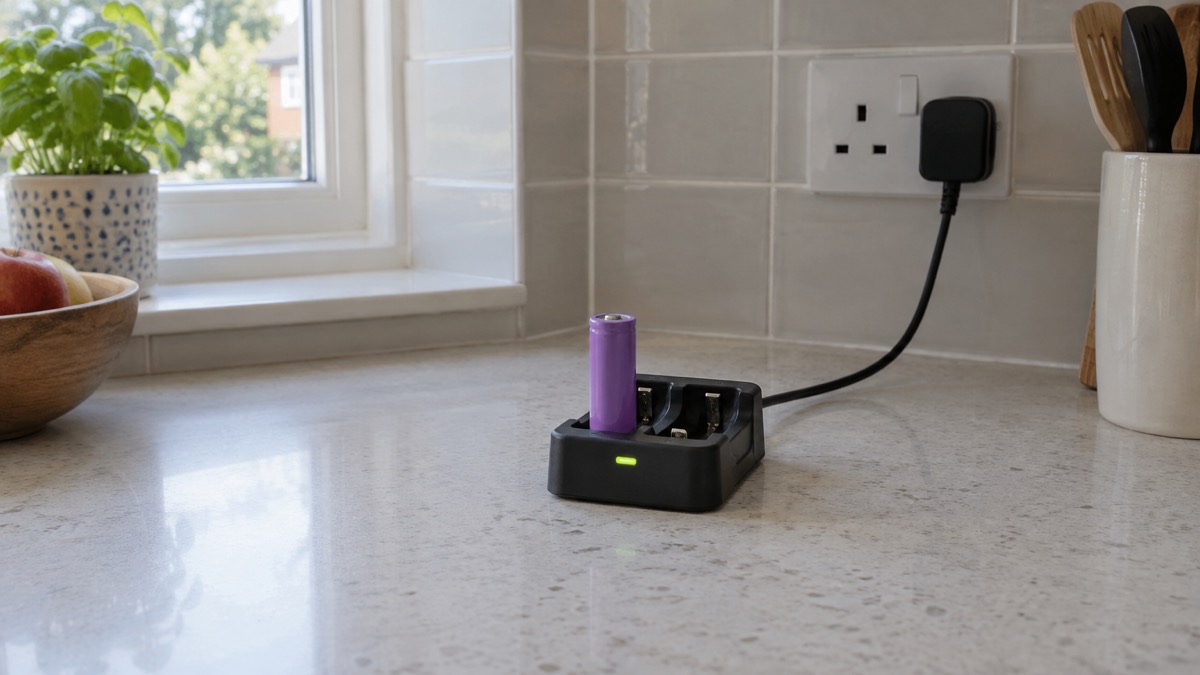
The charging rules for lithium-ion torch batteries are the same as for any lithium-ion device, and fire and rescue services give the same instructions. Mid and West Wales Fire and Rescue Service: always use the charger that came with your device or a genuine replacement from a trusted supplier, because cheap chargers and batteries may not meet UK safety standards and can be dangerous12. Devon and Somerset Fire and Rescue Service lists the causes of lithium-ion battery fires as overcharging batteries, charging devices on flammable surfaces such as a bed or under a pillow, using batteries that are not recommended by the manufacturer, and exposing them to hot temperatures or water15.
The two habits to build are these:
- Charge while you are awake and in the room. Devon and Somerset Fire and Rescue Service says it is never a good idea to charge an electrical product overnight, especially one containing lithium-ion batteries, because fires at night when people are sleeping are particularly dangerous as your reaction time is massively reduced; charge during the day instead, and away from escape routes16. The London Fire Brigade's vaping safety advice puts it flatly: never leave the device charging unattended or on overnight17.
- Never cover the charger, battery or device while charging. Scottish Fire and Rescue Service: do not cover the charger, battery or device while charging, as this can cause overheating or even a fire13. The London Fire Brigade says the same, including using a laptop power lead in bed18, and the National Fire Chiefs Council's e-bike guidance adds not covering chargers or battery packs19.
On replacement chargers, be careful what you buy. Electrical Safety First published a recall notice in June 2022 for an 18650 lithium battery charger sold for LED torches, in which the fuse fitted in the plug contained no silica, and the fuse and supply cord were considered counterfeit20. A charger that looks like the original is not necessarily built like it. Check our page on recalled and unsafe torches and chargers before buying replacements, and whether the wrong USB charger can damage a torch battery for the detail. The full charging routine, including how often to top up a stored torch, is in Charging and Storing Rechargeable Torches Safely.
If a battery leaks, swells or overheats
A swollen, hot or hissing lithium-ion cell is a warning sign, and the risks are real. Official guidance notes that when a lithium-ion battery is overcharged or overheated, it can rapidly overheat, release toxic fumes, and ignite, causing intense fires that are hard to extinguish [S44]. Devon and Somerset Fire and Rescue Service adds that overcharging, charging too long or with too much voltage, can cause overheating and fires [S56]. Mid and West Wales Fire and Rescue Service warns that if a lithium-ion battery is improperly charged, handled, stored or disposed of there is a risk of overheating, catching fire or explosion [S23].
If you notice a cell or pack swelling, getting hot, or smelling strange, stop using it and stop charging it. Move it onto a hard surface away from anything flammable if you can do so safely, and do not put it in the bin: a damaged battery is exactly the kind that causes waste fires, and it must go to a recycling point as described below.
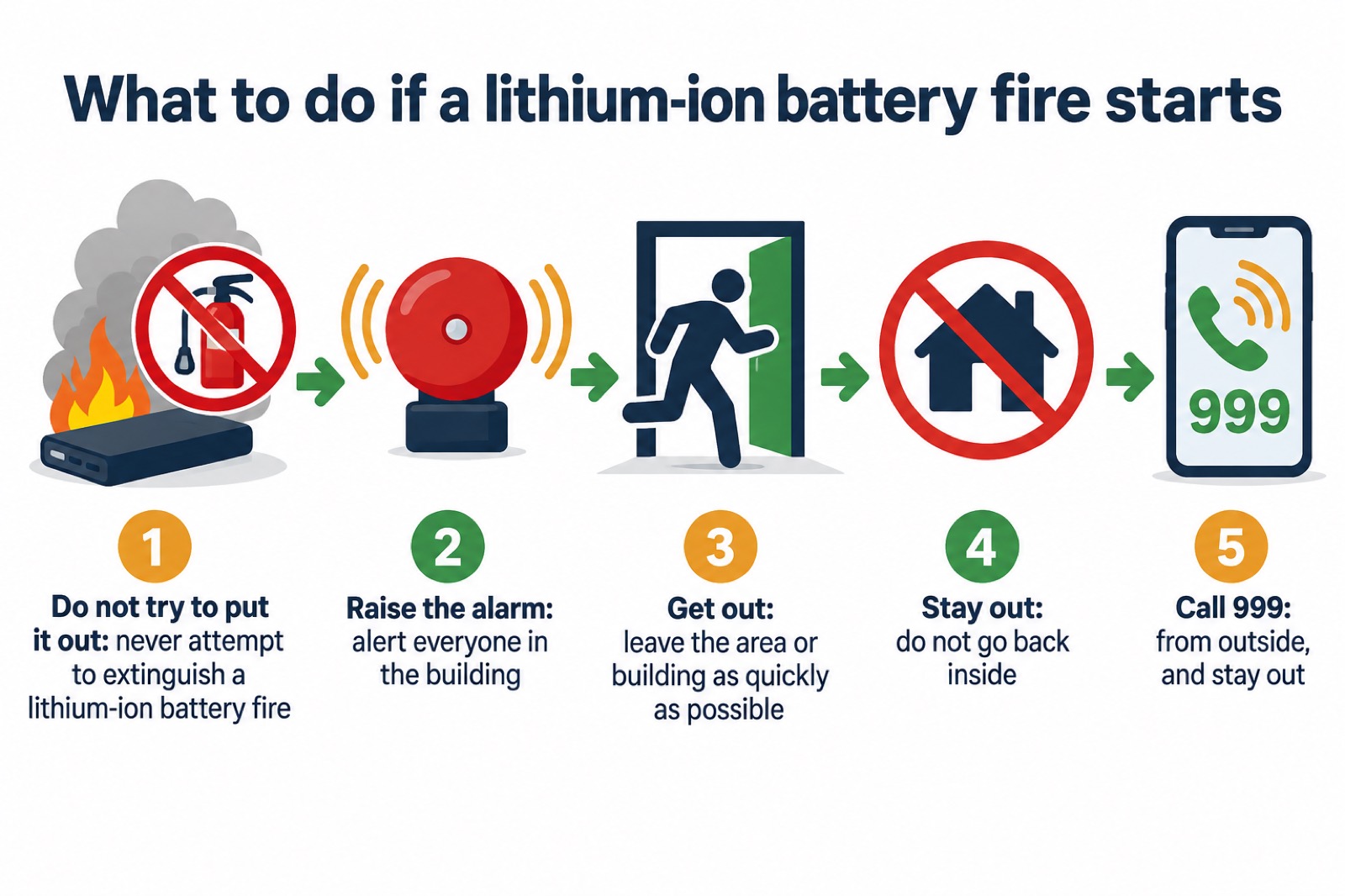
If a lithium-ion battery fire actually starts, the advice from every fire service is the same and it is not to fight it:
"In the event of an e-bike, e-scooter or lithium-ion battery fire, do not attempt to extinguish the fire. Get out, stay out and call 999."
Scottish Fire and Rescue Service21
The UK government's guidance is equally direct: people should never try to extinguish lithium-ion battery fire themselves, but leave the area or building as quickly as possible and call 99922. The London Fire Brigade's first instruction for an e-bike or e-scooter battery fire is to raise the alarm, alerting everyone in the building23. South Wales Fire and Rescue Service gives the same rule for lithium-ion batteries generally: in the event of a fire, get out, stay out, call 99924.
One reason not to relax even if a fire seems to have gone out: Devon and Somerset Fire and Rescue Service warns that these fires can spread quickly, are difficult to extinguish and can reignite after appearing to have gone out25. If you do keep a fire extinguisher at home, Devon and Somerset Fire and Rescue Service advises recharging it after use26. There is also a specific warning for households with medical equipment: Devon and Somerset Fire and Rescue Service notes that the emergency battery backup on dynamic airflow pressure relieving mattresses may continue to pump air, which can cause the fire to burn longer and with greater intensity27.
Batteries never go in household waste
However a battery dies, flat, swollen or damaged, it does not go in the bin. This is one point on which the safety advice is unanimous, and the reason is concrete: batteries put into general household waste can get crushed or punctured on the way to recycling, releasing flammable electrolytes which can trigger explosions and rapidly spreading fires [S69]. The advice on battery fires in the waste stream is plain: batteries of all kinds, whether loose or hidden in electricals, should never be binned, always recycled [S76].
The rules, gathered from official guidance:
- Never throw lithium batteries in household rubbish12, and never place them in the same bins as your regular rubbish or recycling28
- Damaged or end-of-life batteries must not go in household waste or normal recycling: punctured or crushed, they can cause fires in bin lorries, recycling and waste centres21
- Most local recycling centres accept lithium-ion batteries, to be disposed of alongside Waste Electrical and Electronic Equipment (WEEE) items; check with your local authority for your area's guidelines13
- If the battery cannot be removed, for example in a small sealed device, treat the whole item as electrical waste12
- Tape over the terminals of batteries heading for recycling, with electrical tape, to prevent short circuits and fire risk on the journey12
- Check your local authority's website or the recycle your electricals website for the safe disposal route in your area28
For a torch with a removable cell, that means the flat 18650 or 21700 comes out and goes to a recycling point with taped terminals. For a torch with a sealed built-in pack, the whole torch is electrical waste at a WEEE collection point. Either way, it never goes in the kitchen bin or the recycling caddy, however small and flat it looks. See also Are Flat Button Batteries Still Dangerous? and Storing Spare Coin Cell Batteries Safely with Children.
Sources (29)
- NEBO Torchy 2K rechargeable USB-C torch, NEBO Tools
- Ledlenser P7R Core and P3 Core combo set, Ledlenser
- Ledlenser FLEX10 PowerbankPLUS charging bank, Ledlenser
- Power cuts: be prepared, Prepare (UK government campaign)
- How to prepare for the loss of electricity, Wiltshire and Swindon Local Resilience Forum
- Emergency kit, Ready (Scottish Government campaign)
- WeatherReady winter checklist, Met Office, 2026
- Winter car kit, Met Office
- Safety in severe weather conditions, Devon and Somerset Fire and Rescue Service
- Be informed about hazards: power cuts, Be Ready (UK government campaign)
- Swallowed something, Alder Hey Children's NHS Foundation Trust
- Lithium battery fire safety in the home, Mid and West Wales Fire and Rescue Service
- Lithium-ion batteries at home, Scottish Fire and Rescue Service
- Heat, cold and rain: how weather conditions affect e-bikes and e-scooters, London Fire Brigade
- Recycle your batteries, prevent fires, Devon and Somerset Fire and Rescue Service, 2024
- Battery fires, Devon and Somerset Fire and Rescue Service
- Vaping and e-cigarettes, London Fire Brigade
- Batteries and chargers, London Fire Brigade
- E-bikes and e-scooters fire safety guidance, National Fire Chiefs Council
- 18650 lithium battery charger for LED torch: recall notice, Electrical Safety First, 2022
- E-bike and e-scooter safety at home, Scottish Fire and Rescue Service
- Buy safe, be safe: avoid e-bike and e-scooter fires, UK government
- What to do if there's a fire caused by an e-bike or e-scooter, London Fire Brigade
- Lithium-ion batteries, South Wales Fire and Rescue Service
- Residents urged to think before binning batteries, Devon and Somerset Fire and Rescue Service
- Fire safety equipment at home, Devon and Somerset Fire and Rescue Service
- Specialist health equipment fire safety, Devon and Somerset Fire and Rescue Service
- How to dispose of batteries from your e-bike or e-scooter, London Fire Brigade
- E-bikes and e-scooters fire safety advice, South Wales Fire and Rescue Service
 Spare Batteries for Lights
 Candle Safety Checklist
 Lighting Checks Before Winter
 Lighting Home in a Power Cut
 Choosing a Torch for Home
 Head Torches for Power Cuts
 Lanterns for Lighting a Room
 Emergency Bulbs
 Solar and Wind-Up Lamps
 Lumens and Beam Distance
 Charging and Storing Torches
 Candle Fire Safety at Home
 Lights for Disabled People
 Torches, Candles and Children
 Recalled Torches and Chargers