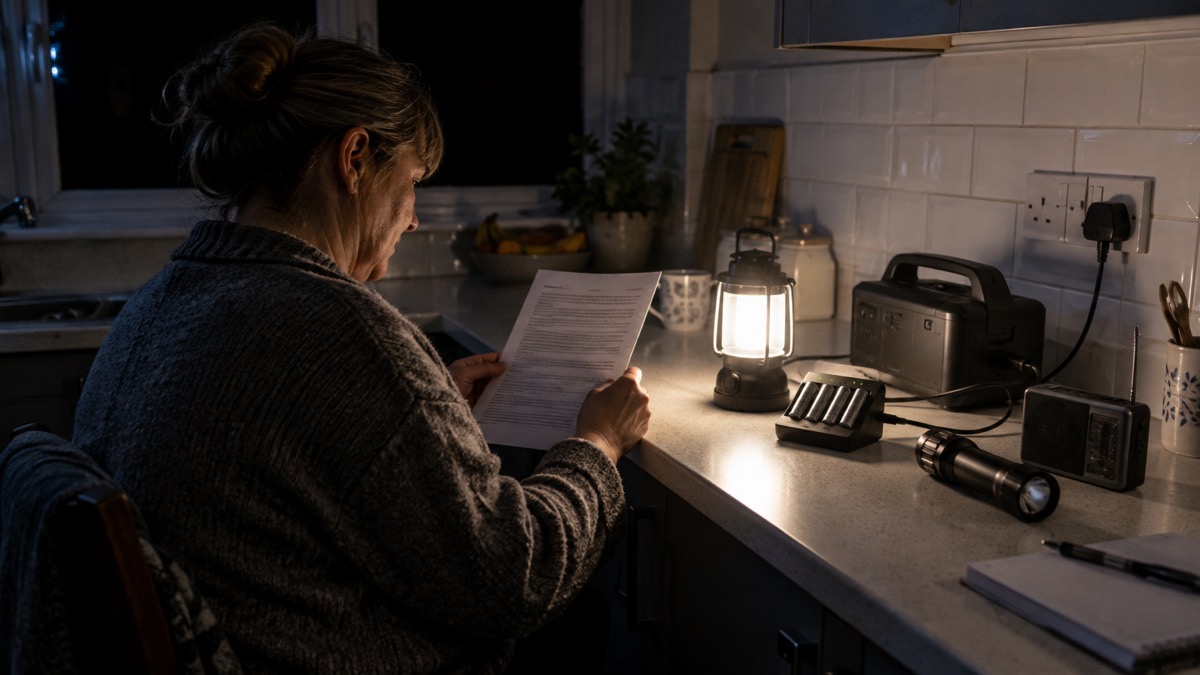
Official preparedness advice in the UK puts a torch and spare batteries near the top of the household kit list. The Prepare campaign's power cut advice is simple: "Keep a battery or wind-up torch (and spare batteries) at home. Torches are safer than candles."1 Batteries are not a niche prepping item: they are among the first things official advice tells you to keep at home.
This page is about the cells themselves: whether to keep rechargeable or alkaline batteries for an emergency, which chargers work with which cells, how to charge and store them safely, and what to do when a battery leaks or reaches the end of its life. Torch and lantern choice itself is covered in our emergency lighting guide, and keeping phones charged is covered in our power banks guide.
What official advice says to keep
Start with the kit lists, because they tell you what the batteries are actually for. The household emergency kit advice is consistent across the four nations. The nidirect household emergency kit for Northern Ireland lists a battery or wind-up radio, a battery or wind-up torch, spare batteries, candles and matches, a first aid kit, spare keys, a spare charger for your mobile phone, and special equipment for children and people with special needs5. Carmarthenshire Council's get prepared page for Wales gives a near identical top ten, including a battery torch with spare batteries or a wind-up torch, bottled water and ready-to-eat food that will not go off6. Wiltshire and Swindon's at-home page lists a battery-operated or wind-up torch, a battery operated or wind-up radio, a small first aid kit, bottled water and long-lasting snacks7.
The Scottish Government's ready campaign includes a torch and spare batteries in the car emergency kit8, and the Met Office winter car kit advice says a large torch with spare batteries, or a wind-up torch which does not require battery power, is essential for your vehicle9. Devon and Somerset Fire and Rescue Service lists a battery powered torch or battery powered candles, blankets, a warm coat, a portable charger, a mobile phone and flat shoes among the essentials for severe weather10. Lancaster City Council's "be prepared" leaflet adds a battery operated radio tuned to the local radio station, alongside a torch and batteries11.
Two points from these lists matter for battery planning. First, spare batteries are named again and again, separate from the torch itself: the advice assumes the torch will outlast its first set of cells. Wiltshire and Swindon's loss of electricity page spells it out: "Make sure you have spare batteries if the torch is battery operated."12 Second, everyone in the home should know where the torches are kept, so the nearest person can retrieve them and safely help others13. Keep your spare batteries with the torch, in a place every adult in the house can find in the dark.
Rechargeable or alkaline: which to keep for which job
For an emergency stock, the two families of AA and AAA cell you will meet are alkaline (single use) and NiMH (nickel-metal hydride, rechargeable). They suit different jobs, and the honest answer is that most households should keep both.
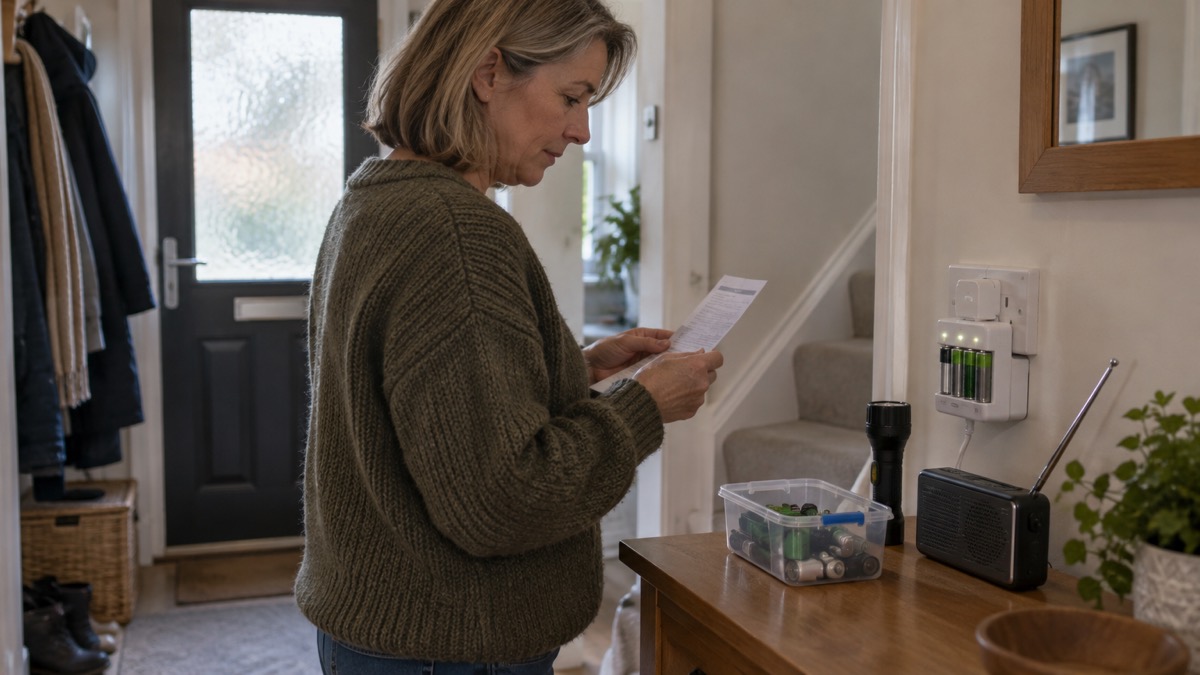
Duracell states that its round cell rechargeable batteries can be used "in absolutely any device where you would normally use an alkaline battery, unless stated otherwise" by the device manufacturer2. So a rechargeable AA will run a torch, a radio or a game controller just as an alkaline AA would. The Royal Society for the Prevention of Accidents describes NiMH as less common than lithium-ion but "considered safer than Li-ion batteries"14. That makes rechargeable AA and AAA cells a reasonable, low-risk choice for devices you use often and can recharge between uses.
The catch is self-discharge. Duracell does not recommend standard rechargeable batteries in smoke alarms precisely because "standard rechargeable batteries discharge with time and die quickly without warning beeps"15. That is a general property of standard rechargeable cells, and it matters for an emergency kit: a rechargeable cell sitting in a drawer for months will have lost some of its charge by the time you need it. A single-use alkaline cell, by contrast, holds its charge on the shelf and is ready the moment you load it.
A practical split follows from this:
| Job | Best cell type | Why |
|---|---|---|
| Smoke alarm | The type the alarm maker specifies, not standard rechargeables | Standard rechargeables discharge with time and die quickly without warning beeps15 |
| Torch and radio in the emergency kit, checked rarely | Alkaline spares, plus rechargeables you top up regularly | Alkaline cells hold their charge on the shelf; rechargeables slowly self-discharge15 |
| Devices used weekly (toys, controllers, everyday torch) | NiMH rechargeables | Can be recharged and reused; usable anywhere an alkaline cell fits, unless the device maker says otherwise2 |
| Equipment used periodically in extreme temperatures | Premium alkaline | Duracell recommends premium alkaline for periodic use in extreme temperatures, as they perform much better than zinc carbon3 |
One more piece of official advice shapes the choice. Devon and Somerset Fire and Rescue Service notes that the safest way to use candles is to buy battery-powered versions, which have almost no fire risk, last longer and are better for the environment "because you can replace, recycle or recharge the battery and reuse the candle"16. Battery-powered candles are a good fit for rechargeable cells, because you can top them up whenever you like.
Choosing batteries for torches and lanterns
The battery advice for lighting comes down to three rules. First, use torches rather than candles in a power cut, and make sure you have spare batteries: Surrey County Council's guidance for power failures is to "use torches and make sure that you have spare batteries"17, and the Prepare campaign says plainly that torches are safer than candles1. Second, if your torch is battery operated, keep spare cells for it specifically, in the size it takes12. Third, consider a wind-up torch or lantern, which Wiltshire and Swindon's loss of electricity page describes as requiring no batteries at all12; the Met Office car kit advice makes the same point for vehicles9.
If you want a fuller comparison of torch, lantern and battery-candle types, including wind-up models, see our emergency lighting guide. For the cells themselves, the choice above applies: alkaline for the spare set that lives untouched in the kit, rechargeable NiMH for anything you use and can recharge routinely.
Chargers only take NiMH cells
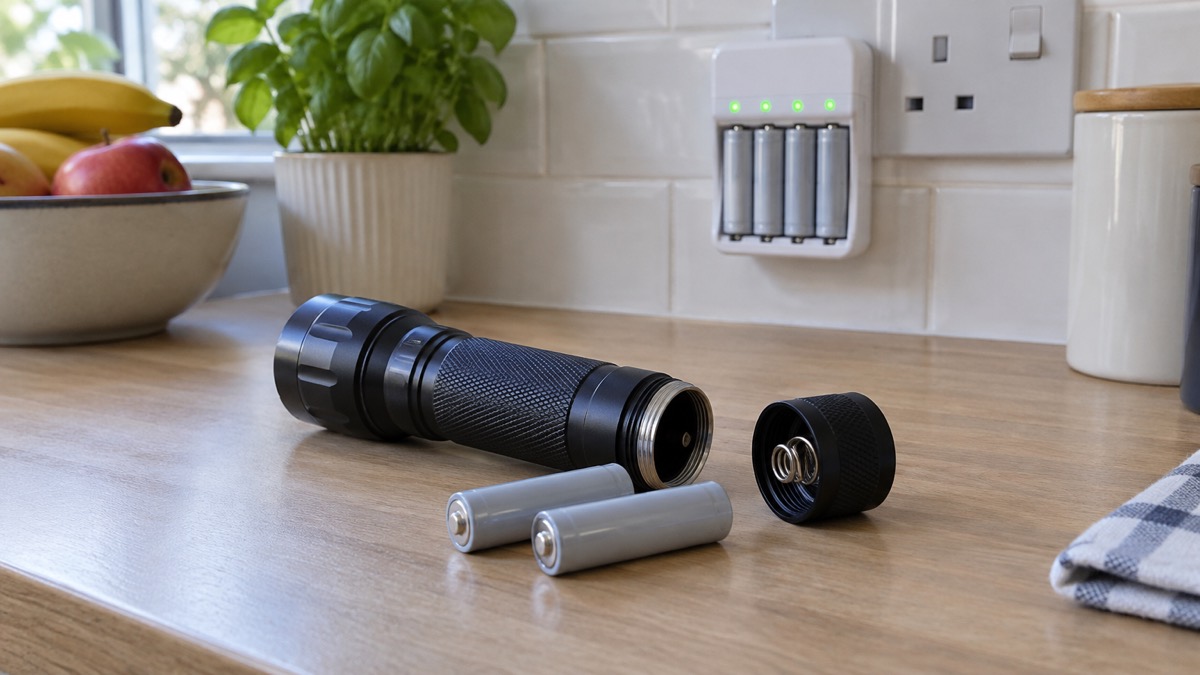
This is the rule most people get wrong, and it is a safety rule, not a preference. Duracell's support guidance is unambiguous: "You can only charge NiMH batteries in a Duracell charger."2 Alkaline, zinc, heavy duty and nicad cells must not be put in a NiMH charger. The same maker guidance confirms that all NiMH batteries can be charged in Duracell chargers15, so the chemistry, not the brand, is what matters.
What does this mean in practice?
- Check the label before you buy or charge. A cell must be marked NiMH to go in a NiMH charger2.
- Never put an alkaline cell in a charger. Single-use cells are not built to be recharged, and the attempt can be dangerous.
- Match the charger to the chemistry. If you later move to lithium-based rechargeables in other devices, those need their own chargers; London Fire Brigade warns that using the wrong charger can overload the battery and increase the risk of overheating and fire18.
On other brands: Duracell states that its chargers will charge other brands' NiMH AA or AAA batteries, but that Duracell "cannot guarantee the quality, safety or performance of other brands"3. So a mixed drawer of NiMH cells from different makers can generally share one charger, though the maker only stands behind its own cells.
Charge time depends on capacity: AAA cells charge faster than AA
When you look at a charger's stated charge time, read it as a range, not a single promise. Duracell explains: "When a charger lists a range of charge time, it refers to the time it takes to charge a lower mAh cell. For example, a AAA cell charges in less time than a AA cell."3 The same explanation appears in the maker's battery life guidance15.
The reason is capacity, measured in milliamp-hours (mAh). A AA cell holds more energy than a AAA cell of the same chemistry, so it takes longer to fill. Two practical consequences follow:
- Expect the smaller cells to finish first. If you charge a mixed batch of AA and AAA cells, the AAA cells will be ready sooner3.
- Higher capacity means longer charging, not faster. A higher-mAh AA cell takes longer to charge than a lower-mah one, even though it runs your torch for longer once full.
If you are charging a set of cells before a named storm or a cold snap, start the night before rather than the hour before: the AA cells are the ones that will keep you waiting.
Safe charging: warmth, ventilation and staying present
The fire and rescue services across the UK give consistent advice on charging batteries safely, and although much of it was written for lithium-ion devices such as e-bikes and vapes, the principles apply to any charger on a worktop. Mid and West Wales Fire and Rescue Service advises: "Charge batteries in a safe, visible location. Avoid charging near flammable materials or in escape routes."19 The Scottish Fire and Rescue Service says: "Do not cover the charger, battery, or device while charging. This can cause overheating or even a fire."20 Mid and West Wales Fire and Rescue Service makes the same point: covering devices while charging "traps heat and increases fire risk"19.
The advice on when to charge is just as consistent. South Wales Fire and Rescue Service, and the National Fire Chiefs Council, both say to charge batteries whilst you are awake and alert, so if a fire should occur you can respond quickly21. Devon and Somerset Fire and Rescue Service says do not charge batteries overnight21, and London Fire Brigade says never leave a vape device charging unattended or on overnight22. Applied to AA and AAA charging, the habit to build is: charge during the evening while you are up, and unplug before bed.
A numbered routine for safe charging:
- Place the charger on a hard, flat surface where heat can disperse, in a well-ventilated spot away from flammable materials and not blocking an escape route19.
- Load only NiMH cells marked rechargeable2.
- Leave the charger uncovered while it works20.
- Stay awake and nearby while charging21.
- Unplug when the cells are full, and never leave a charger on overnight21.
- If a battery gets unusually hot, starts to bulge or starts hissing, stop using it immediately and leave it in a safe place until you can dispose of it properly22.
Two further points from official guidance are worth keeping in mind. Devon and Somerset Fire and Rescue Service warns that anything that heats up needs a lot of electricity and could be a fire risk, and to follow electrical safety advice about charging devices16. And the Met Office's thunderstorm advice includes charging mobile phone devices in advance of a storm, so your kit is full before the weather arrives rather than during it24. The same logic applies to your rechargeable cells: top them up before the forecast turns, not after the power has gone.
For a fuller checklist on safe charging habits at home, see our safe battery charging checklist, and for the wider risks of lithium-ion devices, our lithium-ion battery safety guide.
Storing batteries: cool, dry and at room temperature
Official storage advice is short and consistent. London Fire Brigade advises: "Avoid storing, using or charging batteries at very high or low temperatures."4 The National Fire Chiefs Council's Charge Safe campaign says to store and charge batteries in a cool, dry place25, and London Fire Brigade repeats the advice to store batteries in cool, dry places in hot weather26.
What this means for a household battery drawer:
- Keep spare batteries in a cool, dry place indoors: a drawer or cupboard away from the oven, radiator or boiler, and away from damp25.
- Do not store them in the fridge or freezer: that is a very low temperature environment, which official guidance says to avoid4, and a fridge is damp as well as cold.
- Do not leave batteries or chargers in a hot car or a freezing shed: both extremes are outside the storage conditions the fire and rescue services describe4.
Duracell also advises removing batteries from devices that will not be used for several months, to prevent possible damage from worn batteries2. Our page on whether to remove batteries from stored devices covers this in more detail, and our page on battery storage temperature covers the temperature limits.
Never recharge a battery that is not labelled rechargeable
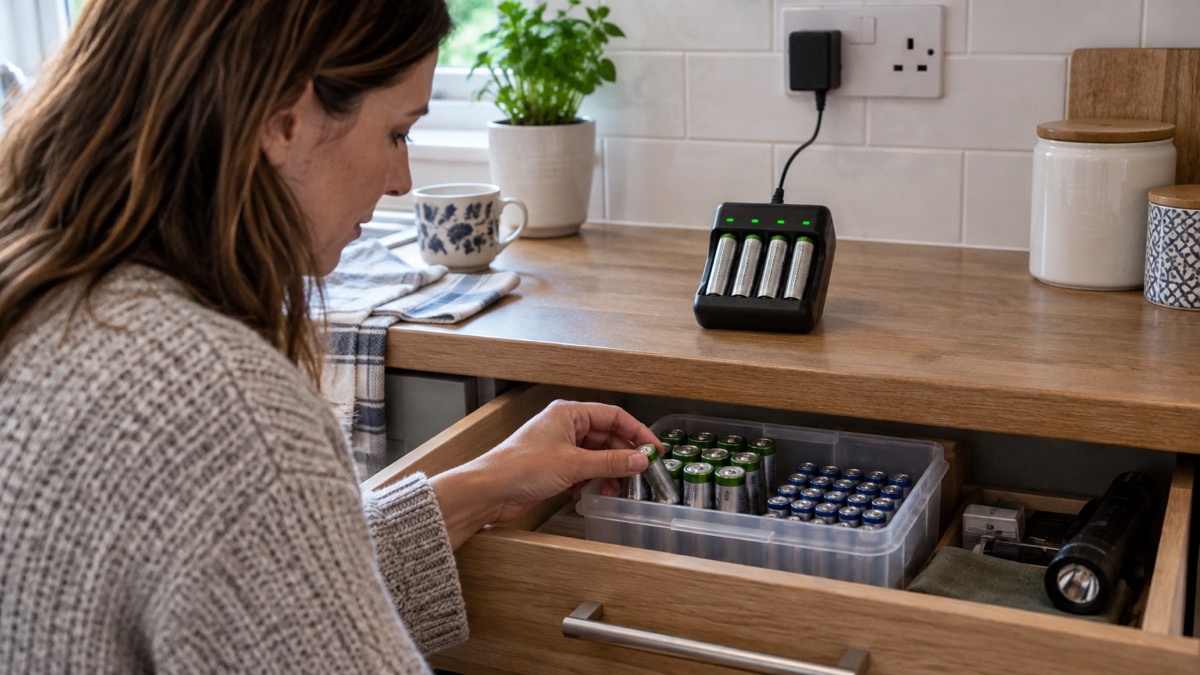
This deserves its own heading because it is the single most important safety rule on the page. Duracell's guidance states: "You can only recharge a battery if it's specifically marked 'rechargeable.' Recharging a non-rechargeable battery may cause it to rupture or leak and may cause personal injury."3 The maker repeats the rule in its battery life guidance15.
The cells most at risk of being put in a charger by mistake are alkaline AAs and AAAs, because they look almost identical to rechargeable ones. Before any cell goes into a charger, check the sleeve for the word "rechargeable" and the chemistry marking NiMH. If either is missing, the cell does not go in.
The same caution extends to the second-hand market. London Fire Brigade advises avoiding second-hand batteries27, and it advises not continuing to use a battery or charger that has been identified as unsafe23. For an emergency kit, where you need to trust every cell, buy new, labelled cells and keep the packaging.
Mixing cells, cold weather and other everyday mistakes
Several smaller rules from the makers and the fire services cover the everyday handling of AA and AAA cells, and they are worth gathering in one place.
Do not mix battery types or brands in one device. Duracell's guidance is direct: "Mixing a lithium battery with an alkaline battery will not improve device performance. In fact, it will reduce performance and may damage the device or cause battery leakage or rupture."3 The rule extends to mixing old and new cells, and to mixing brands: use a matched set in any device.
Cold weather changes which cell to choose. Duracell recommends premium alkaline batteries for equipment used periodically in extreme temperatures, because they perform much better than zinc carbon batteries under such conditions3. Official guidance for e-bike and e-scooter batteries likewise says to protect batteries from extreme heat or cold18. For a torch kept in the car through a British winter, a premium alkaline spare set is the sound choice; for more on cold-weather limits, see our page on charging in freezing weather.
Carry loose batteries with care. London Fire Brigade describes lithium batteries as "the lightweight, rechargeable batteries that power our phones, laptops and cameras"4, and Devon and Somerset Fire and Rescue Service notes that lithium-ion batteries are the rechargeable batteries in electrical items such as mobile phones, laptops, e-scooters, e-bikes and e-cigarettes21. Loose cells carried in a pocket or bag with keys or coins can be damaged or short-circuited, so keep spares in their original packaging or a battery case.
Do not use recalled or unsafe kit. If a battery or charger has been identified as unsafe through a recall or safety alert, stop using it23. Registering products so you receive safety alerts is the practical way to hear about recalls.
Leaking batteries: cleaning up and first aid
A leaking battery is a common household problem, especially in devices left unused for a long time, which is why Duracell advises removing batteries from devices that will sit for several months2. When a leak happens, the cleanup method depends on the battery chemistry.
For alkaline, NiCAD and NiMH batteries, Duracell advises using either one tablespoon of boric acid in one gallon of water, or a mixture of equal amounts of diluted vinegar or lemon juice with water, in a 50/50 ratio3. That is the maker's own instruction for its own cells' chemistry family, and it is the method to use on a leaked AA or AAA.
A cleanup routine:
- Remove the leaked cell from the device, avoiding contact with your skin where possible.
- Clean the leakage from the battery compartment using the solution above, appropriate for alkaline, NiCAD and NiMH batteries3.
- Check the contacts for corrosion before fitting new cells.
- Recycle the leaked cell rather than binning it, as covered below15.
If leakage has caused skin contact or any injury, seek first aid or medical advice; the maker's warning that mishandled batteries can cause personal injury3 applies here too. Age UK's flood kit advice includes rubber gloves, wet wipes and hand sanitiser alongside a torch and a battery-powered radio28, a reminder that handling kit in an emergency is easier with basic protective supplies to hand.
Recycling used and rechargeable batteries
Battery recycling is where household good intentions cause real fires. Duracell's disposal guidance is clear: "All rechargeable batteries should be recycled. Other batteries can and should be recycled as well."15 Nothing in a well-run household goes in the bin.
The fire and rescue services explain why this matters so much. The Scottish Fire and Rescue Service advises: "If you need to dispose of a damaged or end of life battery, don't dispose of it in your household waste or normal recycling. These batteries, when punctured or crushed, can cause fires in bin lorries, recycling and waste centres."29 South Wales Fire and Rescue Service gives the same warning21, as does the National Fire Chiefs Council's guidance on e-bikes and scooters30. A battery crushed in a bin lorry compactor can start a fire that puts crews and the public at risk.
North Yorkshire Fire and Rescue Service's Charge Safe campaign adds that anything with a plug, battery or cable can be reused or recycled, and warns that many electrical items contain hidden batteries which can cause fires if they incorrectly enter the waste stream31. So the rule covers not just loose cells but devices with batteries inside them.
What to do:
- Recycle all rechargeable batteries, and other batteries too15.
- Never put a damaged or end of life battery in household waste or normal recycling29.
- Take batteries to a battery recycling point: most supermarkets, shops that sell batteries and council household recycling centres have collection bins.
- Recycle devices with batteries inside them as small electricals, not in the general bin31.
For a battery that is damaged, swollen or has caught fire, follow the specific steps in our guides on what to do if a battery starts swelling, warning signs a lithium battery is dangerous and disposing of a damaged lithium battery.
Where this fits in your wider preparations
AA and AAA batteries are the smallest part of a backup power plan, but they power the items you reach for first: the torch, the radio, the battery candles. Around them sit bigger decisions, covered elsewhere on this site: what to keep running when the mains fails, power banks for phones, portable power stations and using generators during an outage. If you are building a kit from scratch, our power cut checklist and winter readiness checks pull the whole plan together.
The battery habit itself is small: keep a torch and spare cells where everyone can find them1, keep the rechargeable set topped up before bad weather24, charge while you are awake and in the room21, store everything cool and dry25, and recycle every cell when it is done15.
Sources (31)
- Power cuts: be informed about hazards, Prepare campaign, 2026-10-21
- Batteries removed from devices not expected to be used for several months, Duracell, 2026-10-26
- Is it OK to use rechargeable batteries in a device?, Duracell, 2026-10-26
- Batteries and chargers, London Fire Brigade, 2026-10-25
- Household emergency kit, nidirect, 2026-07-06
- Get prepared, Carmarthenshire County Council, 2026-10-25
- Prepare: at home, Wiltshire and Swindon Prepared, 2026-01-28
- Emergency kit, Readiness campaign Scotland, 2026-10-22
- Winter car kit, Met Office, 2026-10-25
- Safety in severe weather conditions, Devon and Somerset Fire and Rescue Service, 2026
- Be prepared, Lancaster City Council, 2026-10-26
- How to prepare for the loss of electricity, Wiltshire and Swindon Prepared, 2026-10-25
- 12 tips to prepare for a power cut, Horsted Keynes Parish Council, 2026
- Addressing the rising concern of e-bike and e-scooter battery hazards, Royal Society for the Prevention of Accidents, 2025-04-14
- How long do batteries last?, Duracell, 2026-10-26
- Stay warm safely this winter, Devon and Somerset Fire and Rescue Service, 2026
- Power, gas and water: what if they fail, Surrey County Council, 2025-12-29
- How to charge e-bikes and e-scooters safely, London Fire Brigade, 2026-10-25
- Lithium battery fire safety in your home, Mid and West Wales Fire and Rescue Service, 2026-10-26
- Lithium-ion batteries at home, Scottish Fire and Rescue Service, 2025-11-27
- E-bikes and e-scooters, Devon and Somerset Fire and Rescue Service, 2026-07-29
- Vaping and e-cigarettes, London Fire Brigade, 2026-10-25
- Registering your e-bike or e-scooter for safety alerts and product recalls, London Fire Brigade, 2026-10-25
- Stay safe in a thunderstorm, Met Office, 2026-10-25
- Charge Safe campaign, National Fire Chiefs Council, 2026-10-09
- Heat, cold and rain: how weather conditions affect e-bikes and e-scooters, London Fire Brigade, 2026-10-25
- E-bike conversion kits: fire risks and safety advice, London Fire Brigade, 2026-10-25
- Prepare for a flood, Age UK, 2026-10-05
- E-bikes and e-scooters at home, Scottish Fire and Rescue Service, 2026-10-25
- NFCC guidance: e-bikes and scooters, National Fire Chiefs Council, 2022-01
- Charge Safe campaign, North Yorkshire Fire and Rescue Service, 2026-08-18
 Power Cut Backup Power Checklist
 Backup Power Before Winter
 Safe Battery Charging at Home
 What to Keep Running in a Cut
 Power During an Outage
 Watts and Watt-Hours
 Portable Power Stations
 Portable Generator Types
 Generator Safety
 LPG Cylinders and Regulators
 Connecting to Your Home's Wiring
 Home Battery Storage
 Portable Solar Panels
 12V Inverters
 Leisure and LiFePO4 Batteries