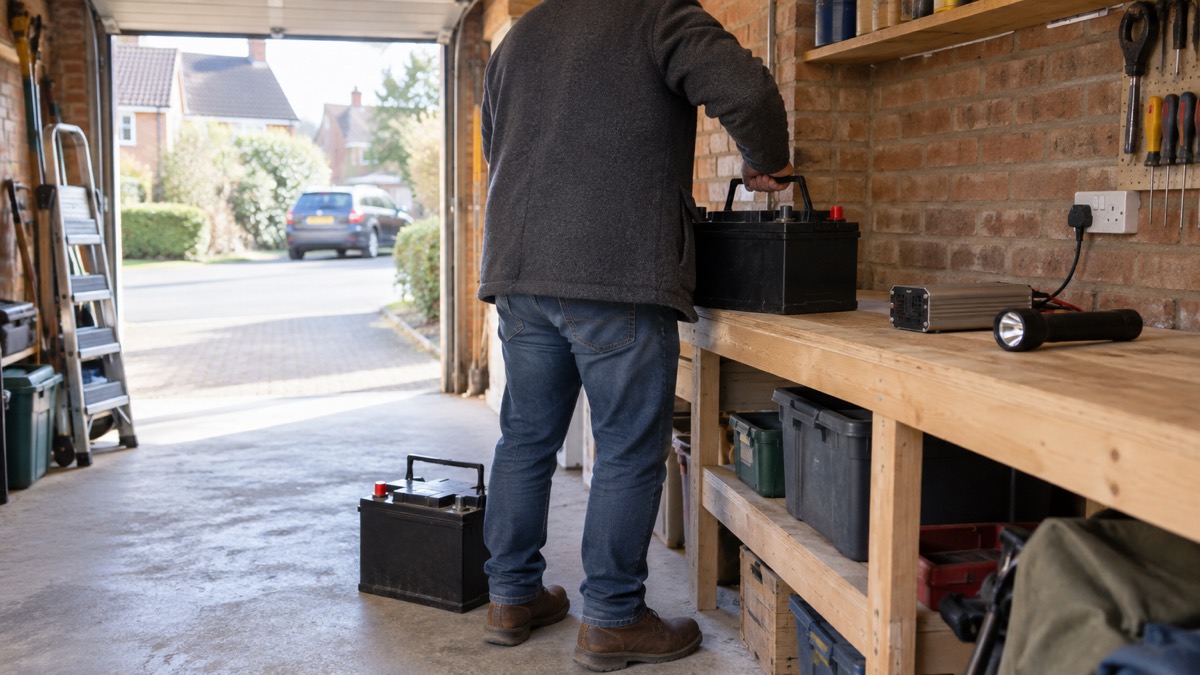
A leisure battery is one of the simplest ways to keep a household running through a power cut. These are the deep-cycle batteries sold for caravans, boats and motorhomes, and they come in two main families: the traditional lead-acid type (including sealed and gel versions) and the newer lithium iron phosphate type, usually written as LiFePO4. Both store electricity you can draw on slowly for hours, running lights, a small fridge, a radio, phone chargers or, through an inverter, ordinary mains plugs.
The two families behave very differently, and those differences matter in an emergency. A lead-acid leisure battery is heavy, needs careful charging and will be permanently damaged if it is left flat, but it is simple and well understood. A lithium battery is, as fire services describe the lithium-ion family, "lightweight, energy dense and long-lasting but can be more volatile than traditional batteries"1. If looked after carefully and used efficiently, a leisure battery should meet several days' basic habitation needs between charges and provide many seasons of service before replacement2.
This page covers what you need to know to use either type safely as a home backup store: how each behaves, how to charge and check them, how to store them between emergencies, and what to do when something goes wrong. If you are still deciding what backup kit suits your household, start with our guide to backup power at home.
Lead-acid or lithium: how each behaves when the mains fails
A leisure battery's job in a power cut is to supply a steady current over many hours, unlike a car battery, which is built to deliver a short burst to start an engine. When you are choosing between lead-acid and LiFePO4 for emergency use, the practical differences come down to weight, how much of the stored charge you can actually use, how fast the battery refills, and how much care it needs between uses.
Lead-acid leisure batteries are the established technology. They are inexpensive per unit of capacity, widely available, and their care routine is well documented. Their weaknesses are weight, slow charging and a hard limit on how deeply they can be discharged: run one flat and leave it, and the damage is permanent. The Caravan and Motorhome Club's technical guidance is blunt about this, warning that "a battery left below 12.4 V will deteriorate quickly and will not be able to be recharged to its original capacity"2.
Lithium iron phosphate batteries are the newer option. LiFePO4 is the chemistry used in most modern leisure batteries and portable power stations. Its advantages for emergency use are lighter weight for the same capacity and much faster charging: the maker Sterling Power, for example, lists maximum continuous charge rates for its AL series LiFePO4 leisure batteries of 50A, 60A, 70A, 80A and 100A across its 60Ah to 200Ah models5, far above what a lead-acid battery of the same size should be asked to accept. As with any lithium battery in the home, always use the charger that came with the device4.
The trade-off is fire risk. Lithium-ion batteries are safe during normal use, but they "present a fire risk when over-charged, short-circuited, submerged in water or if they are damaged"3. That risk is manageable with the right habits, and most of this page is about those habits, but it is the reason lithium batteries deserve more care in the home than the lead-acid type. Our page on lithium-ion battery safety at home covers the general rules.
| Lead-acid leisure battery | LiFePO4 leisure battery | |
|---|---|---|
| Typical use | Caravans, boats, long-established leisure backup | Newer leisure setups, power stations |
| Charging speed | Slow: no more than one tenth of capacity, e.g. 6 A for a 60 Ah battery2 | Fast: Sterling Power lists up to 100 A maximum continuous charge on its largest AL models5 |
| Left flat | Sulphates, possibly permanently, within about a week2 | Less prone to damage from being left part-charged, but must never be over-charged, short-circuited or submerged3 |
| Main hazards | Acid, gas during charging, permanent damage from deep discharge2 | Fire if damaged, over-charged, short-circuited or submerged3 |
| Weight | Heavier for a given capacity | Lithium batteries are "lightweight" compared with traditional types1 |
Reading the voltage: what the numbers tell you
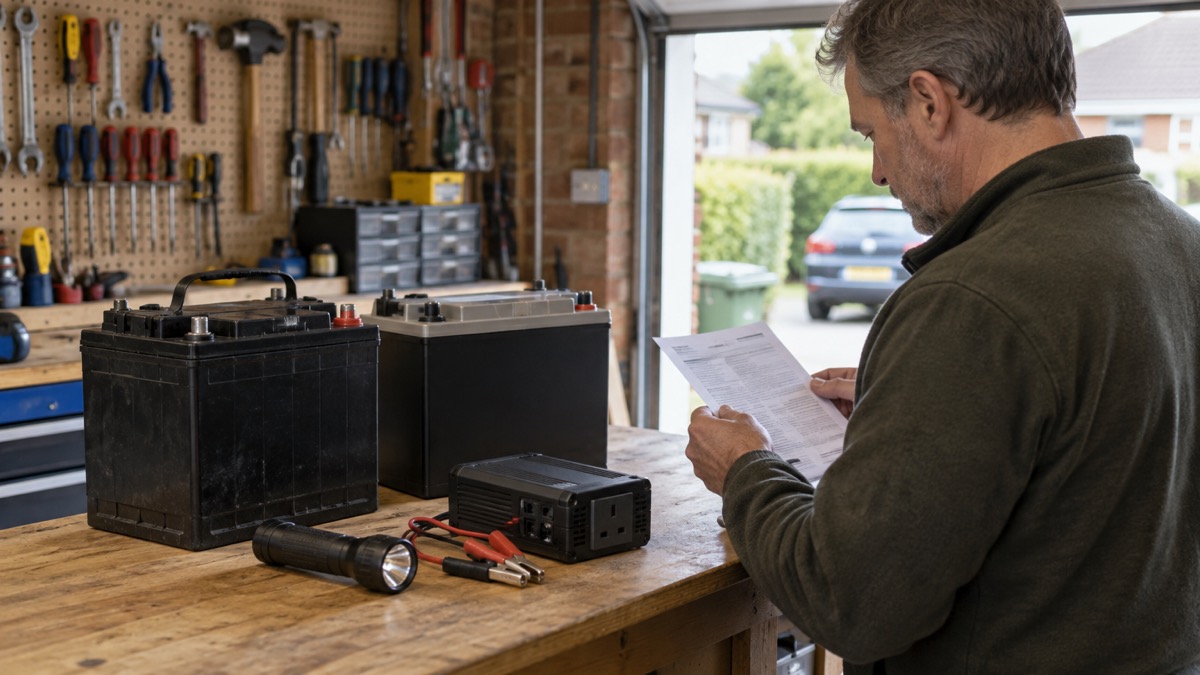
A voltmeter is the simplest health check for a lead-acid leisure battery, and it is worth owning a cheap one if you keep a battery for emergencies. The single most important number is 12.4 V. The Caravan and Motorhome Club's guidance is that a battery left below this voltage will deteriorate quickly and will never recharge to its original capacity2. In practice, that means the battery should be topped up well before it drifts down to that level, not after.
Voltage also tells you when charging is finished, but not immediately. The Club's advice is to charge the battery, disconnect the charger's mains lead, re-check the electrolyte level, then leave the battery for at least four hours before checking its state of charge again2. A reading taken straight off the charger will read high and mislead you; the battery needs that rest for the voltage to settle to something meaningful.
For sealed batteries, the Club describes a process of voltage-controlled charging and resting repeated over several cycles before the battery is fully charged2. If you buy a battery for emergency use, also be aware that a newly purchased battery may not be fully charged when you get it home, so give it a proper charge before putting it into storage2.
For lithium batteries, voltage readings work differently and the maker's own figures are the ones to follow. Sterling Power, for instance, specifies a cut-off voltage of 11V for its AL series LiFePO4 batteries, below which the battery protects itself, and a cut-off temperature of 60 deg C5. Do not apply lead-acid voltage rules to a lithium battery or the other way round: use the figures in the manufacturer's documentation for your specific battery.
Charging a lead-acid leisure battery safely
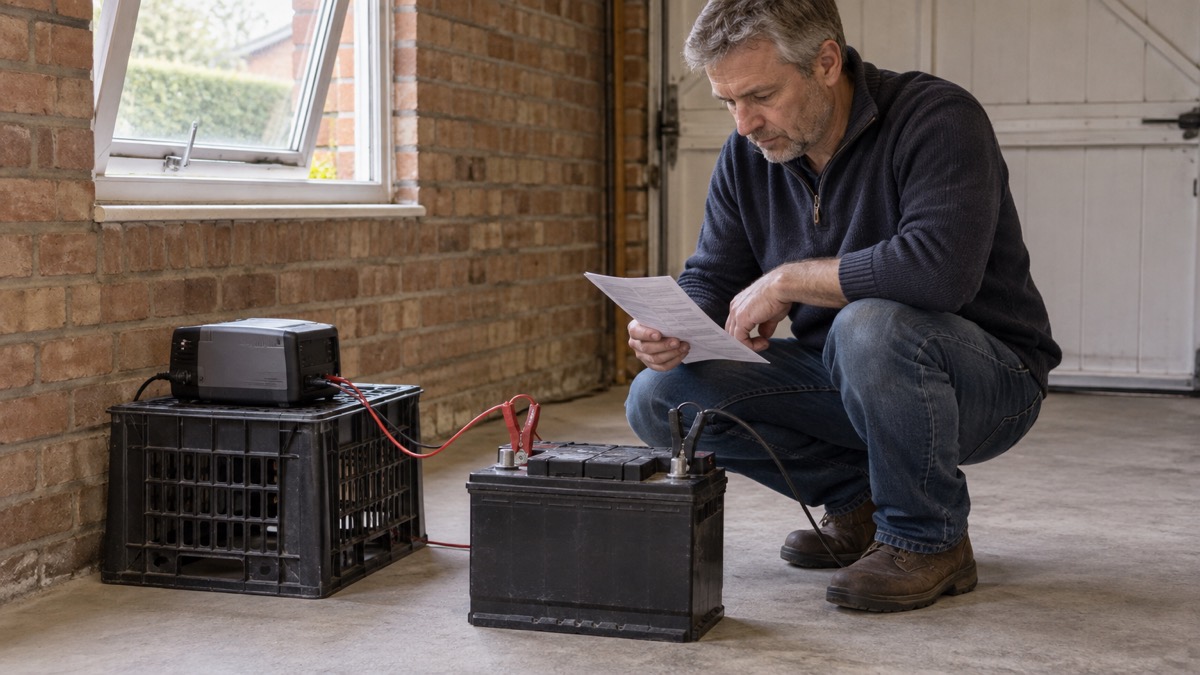
Charging is where most of the care, and most of the risk, sits with a lead-acid battery. The rules are straightforward and worth following exactly.
Charge at the right rate. Do not charge at more than one tenth of the battery's capacity, for example 6 Amp for a 60 Ah battery2. A bigger charger will not fill the battery faster in any useful way; it will damage it.
Expect it to take a long time. A 75 per cent charged battery may only take a few hours to charge fully, whereas a fully discharged battery may take more than 24 hours2. Plan charging sessions around that: start well before a storm is due, not when the lights go out.
Ventilate. If charging the battery indoors, away from the equipment it normally lives in, make sure the premises are well ventilated2. Charging lead-acid batteries produces gas, and a sealed room is the wrong place for it.
Check the electrolyte. Unless the battery is 'sealed for life', remove the vent plugs or strips and shine a torch into each cell to check the electrolyte level, which should cover the plates completely2. Do this when you think the battery is fully charged, after disconnecting the charger's mains lead2.
Do not overcharge a sealed battery. Sealed batteries must not be overcharged, since this will reduce the level of the electrolyte in the cells, which cannot be replenished2. Once a sealed battery's electrolyte is gone, so is the battery.
Give it a rest. Most batteries like at least a short rest period, say 24 hours, from charging for best performance2. Do not put a freshly charged battery straight back onto a charger to "top it up".
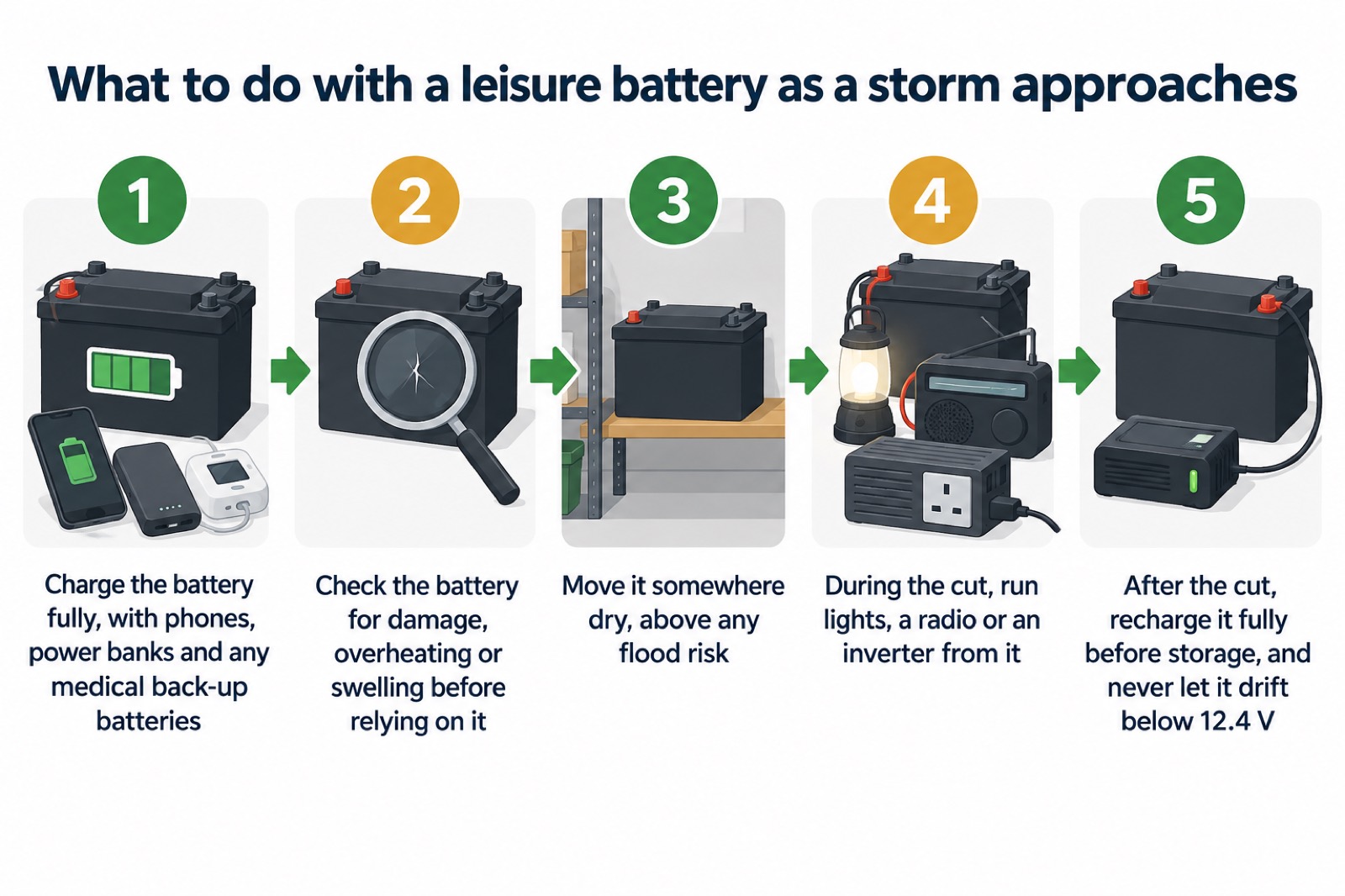
One habit worth building before any emergency: when a storm is forecast, official guidance is to charge mobile phones, power banks and any back-up batteries for medical equipment in case there is a power cut6. A leisure battery that is already full when the weather turns is a leisure battery that is useful.
Sulfation: what leaving a battery flat does to it
Sulfation is the failure mode that kills more stored lead-acid batteries than anything else, and it is entirely preventable. When a lead-acid battery sits discharged, lead sulphate crystals form on its plates. Left long enough, this becomes a permanent change. The Caravan and Motorhome Club's guidance is that if a battery was left discharged and had been run down for a week or so, "it is likely that it has become sulphated, a permanent change which may render the battery totally useless"2.
The reason batteries get into this state is self-discharge. Modern batteries lose 0.1 to 0.2 per cent of their charge per day at room temperature, even when new2. That sounds trivial, but it adds up: a battery left alone after its one emergency use will drift downward week after week, and as batteries age or temperature increases, the self-discharge rate rises2. Eventually it crosses below 12.4 V, and from there the deterioration is quick and permanent2.
The defence is a simple maintenance routine:
- Check the battery every two months and recharge if necessary2
- Never put the battery away after an emergency without recharging it fully first
- Watch the voltage, and treat anything approaching 12.4 V as a signal to charge now2
- Remember that a newly purchased battery may not be fully charged when you buy it2
If a battery has already been left flat for a week or more, it may be beyond saving, and no amount of charging will restore its original capacity2. Test it before relying on it in the next emergency: a battery that has sulphated will not deliver the hours you planned on.
Storing a battery between emergencies
Most of a backup battery's life is spent in storage, and storage is where it is won or lost. The rules differ slightly by type but share one theme: cool, dry and charged.
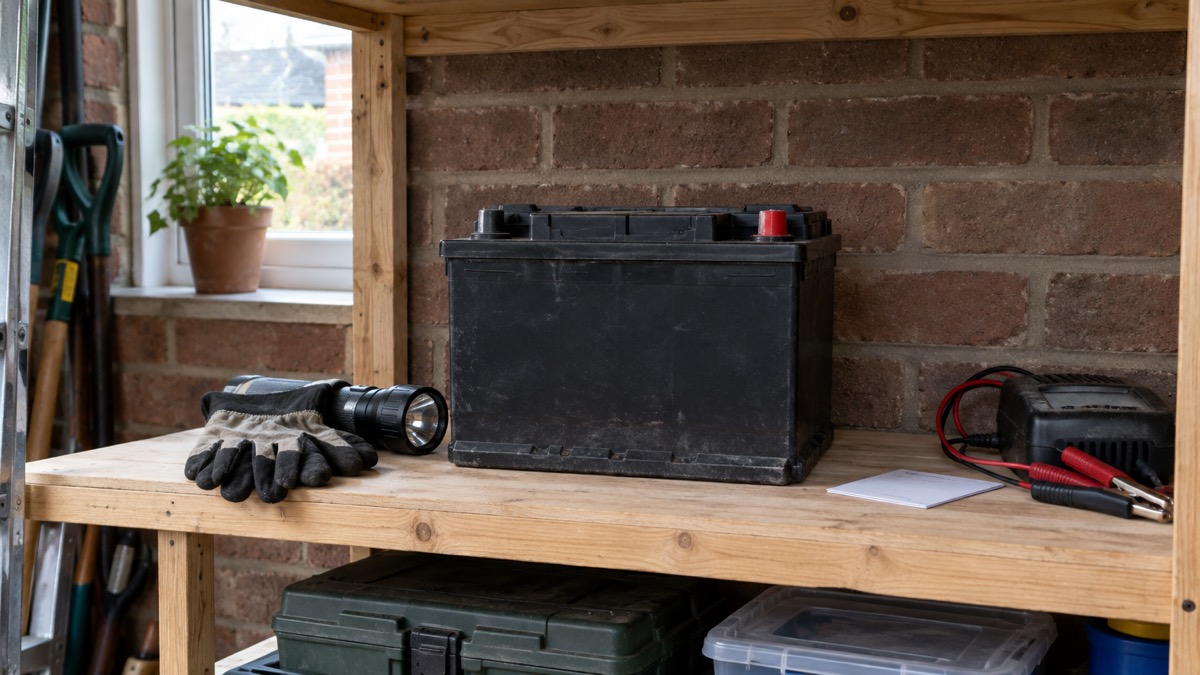
For a lead-acid leisure battery, store it charged and check it every two months, recharging if necessary to ensure long and trouble-free battery life2. A cool location matters because self-discharge rises with temperature2. If you keep a second battery as a reserve, the Caravan and Motorhome Club notes that a second battery, charged up before being put away, will maintain a good state of charge for some weeks and can remain disconnected as a reserve, ready to swap in when the main battery runs low2. If you install a second battery permanently, check that you have enough payload capacity to cope with the additional weight2.
For lithium batteries, fire services advise storing the product and its batteries in a cool place, avoiding exposing them to extreme heat or cold4, and in hot weather to store batteries in cool, dry places7. Cold does not damage a lithium battery in the way heat does, but it does slow it down: cold temperatures reduce performance, with reduced range, slower charging and the battery losing charge more quickly, because the chemical reactions inside it slow down at lower temperatures7.
If a lithium battery has been left in freezing conditions, allow it to warm up slowly indoors before using or charging it7. Do not put a freezing battery straight on charge. Our page on battery storage temperature goes into this in more detail.
When a lithium battery becomes a fire risk
Lithium-ion batteries, including LiFePO4, are safe during normal use. The fire risk appears in specific circumstances, and every household that keeps one should know them. The London Fire Brigade states that lithium batteries "can present a fire risk when over-charged, short-circuited, submerged in water or if they are damaged"3. Devon and Somerset Fire and Rescue Service gives the same list and adds what damage does: damaged batteries "may release flammable electrolytes, increasing the risk of fire"8.
The failure itself, when it happens, is fast and violent. Fire and Rescue Service guidance across the UK describes how, if one cell of a lithium-ion battery overheats, it can enter a state of thermal runaway which can quickly spread to other cells, an explosive chemical reaction the fire service compares to several fireworks going off at once, with such ferocity and intense heat that it cannot be put out easily8. The National Fire Chiefs Council's position statement on home safety warns that "lithium-ion battery fires are particularly dangerous as they are instantaneous and explosive in nature, potentially compromising escape routes"9. North Wales Fire and Rescue Service puts it simply: "The larger the battery, the larger the danger"10.
The warning signs to check for regularly are overheating, swelling and other forms of damage8. Batteries can be damaged by dropping them or by impacts, and where a battery is damaged it can overheat and catch fire without warning, so a damaged battery should be replaced, not used or charged11. Our page on warning signs a lithium battery is dangerous lists what to look for, and what to do if a battery starts swelling covers that specific situation.
Two further points deserve emphasis. First, cheap chargers and batteries may not meet UK safety standards and can be dangerous1, so buy from reputable suppliers. Second, misuse such as unsafe charging or product modifications can significantly increase fire risks, as the National Fire Chiefs Council warned in November 2025 when it called for urgent government action on lithium-ion battery safety standards12.
Safe charging habits for any battery
The charging routine is where households most often go wrong, and fire services across the UK have converged on the same advice. Following it takes no effort once it is habit.
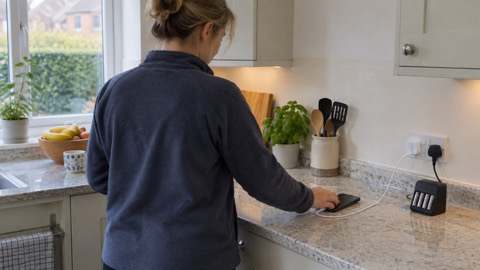
- Use the charger that came with the device. Always use the charger that came with your phone, tablet, e-cigarette or mobile device3, and use the correct charger for any battery-powered kit13.
- Charge where you can see it. Charge in a safe location that does not block fire escape routes or exits, charge when awake and present, and unplug once fully charged14.
- Never charge overnight or when out. Do not charge devices overnight when anyone is asleep, and do not leave them on charge when you have left the home10. Mid and West Wales Fire and Rescue Service advises unplugging devices once fully charged and avoiding leaving them plugged in overnight1.
- Do not cover chargers or batteries. Never cover chargers or charging devices3. Covering devices while charging traps heat and increases fire risk1.
- Keep chargers away from flammable materials. Avoid charging batteries near flammable materials, do not overload power sockets, and do not use unsuitable extension cords; always use uncoiled extension leads that are properly rated for your devices4.
- Use a charger that stops itself. To prevent overcharging, use a charger that automatically shuts off or has a timer15.
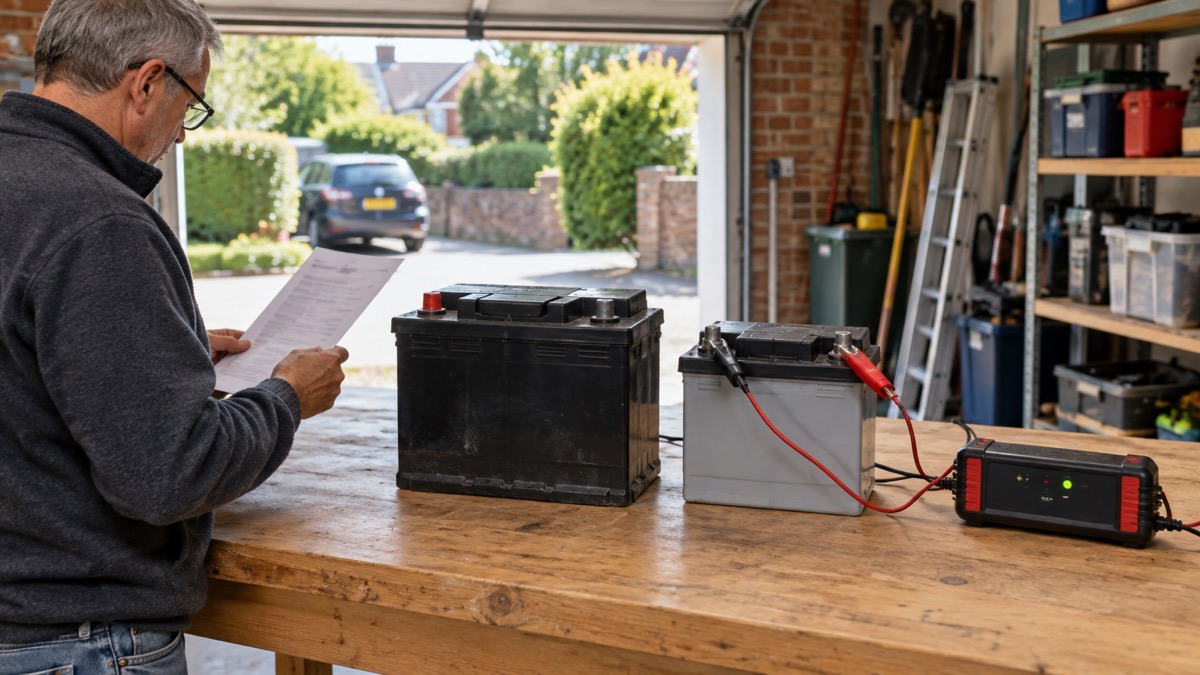
If you are setting up a charging spot at home, our safe battery charging checklist walks through it step by step, and our page on overnight charging answers the question directly. If you suspect a battery or device is damaged, Oxfordshire Fire and Rescue Service advises contacting the manufacturer for specific advice on how to dispose of it safely and to confirm that it is safe to transport16.
Damaged, leaking or end-of-life batteries
A damaged battery is not a battery to make do with. Check your battery regularly for any signs of damage, and if you suspect it is damaged it should be recycled and should not be used or charged4. This applies to lead-acid as well as lithium batteries: a cracked case on a lead-acid battery means acid and gas where neither should be, and the electrolyte check described earlier, shining a torch into each cell to confirm the electrolyte covers the plates, will reveal a battery that has been overcharged or abused2.
For disposal, the rules are firm. Do not dispose of damaged or end-of-life batteries in household waste or normal recycling. Lithium-ion batteries, when punctured or crushed, can cause fires in bin lorries, recycling and waste centres11, and Devon and Somerset Fire and Rescue Service describes them as a main cause of waste fires, extremely dangerous when thrown away with general rubbish or mixed with recyclable materials like card, metal and plastic8. Instead:
- Check whether the manufacturer offers a recycling service, or check with your local authority for suitable battery recycling arrangements in your area17
- Contact the manufacturer for specific advice on how to dispose of a damaged battery or device safely, and to confirm that it is safe to transport16
- Never put a battery that has overheated, swollen or been damaged into a bin of any kind8
Our page on how to dispose of a damaged lithium battery covers the process in full.
Cold weather, water and floods
British emergencies tend to come with weather attached, so think about where your battery will be when the storm arrives.
Before a storm: charge everything. Official guidance for storms is to charge mobile phones, power banks and any back-up batteries for medical equipment in case there is a power cut6, and the Met Office's winter preparation advice adds that you should consider a separate battery charger and store key information such as the power cut helpline number, 105, on your phone18. Keep mobile phones, laptops or tablets fully charged so you have use of battery power for a short time at least19.
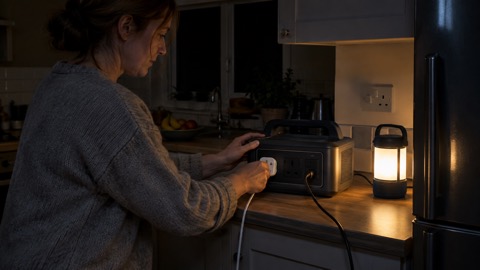
During the outage: run your leisure battery through whatever you planned for it, whether that is lighting, a radio or an inverter feeding mains devices. Keep to the plan you made before the power went, and use only the appliances you decided on when you sized the battery. If you are charging phones, tablets or other mobile devices from it, always use the charger that came with the device20.
Around water: keep batteries away from flooding. Submerging a battery in water or exposing it to heavy flooding can be particularly dangerous, because water entering the battery or electrical components can cause short circuits, corrosion and battery failure7. Power cuts are common during adverse weather events, and electrical items may break down if they have come into contact with water21. If flood water has reached a battery, treat it as damaged: do not use or charge it, and contact the manufacturer for advice on safe disposal and transport16.
In the cold: a lithium battery left in freezing conditions should be allowed to warm up slowly indoors before using or charging it7. Heat is the greater enemy of lithium batteries in the long term: heat can cause the chemicals inside the battery to break down more quickly, reducing lifespan, affecting charging performance and increasing the risk of overheating or failure7. Devon and Somerset Fire and Rescue Service also warns that lithium-ion batteries in phones, vapes, e-bikes and e-scooters can become a fire risk when exposed to high temperatures or charged incorrectly22.
Making a leisure battery part of your household plan
A leisure battery on its own is a store of direct-current electricity. To make it useful in a power cut you need to know what you will connect it to, and that is worth deciding before the emergency, not during it. A fridge, lighting and USB chargers can run directly through suitable low-voltage sockets or adapters. Anything with a normal mains plug needs an inverter to convert the battery's output into ordinary mains electricity, and the inverter must be sized for the job.
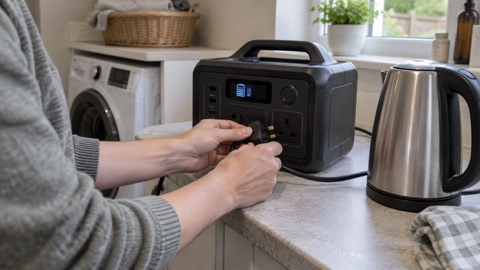
If the planning side of this feels unfamiliar, our pages on deciding what to keep running when the mains fails, on watts, watt-hours and surge and on portable power stations cover the sizing questions. A power station is, in effect, a lithium battery with an inverter and sockets already built in, and for many households it is the simpler route; a separate leisure battery suits those who already own leisure kit or want a store they can keep charged on a shelf.
Whatever you choose, the maintenance habit is the same and it is small: charge it, store it cool and dry, check it every two months, and keep it out of water. A battery looked after that way will, as the Caravan and Motorhome Club puts it, provide many seasons of service before replacement2.
Sources (23)
- Lithium battery fire safety, Mid and West Wales Fire and Rescue Service
- Batteries: technical advice, The Caravan and Motorhome Club
- Batteries and chargers, London Fire Brigade
- Lithium ion batteries, Scottish Fire and Rescue Service
- AL series LiFePO4 battery, Sterling Power
- Storms: be informed about hazards, Prepare campaign
- Heat, cold and rain: how weather conditions affect e-bikes and e-scooters, London Fire Brigade
- Battery fires, Devon and Somerset Fire and Rescue Service
- Home safety position statement, National Fire Chiefs Council
- Lithium ion batteries, North Wales Fire and Rescue Service
- E-bike and e-scooter battery safety, Scottish Fire and Rescue Service
- Lithium-ion batteries are everywhere but safety standards haven't caught up, warn fire chiefs, National Fire Chiefs Council
- E-bike conversion kits: fire risks and safety advice, London Fire Brigade
- Buy safe, be safe: avoid e-bike and e-scooter fires, UK Government
- Recycle your batteries, prevent fires, Devon and Somerset Fire and Rescue Service
- Charging safety, Oxfordshire County Council Fire and Rescue Service
- E-bikes and e-scooters fire safety guidance, National Fire Chiefs Council
- 10 things you should do now to prepare for winter, Met Office
- Strong winds and heavy rain warning: information and advice, nidirect
- Preparing for a flood, nidirect
- Food safety and flooding, Food Standards Scotland
- How to stay safe during a heatwave, Devon and Somerset Fire and Rescue Service
- Power cuts, Scottish Fire and Rescue Service
 Power Cut Backup Power Checklist
 Backup Power Before Winter
 Safe Battery Charging at Home
 What to Keep Running in a Cut
 Power During an Outage
 Watts and Watt-Hours
 Portable Power Stations
 Portable Generator Types
 Generator Safety
 LPG Cylinders and Regulators
 Connecting to Your Home's Wiring
 Home Battery Storage
 Portable Solar Panels
 12V Inverters
 Power Banks for Phone Charging