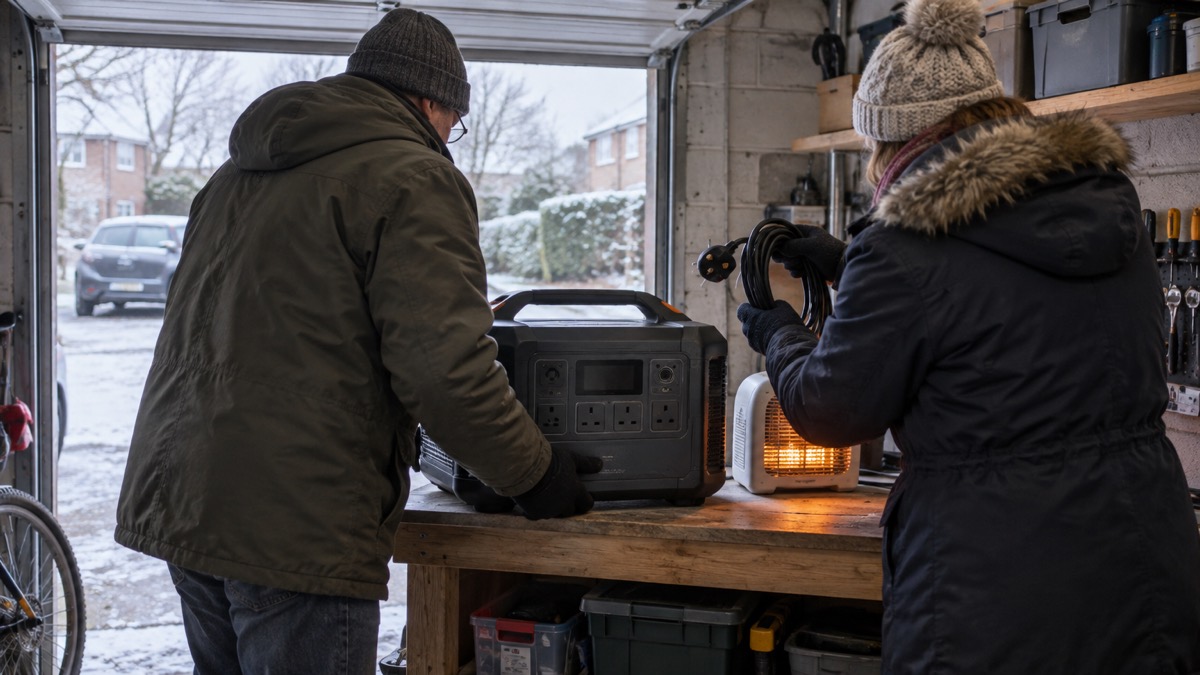
The short answer is no: do not charge a lithium battery while it is at or below freezing. The fire services say to avoid storing, using or charging batteries at very low temperatures1, and to allow a cold battery to warm to room temperature before charging, because charging one when it is extremely cold can damage it2. Battery makers say the same of their own power stations: BLUETTI advises avoiding recharging its AC200L, AC2A, AC70 and AC180 units below freezing3.
What you do instead is simple. Bring the unit indoors, let it reach room temperature, then charge it. A battery left in freezing conditions should be allowed to warm up slowly indoors before use or charging, and a frozen battery should never be put on charge1. Very low temperatures can affect the internal structure of a battery and reduce its ability to hold a charge, and repeated exposure can lead to permanent capacity loss and reduced battery life1.
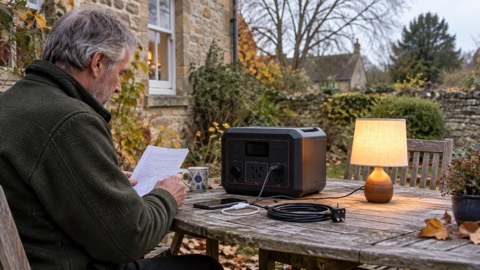
That matters most in a winter power cut, when you want the power station ready and the phone charged. The practical routine is to charge everything fully before cold weather arrives, store it indoors, and treat any unit that has spent the night in a shed or car as cold until it has warmed through6.
Follow the charging guidance in your battery's user guide
Every battery and power station comes with its own instructions, and those come first. Fire and rescue services across the UK are consistent on this: always follow the battery usage, storage and charging guidelines in the user guide9. Fire Scotland adds that you should follow the manufacturer's instructions for charging times, never overcharge a battery, and use the manufacturer-approved charger for the product10.
The general rules sit around that. Avoid storing, using or charging batteries at very high or low temperatures1. Do not cover the charger, battery or device while charging, as this can cause overheating or even a fire10. If a battery is damaged, swollen, leaking or unusually hot, do not use or charge it, and do not put it in household waste11.
For a power station in a cold snap, the sequence is:
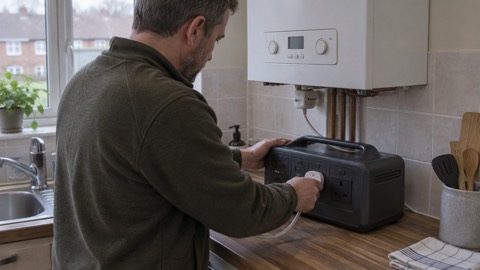
- Bring the unit indoors and let it sit until it reaches room temperature2.
- Check it is undamaged and not swollen before charging11.
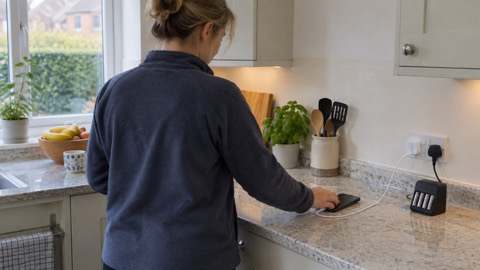
- Charge it uncovered, on a hard surface, using its own charger10.
- Once charged, keep it indoors rather than returning it to a cold shed6.
"Do not attempt to charge a frozen battery."
Some batteries are built for the cold. Sterling Power makes a range of heated lithium batteries with integrated heating for charging in sub-zero conditions, and notes that lithium batteries normally cannot be charged in sub-zero conditions12. Its standard 12V lithium battery lists a 0°C charge circuit disconnect, so the charging circuit cuts out at freezing point13. Heated batteries are aimed at unheated sheds, garages and vehicles left in cold environments14. For an ordinary household with a portable power station, the simpler answer is to bring it inside.
Ways to recharge a power station in a winter power cut
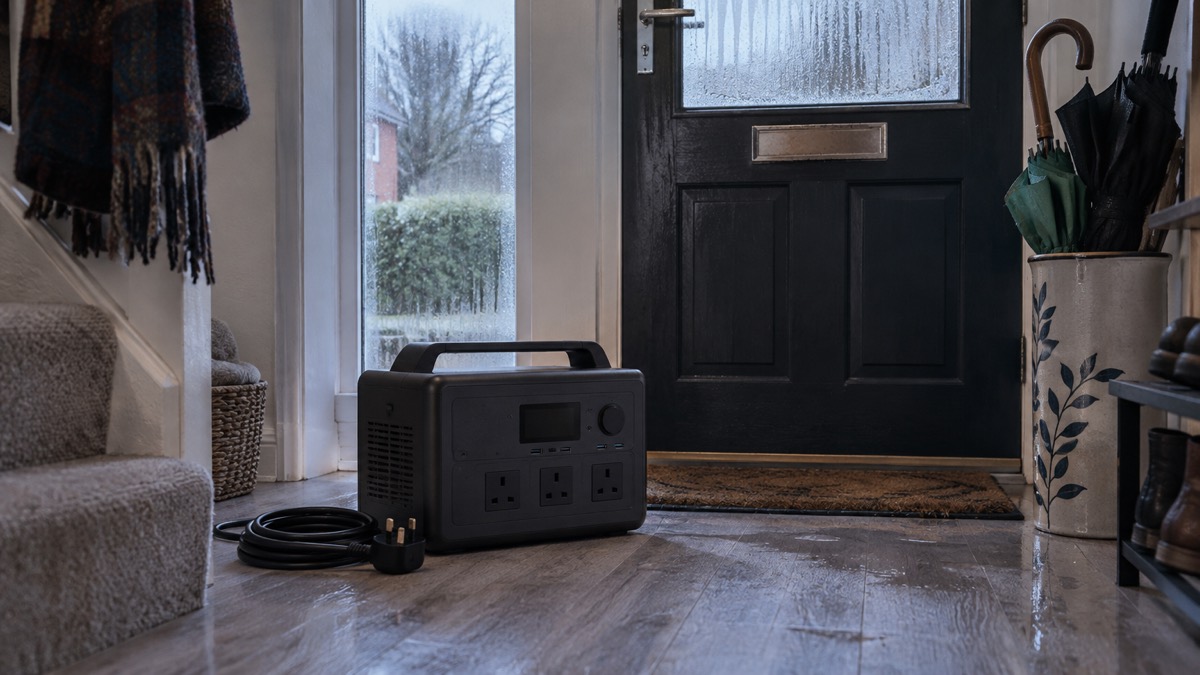
When the mains is off, you have three realistic routes: a generator, a car, or solar. Each behaves differently in winter.
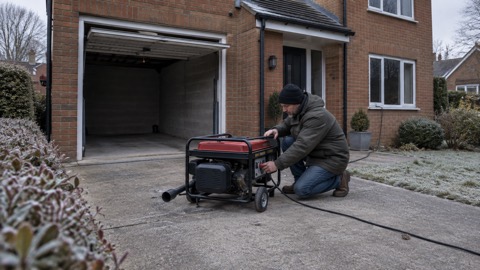
A generator will run a mains charger for a power station, but it must never be used indoors. Generator safety, including carbon monoxide, is covered in our guide to using generators and power stations during an outage and in generator safety.
A car can top up a power station through its 12V socket, but only with the engine running, or you risk a flat car battery. Flat or dead car batteries can happen to any car regardless of age, but in cold weather such problems are far more likely15. Keep a torch and spare batteries at home for the power cuts that adverse weather brings6.
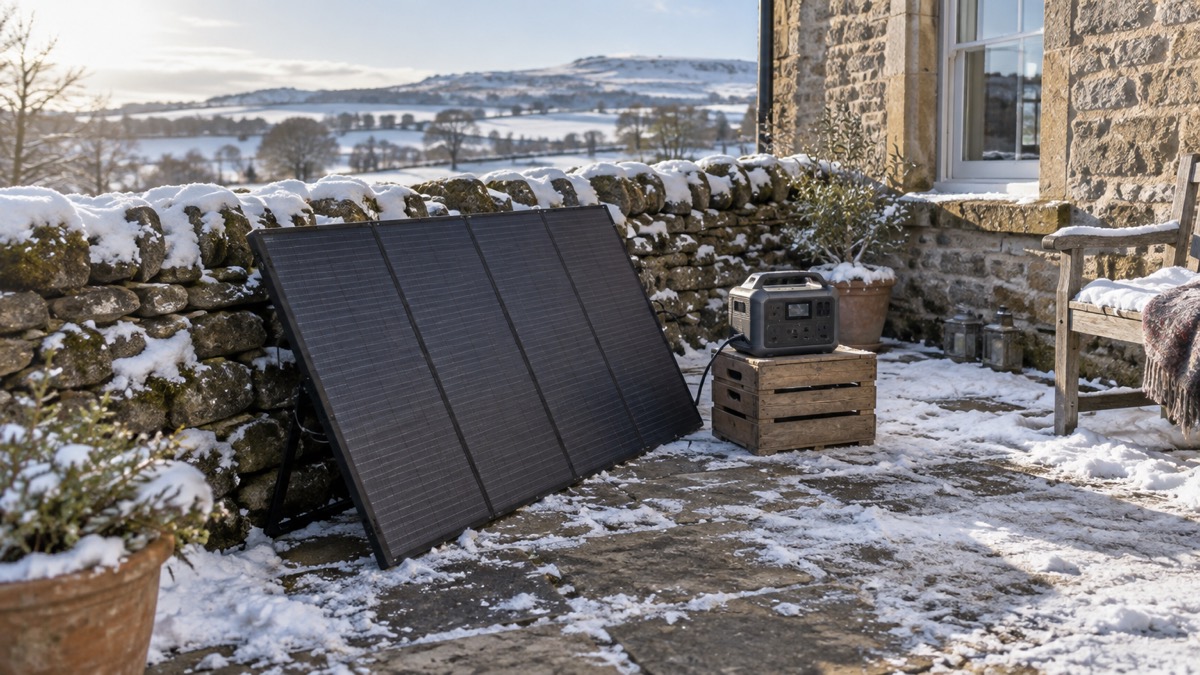
Solar is the slowest route in winter. Independent guidance gives winter generation of about 20Wh from a 25W panel, 16Wh from a 20W panel and 90Wh from a 100W panel, against 600 to 700Wh from the same 100W panel in summer8. A power station charged from solar "will take a while to charge"16. Our page on portable solar panels covers sizing and setup.
| Winter charging route | What it needs | What to watch |
|---|---|---|
| Mains charger | Working mains, or a generator outdoors | Never charge below freezing2 |
| Car 12V socket | Engine running | Cold makes flat car batteries far more likely15 |
| Solar panel | Daylight, clear of snow | About 90Wh a day from a 100W panel in winter8 |
What a 200 to 500Wh power station can keep running
A modest power station is enough for the things that matter most in a cold outage: phones, a lamp, a radio, and possibly a fridge or freezer for a while. Electrical Safety First lists a freezer at 200 watts and 0.86 amps17, which gives you a way to judge run time against your unit's capacity. Our guide to watts and watt-hours explains the arithmetic.
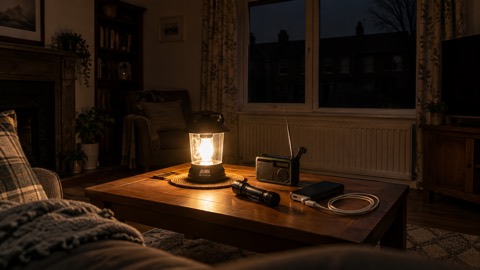
What it will not do is heat a room or run an electric heater for long. Plan to keep one room warm with layers and blankets, and use the power station for light and communications. Keep a torch and spare batteries at home for power cuts in adverse weather18.
For phones specifically, a small power bank is often the better tool than a large power station, because it is cheap to keep charged and easy to carry. See power banks and USB-C charging.
Where a power station is not the answer: medical equipment
If someone in the household depends on powered medical equipment, a portable power station is not a substitute for a plan. Lithium-ion batteries are not designed to operate in freezing conditions1, and a cold unit may not deliver what you expect when you need it.
Speak to the equipment supplier or your clinician about backup arrangements, and register for your electricity distributor's Priority Services Register if you are eligible, so you are contacted during an outage. Our guide to powering medical devices from a battery sets out what to check.
Cold weather, fire risk and what to check before winter
Cold is not the only risk. The fire services warn that lithium-ion batteries can become a fire risk when exposed to high temperatures or charged incorrectly19, and that a lithium-ion battery fire can burn at over 700°C to 1000°C20. Charging a cold battery is one form of incorrect charging.
Before winter, work through a short check:
- Charge every power bank and power station fully6.
- Store them indoors at room temperature, in a dry place6.
- Check for swelling, leaks or damage, and stop using anything affected11.
- Keep chargers out of parked cars, where they get cold in winter or hot in summer21.
- Store and charge in a cool, dry place, away from flammable materials22.
Store batteries at room temperature in a dry environment; refrigeration is not necessary or recommended, and extreme heat or cold reduces performance24. Our winter readiness checklist and battery storage temperature page go further.
Sources (24)
- Heat, cold and rain: how weather affects e-bikes and e-scooters, London Fire Brigade, 2026-10-25
- Batteries and chargers, London Fire Brigade, 2026-10-25
- BLUETTI AC200L, BLUETTI, 2026-10-25
- BLUETTI AC2A and AC70, BLUETTI, 2026-10-25
- BLUETTI AC180, BLUETTI, 2026-10-25
- Winter storm backup power, BLUETTI, 2026-10-25
- Lithium battery fire safety, Mid and West Wales Fire and Rescue Service, 2026-10-26
- Solar power, The Caravan Club, 2026-10-25
- Electrical safety, North Yorkshire Fire and Rescue Service, 2026-09-14
- Lithium-ion batteries, Scottish Fire and Rescue Service, 2025-11-27
- Lithium-ion batteries, National Fire Chiefs Council, 2026-10-09
- Heated batteries, Sterling Power, 2026-10-25
- Lithium batteries (no Bluetooth), Sterling Power, 2026-10-25
- LH Series heated 12V LiFePO4 battery, Sterling Power, 2026-10-25
- Winter car kit, Met Office, 2026-10-25
- Emergency kit packing list, Which?, 2026-09-30
- Ratings of electrical appliances, Electrical Safety First, 2026-10-25
- Staying safe in the snow, North Yorkshire Fire and Rescue Service, 2023-03-09
- How to stay safe during a heatwave, Devon and Somerset Fire and Rescue Service, 2026-06-23
- E-scooter, e-bike and mobility scooter fire safety advice, North Yorkshire Fire and Rescue Service, 2026-03-25
- Chargers, Electrical Safety First, 2026-10-26
- Charging safety, Oxfordshire County Council, 2026
- Charge Safe, National Fire Chiefs Council, 2026-10-09
- Can I mix different battery types?, Duracell, 2026-10-26
 Power Cut Backup Power Checklist
 Backup Power Before Winter
 Safe Battery Charging at Home
 Running a Generator Indoors
 Carbon Monoxide from Generators
 Generator Sizing for a Power Cut
 Generator Run Time on a Tank
 Storing Petrol at Home
 Diesel Storage at Home
 Storing a Generator
 Generators in Cold Weather
 Generator Noise and Neighbours
 Power Station Capacity Sizing
 Power Station Run Time
 Power Station for a Gas Boiler