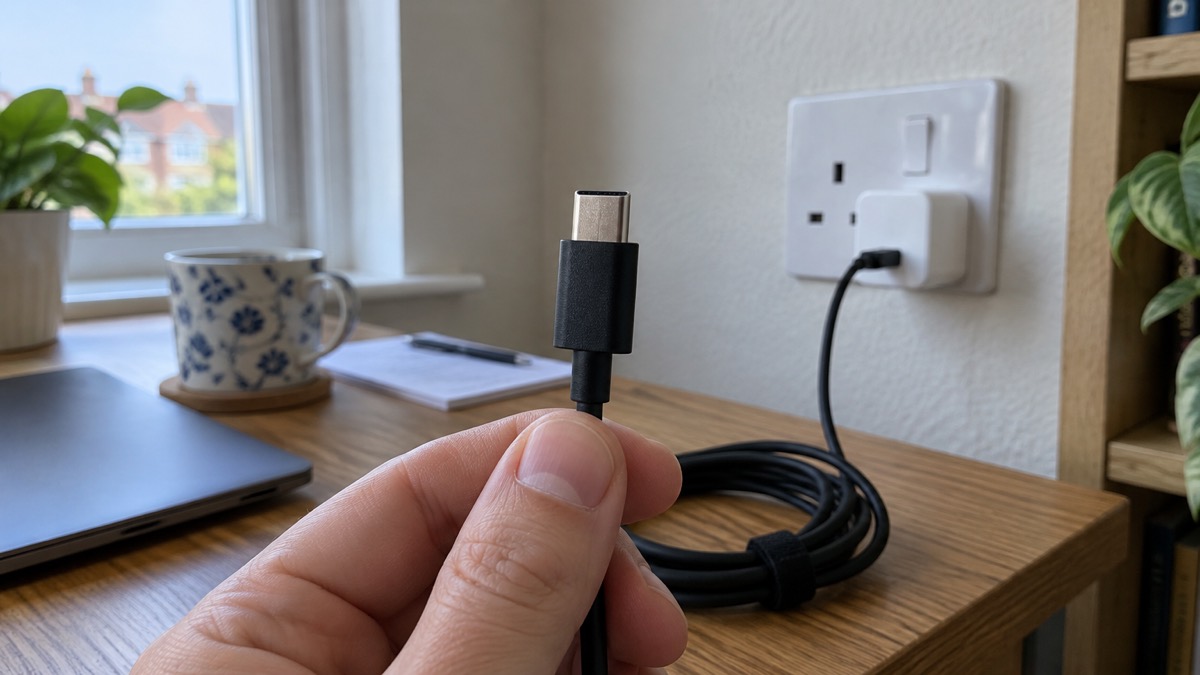
Every USB charger starts from the same place: 5 volts. That is the default voltage all USB chargers work at, and it is what a device receives when nothing more sophisticated happens1. What separates a slow overnight trickle from a fast charge that fills a phone in under an hour is a conversation. Fast chargers negotiate higher voltages through what Electrical Safety First calls a "digital handshake", and if that communication fails, the charger falls back to the standard 5V2. That single mechanism, the charger and the device agreeing on the power, is what USB-C Power Delivery is built around.
For an ordinary household, this matters in two ways. First, it explains why the same-looking plug and cable can behave so differently with different devices, and why the cable you use is part of the safety system, not just a wire. Second, it means one USB-C charger can safely serve a phone, a tablet, a laptop and a rechargeable torch, which is exactly what you want when a power cut forces you to ration sockets and keep communications and lighting going. This page explains how the standards work, what a safe UK charger must meet, and how to charge without creating a fire risk.
How USB-C Power Delivery works: the charger and device agree the power
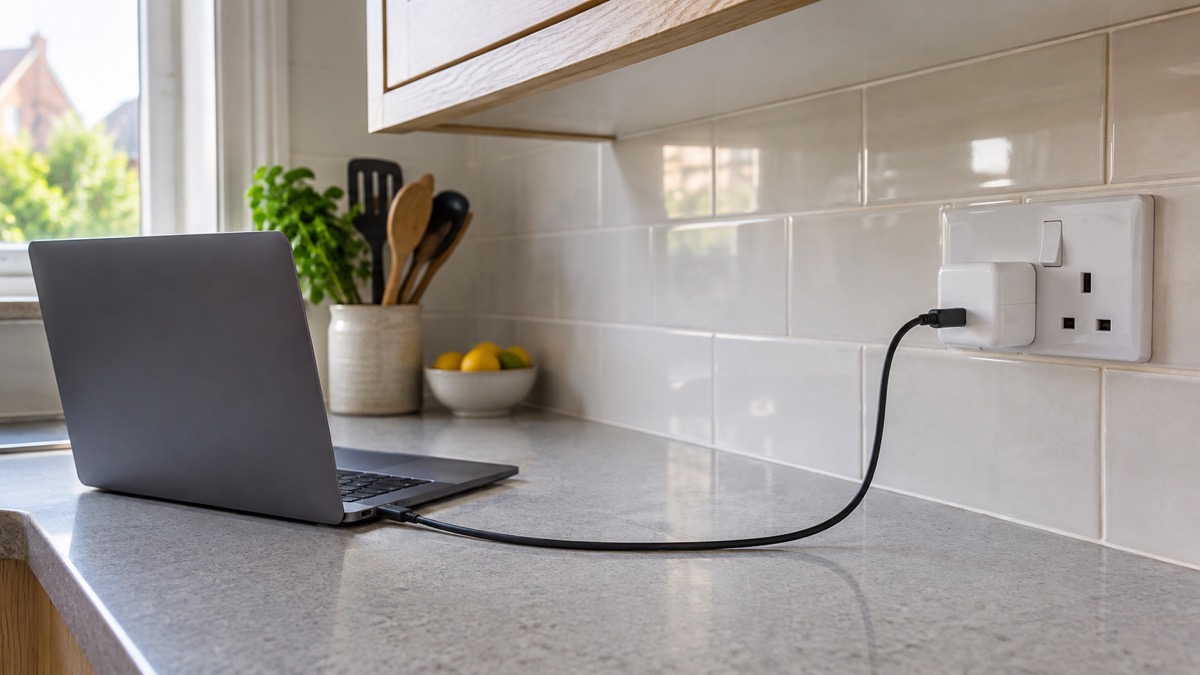
A USB charger is a simple thing at heart: a wall plug and a cable that converts the AC power from your wall outlet into the DC power portable electronics need2. Power flows to the device, and data can flow in either direction along the same connection1. What happens in the first moments after you plug in is what decides how fast, and how safely, the charge proceeds.
The most powerful and flexible option is USB Power Delivery, usually written USB-PD, which works over USB-C. As Electrical Safety First describes it, the charger and the device "talk" to each other to agree on the safest and fastest charging level2. Neither side simply pushes power and hopes. The device states what it can accept, the charger states what it can provide, and the two settle on a level both can live with. If that conversation fails, the system defaults to the standard 5V rather than guessing1.
This negotiation is why one connector can serve very different equipment. Small devices such as phones charge quickly through it, while larger devices such as laptops and monitors can receive much higher power through the same type of cable1. Most modern laptops now charge using USB-C Power Delivery rather than a proprietary charger, and the latest version can deliver enough power even for demanding devices2. Even without any advanced features, a USB-C charger can safely provide more power than older USB connectors, which makes charging faster and more consistent1.
The practical point for your household: the cable is part of the negotiation. A Power Delivery charge only happens if the charger, the cable and the device can all carry it, which is why a cheap or damaged cable can leave a fast-capable phone charging at a crawl. When you are choosing what cable to use for a 100W-class USB-C charger, use a cable rated for Power Delivery and follow the maker's instructions for the device, because the fire and rescue services' standing advice is to use the correct charger for the device5.
Standard USB charging starts at 5V
Before Power Delivery, there was ordinary USB charging, and it still runs the world's older plugs and ports. USB chargers operate with a default voltage of 5V1. That figure is not a maximum or a target: it is where every USB connection begins, and where it stays unless something raises it.
Older USB-A ports, the rectangular ones found on PCs and older chargers, provide limited power and were originally designed mainly for data, not fast charging1. If you have ever plugged a phone into a computer's USB-A port and watched the battery barely move, this is why. The port was built to transfer files, and charging was almost an afterthought.
The 5V default is also the safety net for the whole system. Fast chargers negotiate higher voltages through the "digital handshake" to deliver more power safely, and this handshake defaults to the standard 5V if the communication fails1. So a charger that cannot talk to a device, or a cable that cannot carry the conversation, does not deliver a dangerous surge: it delivers a slow, safe, old-fashioned charge. That is reassuring, but it is also why a phone that should charge in an hour sometimes takes four, and the first thing to check is the cable.
USB Battery Charging: typically 7 to 10 watts, power only
Between plain 5V USB and full Power Delivery sits a middle standard: USB Battery Charging. This allows devices such as phones and headphones to charge more quickly, typically at 7 to 10 watts, but it does not support data transfer1. It is a charging-only arrangement, which is why some dedicated charging cables and ports carry no data capability at all.
For a household, that distinction is worth knowing for two reasons. First, if you plug a phone into a USB Battery Charging port to transfer photos and nothing happens, the port is not faulty: it simply has no data path. Second, 7 to 10 watts is enough to charge a phone or a pair of headphones at a reasonable pace, but it is not in the same league as Power Delivery, and it will not meaningfully charge a laptop.
Power Delivery or basic USB charging: how each one behaves
Put side by side, the two approaches to USB charging look like this:
| Basic USB charging (5V and USB Battery Charging) | USB-C Power Delivery | |
|---|---|---|
| Starting point | 5V default1 | 5V default, then negotiated upward1 |
| Typical power | Limited on USB-A; 7 to 10 watts with USB Battery Charging1 | Enough for phones, laptops and monitors through the same cable type1 |
| Data | USB-A designed mainly for data; USB Battery Charging supports none1 | Data flows in either direction, and the handshake itself is a data exchange1 |
| If communication fails | Stays at 5V1 | Falls back to the standard 5V1 |
| Best suited to | Phones, headphones, small devices, older kit | Phones, tablets, laptops, demanding devices2 |
The behaviour that matters most in a real emergency is the fallback. If you are charging from a power bank or a portable power station during a power cut, and a device charges more slowly than expected, the cause is usually the negotiation: a port, a cable or a device that cannot complete the handshake drops back to 5V. Power banks themselves consist of a battery, circuitry, and one or more charging ports, often USB or USB-C6, and the ports on a single bank may support different standards, so it is worth checking which port is which before the lights go out.
One maker's example shows how the standards mix in a single product. The Belkin BoostCharge Plus 10K USB-C power bank can charge two devices at once through its integrated USB-C and Lightning cables, with a combined 23W of power7. That is Power Delivery territory for a phone, shared across two devices, and it illustrates the practical benefit of the standard: one bank, one set of built-in cables, two devices kept alive.
Fewer chargers, one connector: why USB-C helps in an emergency
USB-C is the smaller, reversible, faster, and modern standard used for new smartphones, tablets, and some laptops2. The reversible part sounds trivial until you have fumbled a USB-A plug three times in the dark. But the real value in an emergency is what Electrical Safety First sums up directly: a USB-C with Power Delivery means fewer chargers, faster charging, and one connector that works across many devices1.
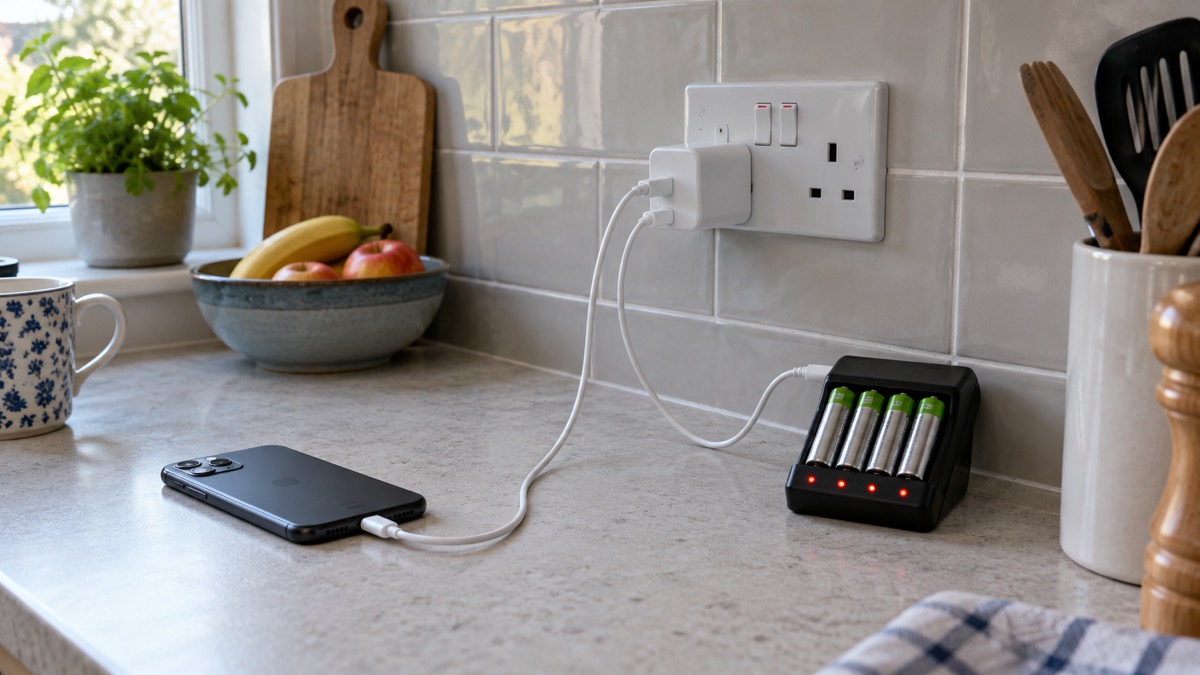
Fewer chargers matters more than it sounds. In a power cut you may be running everything from one extension lead fed by a single power station or generator output. Every distinct charger you do not need to find is a socket freed up and a cable not tangled. A household that has standardised on USB-C can charge the phones, the head torch, the rechargeable lantern batteries and the laptop from the same small set of plugs and cables.
The same logic extends to rechargeable household batteries. The GP Recyko B441 is a USB charger for AA and AAA rechargeable batteries, sold with four AA 2100mAh batteries included8. It takes its own power from a 5V 1A USB input8, so it can be run from a power bank or power station's USB port during an outage, and it charges two AA batteries in about 2 to 4 hours, four AA 2100mAh batteries in 3 to 6 hours, or two AAA 850mAh batteries in about 2.5 to 3.5 hours8. The maker notes that charging time varies with battery capacity8. It has four slots on two channels, and its power cuts off automatically when the batteries are fully charged or overheated, which the maker says saves energy and extends battery life8. The maker also states it monitors battery temperature and cuts off power when it exceeds a safe value, and that its LED lights indicate bad and single-use batteries as well as showing the power status of each battery8. See our page on rechargeable AA and AAA batteries and chargers for the wider picture.
Even small kit benefits. BioLite, describing its Solar String 18' Warm White lights, notes that charging via USB is roughly 6 times faster than via solar, because of the input power9. In a prolonged outage, that ratio is the difference between topping up a light from a power bank in an hour and leaving it outside all day for the same result. USB charging, in short, is the common currency of emergency power: whatever else you own, a USB port somewhere in the house is what keeps the small things running.
What a safe UK USB charger must meet
The legal baseline is straightforward: USB chargers are required to meet the requirements of the Electrical Equipment (Safety) Regulations 20161. For you as a buyer, the check is the mark on the plug. North Yorkshire Fire and Rescue Service advises you always look for the UKCA or CE mark, which indicates chargers comply with UK or European safety standards3. The same check applies to electrical gifts and devices: fire chiefs remind people to check that appliances, including toys and devices, are from reputable sellers and that CE or UKCA marks are visible, a requirement of UK product safety regulations10.
The reason the check matters is counterfeit chargers. London Fire Brigade warns that counterfeit electrical chargers can be deadly, as many fail to meet UK safety regulations, leading to fires and injury4. Mid and West Wales Fire and Rescue Service makes the same point about cheap chargers and batteries: they may not meet UK safety standards and can be dangerous11. Wiltshire and Swindon Prepared adds a mechanism worth understanding: different USB chargers give different voltages, which can cause a lithium battery to be over-cooked to the point where it explodes12. That is precisely the failure the Power Delivery handshake exists to prevent, and precisely why a charger without proper safety circuitry is not a bargain.
For e-bikes, e-scooters and other lithium battery kit, the official advice is the same in substance: make sure your battery and charger meet UK safety standards14, and only buy items from the right shops15. Our page on UKCA, CE and battery safety markings goes into the marks themselves, and our page on buying safe chargers covers the risks of online marketplaces.
Safe charging: follow the maker's instructions
Every fire and rescue service that has published on this subject gives the same first instruction, and it is worth taking literally. North Yorkshire Fire and Rescue Service: always follow the battery usage, storage and charging guidelines in the user guide3. Devon and Somerset Fire and Rescue Service: always follow the manufacturer's instructions for charging and using your product16. South Wales Fire and Rescue Service: follow the manufacturer's instructions when charging and always unplug your charger when it's finished charging14. Fire Scotland: follow the manufacturer's instructions on charging and charging times17. The National Fire Chiefs Council's guidance says the same, and adds not to overload socket outlets or use inappropriate extension leads, using uncoiled extensions and ensuring the lead is suitably rated for what you are plugging into it18. Electrical Safety First applies this to power banks too: read the manufacturer's instructions carefully and always follow them6.
Beyond the instructions, the fire services converge on a short set of habits:
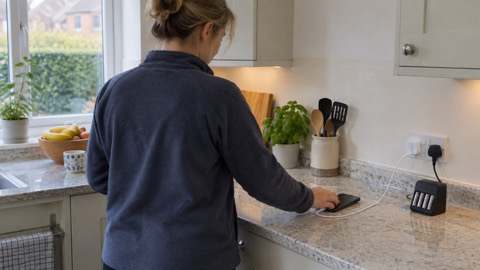
- Charge on a hard, flat surface. Devon and Somerset Fire and Rescue Service advises always charging devices on a hard surface, never on a carpet or bed, never under a pillow, and never leaving them unattended19. Its home fire risk advice repeats the point: charge on a hard, safe surface, never on a carpet or bed, and definitely never under a pillow20.
- Never cover a charger or device. North Yorkshire Fire and Rescue Service warns never to cover a charger, as it may build up heat during the charging process3. London Fire Brigade's easy-read booklet puts it plainly: never cover devices that are charging, as they can get hot15. The National Fire Chiefs Council adds that covering chargers or battery packs when charging could lead to overheating or even a fire18.
- Unplug when finished. Unplug your charger when it has finished charging14, and charge when you are awake and present21.
- Do not charge overnight or while out. Electrical Safety First advises against using USB chargers overnight or while you are out of the house1. Our page on overnight charging covers this in detail.
- Do not block escape routes. Government guidance on e-bike and e-scooter charging says to charge in a safe location that does not block fire escape routes or exits21.
Where a USB charger must never go: water and extreme temperatures
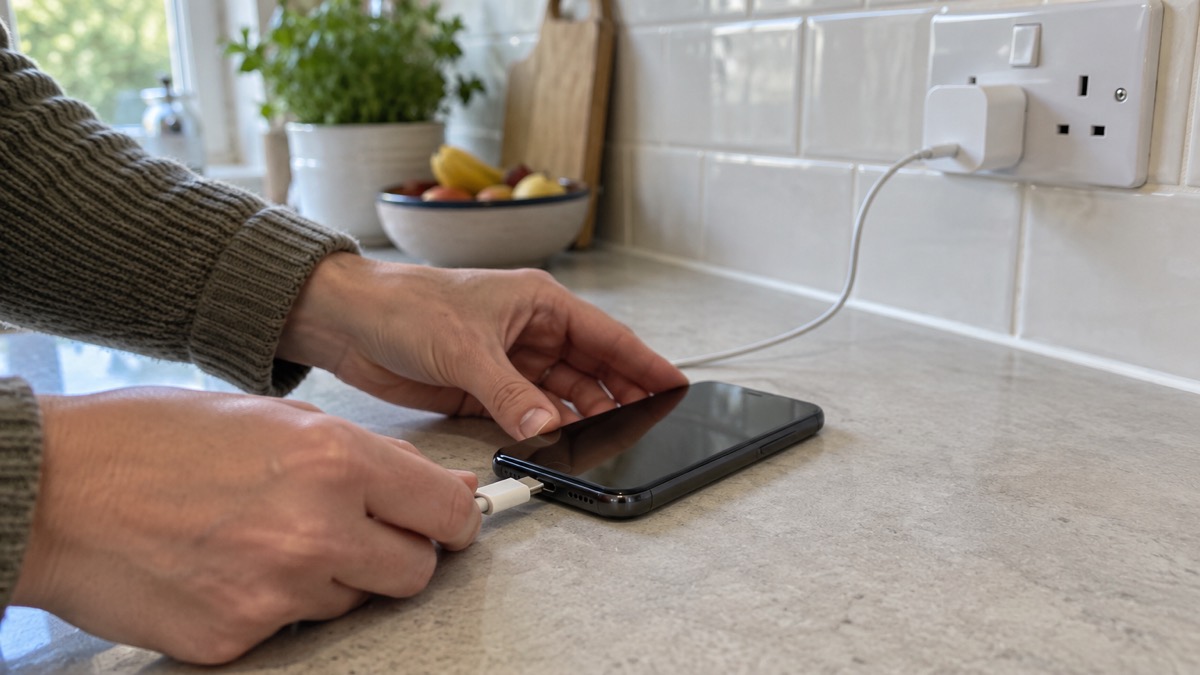
Electrical Safety First's guidance on charger placement is direct: keep USB chargers away from heat sources and liquids, especially direct sunlight, humidity and water, and be aware that exposing a USB charger to extreme temperatures can be dangerous1. Water and electricity need no explanation; the temperature point is subtler and matters in both directions.
On the hot side, Devon and Somerset Fire and Rescue Service advises avoiding charging batteries in strong sunlight or anywhere there is a high temperature or flammable materials16. North Yorkshire Fire and Rescue Service's Charge Safe campaign makes the same point without a number: do not charge or store batteries in direct sunlight or in hot locations22. London Fire Brigade's guidance on vaping batteries makes the same point for a device many households do own: direct sunlight or freezing temperatures can damage the battery, so avoid storing, using or charging batteries in these extreme temperatures, for example in a car23.
On the cold side, Mid and West Wales Fire and Rescue Service advises not charging or storing batteries in very hot or cold environments11. London Fire Brigade gives the practical instruction for a battery that has got too cold: if a battery has been left in freezing conditions, allow it to warm up slowly indoors before using or charging it24. In a cold house during a winter power cut, that means not putting a frozen power bank straight on charge the moment you bring it in from the car or shed. Our pages on charging in freezing weather and battery storage temperature cover this in depth.
Overloaded sockets: the other half of charging safely
Charging safely is not only about the charger; it is about the socket you plug it into. Fire and rescue services across the UK are unanimous. North Yorkshire Fire and Rescue Service: never overload plug sockets, because if too many electrical items draw power from one socket it can overheat and catch fire3. Devon and Somerset Fire and Rescue Service's student safety advice: don't overload plug sockets25. North Wales Fire and Rescue Service explains the mechanism: plugging too many electrical appliances into one socket can lead to overheating26. Northern Ireland Fire and Rescue Service adds warning signs to watch for, including scorch marks or blackness around sockets27, and repeats the advice in its New Year fire prevention tips28. North Yorkshire Fire and Rescue Service's student safety week message is the same: avoid overloading sockets29.
The constructive advice is just as consistent. Humberside Fire and Rescue Service advises using a surge protection extension cable where possible and having only one item per plug socket to avoid overloading30. North Yorkshire Fire and Rescue Service's festive safety guidance adds: ensure only one plug per socket, and always turn off plugs when not in use, except those designed to be left on, like freezers31. London Fire Brigade warns that overloading is all too easy if you add extra adaptors or extensions, or appliances that use lots of power like kettles, tumble dryers or heaters32. When you are running backup kit in a power cut, this is the moment of highest risk: one extension lead suddenly feeding a power station, two phone chargers, a lantern charger and a battery charger at once. Keep the lead uncoiled, suitably rated, and one plug per socket where you can18. Our extension leads and overloading page works through the arithmetic.
Charging for medical equipment: the Priority Services Register
If someone in your household relies on mains-powered medical equipment, such as a CPAP machine, charging and backup power is not a convenience question. Join your electricity network's Priority Services Register. UK Power Networks announced in January 2024 that it loans portable battery packs free to Priority Services Register customers reliant on medical equipment, with the packs delivered, installed and removed by its staff; a pack can power a standard feed pump for over 17 hours33. That is a loan scheme run by the network, not something you buy, and it exists precisely for the households that need it most. Our page on powering CPAP, oxygen and other medical devices from a battery covers what to plan for, and our page on deciding what to keep running when the mains fails helps you order the rest.
Sources (33)
- USB charger guidance, Electrical Safety First
- USB chargers explained, Electrical Safety First
- Electrical safety at home, North Yorkshire Fire and Rescue Service, 2026-09-14
- Batteries and chargers, London Fire Brigade
- Careful around candles, cooking and charging: tips for a safe Christmas, West Yorkshire Fire and Rescue Service, 2024-12-18
- Power banks guidance, Electrical Safety First
- BoostCharge Plus 10K USB-C Power Bank with Integrated Cables, Belkin
- GP Recyko B441 USB Charger with 4 AA 2100, GP Batteries
- Solar String 18' Warm White, BioLite
- Councils and fire chiefs issue reminder on home fire safety ahead of festive season, National Fire Chiefs Council, 2024-12-21
- Lithium battery fire safety, Mid and West Wales Fire and Rescue Service, 2026-10-26
- Reminder not to cut corners with electrical safety this Christmas, Wiltshire and Swindon Prepared
- How to charge e-bikes and e-scooters safely, London Fire Brigade
- E-bikes and e-scooters, South Wales Fire and Rescue Service, 2026-07-29
- Easy read fire safety booklet, London Fire Brigade
- Battery fires, Devon and Somerset Fire and Rescue Service
- E-bike and e-scooters, Scottish Fire and Rescue Service
- E-bikes and e-scooters fire safety guidance, National Fire Chiefs Council, 2025-01-21
- Advice for parents and guardians, Devon and Somerset Fire and Rescue Service
- Top ways to reduce your risk of having a fire at home, Devon and Somerset Fire and Rescue Service
- Buy safe, be safe: avoid e-bike and e-scooter fires, UK Government, 2024-10-24
- Charge Safe safety tips for e-bikes and e-scooters, North Yorkshire Fire and Rescue Service, 2024-11-12
- Vaping and e-cigarettes, London Fire Brigade
- Heat, cold and rain: how weather conditions affect e-bikes and e-scooters, London Fire Brigade
- Student safety, Devon and Somerset Fire and Rescue Service
- Looking after the electrics, North Wales Fire and Rescue Service
- NIFRS New Year's resolutions: the ones worth keeping, Northern Ireland Fire and Rescue Service, 2026-01-05
- Ring in 2025 with a safer home, Northern Ireland Fire and Rescue Service, 2025-01-02
- Encouraging students to stay safe for National Student Fire Safety Week, North Yorkshire Fire and Rescue Service, 2024-09-23
- Celebrate safely, Humberside Fire and Rescue Service, 2026-10-26
- Don't let fire ruin your festive cheer this Christmas, North Yorkshire Fire and Rescue Service, 2020-12-04
- Cables, fuses and leads, London Fire Brigade
- Extra support for people reliant on electricity for medical reasons, UK Power Networks, 2024-01-09
 Power Cut Backup Power Checklist
 Backup Power Before Winter
 Safe Battery Charging at Home
 What to Keep Running in a Cut
 Power During an Outage
 Watts and Watt-Hours
 Portable Power Stations
 Portable Generator Types
 Generator Safety
 LPG Cylinders and Regulators
 Connecting to Your Home's Wiring
 Home Battery Storage
 Portable Solar Panels
 12V Inverters
 Leisure and LiFePO4 Batteries