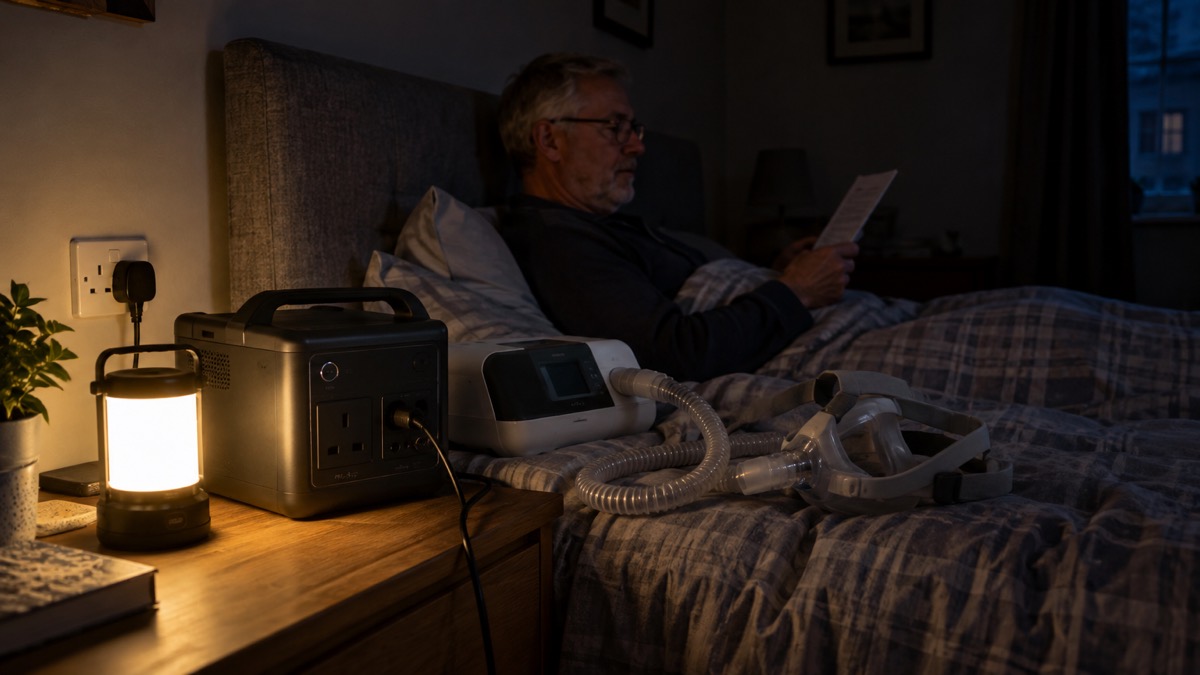
If a power cut stops a CPAP machine, an oxygen concentrator or a home dialysis machine, the first steps are the same: report the cut by calling 105, follow the instructions in your device's own manual, and contact your clinical team or equipment supplier if treatment is interrupted. Ofgem confirms that network operators must offer Priority Services Register customers extra help for both planned and unplanned power cuts, which can include battery packs so you can still charge phones or medical equipment1. Kidney Care UK notes that power cuts can be particularly challenging for those who rely on critical medical equipment, such as home dialysis patients, and that while winter energy blackouts are unlikely, it is best to be prepared.
A portable power station can bridge a short outage for some equipment, but it is not a universal answer. Makers themselves set limits: Jackery states its portable power stations are not recommended for use with medical devices, life-support equipment or other applications where a power interruption could result in personal injury or loss of life2. Most dialysis machines are not designed to run on a battery back-up at all, and Kidney Care UK advises following the patient guide and operator's manual for what to do instead3. So this page sets out what a battery can safely do, what it cannot, and where the real help comes from: your supplier, your clinical team, your network operator and the emergency services.
Join the Priority Services Register first
The Priority Services Register is the single most useful thing you can sign up to before any power cut happens. It is free, and it is run by the company that operates the electricity network in your area, not the company that sells you electricity. The Met Office's power cut guidance is direct on this point: if electricity is crucial for any medical equipment you have, contact your DNO at any time, as they may be able to put you on their Priority Register for assistance during any power outage5.
What you get for joining is set out by Ofgem. For both planned and unplanned power cuts, network operators must offer customers on the Priority Services Register extra help, for example giving them battery packs so that they can still charge phones or medical equipment. Ofgem also notes that what each company offers will be different, so it is worth asking your own operator exactly what they provide1. Some operators deliver help during the outage itself, such as advance notice of planned work and priority attention when supplies fail.
To find your network operator, call 105 or visit the Power Cut website, which directs you to the operator for your area4. Surrey's emergency planning team gives the same route: if the power goes off, report it by calling 105 or via the Power Cut website to be directed to the operator for your area4. Once you know who your operator is, their website will have a Priority Services Register application form, and you can also ask your electricity supplier to pass on your details.
Who qualifies goes beyond medical equipment. The register exists for people who depend on electricity for healthcare, but also for those who are elderly, disabled, chronically sick, or who have other reasons to need extra support during an outage. If someone in your household uses a CPAP machine, an oxygen concentrator, a home dialysis machine, an airflow mattress or any other powered equipment, say so specifically when you apply, because the level of help offered often follows what you declare. Our wider guide to power cuts covers the register and network operator help in more detail.
When the power goes off and your device stops
The first minutes of an unplanned cut matter, and the order you do things in matters too. Work through these steps:
- Check whether it is a network fault. Call 105 or visit the Power Cut website to be directed to your local network operator and report the cut4.
- Follow your device's own instructions. Equipment suppliers issue patient guides and operator's manuals with detailed instructions for a power failure; for dialysis, Kidney Care UK points to these as the authoritative source3.
- Contact your clinical team or supplier if treatment has been interrupted, or if you are unsure whether it is safe to continue or restart.
- Conserve what you have. Use your devices sparingly to conserve battery power until you can charge them again10, and keep phone conversations brief so your phone battery lasts11.
- Stay informed. If the power is out, use a battery-powered or wind-up radio, trying both digital and FM stations; in severe weather it might be safer to stay indoors rather than use a car radio12.
A few practical points make this easier. Wiltshire & Swindon Prepared notes that battery power packs are a reliable source of power when the electricity goes off, letting you charge your phone and still use it at the same time13. Keep mobile phones, laptops and tablets fully charged in advance so you have use of battery power for at least a short time14. Leave one light switched on so you know when the supply returns, and never touch damaged electricity equipment: nidirect's storm advice is blunt on this, and also warns never to approach damaged equipment or broken power lines15.
If any battery in your equipment starts to swell, the London Fire Brigade's advice is to turn off the device16. Swelling, unusual heat, bulging or hissing are all signs a lithium battery has become dangerous, and the same brigade advises stopping use immediately and leaving the device in a safe place until you can dispose of it properly17. Our page on warning signs a lithium battery is dangerous goes through the full list.
For families with technology-dependent children, an NHS letter written ahead of possible power shortages put the risk in perspective: with a clinical team assessment and a contingency plan in place, the risk from a planned power cut was assessed as low, and from an unplanned cut low to moderate18. The same letter advises charging fully any equipment with batteries for any planned power cut, and for unplanned cuts making sure any items not in use are charging or charged18. That is the pattern to copy: know your plan before you need it.
What a power station can and cannot do for a medical device
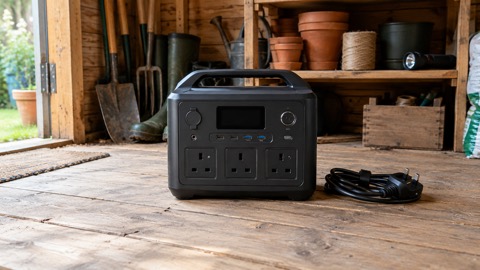
A portable power station is a large battery with mains-style sockets. It produces no exhaust, so it can be used indoors, which is exactly why households with medical equipment consider one. Our guide to portable power stations explains how they work and how to choose one in general; here the question is narrower: what are they actually for when the device that matters is medical?
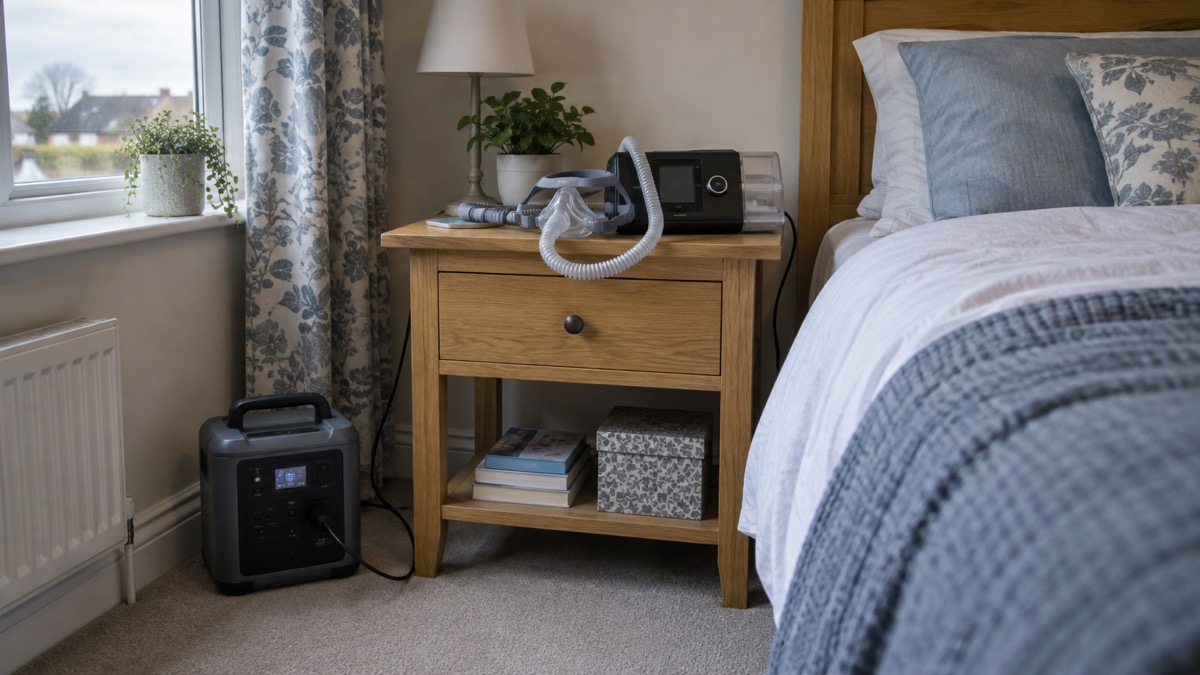
The honest answer from the makers themselves is: less than you might hope. Jackery's own buying guide states, for safety reasons, that its portable power stations are not recommended for use with medical devices, life-support equipment, data servers, or other applications where a power interruption could result in personal injury, loss of life, or significant property damage2. The same maker also advises that individuals with an implanted cardiac pacemaker or other implanted medical devices should not use the product2. That is a maker being clear about where its responsibility ends, and it is a reasonable position: a power station is emergency equipment, not a certified life-support supply.
What a power station can do is buy time and comfort. It can run or charge equipment where a short interruption is inconvenient rather than dangerous: charging a phone, running a CPAP humidifier's power supply if the maker permits it, keeping a nebuliser or a monitor going, or powering the chargers for the smaller batteries your equipment uses. Some equipment carries its own back-up battery as standard: Kidney Care UK notes that one home haemodialysis machine, the Baxter HHD, has a back-up battery that provides power for around 30 minutes during a power failure, while the patient discontinues the treatment3. Thirty minutes is enough to shut down safely, not to continue treatment, and that is the realistic scale of what batteries offer for high-draw medical equipment.
There is one figure in the official guidance worth knowing even though it is not about medical devices: in the switchover of the UK's landline network, Ofcom notes that the back-up battery units supplied for home phones must last for at least one hour in a power cut, but some providers have back-ups that last up to seven hours19. That range, one hour to seven hours, is a fair picture of what purpose-built back-up batteries deliver on modest loads. A CPAP machine without a humidifier draws far less than a fridge, so a mid-sized station can often carry it through a night; an oxygen concentrator draws far more, and a home dialysis machine more again. Our page on how long a power station runs a fridge or laptop shows how run time is worked out from the numbers.
The key discipline is to separate your equipment into what must never stop, what can pause safely, and what is merely convenient. Our page on deciding what to keep running when the mains fails walks through that triage. For anything in the "must never stop" category, the answer is not a consumer power station but your equipment supplier and clinical team, who can tell you what certified back-up exists for your specific device.
Matching capacity, output and waveform to your device
Two numbers decide whether a power station can run a given device: how much energy it holds, measured in watt-hours (Wh), and how much power it can deliver at once, measured in watts, both continuous and for the brief surge when a motor or compressor starts. Our page on watts, watt-hours and surge explained covers the arithmetic, and the sizing pages for power stations and generators apply it to real households. The principle for medical equipment is simple: find your device's rated power draw on its label or in its manual, check any start-up surge, and only then compare it with a station's continuous output. Never work from guesswork when the device is medical.
As a rule of thumb that holds across the market, smaller stations in the few-hundred-watt-hour class suit small loads and short bridging periods, while stations of 1000Wh and above are what longer backup of heavier equipment demands. The exact figure depends on your device's draw, which is why the sizing pages above matter more than any single number here. Run time falls out of the division: a station holding 1000Wh cannot deliver 1000Wh of useful output, because some is lost in conversion, so always size with margin.
Battery life over the years is a separate question from run time per charge, and the makers' own figures are reassuring for occasional use. Jackery states that if a power station is used once every three days, approximately 120 cycles are consumed per year, and with a 4000-cycle lifespan the power station can last over 10 years2. Emergency-only use consumes far fewer cycles than that, so a station bought for power cuts and stored properly should outlast most of the equipment around it. Our page on how to store a power station when not in use covers the storage side.
Pure sine wave: why the inverter type matters
A power station's AC sockets are fed by an inverter that turns the battery's direct current into something resembling mains electricity. Clarke International, a generator and power equipment supplier, explains that many inverter generators produce a pure sine wave output designed to closely replicate mains electricity, which makes them suitable for sensitive equipment such as laptops, televisions, mobile devices, audio equipment and battery chargers20. The same point applies to power stations: a pure sine wave output is the safe choice for anything with sensitive electronics, and medical equipment belongs firmly in that category.
Clarke also warns of the trap: AVR (Automatic Voltage Regulation) is not the same as the electronically conditioned pure sine wave output produced by many inverter generators, and for highly sensitive electronics you should choose equipment specifically designed for that purpose20. Translated to buying: check that a station's specification says "pure sine wave" on its AC output before you connect anything medical to it, and treat anything described only as "modified sine wave" as unsuitable for this job. If your equipment supplier has told you the device needs a UPS or a conditioned supply, that is a question for them, not for a retailer's marketing page.
Charging a power station before and during a power cut
Preparation is the whole of this job. The UK government's storms guidance is explicit: before or when a storm is forecast, charge mobile phones, power banks and any back-up batteries for medical equipment in case there is a power cut21. The NHS letter to families of technology-dependent children says the same in more detail: charge fully any equipment with batteries for any planned power cut, and for unplanned cuts make sure any items not in use are charging or charged18. In practice that means keeping the station itself near full, and keeping every small battery for your medical equipment on a rotation so none of them sits empty.
Charging has its own safety rules, and the fire and rescue services are unanimous about them:
- Unplug the charger once the battery is full, and put your device on a hard surface like a table before you start to charge it22
- Never charge on beds, sofas, under pillows or near other materials that could catch fire, says the National Fire Chiefs Council23
- Avoid charging batteries near flammable materials, do not overload power sockets, and always use uncoiled extension leads that are properly rated, says the Scottish Fire and Rescue Service24
- Avoid charging other electrical items near dynamic airflow pressure equipment, says North Yorkshire Fire and Rescue Service25
- Avoid second-hand batteries, says the London Fire Brigade's e-bike safety advice, a warning that applies equally to power stations bought for medical support26
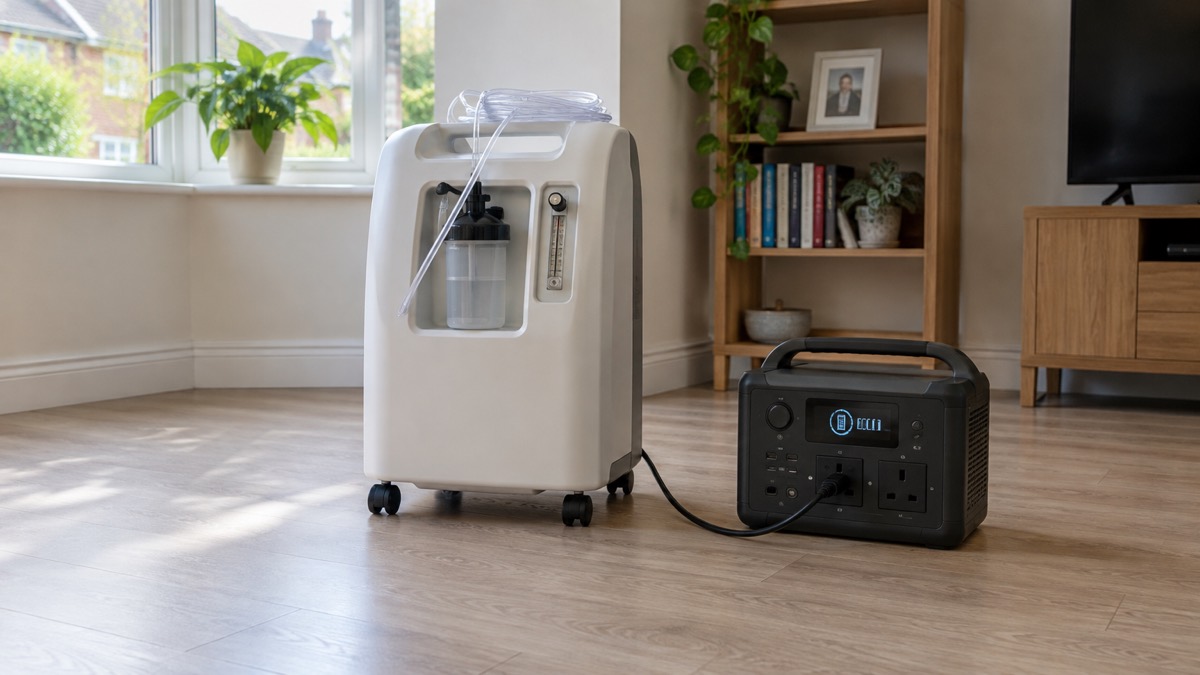
During the cut itself, a station cannot be recharged from the wall, which is where solar comes in. Which? notes that power stations can be charged with solar panels and that it will take a while to charge27. That caution matters: solar charging depends on the panel, the weather and the light available, and UK conditions rarely deliver the fastest figures a maker lists. Treat solar as a way to top up over a long outage, not as a way to refill a station quickly, and see our pages on how long solar charging takes in the UK and what size solar panel you need.
One further point if you are considering a station that can act as a UPS, switching over automatically when the mains fails: our page on using a power station as a UPS and switchover times covers what the switchover gap means for equipment that must not pause. For anything where even a fraction of a second matters, ask your equipment supplier what they certify, because a consumer station's UPS function is not a clinical guarantee.
Oxygen equipment and fire: what must never be near it
Home oxygen changes the fire risk in a house, and the rules around it are firm. Devon and Somerset Fire and Rescue Service explains why: oxygen is a combustible gas with a risk of fire when not used properly, and it is highly explosive when exposed to naked flame or dirt and grease7. The oxygen-rich atmosphere stays within clothing and furnishings, creating an increased risk of rapid fire spread, which is a particular risk for smokers7.
The distances and habits that follow from that are set out by the Northern Ireland Fire and Rescue Service:
- Keep oxygen a minimum of 3 metres away from any open flame, including gas and electric cookers6
- Turn off oxygen equipment when not in use, and store it in a dry and well-ventilated area6
- Never attempt to repair or modify the equipment6
- Keep internal doors open when using oxygen, because gases can build up and concentrate in a closed room but disperse easily in a well-ventilated one7
Smoking and oxygen do not mix at any distance. The London Fire Brigade's guidance for carers is blunt: never smoke or let anyone else smoke nearby whilst using oxygen equipment, and this includes e-cigarettes and their chargers28. Its advice for smokers goes further: do not use your oxygen supply for at least 30 minutes after you have finished smoking, to reduce your risk7. The same brigade's carers' page adds a simple instruction to pass on: tell them to never smoke when using oxygen29.
E-cigarettes and vapes deserve their own warning, because they combine a heat source, a battery and a charger. The Northern Ireland Fire and Rescue Service says never to leave e-cigarettes or vapes charging overnight or whilst out of the house, never to use them close to medical oxygen, emollient creams or airflow mattresses, never to use devices that show signs of damage, and never to charge or use a battery that has been dropped or damaged6. The London Fire Brigade's easy-read booklet puts the same rule in four words: keep e-cigarettes away from oxygen equipment and airflow mattresses22.
One piece of equipment needs special mention alongside oxygen: dynamic airflow pressure mattresses. The London Fire Brigade warns that the emergency back-up battery on these mattresses may continue to pump air during a fire, which can cause the fire to burn longer and with greater intensity28. If your household has one, that back-up battery is a live hazard the fire service needs to know about.
Telling the fire service, and the alarms to have
You no longer need to inform the fire service that you use oxygen, though you can still contact them to request a home visit7. What you must do is tell them during an emergency: if there is a fire, call 999 and inform the operator that you have oxygen on your premises7. That single sentence changes how the fire service responds, so make sure everyone in the household knows to say it.
On alarms, the guidance for oxygen users is to have a working smoke alarm on each floor of your home and to test it at least once a month. If your home has any fuel-burning appliance, the Met Office's winter guidance adds that a carbon monoxide alarm should be fitted in any room containing a gas fuel-burning appliance, like a boiler or gas fire, or a solid fuel burning appliance, and tested regularly; the rooms should also be adequately ventilated30. If you ever suspect carbon monoxide, the Northern Ireland Fire and Rescue Service gives the sequence: turn off or extinguish all fuel-burning appliances if safe to do so, open doors and windows, go outside and stay out, seek medical assistance if you feel unwell, and keep appliances off until checked by a qualified engineer31.
Home dialysis and other electricity-dependent treatment
Home dialysis is the clearest case where a battery is not the answer. Kidney Care UK's guidance for home dialysis patients states that most dialysis machines are not designed to run on a battery back-up, and that the patient guide and the operator's manual offer detailed instructions on what to do in the event of a power cut3. Follow those documents, not general internet advice, because the correct action differs between machines. As noted above, one machine's own back-up battery provides around 30 minutes of power, and that time exists so the patient can discontinue the treatment safely3.
Planning around planned cuts is where dialysis patients have real control. Kidney Care UK advises checking information for any planned or rolling power outages in your area, for which you should have advance notice, and where possible adjusting your dialysis schedule to accommodate them3. The Priority Services Register is what gets you that advance notice, which is another reason to join: network operators must offer extra help to registered customers for planned as well as unplanned cuts1. Keep an emergency power cut kit topped up with extras, Kidney Care UK adds, noting that things like a battery-powered radio can be a great way to pass the time during a longer outage3.
For other electricity-dependent treatment, the same principles apply whatever the condition:
- Ask your clinical team or equipment supplier, before any cut, what happens if the power stops mid-treatment, and write the answer down
- Read the operator's manual's power failure section and keep it where you can find it in the dark
- Keep every back-up battery the equipment came with charged, and any items not in use charging or charged18
- Join the Priority Services Register so your network operator knows you depend on the supply5
- Know which phone number to call out of hours for your supplier or clinical team, and keep a charged power bank so you can call it13
For families with technology-dependent children, the NHS assessment is worth repeating as reassurance rather than alarm: with a clinical team assessment and a contingency plan in place, the risk from a planned power cut was assessed as low, and from an unplanned cut low to moderate18. The contingency plan is the thing that moves the risk down, and building it is a job for a quiet afternoon, not the middle of an outage.
Where to get help: 105, your operator, charities and 999
The numbers and routes, in the order you are likely to need them:
| Situation | What to do | Who says so |
|---|---|---|
| Power goes off | Call 105 free, or use the Power Cut website, to reach your local network operator4 | Surrey emergency planning4 |
| Unplanned cut | Report it directly to your local network operator via their website, or call 105 for free1 | Ofgem1 |
| You depend on power for medical equipment | Contact your DNO at any time about the Priority Services Register5 | Met Office5 |
| Damaged or dangerous electrical equipment | Report it via the Power Cut website, but call 999 in an emergency4 | Surrey emergency planning4 |
| Fire and you have oxygen at home | Call 999 and inform the operator you have oxygen on the premises7 | Devon and Somerset Fire and Rescue Service7 |
Two points complete the picture. First, never approach damaged electricity equipment or broken power lines, and never touch it: nidirect's storm warnings repeat both instructions15. Second, keep your means of contact alive through the outage: battery power packs are a reliable source of power when the electricity goes off13, a charged power pack helps you stay in contact with loved ones even if it just charges a phone11, and if you are using a phone, keep conversations brief so the battery is conserved11. A battery-powered or wind-up radio, trying both digital and FM stations, keeps you informed when the mobile network is strained12.
Beyond the official routes, charities sit close to specific conditions: Kidney Care UK publishes the home dialysis power cut guidance quoted throughout this page3, and condition-specific charities generally publish similar advice for their own equipment. Your equipment supplier's out-of-hours line is the one number to have written down before any of this is needed, because for medical equipment the supplier's word outranks anything a general guide, including this one, can tell you.
Sources (31)
- Check if you can get payment for a power cut, Ofgem, 2026
- Jackery buying guide, Jackery, 2026-10-25
- Managing home dialysis during a power cut or energy blackout, Kidney Care UK, 2023-11-29
- Power, gas and water: what if they fail, Surrey County Council, 2025-12-29
- What to do in a power cut, Met Office, 2026-10-25
- Home fire safety, Northern Ireland Fire and Rescue Service, 2026-10-14
- Specialist health equipment, Devon and Somerset Fire and Rescue Service, 2026
- Lithium-ion batteries, South Wales Fire and Rescue Service, 2026-01-13
- Charging safety, Oxfordshire County Council, 2026
- Phone and broadband outages, UK government Prepare campaign, 2026-10-12
- Personal resilience: yourself, Wiltshire and Swindon Prepared, 2026-10-25
- Emergency plan, Ready Scotland, 2026-03-24
- How to prepare for the loss of electricity, Wiltshire and Swindon Prepared, 2026-10-25
- Get prepared for emergencies, Carmarthenshire County Council, 2026-10-25
- Strong winds and heavy rain warning: information and advice, nidirect, 2026-01-27
- Batteries and chargers, London Fire Brigade, 2026-10-25
- Smoking, vaping and e-cigarettes, London Fire Brigade, 2026-10-25
- Parental letter re power shortages, NHS North West Children's ODNS Hub, 2022-11-25
- Future of landline calls, Ofcom, 2026-08-26
- Generators, Clarke International, 2026-10-25
- Storms, UK government Prepare campaign, 2026-10-19
- Digital easy read fire safety booklet, London Fire Brigade, 2026
- Lithium-ion batteries campaign, National Fire Chiefs Council, 2026-10-09
- Lithium-ion batteries, Scottish Fire and Rescue Service, 2025-11-27
- Medical equipment safety, North Yorkshire Fire and Rescue Service, 2026-03-09
- E-bike conversion kits: fire risks and safety advice, London Fire Brigade, 2026-10-25
- Emergency kit packing list, Which?, 2026-09-30
- Specialist health equipment for carers and support workers, London Fire Brigade, 2026-10-25
- Caring for smokers, London Fire Brigade, 2026-10-25
- Keeping your home warm in winter, Met Office, 2026-10-26
- Other safety advice, Northern Ireland Fire and Rescue Service, 2026-10-22
 Power Cut Backup Power Checklist
 Backup Power Before Winter
 Safe Battery Charging at Home
 What to Keep Running in a Cut
 Power During an Outage
 Watts and Watt-Hours
 Portable Power Stations
 Portable Generator Types
 Generator Safety
 LPG Cylinders and Regulators
 Connecting to Your Home's Wiring
 Home Battery Storage
 Portable Solar Panels
 12V Inverters
 Leisure and LiFePO4 Batteries