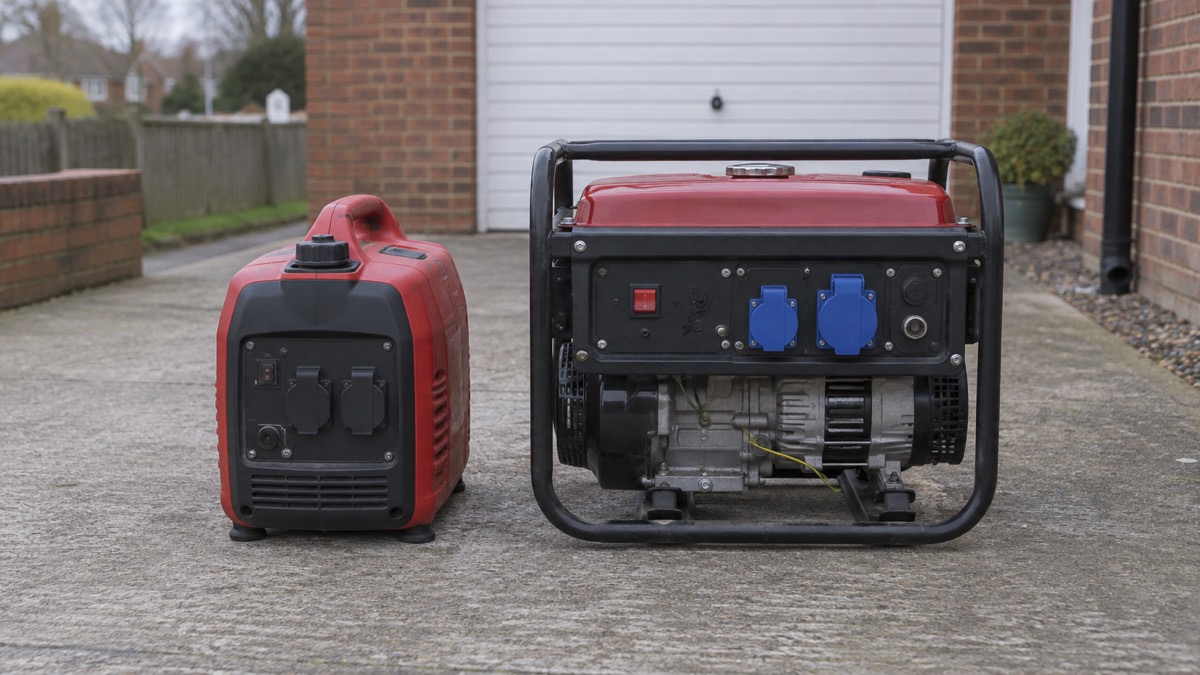
If you are weighing up an inverter generator against an open-frame one, the short answer is that they do the same basic job by different means. An inverter generator electronically controls and conditions the power it produces, and is generally quieter, more compact and more fuel-efficient at lighter loads1. An open-frame generator is the conventional machine: a bare engine and alternator on a metal frame, built to power tools, lighting and equipment rather than delicate electronics1.
For most households facing a power cut, the inverter type is the easier fit. Many produce a pure sine wave output designed to closely replicate mains electricity, which suits sensitive equipment such as laptops, televisions, mobile devices, audio equipment, battery chargers and modern caravan electronics1. They are also the type usually called a suitcase generator, because the whole unit is built into a carry case.
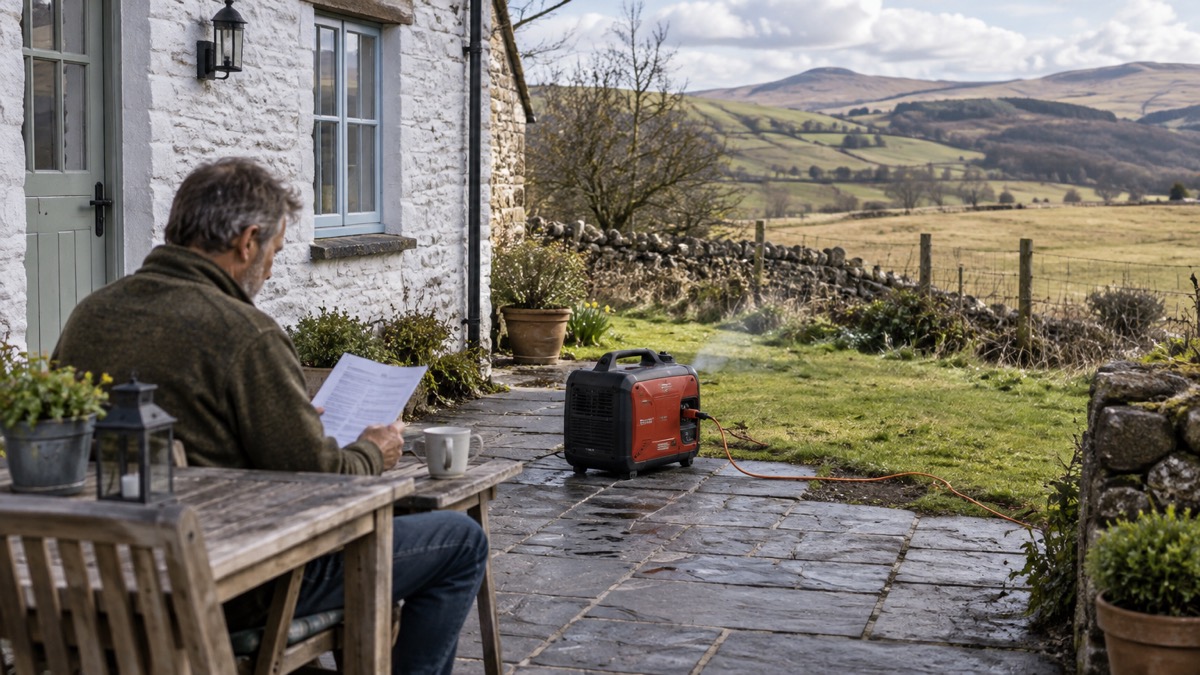
Whichever you choose, two rules decide whether it is safe to use. A generator must never run indoors, because its exhaust gases contain carbon monoxide2. And it must never be connected directly to your household wiring or a wall socket; that must be done by a qualified electrician1.
What an inverter generator is, and why it is called a suitcase generator
An inverter generator is a small generator whose electronics clean up the raw output of the engine before it reaches the sockets. The maker Clarke describes the principle plainly: inverter generators electronically control and condition the power they produce, and are generally quieter, more compact and more fuel-efficient at lighter loads, which is why they are popular for caravans, camping, laptops, televisions, chargers and other sensitive devices1. The same maker's range runs from compact portable inverter models for leisure use to larger conventional petrol generators designed to power tools, lighting and equipment1.
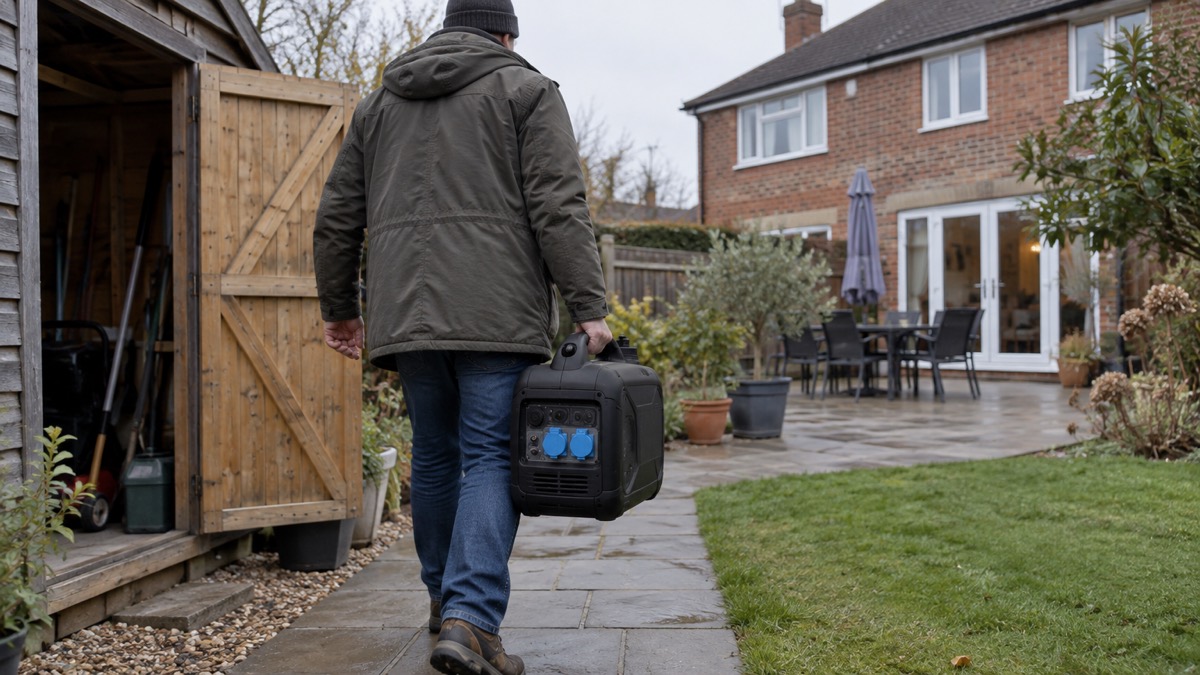
The "suitcase" name comes from the shape. The engine, alternator and fuel tank sit inside a moulded case with a carrying handle, so the unit can be lifted in and out of a shed or car boot by one person. That matters in a power cut, when you may be setting it up in the dark and in poor weather.
The trade-off is output. Because they are small, portable generators have a limited output capacity, and some models will not power every appliance in the home6. A typical inverter unit is bought to run a chosen list of things, not the whole house. Working out that list before you buy is the single most useful thing you can do; our guide to watts, watt-hours and surge explains how to add it up.
Output: what these machines can and cannot run
Inverter generators cover a wide span of sizes. What matters is not the headline number but what it will actually start and run.
A generator can provide temporary emergency power during a power cut. Smaller models may support selected items such as lighting, phone chargers, a refrigerator or freezer, while larger generators may run additional equipment within their rated capacity1. That is the honest framing: a generator buys you a chosen set of appliances for the hours or days of an outage, not a return to normal life.
Two figures on any generator decide what it can do:
- Rated output is what it will supply continuously. The maXpeedingrods Portable Inverter Generator is listed at 3300W6.
- Run time is how long a tank lasts at a stated load. The same unit is claimed to run 8.3 hours at 25% load, which is a 750W load6. The Briggs & Stratton P2400 PowerSmart Series Inverter Generator is stated to supply equipment for 8 hours straight at 25% load7.
Note how both run-time figures are quoted at a quarter load. Run a generator near its maximum and the tank empties far sooner. If run time is the deciding factor for you, our guide to how long a generator runs on a tank goes through it.
| What you might want to run | What it needs from the generator | What to check |
|---|---|---|
| Phones, laptops, small chargers | A modest continuous load and clean output | Inverter output suits sensitive devices1 |
| Television, audio equipment | Clean, stable output | Pure sine wave output is designed for these1 |
| Fridge or freezer | Enough rated output to start the compressor | Smaller models may support a fridge or freezer1 |
| Power tools | A stable supply | Some electronically controlled tools need a stable supply, so check the tool maker's guidance before connecting them to a conventional generator1 |
Clean power for sensitive equipment
The reason inverter generators are recommended for electronics is the shape of the electricity they produce. Many produce a pure sine wave output designed to closely replicate mains electricity, suitable for sensitive equipment such as laptops, televisions, mobile devices, audio equipment, battery chargers and modern caravan electronics1. The Champion 2200 Watt Inverter Petrol Generator 110V, for example, is built around true sine wave inverter technology8.
This is not a marketing nicety. Unstable power can cause some devices to malfunction, overheat or shut down, so always check the generator specification and the equipment manufacturer's instructions before connecting sensitive electronics1. A conventional open-frame generator is designed for tools and lighting, and the maker's own guidance is to check the tool manufacturer's guidance before connecting electronically controlled tools to a conventional generator1.
If your reason for buying is a laptop, a router, a television or medical equipment, the inverter type is the one built for the job. If your reason is a circular saw and a work light during a building project, an open-frame machine is the natural fit and the electronics question does not arise.
Noise: where it comes from and why it matters
Noise from any generator comes from two places: the engine itself, and the cooling and exhaust system around it. An open-frame generator leaves all of that exposed, which is why it is the louder design. An inverter generator encloses the engine in a case, and because it conditions its output electronically it can also let the engine run at varying speeds rather than a fixed high rev, which is why inverter generators are generally quieter than conventional open-frame generators, particularly at lower loads1.
How much quieter depends on the model, the load and how far away you are standing. Actual noise varies by model, operating load and measuring distance1. As a guide to what a well-sorted inverter unit can achieve, the Briggs & Stratton P2400 PowerSmart Series Inverter Generator is quoted at 58dB operating volume, which the maker says is quieter than a normal conversation7.
Why does it matter for a household? Three reasons:
- Neighbours. A generator running through the night in a suburban garden is audible over a fence. In a long outage, a quieter unit is easier to live with and easier for those around you to tolerate.
- Where you can site it. A generator must be outdoors with plenty of air flow around it9. On a small plot, the quietest spot that is still safely away from doors and windows may be close to a boundary.
- Your own household. If someone is sleeping near the garden, or you are running the unit in the evening, lower noise makes the difference between using it and not bothering.
If noise is your main concern, our guide to generator noise and neighbours covers siting and expectations in more detail.
Fuel, start method and sockets to check
Three practical details separate one generator from another, and all three are on the specification sheet.
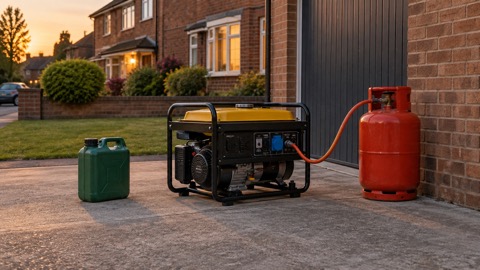
Fuel. The inverter generators described here are petrol machines. The maXpeedingrods Portable Inverter Generator is petrol-powered6, and Briggs & Stratton describes its petrol inverter generators as compact and easy to manoeuvre7. Petrol has to be stored and rotated carefully; our guide to storing petrol at home sets out the limits. If you want the option of bottled gas as well, you need a model sold as dual fuel, covered in our guide to LPG or petrol generators.
Start method. An electric-start model uses a key or switch, making larger engines easier to operate. Its battery must be kept charged and maintained, although some models retain a recoil starter as a backup1. Smaller inverter units commonly use a recoil, or pull-cord, start: the Champion 2200 Watt Inverter Petrol Generator 110V lists its start type as recoil8. A pull-cord needs no battery to go flat, but it needs a firm pull and some strength.
Sockets. This is where buyers are most often caught out. UK appliances expect 230V, but not every generator provides it. The Champion 2200 Watt Inverter Petrol Generator 110V has a single 110V 16A AC outlet and a 12V DC output rated 12/8.38. By contrast, the maXpeedingrods unit is listed with two 230V 13A sockets, a 12V DC outlet and two USB ports6. Check the outlet types on the model you are considering against the plugs in your house before you commit.
| Feature | What to look for | Example from the makers |
|---|---|---|
| Fuel | Petrol, or dual fuel if you want a gas option | Petrol inverter generators7 |
| Start | Key or switch, or pull-cord | Recoil start8; electric start with a maintained battery and sometimes a recoil backup1 |
| AC sockets | 230V for UK household plugs | Two 230V 13A sockets6 |
| Site sockets | 110V for site equipment | One 110V 16A outlet8 |
| DC and USB | For charging phones and small devices | 12V DC and two USB ports6; 12V DC output 12/8.38 |
Where a generator must never go
This is the section that matters most. A generator produces carbon monoxide, an invisible gas with no smell, and the exhaust can kill.
The official position is unambiguous. Do not use petrol or diesel generators or other similar fuel-driven equipment indoors because their exhaust gases contain carbon monoxide2. The Northern Ireland Executive's warning is equally direct: if you are using a generator, be careful where you put it in case of carbon monoxide poisoning10. NIE Networks adds the practical detail: make sure there is plenty of air flow around the generator to supply oxygen and remove the fumes9.
"never use standby generators indoors, as the fumes from the engine can be lethal"
The same warning covers other fuel-burning equipment people reach for in a power cut. Using equipment such as kerosene heaters, charcoal grills (BBQs) and portable generators indoors can cause carbon monoxide poisoning10. A generator in a garage, a shed, a porch or a conservatory is still indoors for this purpose, because the fumes have nowhere safe to go.
There is a second, separate danger: water and electricity. The maker's instruction is plain: do not use it in rain or standing water1. If you must run a generator in wet weather, it needs shelter that keeps rain off while leaving the exhaust and cooling air free, which is harder to arrange than it sounds. Our guide to running a generator in the rain deals with that problem, and can you run a generator indoors or in a garage answers the question people most often ask.
Get advice from a qualified electrician before you connect one
A generator can run an extension lead to a few appliances. Connecting it to your home's wiring is a different matter, and it is not a DIY job.
The maker's warning is explicit: never connect a portable generator directly to household wiring or a wall socket, because this can create dangerous backfeed into the electricity network and may cause serious injury, fire or damage1. The reason backfeed matters beyond your own home is set out by SP Energy Networks: before connecting a generator, the incoming supply must be switched off and isolated from your own electrical circuits and the generator, otherwise you risk damaging your property and endangering the lives of SP Energy Networks employees working on power lines some distance from your home11.
Every network operator says the same thing about who does the work. Only a qualified electrician can connect a generator safely4. National Grid says that should you decide to hire a generator, for safety reasons it is essential that it is connected by a qualified electrician12. NIE Networks goes further and asks for an NICEIC approved electrician13. Northern Powergrid says that if you do choose to connect your own generation, this must be done by a qualified professional14.
Wiltshire and Swindon Prepared adds the wider point: it takes research by you and the advice and expertise of a qualified electrician for a generator to help you15. Earthing is part of that conversation. Earthing requirements depend on the generator design, connected equipment and application, so follow the manual and seek advice from a qualified electrician where necessary1.
Our guide to connecting a generator or battery to your home's wiring, and the wider generator safety guide, take this further.
Generators from your network operator, and what to expect in an outage
It is worth knowing what your network operator will and will not do, so you are not waiting for a generator that is never coming.
NIE Networks is clear: where possible, it fits a generator at the local substation, and it does not fit generators in individual homes or businesses16. It also says that buying your own generator is a personal decision and not something it can advise on17. Electricity North West says generators are only provided in exceptional circumstances, such as for medical needs like oxygen equipment, mobility aids or end-of-life care, and that in exceptional circumstances such as weddings or funerals it does its best to provide a generator to minimise the impact of the power cut18.
Where a generator is used, it is usually temporary. Generators will sometimes be used for temporarily restoring customers while permanent repairs are completed, ordered through network partners who ensure a robust refuelling strategy is in place and connect to the network safely19. That is why you may experience a short outage while you are connected back to the network after the repair19. It is a normal step, not a new fault.
If you have a medical need, the Priority Services Register is the route to help. SSEN says that if you use medical equipment that needs electricity it will try to give you portable power generators5. Contact your own network operator to join its register, and read our guide to powering medical devices from a battery so your plan does not depend on a generator arriving.
Carbon monoxide: the symptoms to act on
Carbon monoxide poisoning can feel like something else entirely. Symptoms include headache, dizziness, nausea or vomiting, tiredness or weakness, shortness of breath and confusion, with loss of consciousness in severe cases20. They can feel like flu, fatigue, food poisoning, a hangover or a virus but without a temperature, and worsen the longer you are exposed21.
The early signs are headache, nausea, poor concentration and subjective weakness; later signs can include the appearance of intoxication or memory change, vertigo and ataxia, breathlessness and tachycardia, chest pain, loss of consciousness and seizures22. The risk from portable devices may also be higher in caravans, boats and mobile homes23.
What to do is simple and should be acted on at once. If you experience dizziness, headaches or disorientation, switch the appliance off, move to a well-ventilated area and seek medical advice24. Liquid Gas UK gives the same instruction for appliances in use: if you ever suffer headaches, nausea or dizziness, turn them off immediately and have them checked by a Gas Safe Registered installer25.
A carbon monoxide alarm is the backstop. Our guide to carbon monoxide from generators covers warning signs, and our review of how carbon monoxide detectors are tested explains what a good one does.
Sources (25)
- Generators, Clarke International, 2026-10-25
- Flooding and health: safely cleaning your home, Wiltshire and Swindon Prepared, 2026-10-25
- Emergency power cuts, Electricity North West, 2026-10-25
- Your planned power cut explained: repairing our network, SSEN, 2026
- Priority Services, SSEN, 2022
- How to buy the best generator, Which?, 2026-01-20
- P2400 PowerSmart Series Inverter Generator, Briggs & Stratton, 2026
- Champion 2200 Watt Inverter Petrol Generator 110V, Champion Power Equipment, 2026-10-25
- Power cut advice, NIE Networks, 2026-10-25
- Strong winds and heavy rain warning: information and advice, nidirect, 2026-01-27
- Planned interruptions, SP Energy Networks, 2023
- Planned interruptions: information and advice, National Grid, 2026
- Planned work FAQs, NIE Networks, 2026-10-25
- Emergency power cuts: FAQ, Northern Powergrid, 2025-03
- Generators, Wiltshire and Swindon Prepared, 2026-10-25
- Planned work, NIE Networks, 2026-10-25
- Should I buy my own generator?, NIE Networks, 2026-10-25
- FAQs, Electricity North West, 2026-10-25
- Restoration following a power cut, Electricity North West, 2026-10-25
- Carbon monoxide, North Wales Fire and Rescue Service, 2026
- How we test carbon monoxide detectors, Which?, 2026-07-14
- Carbon monoxide poisoning, NHS Scotland, 2013-12-12
- Carbon monoxide poisoning, nidirect, 2024-12-16
- Household flood plan, nidirect, 2018-12
- Safety advice, Liquid Gas UK, 2026-10-25
 Power Station vs Generator
 LPG vs Petrol Generator
 Power Bank vs Power Station