
Briggs & Stratton is an engine maker, and for a UK household the product that matters most is a portable petrol generator: a machine you wheel out into the garden during an extended power cut to keep a fridge, freezer or a few lights running. The maker's own product pages set out what each model can do, and the safety rules that come with it are strict and simple. A fuel-driven generator must never be run indoors, in a garage, in a caravan, motorhome, tent or awning, because the fumes from the engine can be lethal1.
Before you buy anything, decide what you actually need to run. A generator is only useful if its output matches your appliances, and a machine that is too small will trip or overload. Pramac advises focusing on three points when choosing a portable generator: the usage (home standby, long run or temporary run), the tension (single phase or three phase) and how much power you need for the items you care about1. Briggs & Stratton notes that portable generators have a limited output capacity, so some models will not power all appliances2.
This page covers what Briggs & Stratton makes for UK households, how to choose and run a generator safely, how to fuel and store it, and where to go for support, parts and warranty cover. If you are still at the planning stage, the Backup Power at Home: A Household Guide sets out the wider options, and Power Cuts: A Household Guide explains what to do when the lights go out.
What Briggs & Stratton makes for UK households
Briggs & Stratton's UK range is built around small engines, and the household product that matters in an emergency is the portable generator. The maker's own pages list models such as the Elite 8500EA, a wheeled petrol generator with a folding T-bar handle, a steel tube frame and a 28 litre fuel tank1. That is a machine for a household that wants to keep a fridge, freezer and some lighting going through a long outage, not a small handheld unit.
The company's name also appears on the engine itself: the Elite 8500EA uses a Briggs & Stratton 2100 Series I/C OHV engine, with a cast iron cylinder sleeve and a Super Lo-Tone muffler1. Those details matter to a household because they affect how long the machine lasts, how noisy it is and how easy it is to service.
Beyond generators, the same engines turn up in outdoor power equipment such as lawnmowers and other garden machinery. That equipment is not emergency kit, but the servicing and fuel-handling habits you learn from it carry over: clean fuel, approved containers, and a machine that is tested before you need it.
For the wider picture of what a household should hold for an outage, see Backup Power at Home: A Household Guide. If you are weighing a generator against battery options, the independent guidance is that battery generators are smaller and more portable than fuel-tank generators, but only really useful if you have low power demand, and can sometimes be charged with solar panels6. A fuel generator suits a larger load; a battery unit suits a small one.
Portable generators for extended power cuts
A portable generator is for the long outage: the kind that stretches past a few hours and threatens the contents of a freezer. The Elite 8500EA is the model the maker documents in most detail for the UK, and its specification sheet is the best guide to what a machine of this class offers1.
| Specification | Elite 8500EA detail |
|---|---|
| Engine | Briggs & Stratton 2100 Series I/C OHV1 |
| Starter | Electric start, key1 |
| Alternator | Power Surge / AVR1 |
| Voltage regulation | Limits variation to + or - 2%1 |
| Fuel tank | 28 litres, with fuel gauge1 |
| Outlets | 2x 230V / 16A (Type F, EU); 1x 230V / 32A (IEC 60309, 2P+E)1 |
| Circuit breaker | Yes1 |
| Frame | 38mm steel tubing1 |
| Portability | Wheelkit and folding T-bar handle included1 |
| Muffler | Super Lo-Tone1 |
| Cylinder | Cast iron sleeve1 |
| Warranty | Engine 2 years limited consumer; generator 1 year limited consumer1 |
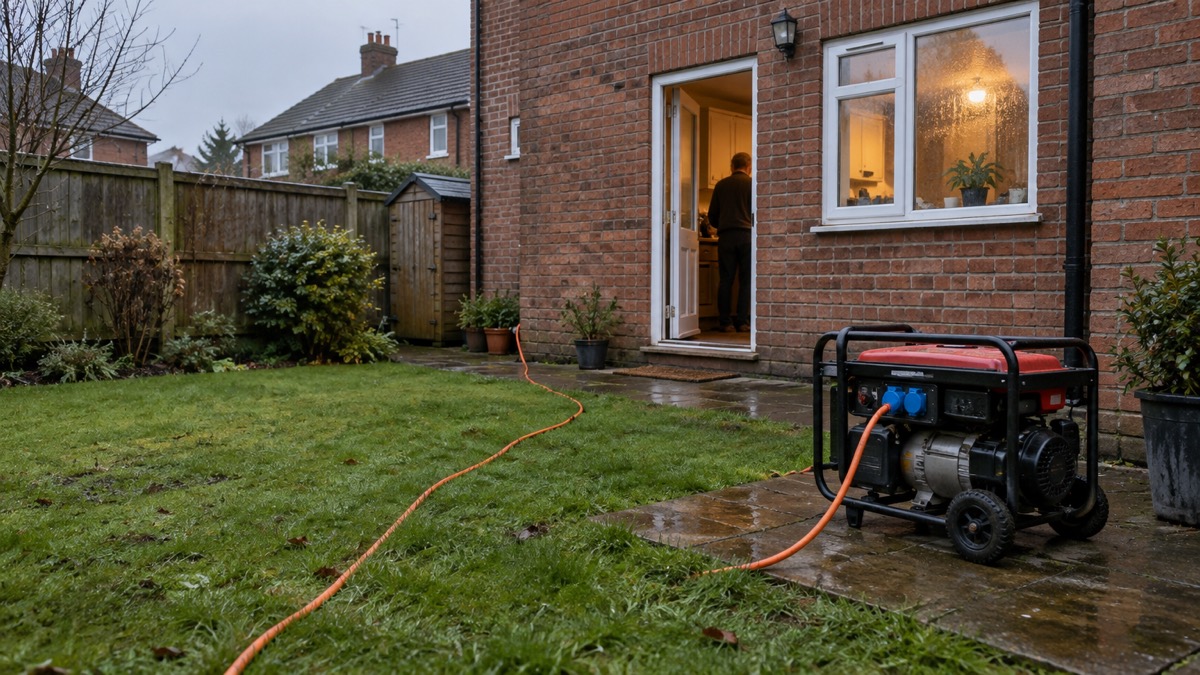
The voltage regulation figure is worth understanding: limiting variation to plus or minus 2 per cent keeps connected equipment running smoothly and safely, which matters for a fridge compressor or a freezer1. The circuit breaker gives you a way to isolate the load if something goes wrong1. The electric key start means you are not pulling a cord in the dark and wet1.
What a generator of this kind cannot do is power the whole house through its wiring. It is a standalone machine: you run outdoor-rated extension leads from its outlets to the appliances you want to keep alive, and you keep the number of appliances within what the machine can supply2. The independent guidance is clear that portable generators have a limited output capacity, so some models will not power all appliances6. Plan for the essentials, not everything.
Advice from Briggs & Stratton before you buy a portable generator
The maker's own safety advice is short and worth reading before you spend anything. Use only appropriate heavy-duty, outdoor-rated extension cords designed for generators, and check them for damage before use; never overload the machine by connecting too many appliances2. Those two rules cover most of the mistakes a first-time buyer makes.
Think about where the machine will stand. It needs to be outdoors, in the open air, away from doors, windows and vents so that exhaust cannot drift back inside7. It needs a firm, level surface, and it needs to be somewhere you can reach with a lead without running one through a doorway or under a gap that lets fumes in.
Think about noise and neighbours. A petrol generator is audible, and in a terrace or a flat with a shared garden the practicalities matter as much as the specification. If you have no safe outdoor space of your own, a fuel generator is not the right answer for you, and a battery unit or a plan built around Emergency Lighting at Home: Torches, Lanterns and Candles and Heating and Cooking Without Mains Power or Gas: A Household Guide may serve better.
Think about storage. Petrol must be kept in approved containers, and those containers must be labelled "PETROL" or "HIGHLY FLAMMABLE" and checked regularly for good condition and leaks4. Don't overstock fuels of any type, and store them safely8. Fuels should be stored separately to reduce fire loading and prevent a fire from starting and spreading5.
Choosing a generator by what your household needs to run
The right machine is the one that matches your load. Work through the appliances you would want to keep running, in order of priority: the fridge and freezer first, then lighting, then perhaps a phone charger or a router. The independent guidance notes that portable generators are small enough to carry and have labelled inputs, but their limited output capacity means some models will not power all appliances6. Match the machine to the list, not the other way round.
The Elite 8500EA's outlet layout tells you what it is designed for: two 16A domestic-style outlets and one 32A industrial outlet1. The 32A outlet is for heavier equipment; the 16A outlets take ordinary household appliances through suitable leads. The circuit breaker lets you reset the supply if you draw too much1.
A battery generator is the other route. The independent guidance describes these as smaller and more portable than fuel-tank generators, but only really useful if you have low power demand, and notes they can sometimes be charged with solar panels6. For a household that wants to keep a router, a light and a phone alive through an evening outage, that may be enough. For a freezer through a two-day cut, it usually is not.
| What you need to run | What suits it |
|---|---|
| Fridge, freezer and several lights through a long outage | A fuel generator with enough output and a large tank, run outdoors1 |
| A router, a light and phone charging for a few hours | A battery generator, if your demand is low6 |
| Heavy equipment on a 32A supply | A machine with an industrial outlet such as the Elite 8500EA1 |
| Nothing beyond torches and a warm room | No generator needed; see the lighting and heating guides |
Whatever you choose, the safety rules do not change. The generator stays outside, the leads are outdoor-rated and undamaged, and the load stays within what the machine can supply2.
Where a generator must never go
This is the section that matters most. Every fire and rescue service that addresses the point says the same thing: fuel-driven generators do not go indoors. The message is repeated across England, Wales, Scotland and Northern Ireland because the risk is the same everywhere: carbon monoxide from a generator's exhaust can kill, and it gives no warning2.
The list of forbidden places is longer than most people expect. A generator must not be run inside a house, a garage, a cellar or a shed. It must not be run inside a caravan, motorhome, tent or awning3. It must not be brought indoors during a flood, however tempting it is to keep it dry11. Farmers are warned never to use standby generators indoors, as the fumes from the engine can be lethal12.
"Never run a gas, petrol or diesel-powered generator or a heater that is not designed for this purpose inside a caravan, motorhome, tent or awning"
The same principle applies to ventilation. The Health and Safety Executive advises never to block ventilation for a gas appliance13, and the logic carries to any fuel-burning equipment: it needs air, and its exhaust needs somewhere to go that is not back into the house.
If you have a carbon monoxide alarm, test it. If you do not, fit one: it is the protection against the risk a generator creates. The Home Emergencies: Fire, Carbon Monoxide, Gas Leaks and Burst Pipes guide covers alarms and what to do if one sounds.
Safe fuelling and storage
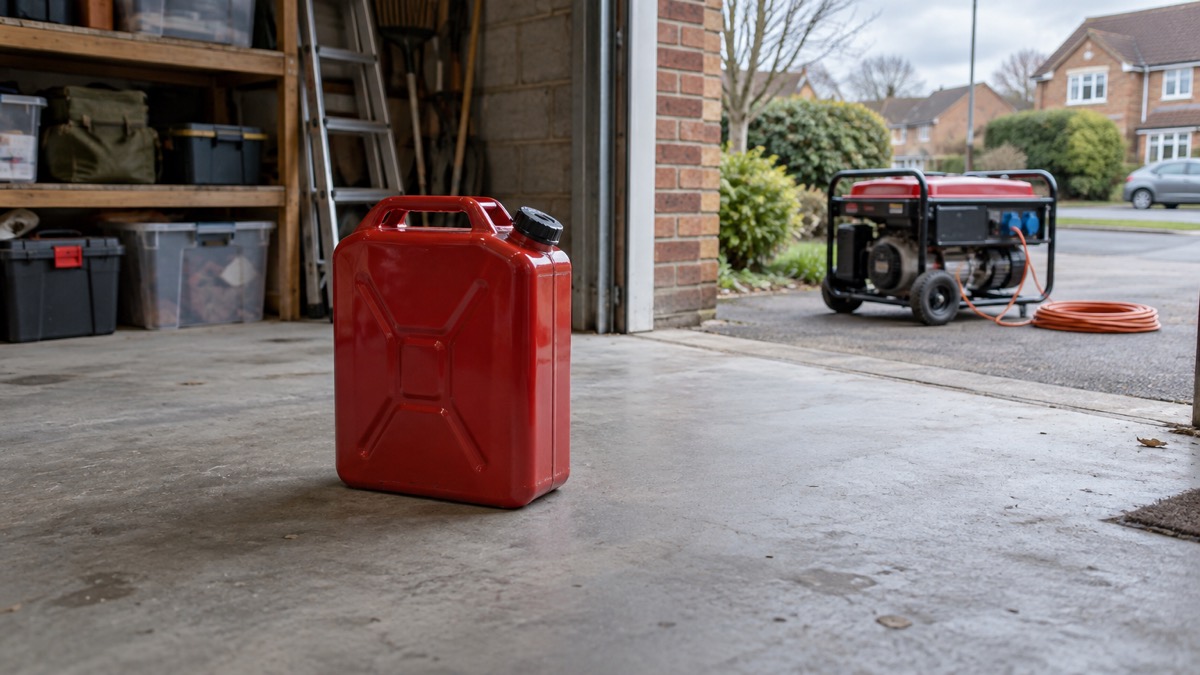
Fuel is the other half of generator safety. The Elite 8500EA holds 28 litres and has a fuel gauge, so you can see how much is left without opening the cap1. Refuel outdoors, with the engine switched off and cool, and clean up any spillage immediately14.
Storage rules come from the fire and rescue services and the Health and Safety Executive, and they are consistent:
- Store fuel only in approved containers, labelled "PETROL" or "HIGHLY FLAMMABLE", and check them regularly for good condition and leaks4.
- Don't overstock fuels of any type, including paraffin or biofuel, and store them safely8.
- Store fuels separately to reduce fire loading and prevent a fire from starting and spreading5.
- Follow petrol station safety instructions when filling a portable container, and place the container on the ground when filling it15.
A generator that has been running is hot. Let it cool before refuelling, and never store fuel next to the machine while it is in use. Keep containers out of the reach of children and away from any source of ignition.
Other outdoor power equipment
Briggs & Stratton engines also power outdoor equipment such as lawnmowers and other garden machinery. That equipment is not part of an emergency plan, but the habits it teaches are: fresh fuel, clean air filters, sharp blades and a machine that is serviced before the season starts.
The same engine features that appear on the generator appear across the range. The cast iron cylinder sleeve is a durability feature, and the Super Lo-Tone muffler reduces noise1. If you already own Briggs & Stratton garden equipment, the servicing routines and fuel handling are the same as for the generator, and the same storage rules apply to any petrol you keep for it4.
For households thinking about how to keep a garden and outdoor space useful in an emergency, the Self-Reliance at Home: Rainwater, Off-Grid Power and Living Without Mains guide covers the wider ground. For most households, though, the generator is the only Briggs & Stratton product that belongs in an emergency plan.
Support and warranty
The Elite 8500EA carries two separate warranty periods: 2 years limited consumer cover on the engine and 1 year limited consumer cover on the generator1. Keep the receipt and note both dates, because a claim will ask for them.
For support, parts and servicing, contact Briggs & Stratton or an approved dealer. Have the model and serial number to hand. Appliance registration typically asks for the model name or number, the serial number and the purchase date, and registering an electrical item with the manufacturer means you are told about any safety recall16. That is worth doing for a generator as much as for a washing machine.
If your home has been damaged, contact your insurer as soon as possible: most have 24-hour emergency helplines to give guidance on what to do and arrange repairs quickly17. If you are struggling to keep your home warm or to afford energy, the British Gas Energy Trust offers energy grants to customers and non-customers, and can be reached on 0121 348 779718. Households with a disability or medical dependency can ask their electricity supplier about the Priority Services Register, which is covered in Extra Help in an Emergency: Older, Disabled and Medically Dependent Households.
Safety notices and recalls
Generators and other electrical items can be recalled if a fault is found. Manufacturers issue product recall notices if an electrical appliance could develop a fault, including a risk of electric shock or fire19. The Office for Product Safety and Standards issues recalls and alert notices on its website, and that is the place to check a model you own20.
Recalls are specific: they name a batch or a serial range, not every unit of a model. A recent fire alarm recall, for example, was confined to a single batch of control units, and not all units in that batch were affected21. So when you check, have the serial number ready and compare it carefully.
- Register your generator with the manufacturer so you are told about recalls22.
- Check the Office for Product Safety and Standards website periodically for recalls and alert notices20.
- Check the Electrical Safety First website for recalls or safety notices on white goods and other appliances23.
- Keep the manual and receipt together, so a claim or a recall check is straightforward.
Sources (23)
- Elite 8500EA portable generator, Briggs & Stratton, 2026
- Safe use of heaters and generators, Armagh City, Banbridge and Craigavon Borough Council, 2026
- Caravan, motor home and campervan safety, Humberside Fire and Rescue Service, 2026
- Domestic and non-workplace storage of petroleum, Greater Manchester Fire and Rescue Service, 2026
- Fire safety at home, Surrey County Council, 2026
- How to buy the best generator, Which?, 2026
- Generators: Diesel and Petrol, Honda & Clarke - Clarke International, Clarke International
- Stay warm safely this winter, Greater Manchester Fire and Rescue Service, 2026
- Carbon monoxide safety, Mid and West Wales Fire and Rescue Service, 2026
- Carbon monoxide safety (Welsh), Mid and West Wales Fire and Rescue Service, 2026
- Flooding advice, Scottish Borders Council, 2026
- Strong winds and heavy rain warning: information and advice, nidirect, 2026
- Gas appliances: frequently asked questions, Health and Safety Executive, 2026
- Fire and summer safety advice, nidirect, 2026
- Staying safe with fire and explosion risks, Health and Safety Executive, 2026
- Electrical safety | Scottish Fire and Rescue Service, Scottish Fire and Rescue Service
- Emergency planning, Belfast City Council, 2026
- Keeping your home warm, NHS Frimley Healthier Together, 2026
- Product recall: B&Q GoodHome Saturnia electric blanket, Office for Product Safety and Standards, 2025
- Electrical items, London Fire Brigade, 2026
- Product recall: Bull and Cygnus Fire Alarm Detection System, Office for Product Safety and Standards, 2026
- Electrical fire safety leaflet, Greater Manchester Fire and Rescue Service, 2026
- White goods, Cheshire Fire and Rescue Service, 2026
 P2400 PowerSmart Series Inverter Generator
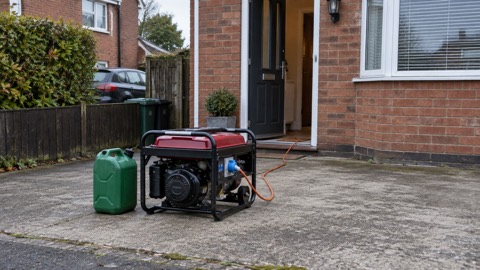 ProMax 7500EA Petrol Generator
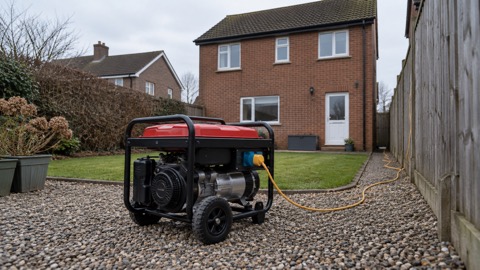 ProMax 9000EA Petrol Generator
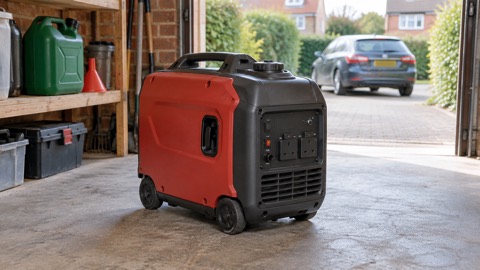 Q6500 QuietPower Series Petrol Generator