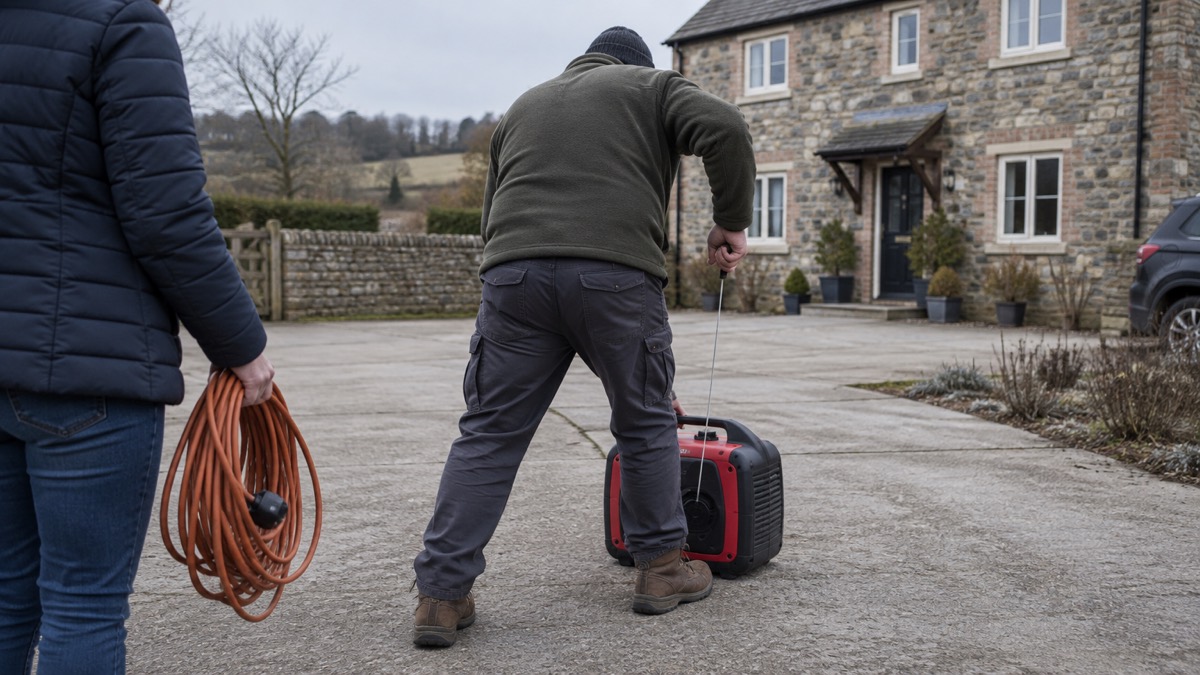
The P2400 PowerSmart Series is a small petrol inverter generator from Briggs & Stratton, sized for a household rather than a building site. It delivers 1,800 watts of running power and 2,400 watts to start an appliance, runs for up to 8 hours at a quarter load, and carries two 230V sockets, a 12V charging socket and two USB ports on the UK model1. For a household facing a power cut, that is enough to keep a fridge cold, charge phones and run a few lights, provided you run it outdoors and follow the maker's safety instructions.
It is a petrol generator, so it needs fuel, oil and a safe place to sit outside. It is not a battery you can bring indoors. The maker fits automatic low-oil shutdown and a circuit breaker, and the US version carries CO Guard, a carbon monoxide shut-off system1. The UK model's page does not list CO Guard, so treat carbon monoxide as the first risk whatever the specification says.
This page sets out what the P2400 is, what it can run and for how long, how to keep it ready between emergencies, and how to use and store it safely. It does not give a price and does not rank it against other generators.
What the P2400 is and who it suits
The P2400 is a portable inverter generator: a small petrol engine turns an alternator, and inverter electronics convert the output to a steady 230V supply at 50Hz1. The maker states that inverter technology produces smoother power, so you can safely recharge and power sensitive electronics such as laptops, smartphones and gaming systems1. That matters in an emergency, because phones, radios and medical equipment are exactly what a household wants to keep running.
It suits a household that wants a petrol-fuelled backup for short outages and is able to store fuel safely and run the unit outdoors. It weighs little enough to carry with its twin carry handle, and an optional wheel kit is listed for moving it1. It is not a whole-house solution: at 1,800 running watts it covers selected appliances, not the mains wiring of a home. If you are weighing a generator against a battery unit, our guide to portable power stations explains the trade-offs, and portable generators covers the petrol, diesel and inverter types.
Specifications
The maker's UK and US pages agree on the core figures: 1,800 watts running and 2,400 watts starting, a 79 cc four-stroke OHV engine, recoil starting and a run time of up to 8 hours3. The UK model runs at 230V and 50Hz; the US CO Guard model is a 120V machine1.
| Specification | UK model | US CO Guard model |
|---|---|---|
| Running watts | 1,800W1 | 1,800W2 |
| Starting watts | 2,400W1 | 2,400W2 |
| Voltage and frequency | 230V, 50Hz1 | 120V2 |
| Engine | 79 cc, 4-stroke OHV1 | 79 cc2 |
| Start type | Recoil1 | Recoil2 |
| Fuel tank | Check the label on your own unit1 | 1.0 gallon2 |
| Run time | Up to 8 hours at 25% load1 | 8 hours2 |
| Dimensions | 51 cm long, 31 cm wide, 44 cm high1 | 20.0 in long, 12.2 in wide, 17.4 in high2 |
| Warranty | 2 years limited consumer1 | 12 months commercial2 |
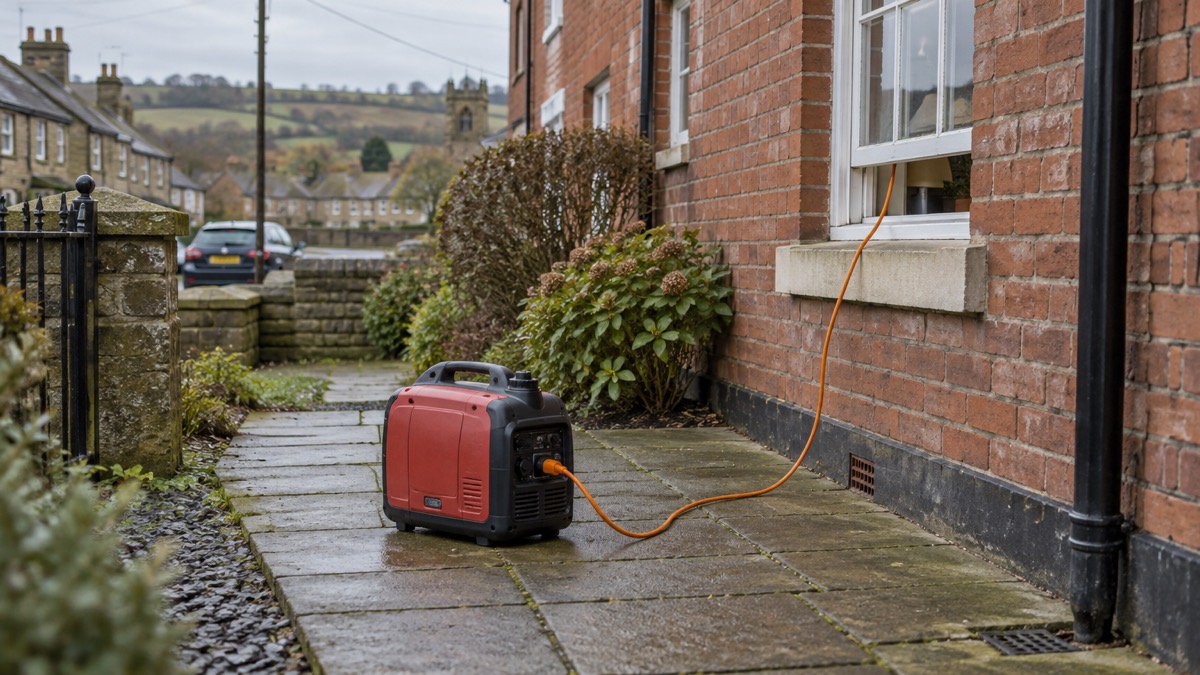
The US page also lists automatic voltage regulation and LED lights for low oil and overload alerts2. The UK page lists automatic low-oil shutdown and a circuit breaker1. Where the two pages differ, the UK figures are the ones that apply to a generator bought here.
The two versions: UK 230V and the 120V CO Guard model
The model sold in the UK is a 230V, 50Hz machine with two 230V sockets wired to the UK Type G plug1. A European version is listed with two 230V 16A Type F sockets1. The US model is a different machine: 120V output, two 120V 20A outlets, a parallel port and one USB port, and it carries CO Guard2.
That difference matters if you are reading about the P2400 online. Much of the material describes the American unit, with its 120V sockets, gallon fuel tank and CO Guard shut-off. The maker's UK specification lists 230V and 2x 230V / 13A (Type G, UK) sockets2. Do not assume a feature described on a US page is fitted to a UK unit; check the label and the manual that came with yours.
CO Guard, where fitted, is a carbon monoxide monitoring system that shuts the generator down. It is a backstop, not a licence to run the machine in a confined space. The Health and Safety Executive's position, and the fire and rescue service's, is that petrol generators must never be used indoors, in a garage or in any enclosed space, because carbon monoxide is invisible and can kill. Our page on carbon monoxide from generators sets out the warning signs, and generator safety covers fuel and electric shock as well.
Outlets and charging: 230V sockets, USB and 12V DC
The maker's UK specification lists 2x 230V / 13A (Type G, UK) sockets, 1x 12V / 5 Amp DC battery charging socket and built-in USB ports rated 1x 1,0A and 1x 2,1A2:
- Two 230V sockets, for a fridge, a lamp, a charger or a small appliance.
- One 12V, 5 amp DC battery charging socket, for charging a battery directly.
- Two USB ports, for phones and small devices.
For anything that expects fast charging, plug your own charger into a 230V socket rather than relying on the built-in USB ports. Our guide to USB charging explains why the port's rating, not the cable, sets the speed.
The 12V socket is for charging a battery, not for running 12V appliances directly. If you want to run mains equipment from a battery rather than the generator, a 12V inverter does that job, and leisure batteries covers the batteries themselves.
Whatever you plug in, keep the total within the running rating. The maker gives 1,800 watts running and 2,400 watts starting3. Appliances with motors, such as fridges, draw a surge when they start, which is what the 2,400 watt figure is for. Our guide to watts and watt-hours explains how to add up what you want to run, and what size generator you need walks through the sum. Use an extension lead rated for the load and keep it out of water; extension leads and overloading covers the risks.
Run time: up to 8 hours on a tank
The maker states the P2400 can supply power for 8 hours straight at 25% load1. That is a quarter of its running capacity, so roughly 450 watts of demand: a fridge cycling on and off, a few lights and a phone charger would sit in that range. Push closer to the full 1,800 watts and the tank will not last as long.
The maker gives a run time of up to 8 hours at 25% load1. The hour meter records running time, so you can see how quickly you are using fuel and plan refuelling2. Our guide to generator run time explains how load changes the figure.
Plan your fuel around the outage you expect. A generator is only useful if there is petrol to put in it, and petrol storage at home is limited by fire safety rules. Our guide to petrol storage sets out how much you can keep and how to keep it safely. Rotate any stock you hold so it is fresh when you need it.
Built-in protection: low-oil shutdown, circuit breaker and CO Guard
The P2400 carries several protections that matter in an emergency, when the machine may run for hours unattended1:
- Automatic low-oil shutdown stops the engine before oil runs too low to protect it1.
- A circuit breaker trips if the load is too great1.
- LED lights on the US model alert you to low oil and overload2.
- CO Guard, on the US model, monitors carbon monoxide and shuts the unit down2.
- A spark arrestor, listed on the US model, traps hot particles in the exhaust2.
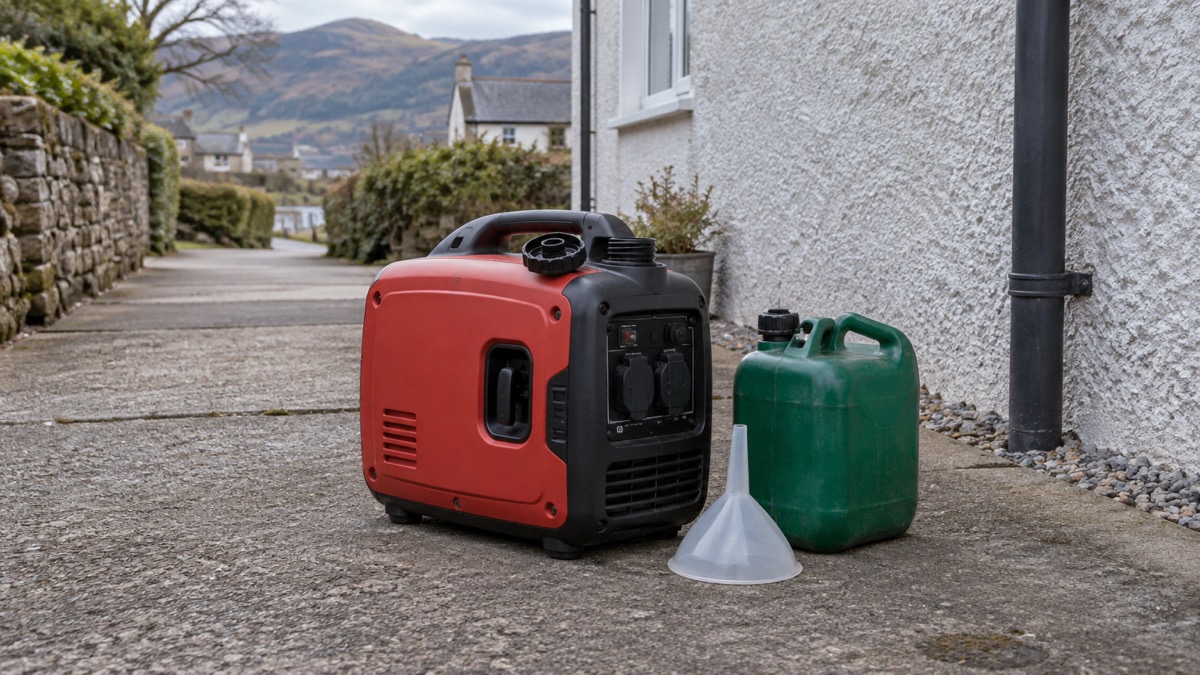
Check the oil before every run and top it up to the maker's mark. Low-oil shutdown protects the engine, but it also means the generator stops when you may need it most, so keep oil to hand. If the circuit breaker trips, unplug appliances, reduce the load and reset it; if it trips again, something is drawing too much.
Keeping it ready between emergencies
A generator that will not start is no use in a power cut. The maker's own instructions for its product are the ones to follow for servicing, oil grade and storage. Between emergencies, work through a short routine:
- Run it briefly every few months so you know it starts and the fuel is fresh.
- Check the oil before each run and keep a bottle of the maker's specified oil with the unit.
- Keep the tank and any spare fuel fresh, rotating stock so it does not go stale.
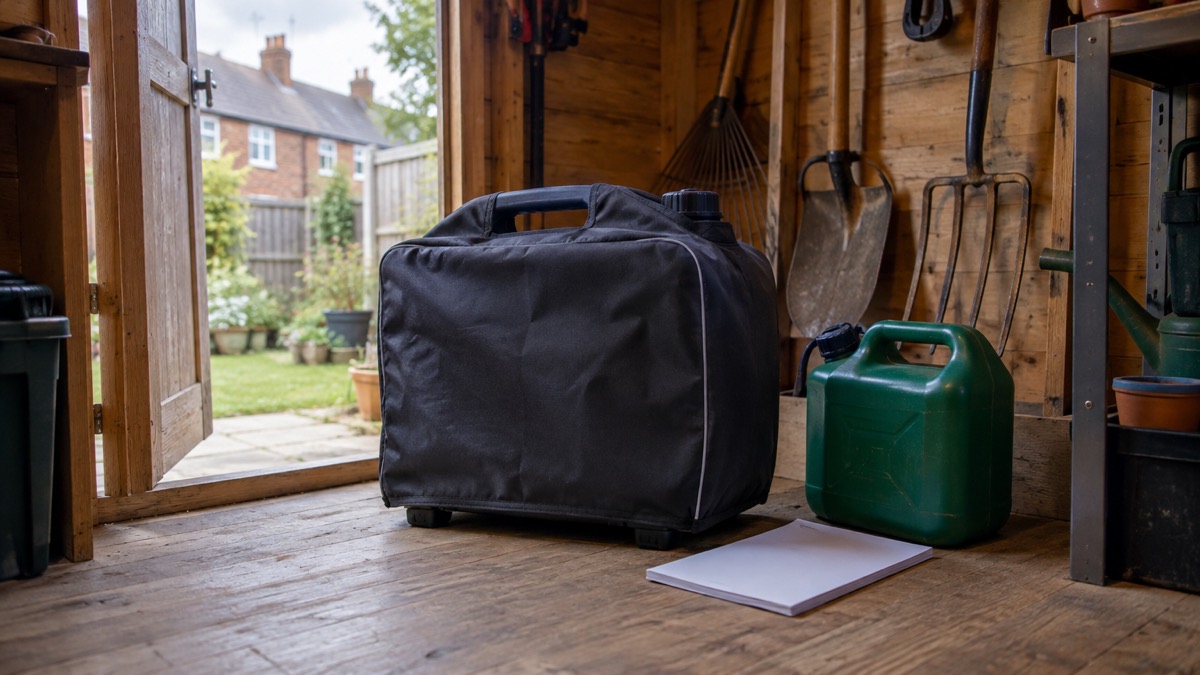
- Store it dry and covered, with the fuel tap off, following the maker's storage instructions.
- Keep the manual, the spark plug spanner and the funnel together with the unit.
Our guide to storing a generator after a power cut covers the longer term, and will a generator start in cold weather explains what to expect in winter. Before winter arrives, our backup power checks list is a good prompt.
Running it safely in a power cut
When the power goes, the order matters. Decide what you need to keep running first, using our guide to deciding what to keep running. Then set the generator up outdoors, on a firm, level surface, well away from the house and from anything that could catch fire. Start it before plugging anything in, and plug appliances in one at a time, watching for the circuit breaker tripping.
Keep leads off wet ground and out of puddles, and never run the generator in rain without shelter that still lets exhaust escape. Our guide to running a generator in the rain covers this. Do not connect the generator to your home's wiring unless a qualified electrician has installed a proper changeover arrangement; our guide to connecting to the home's wiring explains why. For the wider picture of using backup power during an outage, see using generators and power stations during an outage.
Parallel running, noise and other practical points
Running two units. The maker lists an optional parallel connector kit, part number 6362, that lets you connect two units together for more power1. The US page describes the same idea, with the kit sold separately2. For most households a single unit covers the essentials; parallel running is for larger loads and needs the kit and the maker's instructions.
Noise. The maker states the P2400 runs at 58dB, quieter than a normal conversation, with a Super Lo-Tone muffler1. That figure is measured at a quarter load at 7 metres from the control panel side, and the maker notes sound levels vary with proximity and location1. Place it as far from neighbours and bedrooms as the leads allow, and think about timing. Our guide to generator noise covers neighbours and planning.
Moving it. A twin carry handle is fitted, and an optional wheel kit, part number 6861, is listed1. At 51 cm by 31 cm by 44 cm it fits in a shed or the boot of a car1.
Spark arrestor. If your unit has one, keep it clean as the maker instructs.
Support and warranty
The maker's UK page lists a 2 year limited consumer warranty on the generator1. The US CO Guard page lists a 12 month commercial warranty2. Check the terms that came with your own unit and keep your proof of purchase.
Keep a note of oil changes and any repairs. For servicing, parts and the manual, go to the maker: Briggs & Stratton publishes the product pages and support information for its generators.
If your household depends on powered medical equipment, plan for that separately and tell your electricity supplier so you can join the Priority Services Register; our guide to extra help in an emergency explains how, and powering medical devices covers the equipment side.
Sources (3)
- P2400 PowerSmart Series Inverter Generator (UK), Briggs & Stratton, 2026
- P2400 PowerSmart Series Inverter Generator with CO Guard (US), Briggs & Stratton, 2026
- Portable Inverter Generators, Briggs & Stratton, 2026

 BLUETTI Apex 300 Power Station
 BLUETTI Elite 100 V2
 Anker SOLIX C2000 Gen 2
 Anker SOLIX C1000 Power Station
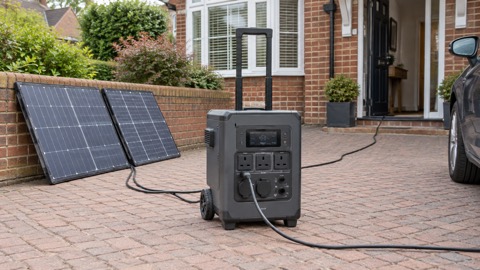 EcoFlow DELTA Pro
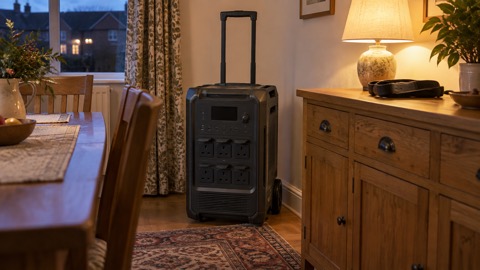 BLUETTI Elite 400
 Anker SOLIX C300 Power Station
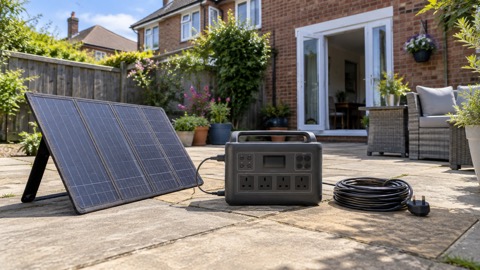 EcoFlow DELTA 3
 EcoFlow DELTA 2 and DELTA 2 Max
 EcoFlow DELTA and DELTA Max
 EcoFlow RIVER 3 and RIVER 3 Plus
 EcoFlow RIVER 2 and RIVER 2 Max