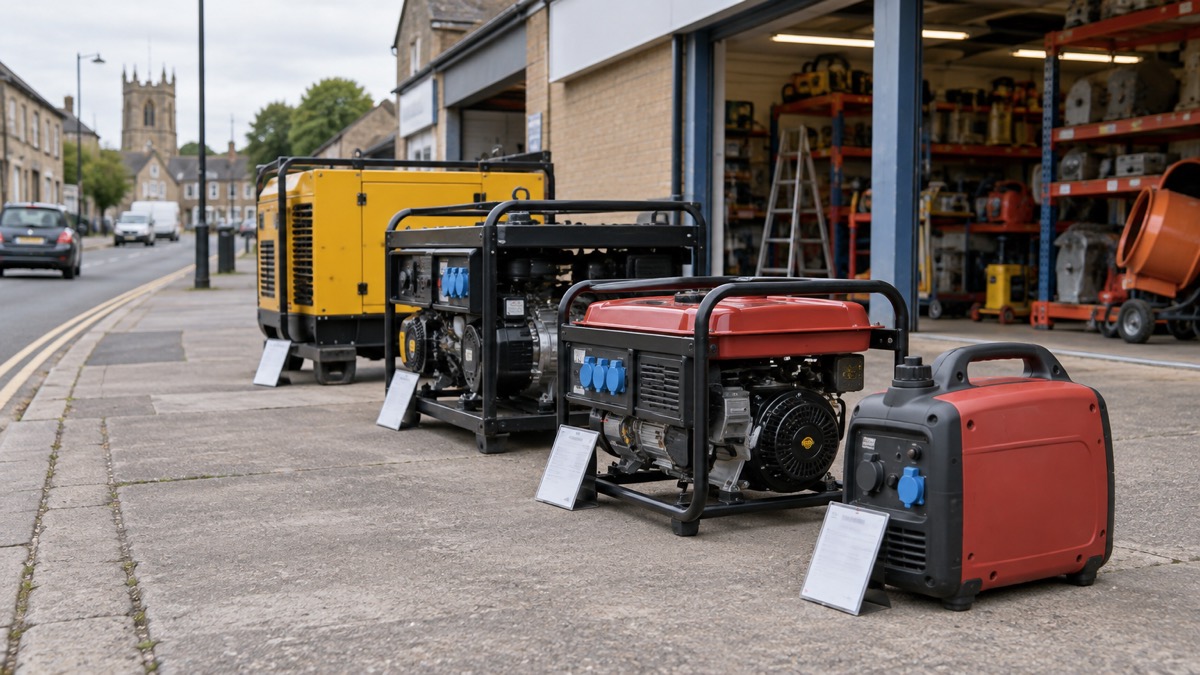
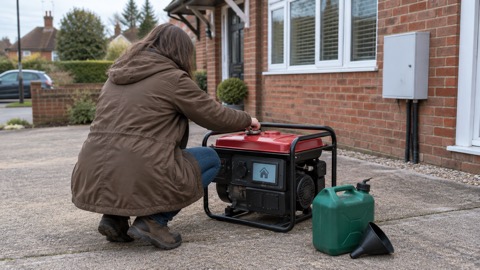
If you are thinking about a generator for a power cut, start with what you actually want to keep running rather than with a wattage. A fridge, a freezer, a few lights, a phone charger and perhaps a microwave are the usual list. Match the generator's rated output to those loads, check how long a tank lasts, and decide where it will stand outside, because a fuel generator must never run indoors.
The sizes on sale run from small suitcase machines to large three-phase units. A typical household petrol generator is rated at 2800W with a maximum output of 3200W1, which is enough for a fridge and a handful of essentials if you manage the loads carefully. Bigger machines cost more, burn more fuel and are heavier to move.
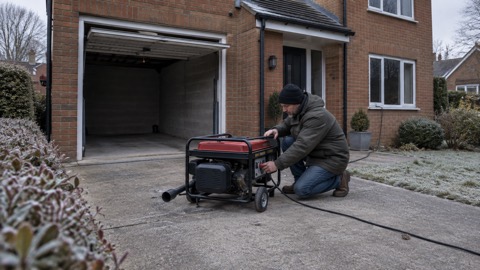
The safety rules matter more than the wattage. Official guidance is consistent across the UK: never run a petrol or diesel generator indoors, because the exhaust gases contain carbon monoxide, which can kill2. Site it outside in a well ventilated space where fumes cannot gather or drift into windows and doors4. And if you want to connect a generator to your home's wiring rather than run extension leads, only a qualified electrician can do that safely5.
Generator sizes, from small suitcase units to three-phase machines
The range of generators sold for UK use is wide, and the right size depends on the job. At the small end, portable inverter generators are light enough to carry and quiet enough to sit outside a kitchen door. At the large end, three-phase diesel sets are aimed at workshops and commercial premises, not households.
| Type | Typical output | What it suits |
|---|---|---|
| Small petrol inverter | around 3300W to 3500W rated8 | Fridge, lights, phone charging, a laptop |
| Household petrol generator | 2800W rated, 3200W maximum1 | Fridge, freezer, microwave, a few lights, managed one at a time |
| Dual fuel inverter | 3600W class, petrol or propane9 | The same loads with a second fuel option |
A 3200W generator is a sensible reference point. Its rated output of 2800W is the figure to plan around for continuous running, while the 3200W maximum is a short-term ceiling1. In practice that means a fridge and freezer cycling on and off, plus lights and a phone charger, with the microwave used on its own rather than at the same time as everything else. If you are unsure how the numbers work, watts, watt-hours and surge explained sets out the difference between running load and the brief surge when a motor starts.
Larger machines exist for good reasons, but they are not automatically better for a household. For a home, the practical ceiling is usually set by weight, noise, fuel storage and whether you can move it on your own.
Choosing a size: output, run time, fuel and noise
Sizing is a balance of four things: what the generator can run, how long it runs on a tank, what fuel it takes and how loud it is. Get these right and the machine will do the job quietly and predictably. Get them wrong and you will either run out of power or run out of fuel.
Output. Plan around the rated figure, not the maximum. The 3200W Champion model is rated at 2800W and peaks at 3200W1. Add up what you want to run at the same time and keep it below the rated output, leaving headroom for motors starting.
Run time and fuel. Fuel use rises with load. The same 3200W model uses 1.46 litres an hour at 50% load, 1.73 litres an hour at 75% load and 2.24 litres an hour at 100% load1. The maker quotes up to 12 hours of run time at 50% load7. That tells you how much fuel to have in and how often you will need to refuel during a long outage. How long a generator runs on a tank goes into this in more detail.
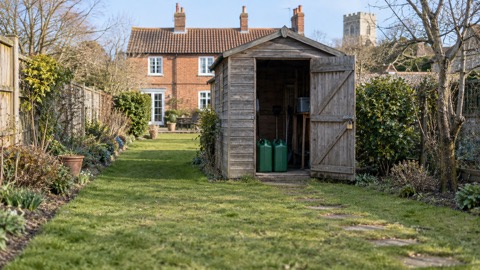
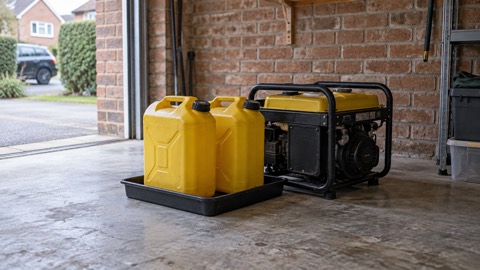
Fuel type. Petrol is the common choice for small household sets7. Dual fuel models run on petrol or propane, which gives a fallback if one fuel is unavailable9. Diesel appears mainly on larger machines10. Store fuel safely and away from the house, and see how much petrol you can store at home before you buy cans.
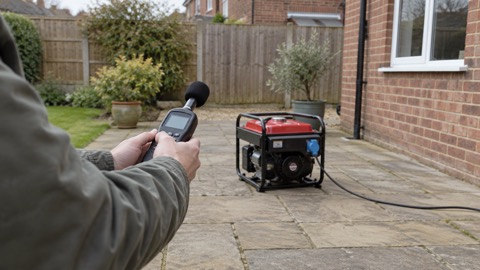
Noise. Engine noise is quoted at a set distance. The 3200W petrol model is listed at 68 dBA at 7 metres7. An inverter model from Briggs & Stratton is quoted at 58 dB, described by the maker as quieter than a normal conversation11. A Jackery solar generator is quoted at 30dB12. Quieter machines and more distance from the house both help, and generator noise and neighbours covers the practical side.
Sockets and voltage: what you can plug in
The sockets on a generator decide what you can connect without adaptors. UK household appliances expect 230V on a 13 amp three-pin plug. Generators vary in what they offer, and the mix tells you whether the machine is aimed at homes, sites or both.
- 13 amp three-pin sockets: the standard UK household outlet, found on many portable generators13.
- Blue 230V industrial sockets: common on larger machines and site equipment13.
- Yellow 110V industrial sockets: used on UK building sites for safety, not for household appliances13.
- 12V cigarette lighter or DC outlets: for charging batteries and small accessories7.
- USB ports: found on some inverter models for phones and tablets8.
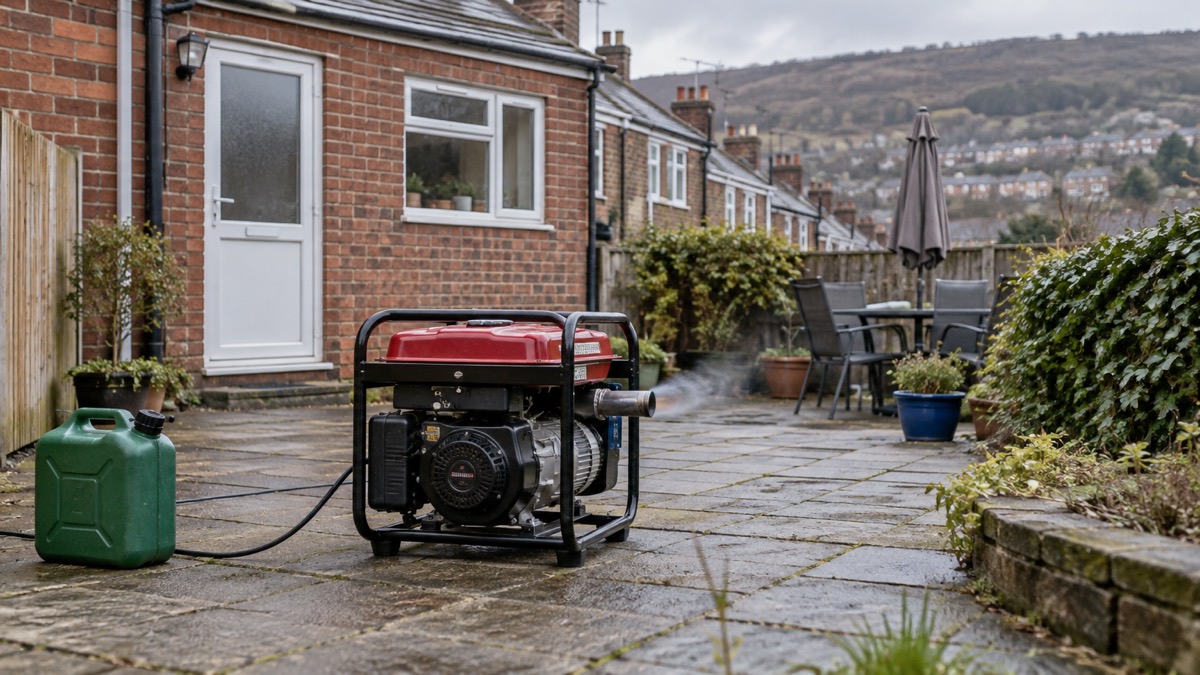
A maXpeedingrods inverter generator, for example, has two 230V 13A sockets, a 12V DC outlet and two USB ports8. The Champion 3200W model has 12VDC output as well as 16A 120V and 230V sockets7. The Champion CPG3500UK is fitted with a 12V battery charging outlet and 230v/220v (UK/EU) and 110v sockets14. Larger three-phase machines add 415V three-phase and 240V single-phase outputs10.
For a household, the 13 amp three-pin sockets are the ones that matter. Check before you buy that the generator has enough of them for what you plan to run, and use a proper extension lead rated for the load rather than a domestic reel wound up. Extension leads and overloading explains the risks.
Where a generator must never go: carbon monoxide and air flow
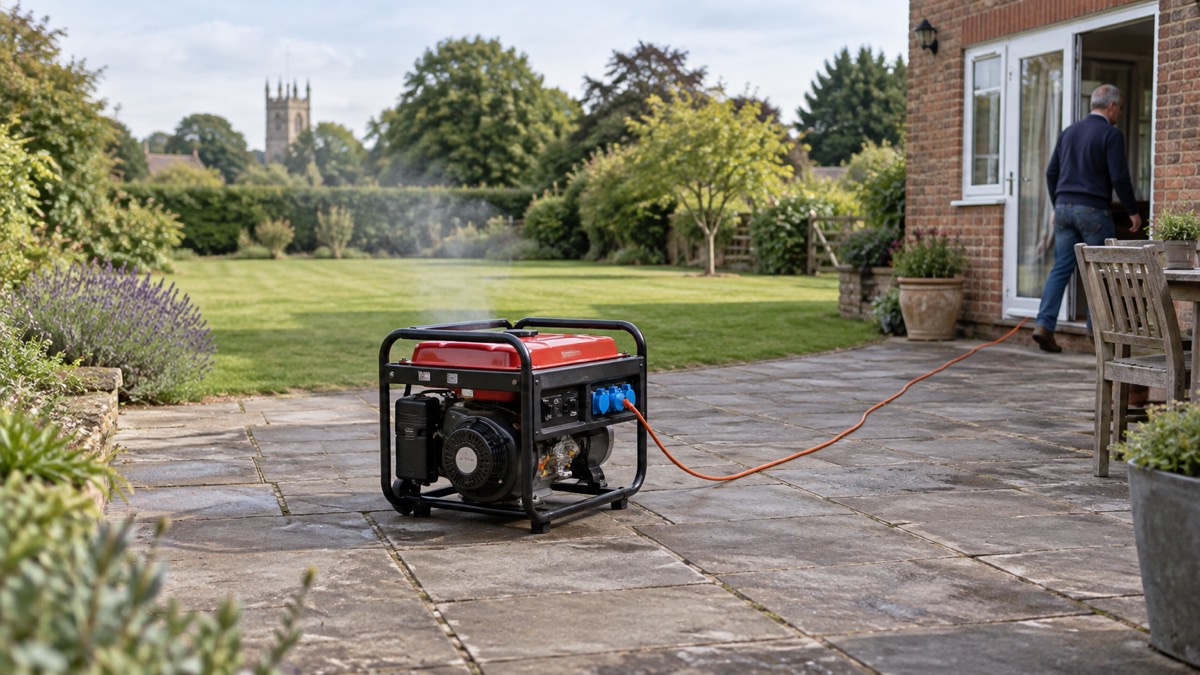
This is the part that matters most. Carbon monoxide from a generator's exhaust is colourless and can kill. Every official source says the same thing: keep fuel generators outside.
The London Fire Brigade's flood advice is blunt: "never run a petrol or diesel-powered generator indoors. They can produce fatal levels of carbon monoxide"2. Wiltshire and Swindon's preparedness guidance says not to use petrol or diesel generators or similar fuel-driven equipment indoors because the exhaust gases contain carbon monoxide15. Runnymede's flooding guidance says the same: do not use petrol or diesel generators indoors because the exhaust gases contain carbon monoxide, which can kill16.
The Health and Safety Executive's advice is to locate petrol generators outside in well ventilated spaces so that fumes disperse and cannot gather or drift into building openings4. Northern Ireland's nidirect guidance warns to be careful where you put a generator in case of carbon monoxide poisoning17. Northern Ireland Electricity Networks adds that you should make sure there is plenty of air flow around the generator to supply oxygen and remove the fumes3. National Grid's power cut safety advice says never use a portable generator or barbecue indoors during a power cut or planned interruption18.
If you are clearing up after a flood, the same rule applies. nidirect's after-flood guidance says to put the generator outside to avoid carbon monoxide poisoning from the exhaust19. Generator safety: carbon monoxide, fuel and electric shock covers the warning signs and what to do.
Check with a qualified electrician before connecting to your home
Running extension leads from a generator to a few appliances is one thing. Connecting a generator to your home's wiring so that sockets and lights work as normal is another, and it is not a DIY job.
Wiltshire and Swindon's guidance says it takes research by you and the advice and expertise of a qualified electrician for a generator to help you20. Scottish and Southern Electricity Networks states plainly that only a qualified electrician can connect a generator safely5. Its repair guidance adds that the network cannot provide you with a generator, that you can hire small generators from local hire shops, but that you must let the network know so it can make sure it is safe, and that only a qualified electrician can connect a generator safely6. National Grid says that if you decide to hire a generator, for safety reasons it is essential that it is connected by a qualified electrician21.
Electricity North West makes a further point: using a generator is not always the simplest solution, because there will not be enough generators to keep everyone powered, and it may take longer to install and connect a generator to your local substation than the duration of the emergency power cut. If you do choose to connect your own generation, this must be done by a qualified professional22.
The practical upshot is simple. If you want backup power for the whole house, talk to a qualified electrician before you buy anything, and tell your network operator what you plan to do. If you only want to run a fridge and a few lights, use extension leads from the generator's own sockets and keep the generator outside. Connecting a generator or battery to your home's wiring explains the options.
What the network operator will and will not do
It helps to know what to expect from your electricity network operator during a power cut, because it affects how much generator capacity you need and for how long.
Network operators sometimes use generators to restore customers temporarily while permanent repairs are completed, and they order them through network partners who ensure a robust refuelling strategy is in place and connect to the network safely23. That is for network use, not a generator for your home.
Generators are only provided in exceptional circumstances, such as for medical needs like oxygen equipment, mobility aids or end-of-life care24. Electricity North West also says that in exceptional circumstances, such as weddings or funerals, it does its best to provide a generator to minimise the impact of the power cut24. If you rely on powered medical equipment, register on the Priority Services Register so your network operator knows. Powering CPAP, oxygen and other medical devices covers the household side.
Expect a brief interruption when power returns. Network operators warn that you may experience a short outage while you are connected back to the network after the repair23. Keep sensitive equipment switched off until the supply has settled.
Sources (24)
- Champion 3200 Watt Petrol Generator, Champion Power Equipment, 2026-10-25
- After a flood, London Fire Brigade, 2026-10-25
- Power cuts advice, Northern Ireland Electricity Networks, 2026-10-25
- Carbon monoxide, Health and Safety Executive, 2026
- Your planned power cut explained: network maintenance and inspection, Scottish and Southern Electricity Networks, 2026
- Your planned power cut explained: repairing our network, Scottish and Southern Electricity Networks, 2026
- Champion 3200 Watt Petrol Generator specifications, Champion Power Equipment, 2026-10-25
- How to buy the best generator, Which?, 2026-01-20
- Champion 500988-DF-UK 3600 Watt Dual Fuel Inverter Generator, Champion Power Equipment, 2026-10-25
- Warrior 12.5 kVA Diesel Generator 3 Phase, Champion Power Equipment, 2026-10-25
- P2400 PowerSmart Series Inverter Generator, Briggs & Stratton, 2026
- Small generators, Jackery, 2026-10-25
- Generators buyers guide, Machine Mart, 2026-10-25
- Champion CPG3500UK, Champion Power Equipment, 2026-10-25
- Flooding and health: safely cleaning your home, Wiltshire and Swindon Prepared, 2026-10-25
- Flooding, Runnymede Borough Council, 2026-10-26
- Strong winds and heavy rain warning: information and advice, nidirect, 2026-01-27
- Safety first, National Grid, 2026
- After flood: clearing, nidirect, 2026-05-06
- Generators, Wiltshire and Swindon Prepared, 2026-10-25
- Planned interruptions, National Grid, 2026
- Emergency power cuts, Electricity North West, 2026-10-25
- Restoration following a power cut, Electricity North West, 2026-10-25
- Frequently asked questions, Electricity North West, 2026-10-25
 Power Cut Backup Power Checklist
 Backup Power Before Winter
 Safe Battery Charging at Home
 Running a Generator Indoors
 Carbon Monoxide from Generators
 Generator Run Time on a Tank
 Storing Petrol at Home
 Diesel Storage at Home
 Storing a Generator
 Generators in Cold Weather
 Generator Noise and Neighbours
 Power Station Capacity Sizing
 Power Station Run Time
 Power Station for a Gas Boiler
 Power Station UPS Mode