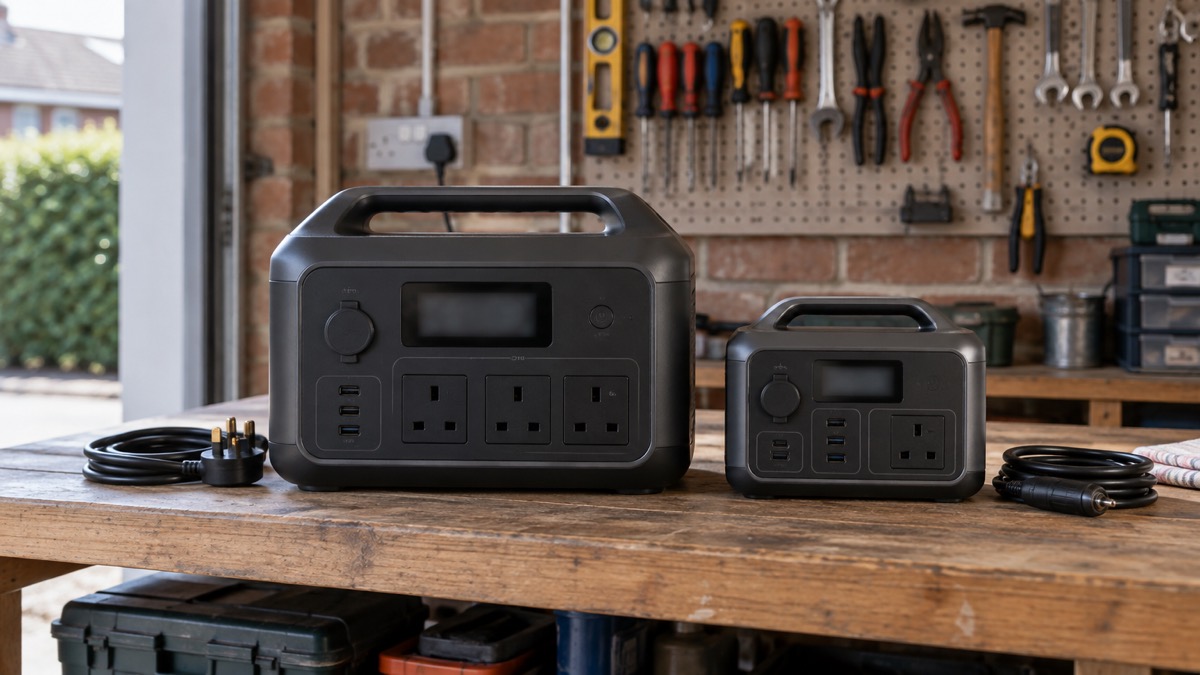
Most households do not need a large power station. If you want to keep phones, a laptop, the wifi router and a few lights going through a power cut, a unit in the 200 to 500Wh range is enough, and a maker's own worked example puts those essential loads at roughly 95 watts combined1. The number that decides whether a bigger unit is worth having is not capacity but what you want to plug in: anything with a heating element or a large motor needs far more output than a phone charger.
Capacity, measured in watt-hours, tells you how long a station will run something. Output, measured in watts, tells you what it can run at all. Get the second wrong and the station will simply shut down or refuse to start the appliance, however much energy is stored inside. Get the first wrong and you run out in the middle of the evening.
This page sets out how to size both, what each size realistically covers in a UK power cut, how you will recharge it, and why a power station is not the right answer for everyone, particularly households that depend on medical equipment.
Start with what you want to keep running
Sizing begins with a list, not a product. Walk round the house and write down what you would genuinely want powered during an outage: the fridge, the boiler, the router, a lamp, a phone charger, perhaps a CPAP machine. Then find the wattage of each, which is usually printed on the appliance or its plug. Electrical Safety First publishes typical ratings for common appliances, and those figures are the ones to use rather than guesses3.
A maker's worked example is a useful sanity check. A phone charger at 10W, LED lights at 15W, a wifi router at 10W and a laptop at 60W add up to roughly 95 watts combined, which a mid-sized power station can run for many hours1. That is the realistic core of most households' needs: communications, light and a little computing.
Lighting is the smallest load to cover. LED night lights generally consume 0.5 to 2 watts, making them the most energy-efficient option, and smart versions draw 1 to 5 watts depending on features and settings5. Most LED Christmas lights operate at extra low voltage, which reduces the risk of electric shock, uses much less power and generates less heat6. A handful of LED lights is a rounding error in your budget; an old halogen lamp is not.
Once you move beyond electronics, the numbers climb quickly. Anything that heats, such as a kettle, heater or hair dryer, draws far more than a small station can supply. Anything with a motor, such as a fridge compressor or a power tool, draws a surge when it starts. Clarke's guidance for generators makes the point plainly: before connecting a power tool, check its voltage, running wattage and starting requirement, because tools with large motors may need substantially more capacity than their normal running wattage suggests7. The same caution applies to a power station's output rating.
Capacity: how much energy you need in watt-hours
Watt-hours are the fuel tank. A 200 to 500Wh station will keep phones, laptops, a router and small lights going through most outages, because those loads are small and intermittent. For scale, a maker's 2kWh model stores 2048Wh, roughly four times the top of that range8. Whether you need that depends entirely on how long you expect to be off supply and what you add to the list.
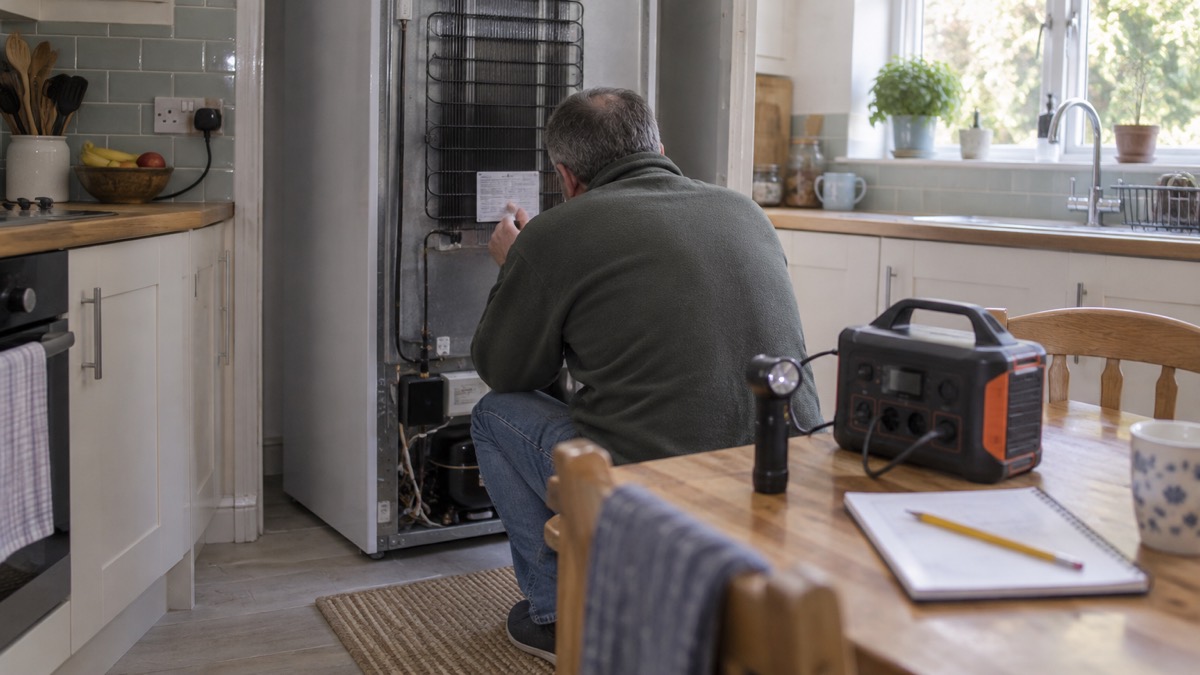
Most power cuts do not last very long, which is worth remembering before spending on capacity you will rarely use9. The longer outages that do happen tend to be weather-driven, and the response is usually to wait it out with light, heat and communications rather than to run the whole house.
The arithmetic is simple: add up the watts of everything you will run at the same time, then multiply by the hours you need it. Add a fridge and the same four hours will exceed it. The watts and watt-hours guide walks through the sums, and the power station run-time page covers specific appliances such as fridges and laptops.
| What you want to run | Typical draw | What it means for capacity |
|---|---|---|
| Phone, headphones | 7 to 10W on USB10 | Negligible; days of charging |
| LED lights | 0.5 to 5W5 | Negligible; run several for many hours |
| Cordless tool charger | 50 to 350W3 | A large share of a small station's energy |
| Heating appliances | Far above small-station output | Not a power station job |
AC output: the figure that decides what will actually start
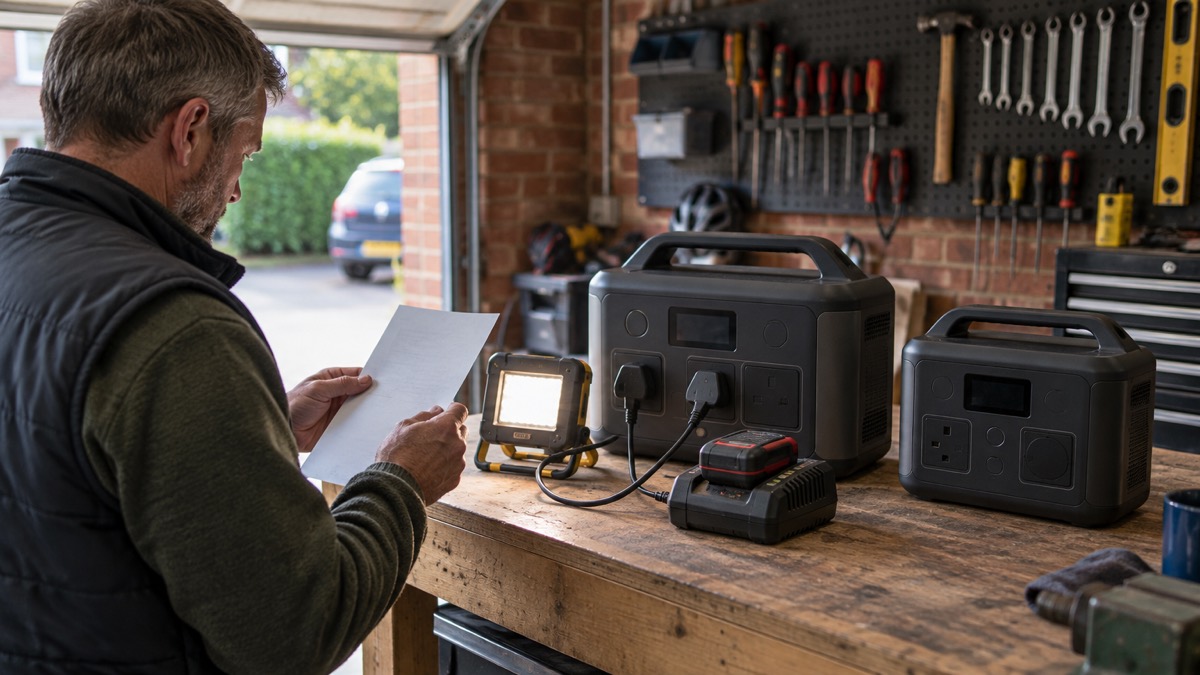
The three-pin socket on a power station is rated in watts, and that rating is a ceiling, not a target. A unit with a modest AC output will run a laptop and a lamp happily but will trip or refuse when asked to start a tool or an appliance with a motor. This is why the output figure matters as much as capacity, and why a large battery with a small inverter is a poor choice for anything beyond electronics.
For tools and larger loads, look for an AC output of 1000W or more. That gives headroom for the surge that a motor draws at start-up, which is the moment most overloads happen. Clarke's guidance is to check the starting requirement as well as the running wattage before connecting a power tool, because a large motor can demand substantially more than its normal running figure7. A station rated just above the running wattage may still fail at start-up.
High-capacity units are built for this. EcoFlow describes its alternator charger as intended for power stations of 2kWh and above, charging a high-capacity unit to full while driving2. That is a different class of kit from a 300Wh unit for phones, and it is priced and sized accordingly.
There is a wider point about whether a power station is the right tool at all. One network operator notes that using a generator is not always the simplest solution: there will not be enough generators to keep everyone powered, and installing one at a local substation can take longer than the emergency cut itself11. If you do connect your own generation to the home's wiring, that must be done by a qualified professional11. The connecting to the home's wiring page explains why, and the generator sizing page covers the equivalent calculation for fuel-driven sets.
What a power station can and cannot do in a power cut
In a power cut, a charged power pack is genuinely useful: official advice describes having one charged as very helpful in an emergency or power cut12. The essentials that could help you cope are battery candles, torches and batteries, and a mobile phone power pack13. A power station is an extension of that idea, not a replacement for the grid.
What it does well is keep you informed, lit and in contact. Phones charged, radio working, router running, a lamp in the room you use most. What it does less well is anything involving heat or sustained motor load. A fridge will run for a while on a mid-sized unit but will eat capacity quickly; a kettle or heater is out of reach.
It is also worth knowing how rare the worst case is. Planned emergency power cuts, known in the industry as rota load disconnection, would only be used as a last resort if there was ever a major national energy shortage that could not be dealt with by other measures first14. In Northern Ireland, planned emergency power cuts are used by energy companies in response to a severe shortage of electricity generation15. These are exceptional events, and sizing for them is different from sizing for a storm-related outage of a few hours.
Report any unplanned cut to your network operator through their website, or call 105 for free, which puts you through to your operator16. In Scotland, England and Wales, 105 is a free service and you can also report online at powercut105.com17. The number is worth having somewhere accessible17. The power cuts section covers what to do while you wait.
Charging it back up: mains, car socket or solar
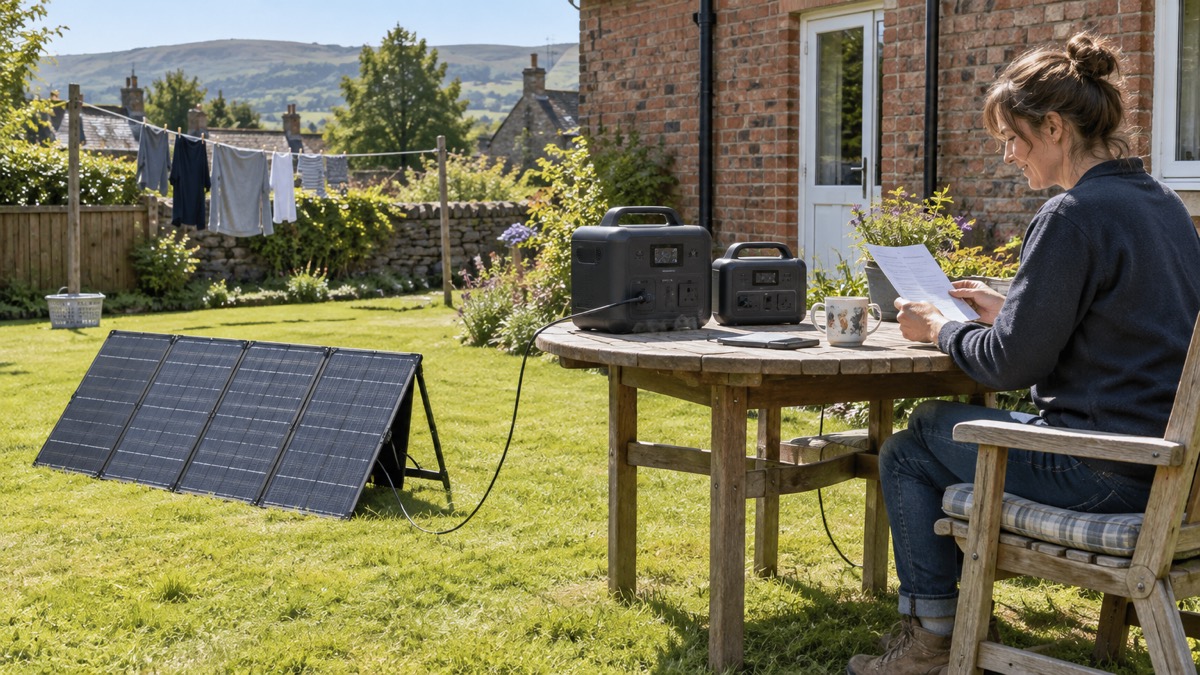
A power station is only as good as your ability to refill it. Most units offer several routes: one maker lists AC mains, solar panels or a car socket18, and another lists a wall outlet, solar panels, the car, or a PD 3.1 USB-C port19. Before an outage, charge from the mains. During a long one, the other routes matter.
Solar works but is slow. Power stations can be charged with solar panels, and it will take a while20. The panel has to match the station: one maker specifies panels between 11 and 28 volts with an XT60 connector, and recommends its own 100W panels19. For scale, a caravan guide suggests at least a 40W panel simply to keep a leisure battery topped up while on site21. Treat solar as a way to stretch a long outage, not to refill quickly. The solar panel sizing page and the solar charging time page go further.
Car charging is useful if you drive. EcoFlow's alternator charger is designed to charge a high-capacity unit to full while driving, for power stations of 2kWh and above2. For smaller units, a car socket or USB-C route is typical: Anker lists the SOLIX C300 as rechargeable from a wall outlet, solar panels, your car or the PD 3.1 USB-C port22, and the C300 DC from 100W solar, 140W PD USB-C or a car socket21. The car charging page covers what to expect.
There is a first-use quirk to watch for. One maker's instructions say to recharge with an 18W or higher USB-C wall charger to activate the unit for the first time, and that only certain USB-C ports can be used for this22. Read the maker's own instructions for your model before you rely on it in an emergency.
Medical equipment: why most power stations are not meant for it
This is the section to read carefully if anyone in the household depends on powered medical equipment. A power station is not a medical device, and most are not intended or certified for that role. Official guidance is clear that people who depend on equipment such as breathing apparatus or dialysis machines may need hospital care without power23. That is a clinical risk, not a battery-sizing problem.
The right response is a plan, made in advance. Official advice is to make a plan with your care provider or clinical care team now about what will happen in a power cut, setting out what action you or the person you care for needs to take and who to contact4. Regularly charge any medical equipment you rely on, and consider keeping a battery backup available for it24. That backup should be the equipment maker's own solution or one specified by your clinical team, not a general-purpose power station chosen from a capacity table.
Help exists. Some network operators provide generators only for customers who are medically dependent on electricity, and not for businesses or personal use25. One operator has trialled loaning free portable battery packs to customers who rely on medical equipment during power cuts over four hours26. Ask your network operator what is available where you live, and register with your supplier's Priority Services Register if you are eligible. The medical devices page covers the equipment side in more detail.
Care settings face the same question at a larger scale. Official guidance notes that care homes with vulnerable residents who require certain medical equipment may decide it is worth installing a permanent generator for resilience9. For a household, the equivalent decision is whether a planned, clinically agreed backup is more appropriate than a portable unit.
Matching the size to your household
The table below sets out the broad bands and who each suits. It is a starting point for your own list, not a recommendation of any product.
| Band | What it typically covers | Who it suits |
|---|---|---|
| 200 to 500Wh | Phones, laptops, router, LED lights1 | Most households wanting communications and light through short cuts |
| Around 2kWh and above | Longer runs, larger loads, high-capacity charging from a vehicle2 | Households expecting long outages or wanting to run more appliances |
| AC output 1000W or more | Tools and larger loads with start-up surge7 | Anyone planning to run motor-driven equipment |
Two further checks before you buy. First, confirm the AC output against the hardest thing you plan to start, not the easiest. Second, confirm the recharge routes and how long each takes, because a station you cannot refill is a one-shot resource. The portable power stations guide covers the features to look for, and the power bank or power station comparison helps if your needs are only phones and a radio.
For a full household plan around an outage, the backup power section sets out the options side by side, and the power cut backup power checklist turns this into a list you can work through.
Sources (26)
- How to Build a 72-Hour Household Emergency Power Outage Plan, Jackery, 2026-10-10
- EcoFlow Alternator Charger (DELTA Pro), EcoFlow, 2026-10-25
- Ratings of Electrical Appliances, Electrical Safety First, 2026-10-25
- Power Cuts, Prepare (UK Government), 2026-10-21
- Night Lights, Electrical Safety First, 2026-10-25
- Christmas Lights, Electrical Safety First, 2026-10-25
- Generators, Clarke International, 2026-10-25
- Fogstar 2kWh Portable Power Station, Fogstar, 2026-10-25
- Generators, Wiltshire and Swindon Prepared, 2026-10-25
- USB Chargers, Electrical Safety First, 2026-10-25
- Emergency Power Cuts, Electricity North West, 2026-10-25
- Failure of National Electricity, Wiltshire and Swindon Prepared, 2026-10-25
- Power Cuts, Scottish Fire and Rescue Service, 2026-10-25
- Emergency Power Cuts, Northern Powergrid, 2026-10-25
- Emergency Power Cuts, NIE Networks, 2026-10-25
- Check If You Can Get Payment for a Power Cut, Ofgem, 2026
- 10 Things You Should Do Now to Prepare for Summer, Met Office, 2026-10-25
- How to Buy the Best Generator, Which?, 2026-01-20
- Anker SOLIX C300 DC with 100W Solar Panel, Anker SOLIX, 2026-10-25
- Emergency Kit Packing List, Which?, 2026-09-30
- Solar Power, The Caravan Club, 2026-10-25
- Anker SOLIX C300 DC Portable Power Station, Anker SOLIX, 2026-10-25
- Supporting Vulnerable People: Guidance for Care Professionals, GOV.UK, 2026
- 12 Tips to Prepare for a Power Cut, Horsted Keynes Parish Council, 2026
- Planned Power Cuts, SSEN, 2026-10-25
- Extra Support for People Reliant on Electricity for Medical Reasons, UK Power Networks, 2024-01-09
 Power Cut Backup Power Checklist
 Backup Power Before Winter
 Safe Battery Charging at Home
 Running a Generator Indoors
 Carbon Monoxide from Generators
 Generator Sizing for a Power Cut
 Generator Run Time on a Tank
 Storing Petrol at Home
 Diesel Storage at Home
 Storing a Generator
 Generators in Cold Weather
 Generator Noise and Neighbours
 Power Station Run Time
 Power Station for a Gas Boiler
 Power Station UPS Mode