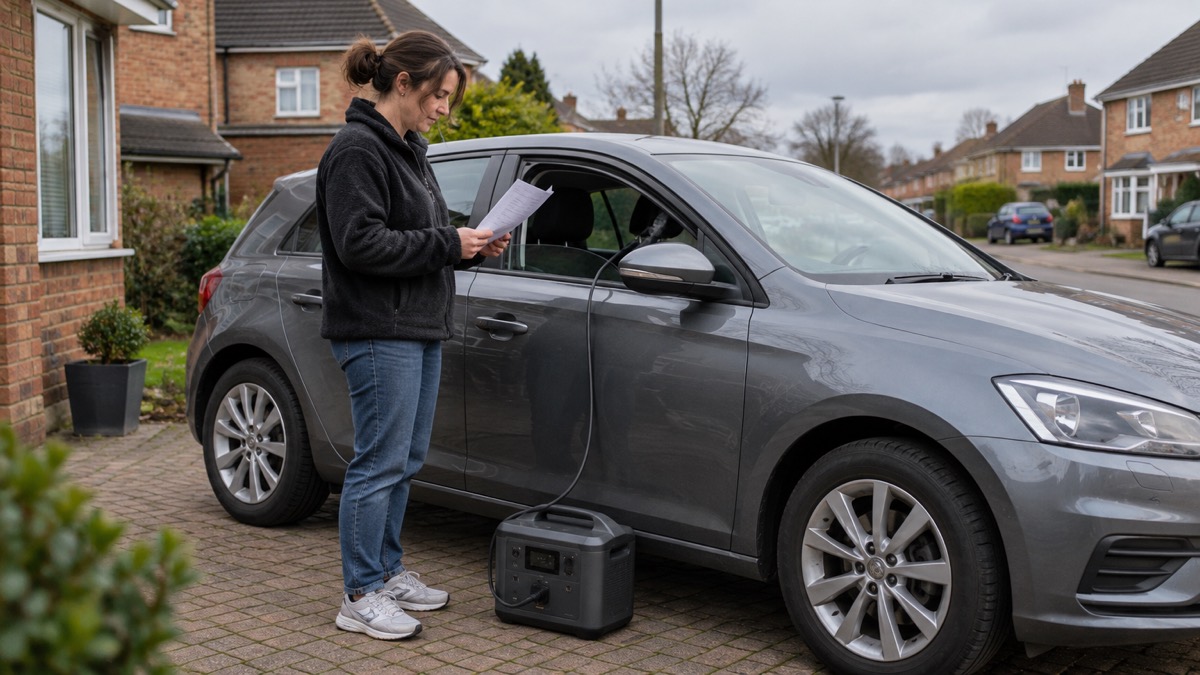
If the mains has failed and the sun is not doing much, your car is the most likely source of power left in the driveway. The short answer is yes: many portable power stations can be topped up from a car, either through a 12V socket or, on some models, a dedicated car charging cable. It is not universal. Most battery-powered generators need to be charged at a wall outlet, although some models can be charged using a car port or solar panels1. Check your own model before you count on it.
The car is a slow source. A 12V socket delivers a trickle compared with a mains charger, so plan on topping up rather than filling a large battery from empty. What it does well is keep a modest unit, or a phone, alive through a long outage. Portable power stations can be charged from the mains, your car or solar panels2, and some makers list car charging among the charging options for their units3.
This page covers how car charging fits with mains and solar, what a small unit can actually run once charged, how to choose a power station with car charging in mind, and where a power station is the wrong tool altogether. Safety runs through all of it: lithium batteries need care wherever they are charged, and a car is no exception.
Yes: most power stations can charge from a car socket
The principle is simple. A power station has a charging input, and a car has a 12V socket that can supply it through an adapter cable. Makers sell these cables for their own units. BioLite's 12V Car Charger Cable, for example, enables BioLite BaseCharge power stations to recharge from your 12V car port, commonly where lighters are found9. The Exposure Car Charger 12V is compatible with any 12V socket in cars, caravans and similar10.
The catch is that the cable is often not in the box. Anker states that the car charging and solar charging cables for the SOLIX C300 can be purchased separately, and directs buyers to its support team4. The same wording appears for the C300X5. If car charging matters to you, establish before you buy whether your chosen model includes the cable or sells it as an accessory.
Charging speed is the other limitation. A 12V car socket is a low-power source, so a large power station will take many hours to fill from it, and some units limit how much they will accept through that input. The Anker SOLIX F2000, for instance, lists a car charger output of 12V, 10A11. That is a modest input by mains standards. Treat the car as a maintenance source: it holds a battery at its current level or nudges it up, rather than rescuing an empty one in an hour.
There is a simpler version of the same idea that needs no power station at all. The Met Office advises keeping an in-car phone charger so you can top up your battery even when you are out and about12, and Electricity North West suggests charging devices in your car if possible2. If all you need is a working phone, a car charger and a cable will do it.
How car charging fits alongside mains and solar
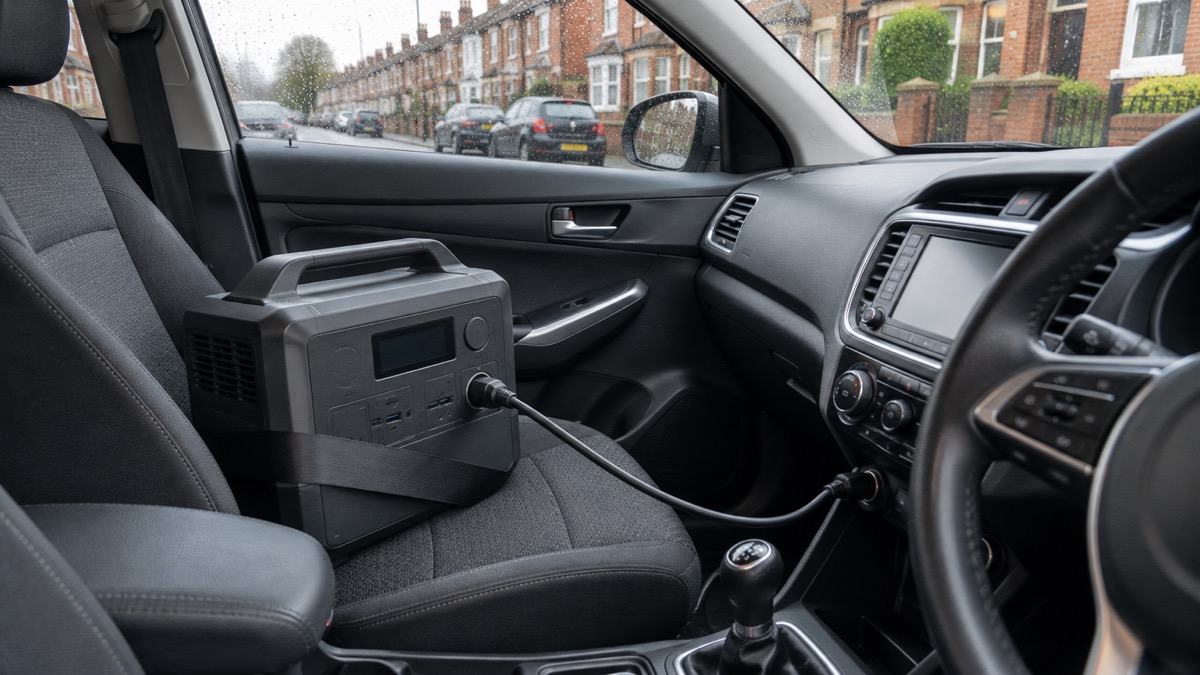
Think of a power station as having three ways in, and choose between them by what is available. The mains is fastest and is what most units are designed around. Solar is slow and weather-dependent. The car sits between them: more reliable than the sun in a British winter, slower than a wall socket.
Makers increasingly build for all three. NEBO lists three charging routes for the Rambler PS100: a USB-C PD adapter at home, a 12V DC power cord in a vehicle, and a solar panel connected via a DC5525 cable sold separately13. BLUETTI describes charging from both your car and solar panels, powering your main storage and leisure battery while driving, with no drain on your reserve14. Which route suits you depends on where the unit will sit during an outage.
| Source | Speed | When it suits | What to check |
|---|---|---|---|
| Mains socket | Fastest | Before an outage, or whenever power is on | That the unit is fully charged in advance6 |
| Car 12V socket | Slow | Mains down, car available and safe to run | Cable included or sold separately4 |
| Solar panel | Slow, weather-dependent | Daylight, unit can sit outside or by a window | Panel and cable often sold separately13 |
The order to use them is straightforward. Charge from the mains whenever a storm is forecast, because that is the quickest route and the one the guidance assumes. The Scottish Government's Ready Scotland advice is to charge mobile phones, power banks and any backup batteries for medical equipment in case there is a power cut6. Once the power is off, the car becomes your fallback, and solar becomes a bonus if the weather allows.
That distinction matters more than it first appears. A household with rooftop solar might assume the panels will keep a battery topped up in an outage. They will not, because the system shuts down with the grid. A portable panel plugged directly into a portable power station is a different arrangement and does not depend on the house wiring. For more on that route, see portable solar panels for charging in a power cut.
What a 200 to 500Wh unit can do once charged
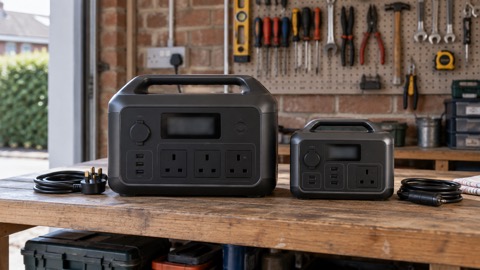
Small and mid-sized units are the ones most often charged from a car, because the slow input suits a smaller battery. What they can do is best understood through two numbers. Capacity, in watt-hours, determines how many times you can recharge a device before the power station needs recharging. Output power dictates how quickly your devices will charge15. A unit with plenty of capacity but a low output will run small things for a long time; a unit with a high output but little capacity will run a kettle briefly and then be empty.
Which.co.uk notes that power stations can be charged with solar panels and will take a while to charge, and that manufacturers make claims about what a unit can run, such as a refrigerator, over a stated period16. Treat maker run-time claims as the maker's estimate and check them against your own appliances. Our guide to how long a power station will run a fridge or laptop works through the sums.
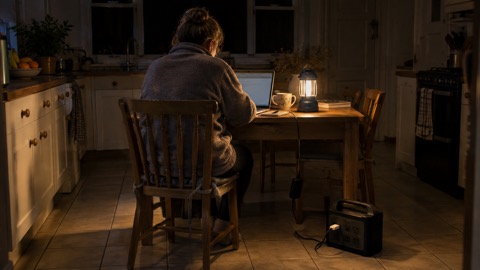
In practice, a unit in this range is a phone, light and router reserve. It will charge phones several times over, run LED lighting for evenings, and keep a broadband router alive for a stretch. It will not run an electric heater, a kettle repeatedly, or anything with a heavy motor for long. The output figure is the gatekeeper: if an appliance draws more than the unit's AC output, it will not start at all, however full the battery.
Choosing a power station for car charging: outputs and capacity
If car charging is part of your plan, four things decide whether a model suits you. The first is whether it accepts a car input at all, and whether the cable comes with it. The second is the input's rating, which sets how quickly it will fill. The third is the AC output, which sets what you can plug in. The fourth is capacity, which sets how long it all lasts.
| What to check | Why it matters | Example from the makers |
|---|---|---|
| Car charging input | Some units accept one, some do not | NEBO Rambler PS100 takes a 12V DC power cord in a vehicle13 |
| Cable included | A missing cable stops car charging | Anker SOLIX C300 and C300X cables sold separately4 |
| Car input rating | Sets charging speed from the socket | Anker SOLIX F2000 lists 12V, 10A11 |
| AC output | Sets what appliances will start | Choose a unit with a higher output than your appliance requires for stable operation15 |
| Capacity | Sets how long it runs | Capacity determines how many times you can recharge your device before the power bank needs recharging15 |
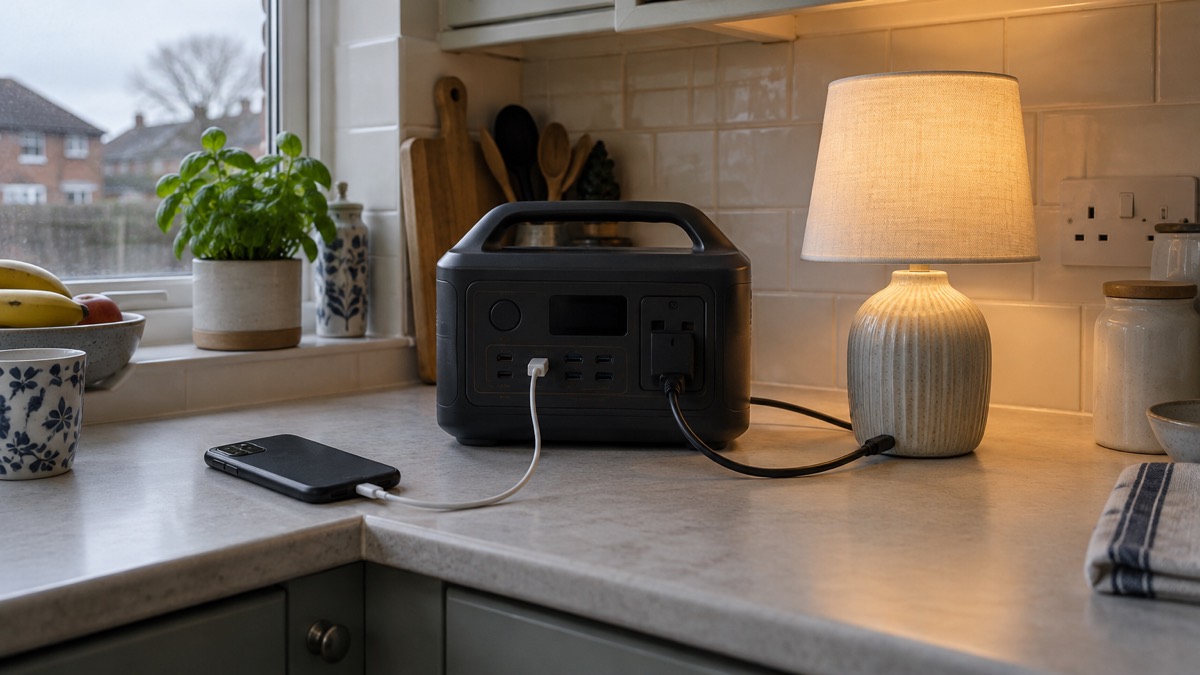
The output figure deserves particular attention because it is the one people misread. A 1000W AC output does not mean an hour of anything; it means no single appliance above that rating will run, and the capacity decides how long a smaller load lasts. Add up what you intend to run together and keep the total below the output, allowing for the surge when a motor starts. Our explainer on watts, watt-hours and surge sets out the arithmetic.
For a fuller comparison of models by what they do rather than by brand, see portable power stations: what they do and how to choose. If you are weighing a power station against a petrol generator, our comparison of a portable power station or a petrol generator for a power cut covers the trade-offs, including the fact that a generator needs fuel and must never run indoors.
Where a power station is not the answer
A power station is a battery, and batteries have limits. The most important is that they are not a substitute for the grid when something depends on continuous power. Medical equipment is the clearest case. The Be Ready checklist suggests keeping a charged power bank to charge phones or compatible medical devices17, and that word "compatible" is doing real work. If someone in your household depends on a device, ask the device manufacturer whether it will run from a power station, and for how long.
There is also formal help. SSEN's Home Battery Pack provides eligible customers who are medically dependent on electricity with a free portable battery to power some devices for a period of time during a power cut, including specialist in-home medical equipment subject to manufacturer approval, plus items providing light and heat, mobile phones, laptops and broadband routers18. Ask your network operator about the Priority Services Register and what support exists where you live. Our guide to powering CPAP, oxygen and other medical devices from a battery goes further.
Electric cars are the second case. Only a power station with a dedicated EV outlet can do it, and even then it is a short top-up. The Anker SOLIX F3800 has an EV charging port, but the car charging cable is not included, and the maker's method is to double-click the AC outlet button, wait until the car icon appears on the screen, then connect the EV charge to the EV port19. Most units have no such port. For charging an electric car at home, the ordinary charge point is the answer, and during a planned power cut your EV charger will stop charging when the power goes off, with most chargers starting again as normal once power is restored, though some models may need a quick check, reset or restart via an app7.
Cordless tools are the third. You can charge a tool battery by plugging the tool's own charger into the power station's mains socket, provided the output can cope. Electrical Safety First advises charging a tool battery only with the original charger or a replacement obtained from the manufacturer or a reputable retailer20. Do not improvise a lead between a power station and a tool battery.
Charging safely from a car, and what to avoid
Charging from a car adds two hazards to the ordinary ones: the vehicle itself and the temperature inside it. Electrical Safety First is direct about the second: do not leave a USB charger in a parked car where it could get cold in winter or hot in summer8. The same applies to a power station left in a boot. Bring it indoors when it is not in use, and charge it where you can keep an eye on it.
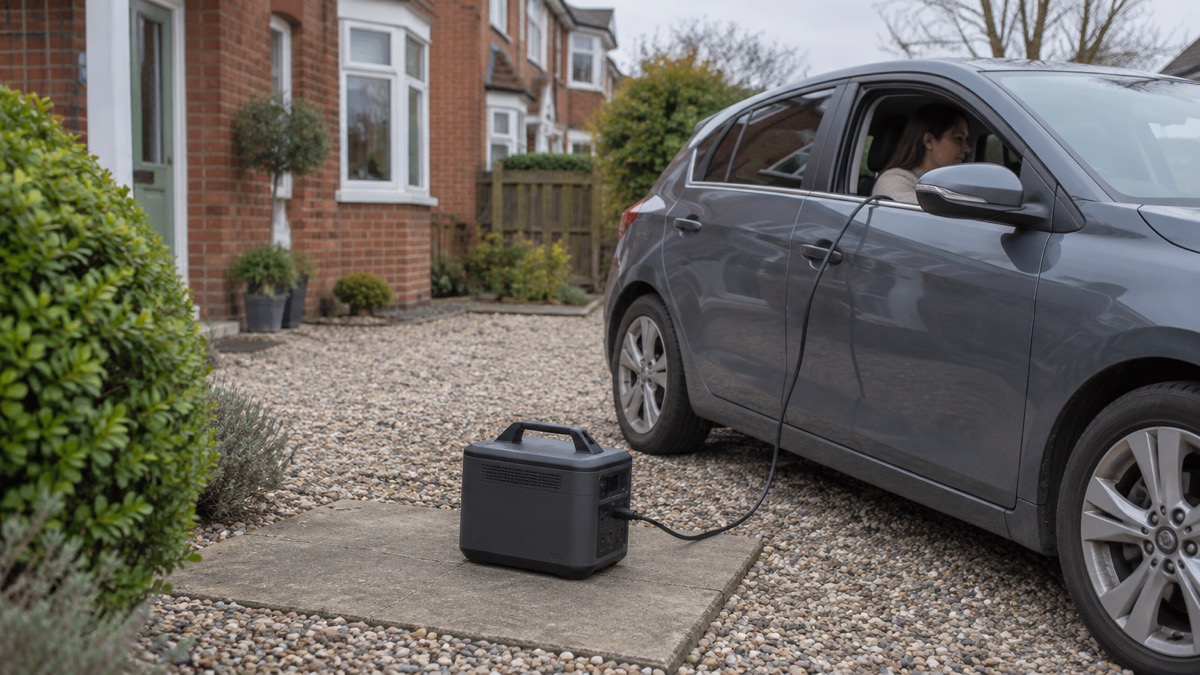
The fire services are consistent on where batteries should be charged. Charge batteries in a safe, visible location, avoiding flammable materials and escape routes22. Do not charge them in hallways or communal areas that serve as escape routes24, and do not charge devices in hallways, landings or near doors where they could block your escape21. If you cannot avoid charging indoors, do not do it in an escape route, which matters particularly in shared housing and high-rise flats25. Charge in a well-ventilated area and do not cover the battery23.
If you are running the engine to charge, do it outdoors. Never run a car engine in a closed garage to charge a device, for the same reason you would never run a generator indoors: the exhaust gases are dangerous. Keep the car outside and the cable routed so nobody trips over it.
For the wider picture on battery safety at home, including warning signs and what to do if a battery catches fire, see lithium-ion battery safety at home. Our safe battery charging at home checklist sets out a routine you can follow each time you charge.
Keeping phones and lights going when the mains is off
The most common use of car charging is not a power station at all: it is a phone. Network operators and the Red Cross all point the same way. Charge mobile phones, power banks and other essential devices whenever severe weather is forecast26. Keep a mobile phone fully charged27. Charge your phone and any power packs28. If the power is out, use a battery-powered or wind-up radio, trying both digital and FM stations, and you can also use a car radio, though in severe weather it might be safer to stay indoors29. Northern Ireland Networks suggests using a car radio to tune in for hourly news bulletins during a planned emergency power cut30.
For light, a work light that charges by USB is a practical companion to a power station. The NEBO BANDO 1K Strap Light charges by inserting the USB-C end of the included cable into the port on the handle and the USB-A end into a power source with a USB-A port31. It can also charge a phone or other USB device from its own USB-C port31, so it doubles as a small power bank. For more on lighting choices, see emergency lighting at home.
A simple routine keeps all of this working:
- Charge the power station and every power bank from the mains before you need them, since they are charged from the mains, your car or solar panels6.
- Keep an in-car phone charger in the vehicle so you can top up when out and about12.
- If the power fails, charge phones in the car by running the engine for a few minutes32.
- Use a battery or wind-up radio, or the car radio, for news29.
- Bring the power station indoors and charge it where you can see it, away from escape routes22.
If you have an electric vehicle and a keypad meter, Northern Ireland Networks suggests trying to charge the vehicle at a time when there are fewer electricity devices in use in the home33. That is about managing load, not about outages, but it is the same principle of spreading demand.
Where to get help
If the power goes off, the first call is 105, the national power cut number, which also carries storm advice27. Your network operator can tell you what is happening and how long it may last. Keep the number somewhere you can find it without a phone signal, and note that a charged phone is only useful if you have kept it charged.
For people who need extra support, ask your network operator about the Priority Services Register. SSEN's Home Battery Pack is one example of what that can bring: a free portable battery for eligible customers who are medically dependent on electricity, covering some specialist equipment subject to manufacturer approval, plus light, heat, phones, laptops and routers18. Arrangements differ between England, Scotland, Wales and Northern Ireland, so ask the operator for your area rather than assuming.
General household preparation is set out by the government's Prepare campaign17 and by Ready Scotland29. Wiltshire and Swindon Prepared, for example, notes that having a power pack that is charged can be very helpful in an emergency or power cut34. The principle is the same everywhere: charge in advance, keep a car charger to hand, and know who to call.
Sources (34)
- How to buy the best generator, Which?
- Tips to help you during a power cut, Electricity North West
- Power cut, Energy Networks Association
- Anker SOLIX C300 with 100W solar panel, Anker SOLIX
- Anker SOLIX C300X with 60W solar panel, Anker SOLIX
- Storms, Prepare
- Planned power cuts, SSEN
- Chargers, Electrical Safety First
- 12V Car Charger Cable, BioLite
- Exposure Car Charger 12V, Exposure Lights
- Anker SOLIX F2000 user manual, Anker
- Winter car kit, Met Office
- NEBO Rambler PS100, NEBO Tools
- Camping portable power station, BLUETTI UK
- Power banks, Electrical Safety First
- What to pack in an emergency kit - Which?, Which?
- Get prepared for emergencies, Prepare
- Home Battery Packs, SSEN
- Anker SOLIX F3800 user guide, Anker
- Heat guns, Electrical Safety First
- Lithium-ion batteries campaign, National Fire Chiefs Council
- Lithium battery fire safety, Mid and West Wales Fire and Rescue Service
- E-scooter, e-bike and mobility scooter fire safety advice, North Yorkshire Fire and Rescue Service
- Lithium-ion batteries, Scottish Fire and Rescue Service
- Battery fires, Devon and Somerset Fire and Rescue Service
- Power cut, British Red Cross
- Storm, Power Cut 105
- Important information: preparing for a power cut, SP Energy Networks
- Emergency plan, Ready Scotland
- Emergency power cuts, Northern Ireland Networks
- NEBO BANDO 1K Strap Light, NEBO Tools
- Frequently asked questions, Electricity North West
- Temporary power outages: keypad customers, Northern Ireland Networks
- Yourself, Wiltshire and Swindon Prepared
 Power Cut Backup Power Checklist
 Backup Power Before Winter
 Safe Battery Charging at Home
 Running a Generator Indoors
 Carbon Monoxide from Generators
 Generator Sizing for a Power Cut
 Generator Run Time on a Tank
 Storing Petrol at Home
 Diesel Storage at Home
 Storing a Generator
 Generators in Cold Weather
 Generator Noise and Neighbours
 Power Station Capacity Sizing
 Power Station Run Time
 Power Station for a Gas Boiler